


You’ve probably already mapped out the basics: strong science grades, shadowing a physician, maybe a hospital volunteer program on the weekends. The dream of medical school is vivid, and the work ethic is there. But here’s a piece of the puzzle that most aspiring doctors underestimate until it’s almost too late. Your SAT or ACT score matters far more to your medical journey than you might think.
Not just for getting into college. For the entire trajectory of your pre-med path.
For students hoping to become doctors one day, SAT and ACT scores can play a bigger role than expected. This article walks through what pre-med students should know about standardized testing, including score expectations, SAT vs. ACT differences, test timing, retake strategies, and effective ways to prepare with confidence.
Why SAT and ACT Scores Matter More for Pre-Med Students

Most high school juniors think of standardized tests as a one-time hurdle standing between them and their college acceptance letter. For pre-med students, the stakes are layered differently.
Here’s why: the college you attend as a pre-med student shapes the quality and rigor of the science coursework available to you. Schools with strong pre-med programs, places like Johns Hopkins, UCLA, University of Michigan, or Emory, look at your full academic profile, and your SAT or ACT score is one of the clearest signals they have about how prepared you are for demanding coursework.
Accepted students at these institutions who go on to pursue medicine consistently arrive with strong academic foundations. That doesn’t mean a below-average test score is an automatic rejection, but it does make the road steeper. You may find yourself at a school where the organic chemistry professor isn’t used to students heading to medical school, where research opportunities are limited, or where MCAT prep resources are thin.
There’s also a more subtle but important connection. Research in academic medicine literature shows a consistent link between stronger baseline academic preparation and better performance in the first two years of medical school. Those years, often called the preclinical years, involve enormous content volume: biochemistry, physiology, pharmacology, anatomy, and more. Students who were academically well-matched to their undergraduate programs from the start tend to build the study habits and scientific reasoning skills that help them thrive later.
Your SAT or ACT score is part of how you get into the right undergraduate environment. It’s worth taking seriously now rather than scrambling to compensate later.
SAT vs. ACT for Pre-Med Students: Understanding the Real Difference
One of the most common mistakes students and parents make is treating these two exams as identical options with different branding. They’re not. Each test measures different cognitive skills, moves at a different pace, and rewards different types of thinkers.
How the SAT Is Structured
The SAT focuses on evidence-based reading, writing, and mathematical reasoning. The questions tend to be longer and more contextual. You’ll often be asked to locate evidence in a passage, interpret data in charts, or reason through multi-step math problems. The exam rewards careful, methodical thinking and the ability to analyze meaning in context.
If you’re a student who likes to work deliberately, read carefully, and can focus intensely for a slightly slower-paced test, the SAT may suit you naturally.
How the ACT Is Structured
The ACT covers English, mathematics, reading, and science. It moves much faster, with more questions, a tighter time budget per question, and a broader content range. The science section, which we’ll cover in detail shortly, is one of the ACT’s most distinctive features.
Students who process information quickly, handle variety well, and don’t get rattled by pacing pressure often perform better on the ACT. It’s also worth noting that the ACT is sometimes considered slightly more content-focused in math, testing a wider range of concepts, including some trigonometry.
Which Should You Choose?
The honest answer is: neither is objectively better for pre-med students. Both are accepted equally by virtually every college and university in the United States. The smarter approach is to take a full-length practice version of each test under realistic conditions, compare your scaled scores, and go with the one where you show more natural strength.
Don’t let assumptions drive the decision. A lot of students assume the SAT is the “serious” test or that the ACT is “easier.” Neither is true. They’re just built for different minds.
Target Score Ranges That Actually Mean Something
Generic advice like “aim for a good score” helps no one. Let’s talk about real benchmarks.
SAT Score Targets for Pre-Med Students
For students aiming at universities with genuinely strong pre-med environments, a competitive SAT score generally falls in the 1400 to 1550 range. Scores in the 1350s can still open doors depending on the rest of your application, but as you move below 1400, the pool of colleges with serious pre-med infrastructure begins to narrow.
A score above 1500 doesn’t just help with admissions. It signals that you’re genuinely prepared for the analytical and reading-heavy coursework that pre-med programs demand, including upper-division cell biology, biochemistry labs, and research methods courses.
ACT Score Targets for Pre-Med Students
On the ACT, the equivalent range is roughly 31 to 35. A composite score in the low 30s is competitive at many strong undergraduate institutions. Getting into the 33 to 35 range places you firmly in consideration at the most selective pre-med programs.
These targets aren’t about prestige for its own sake. They reflect the academic preparation level that demanding science coursework actually requires. A student who squeaks into a rigorous biology program while underprepared doesn’t do themselves any favors. The first semester often becomes a wake-up call that damages GPA early, and early GPA damage is notoriously hard to recover from on a medical school application.
How to Actually Get There
Many students reach a frustrating plateau in test prep where they keep taking practice tests, keep seeing the same mistakes, and can’t figure out why their score isn’t moving. This is where generic prep books and YouTube videos tend to fail.
Working with a qualified SAT private tutoring specialist gives you something that self-study rarely provides: a trained eye that recognizes your specific error patterns. Maybe you’re consistently misreading inference questions on reading passages. Maybe you’re making the same type of arithmetic slip under time pressure. A skilled tutor catches these patterns quickly and builds a correction strategy around them. The result is faster, more targeted improvement rather than another month of spinning wheels.
ACT Science Section: A Surprising Edge for Future Doctors
If you’re a pre-med student considering the ACT, there’s one section you should pay close attention to, and it’s not the one most people talk about.
The ACT science section is a hidden advantage for students heading into medicine, but only if you understand what it actually tests.
What the Science Section Really Measures
Many students assume this section requires memorized biology facts or chemistry formulas. It doesn’t. The ACT science section is entirely reasoning-based. You’re presented with data tables, graphs, experimental setups, and conflicting scientific viewpoints, and you’re asked to interpret, compare, and draw conclusions.
Sound familiar? It should. These are precisely the skills tested on the MCAT, the standardized exam for medical school admissions. The MCAT is full of passages that ask you to analyze research designs, evaluate hypotheses, and interpret results. Students who have already practiced those skills on the ACT have a genuine head start.
For students already drawn toward science, the reasoning-focused structure of this section often feels more natural and engaging than abstract SAT math problems. Performing well here also sends a signal to admissions committees that you already think in the evidence-based, systematic way that medicine requires.
Challenge: Pacing
The ACT science section is notoriously fast. Students typically have 35 minutes for 40 questions, which works out to about 52 seconds per question. That’s tight, especially when some passages involve multiple charts or conflicting researcher claims.
Students who struggle with this section usually don’t lack scientific aptitude. They’re just unfamiliar with the specific passage format and haven’t developed efficient reading strategies for it. This is exactly where working with an experienced ACT private tutor pays dividends. A good tutor will break down the three passage types, namely data representation, research summaries, and conflicting viewpoints, and teach you how to navigate each one efficiently. For many students, targeted coaching on this section alone can move a composite score up by two to four points.
When to Test and How to Approach Retakes
Timing your standardized testing strategically is one of the most underrated parts of this whole process.
Best Time to Start
For pre-med students, the recommended window for a first attempt is the spring of the sophomore year or the early fall of the junior year. This isn’t arbitrary. Testing earlier gives you critical runway: time to review your results, identify weak areas, work on them intentionally, and retake before the pressure of senior year application season hits.
Students who take the SAT or ACT for the first time in the spring of junior year or later often find themselves cramming prep into an already packed schedule filled with AP exams, extracurriculars, and college visits. The quality of preparation tends to drop, and so do scores.
Should You Retake?
Yes, in almost every realistic scenario. Most students improve on their second attempt, particularly when the time between tests is spent on focused preparation rather than hoping for a luckier day. A realistic expectation for improvement with intentional work over 8 to 12 weeks is 100 to 150 SAT points or 2 to 4 ACT composite points.
Here’s the good news about multiple attempts: medical school admissions officers never see your high school test scores. College admissions offices generally superscore or consider your best single sitting. There is no strategic downside to retaking. The only scenario where it doesn’t help is if you retake without doing anything meaningfully different in between.
What Intentional Preparation Actually Looks Like
Intentional prep means more than completing another set of practice problems. It means:
- Reviewing every wrong answer to understand the reasoning error, not just the correct answer
- Targeting your two or three weakest content or skill areas rather than practicing everything equally
- Taking full-length timed practice tests under realistic conditions, not section-by-section drills
- Getting feedback from someone who can spot patterns you can’t see yourself
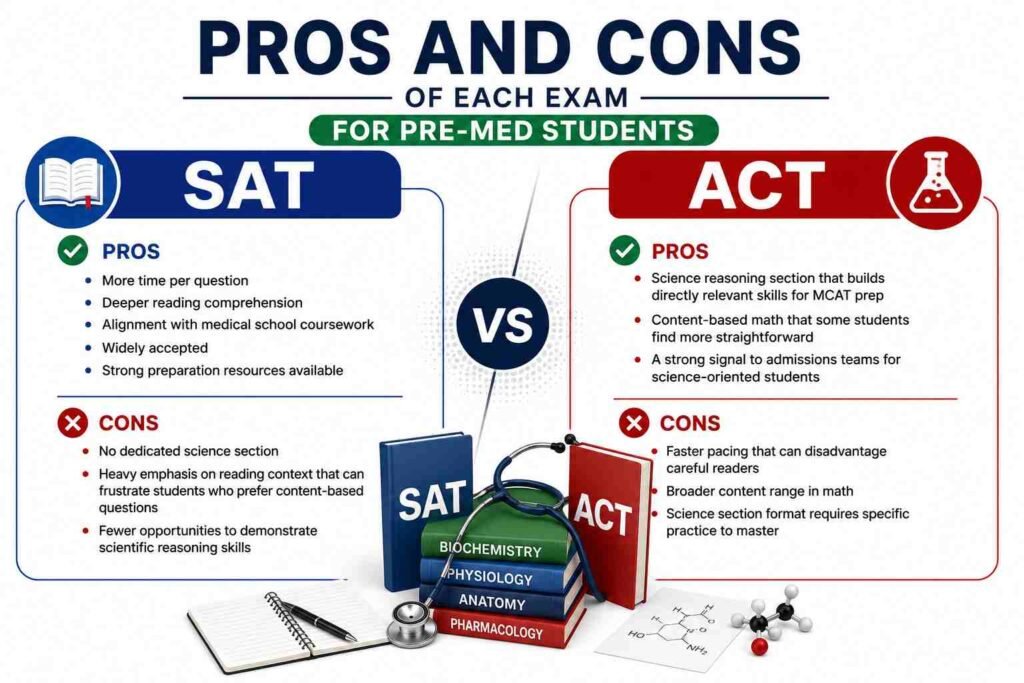
Pros and Cons of Each Exam for Pre-Med Students
SAT
- Pros: More time per question, deeper reading comprehension, alignment with medical school coursework, widely accepted, strong preparation resources available.
- Cons: No dedicated science section, heavy emphasis on reading context that can frustrate students who prefer content-based questions, and fewer opportunities to demonstrate scientific reasoning skills.
ACT
- Pros: Science reasoning section that builds directly relevant skills for MCAT prep, content-based math that some students find more straightforward, and a strong signal to admissions teams for science-oriented students.
- Cons: Faster pacing that can disadvantage careful readers, broader content range in math, science section format requires specific practice to master.
Frequently Asked Questions
What is a good SAT score for a pre-med high school student?
A competitive SAT score for students aiming at schools with strong pre-med programs is generally between 1400 and 1550. Scores in this range suggest the academic preparation needed for rigorous science coursework. That said, your overall application matters too. Test scores are one important factor among several.
Is the ACT or SAT better for pre-med students?
Neither test is universally better for pre-med students. Colleges accept both equally. The best choice depends on how you naturally perform on each. Take a full practice test for both under timed conditions, compare your results, and choose the one where your strengths show up more clearly.
Does my SAT or ACT score affect my chances of getting into medical school?
Not directly. Medical schools focus on undergraduate GPA, MCAT scores, clinical experience, research, and letters of recommendation. However, your high school standardized test scores influence which undergraduate institution you attend, and the quality of your undergraduate program has a significant effect on your preparation for medical school.
How many times can I take the SAT or ACT?
There’s no strict limit. Most students take the SAT or ACT two to three times. College admissions offices typically either superscore or consider your best single sitting, so multiple attempts are a normal and encouraged part of the process.
When should a student planning for medical school first take the SAT or ACT?
Ideally, the spring of sophomore year or early fall of junior year. This gives you enough time to receive your scores, prepare specifically for improvement, and retake the exam well before application deadlines, without the pressure of senior year stacking on top.
Can tutoring really make a meaningful difference in test scores?
Yes, particularly for students who have plateaued with self-study. The main value of working with a skilled tutor is targeted feedback: identifying the specific reasoning errors or content gaps that are costing you points and building a correction strategy around them. Generic prep materials can’t do that.
What should I do between test attempts, actually, to improve?
Review every wrong answer thoroughly, identify your most consistent error patterns, work specifically on your two or three weakest areas, take full timed practice tests rather than partial drills, and consider working with a tutor if you’re not seeing movement on your own.
Disclaimer
The information in this article is intended for general educational and informational purposes only. Score benchmarks and admissions data referenced are based on general trends and publicly available information and may vary by institution, year, and individual circumstances. This content should not be taken as formal academic advising or a guarantee of admissions outcomes. Students are encouraged to consult directly with their school counselors, college admissions advisors, and the specific institutions they are applying to for personalized guidance.
Bottom Line
If you’re a high school student with your eyes set on medical school, standardized testing is one of the most leverageable investments you can make right now. Not because a single number defines you. It doesn’t. But because the right score opens the door to the right undergraduate environment, and the right undergraduate environment makes everything that follows more achievable.
The students who tend to struggle in pre-med coursework aren’t usually lacking in intelligence or dedication. Many of them weren’t academically matched to the rigor of their program from the start, and that mismatch echoes forward in ways that are hard to undo.
The earlier you treat this part of your preparation with real seriousness, the more options you’ll have. That means choosing between SAT and ACT thoughtfully, testing at the right time, preparing intentionally rather than casually, and being willing to retake when the results don’t yet reflect what you’re capable of.
Medical school is a long road. This is one of the best places to start it right.