

We talk often about the future of cities—smart cities, green cities, 15-minute cities. But there is a “silent” future demographic that urban planners are only just beginning to address: the aging city.
By 2050, nearly 22% of the world’s population will be over 60. Yet our urban environments are still primarily designed for non-disabled, working-age adults commuting by car. This mismatch isn’t just an inconvenience; it’s a structural barrier to economic growth and social stability. As highlighted in a recent Novartis analysis on societal aging, the key to unlocking the “Silver Economy” isn’t just about healthcare—it’s about the physical spaces where we live, work, and age.
“Age-Friendly” City is an Economic Engine
When we design cities that exclude older adults—think heavy doors, short crosswalk signals, steep curbs, and disjointed public transit—we effectively lock a massive portion of the population out of the economy. Conversely, an Age-Friendly City enables “functional ability,” allowing older residents to shop, work, and socialize independently.
Novartis and the Global Coalition on Aging (GCOA) argue that functional ability is the currency of the longevity economy. Urban planning is the infrastructure that allows this currency to circulate. If an 80-year-old cannot safely walk to the bus stop, they cannot volunteer at the library, shop at the local market, or visit their grandchildren without assistance. Their world shrinks, and with it, their economic contribution.
“Given the rapid aging in all societies as they modernize, we believe the basic public policies that were invented in the 20th century… must be reframed, reimagined and adapted to the age demographics of the 21st century.” — Michael W. Hodin, CEO, Global Coalition on Aging.
Beyond Ramps and Elevators: A Holistic Approach

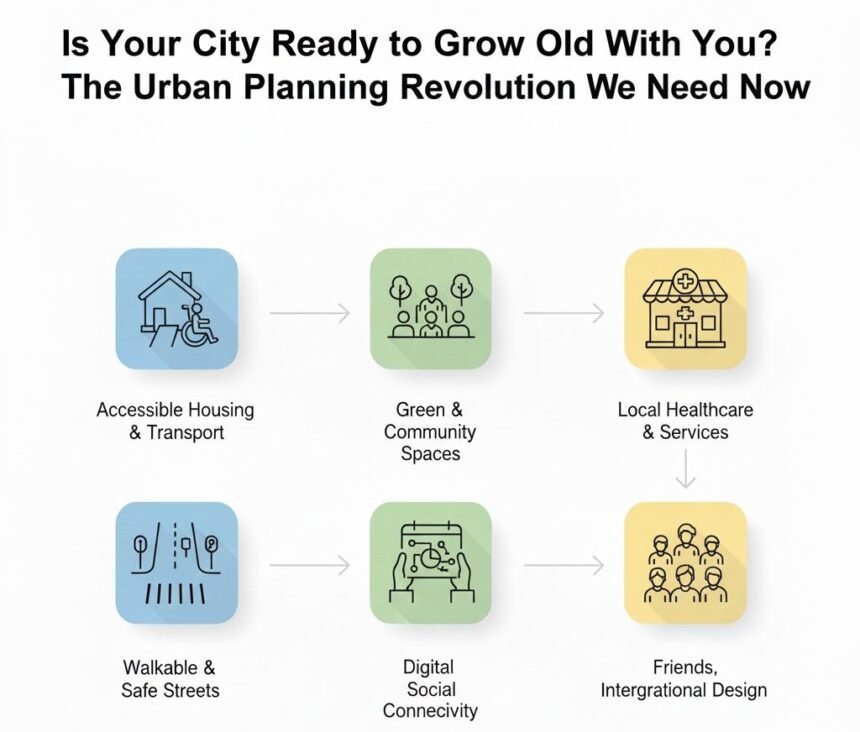
Accurate age-friendly planning goes far beyond simple accessibility compliance or installing a few ramps. It requires a holistic rethinking of urban space that prioritizes connection over isolation. We need to move away from the 20th-century model of “warehousing” seniors in distant retirement communities and towards integrated, multi-generational living.
Here are three key pillars of this new urban philosophy:
1. The “Last Mile” of Health: Decentralizing Care
The “Engage with Heart” initiative in Baltimore proved that healthcare is most effective when it is hyper-local. Planners must zone for “health hubs” in community centers, libraries, and churches, integrating care into the daily fabric of neighborhoods rather than isolating it in distant hospital districts.
- Why it works: When a blood pressure screening is held at a local church, it removes the transportation barrier and the anxiety associated with clinical visits. It turns health maintenance into a community ritual rather than a medical chore.
- The Planning Shift: Cities need to incentivize mixed-use developments that include health clinics on the ground floor of residential buildings, ensuring that primary care is within walking distance for seniors.
2. Intergenerational Zoning and Housing
Isolation is a silent killer, rivaling smoking and obesity in its health impact. Successful age-friendly cities, like Toyama in Japan, use “residential encouragement zones” to subsidize housing near transit lines, keeping older adults connected to the city center.
- Innovative Models: In Gothenburg, Sweden, the city installed “chatty benches”—yellow benches marked with invitations to sit and talk—in spots seniors frequented. It’s a low-cost intervention that fights loneliness.
- Co-Living Solutions: We are seeing a rise in multi-generational housing developments where students receive discounted rent in exchange for socializing with older residents. Planners must update zoning codes to allow for these flexible, communal living arrangements (ADUs, granny flats, and co-housing).
3. Walkability as Wellness
Wider sidewalks, frequent benches, longer crosswalk timers, and better lighting aren’t just “nice-to-haves”; they are public health interventions.
- The “10-Minute” Rule: Older adults should be able to reach a park, a grocery store, and a pharmacy within a 10-minute walk. This encourages physical activity, which directly reduces cardiovascular risk and delays the onset of frailty.
- Safety First: Fear of falling is a significant deterrent to mobility. Smooth pavements, non-slip surfaces, and clear signage give older adults the confidence to navigate their city independently.
Planner’s Mandate: Design for the Old, Include Everyone
For urban planners and municipal leaders, the message is clear: designing for the old is designing for everyone. This is the principle of Universal Design.
- A wheelchair ramp is also perfect for a parent with a stroller or a traveler with a suitcase.
- Clear, high-contrast signage for failing eyesight helps a distracted tourist find their way.
- Audio announcements on buses for deaf people help everyone know their stop in a crowded carriage.
By integrating the principles of the Silver Economy into our blueprints, we don’t just build cities that are easier to live in; we create cities that are better for people. We build cities that remain vibrant, productive, and inclusive, no matter the age of their citizens.
Conclusion
The “hidden opportunity” of aging is waiting on our street corners. It’s in the retired teacher who wants to tutor kids but can’t drive to the school. It’s the grandmother who wants to buy groceries but fears the uneven pavement. It’s in the wisdom and economic power of a generation that is ready to participate, if only we build the infrastructure to welcome them.
It is time to stop building cities for the people we were 50 years ago, and start building them for the people we will all become.