

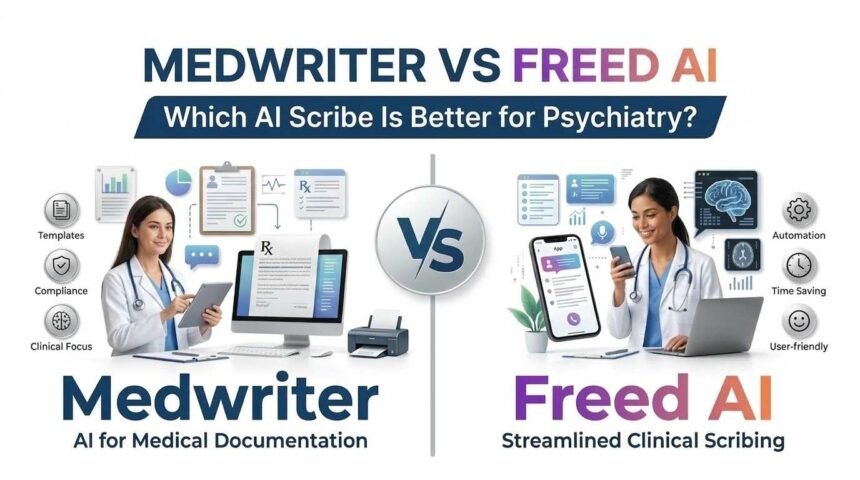
Psychiatrists and psychiatric mental health nurse practitioners (PMHNPs) spend hundreds of hours each year on documentation, from clinical notes and treatment plans to billing and prior authorisations. This administrative burden contributes significantly to burnout and limits the time available for patient care.
AI scribe tools have emerged as a solution to reduce this workload, but not all are designed with the unique demands of psychiatric practice in mind. Medwriter and Freed AI are two widely discussed options, each offering ambient listening, note generation, and EHR compatibility. However, differences in psychiatry-specific features such as structured Mental Status Examination, treatment plan drafting, CPT/E/M coding, and prior authorisation support can make one tool more suitable than the other.
Documentation Problem in Psychiatry
Psychiatrists spend an estimated 720 or more hours per year on documentation alone. Between clinical notes, prior authorisations, billing codes, and treatment plans, the administrative burden is one of the leading drivers of burnout in the field. AI scribe for psychiatry tools have emerged as a powerful solution, but not all of them are built with the specific demands of psychiatric practice in mind.
Medwriter and Freed AI are two of the most discussed options currently available. Both offer ambient listening, note generation, and EHR compatibility. But when it comes to the specific demands of a psychiatry practice, including structured Mental Status Examinations, prior authorisation support, CPT coding, and treatment plan drafting, the comparison between the two reveals meaningful differences that psychiatrists and psychiatric mental health nurse practitioners (PMHNPs) need to understand before choosing a platform.
This article provides a detailed, feature-by-feature breakdown of how Medwriter and Freed AI compare across the areas that matter most in psychiatric practice.
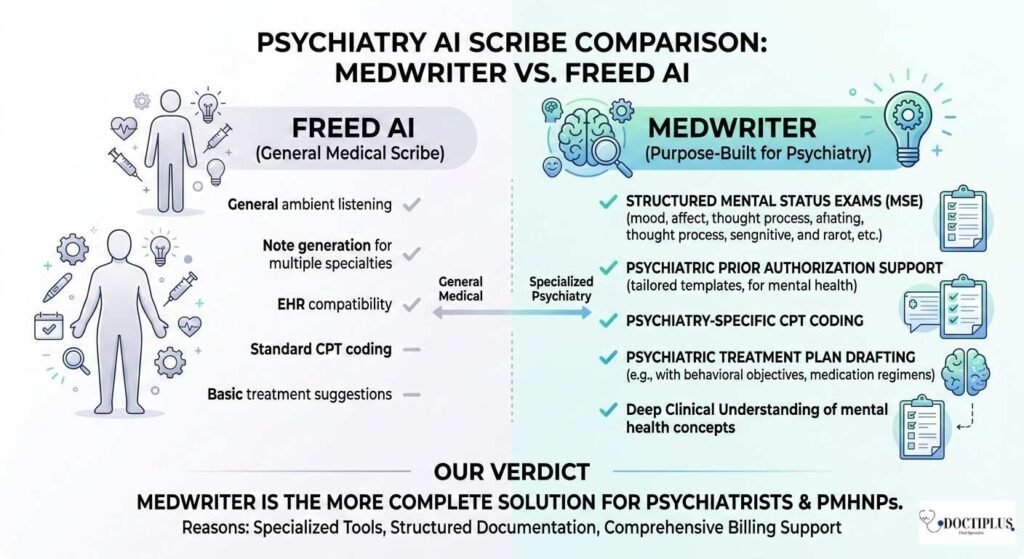
Our verdict: Medwriter is purpose-built for psychiatry. Freed AI is a strong general-purpose medical scribe. For psychiatrists who need structured psychiatric documentation, comprehensive billing support, and prior authorisation tools designed specifically for their specialty, Medwriter is the more complete solution.
Quick Comparison at a Glance
| Feature | Medwriter | Freed AI |
| Built for psychiatry | Yes, purpose-built | General, 20+ specialties |
| Mental Status Exam (MSE) | Structured, automatic | Requires customisation |
| Psychiatry ROS | Included by default | Requires customisation |
| CPT and E/M coding | Full support | Limited, ICD-10 focused |
| Prior auth tool | Dedicated review tool | Not prominently featured |
| Treatment plan drafting | Automated with goals | Not prominently featured |
| Pre-charting support | Summary and follow-up Qs | Pre-visit summary, AI chat |
| EHR integration | Direct integration | Chrome extension push |
| Group practice tools | MA workflows, shared templates | Group plans, individual history |
| Post-visit documents | Psychiatry-specific letters | 14+ general document types |
Our Pick: Medwriter Wins for Psychiatry
If you are short on time, here is the summary. Medwriter was purpose-built for psychiatrists and PMHNPs, while Freed AI is a general-purpose medical scribe that supports psychiatry as one of more than 20 specialties. That distinction appears consistently across nearly every feature category.
Medwriter supports structured note templates including Mental Status Examinations and Psychiatry Review of Systems sections, full CPT and E/M level billing support, a dedicated prior authorisation review tool, long-term treatment plan drafting with measurable goals and automatic update reminders, and pre-charting with suggested follow-up questions. Freed AI does not currently match these features at the same depth.
Freed AI is a strong general-purpose scribe with solid ambient note generation, flexible EHR push via Chrome extension, and useful post-visit letter generation. But for psychiatrists who need documentation, billing, and administrative tools designed specifically for their specialty, Medwriter is the clear winner.
Psychiatry-Specific Documentation
This is where the largest gap between the two platforms appears.
Medwriter
Medwriter was built from the ground up for psychiatry. It automatically generates structured clinical note sections specific to mental health encounters, including the Mental Status Examination (MSE) and Psychiatry Review of Systems (ROS). Templates are customisable and available for psychiatric intake evaluations, follow-up visits, and subspecialty encounters. The platform includes dedicated therapy add-on documentation sections and automatically suggests therapy add-on billing codes, such as 90833, when clinically appropriate.
Freed AI
Freed AI is a general-purpose AI medical scribe that supports psychiatry among more than 20 other specialties. It offers specialty-specific templates that can be customised, and its Learn My Format feature adapts note style over time based on clinician edits. However, Freed’s psychiatric documentation is not pre-structured around the same level of clinical specificity. Psychiatrists using Freed may need to do more manual editing to achieve the structured MSE, ROS, and risk assessment sections that are standard in psychiatric documentation.
Bottom line: Medwriter delivers psychiatry-ready documentation out of the box. Freed offers flexibility across specialties but requires more customisation to match psychiatry-specific workflows.
Billing and Coding Support
Billing is a significant concern for psychiatrists, especially when it comes to selecting the correct E/M level for complex visits and ensuring documentation supports the code selected.
Medwriter
Medwriter provides built-in billing intelligence that includes ICD diagnostic code recommendations, CPT procedure code suggestions, including commonly used psychiatry codes such as 99213, 99214, 99215, and 90833, and E/M level suggestions based on session complexity and documentation. This helps psychiatrists bill appropriately without second-guessing their coding after every session.
Freed AI
Freed AI offers ICD-10 code recommendations that appear after each note is generated. Freed’s coding support focuses primarily on ICD-10 codes, with CPT and E/M level suggestions being less prominently featured compared to Medwriter’s integrated billing workflow.
Bottom line: For psychiatrists who want comprehensive CPT, ICD, and E/M level support built into their documentation workflow, Medwriter offers a more complete billing toolkit.
Prior Authorisation Support
Prior authorisations are one of the most time-consuming administrative tasks in psychiatry. The cycle of submissions, denials, and appeals can consume hours out of a clinician’s week and delay patient access to treatment.
Medwriter
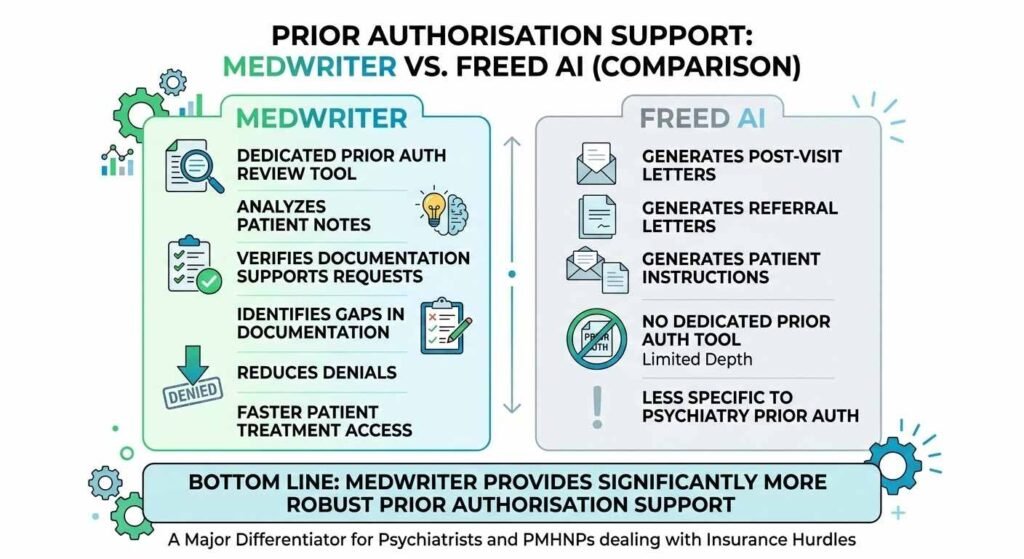
Medwriter includes a dedicated Prior Auth Review Tool that analyses the patient’s recent clinical notes to verify that documentation supports prior authorisation requests. It helps clinicians identify and address gaps in documentation so that submissions are more complete from the outset, reducing the likelihood of denials.
Freed AI
Freed AI generates post-visit letters, referral letters, and patient instructions, but does not appear to offer a dedicated prior authorisation generation or review tool at the same level of depth as Medwriter.
Bottom line: Medwriter provides significantly more robust prior authorisation support, which is a major differentiator for psychiatrists who regularly deal with insurance hurdles.
Additional Document Generation
Beyond clinical notes, psychiatrists regularly need to produce patient letters, discharge summaries, accommodation letters, and other supporting documentation.
Medwriter
Medwriter generates supplementary clinical documents, including patient instructions, discharge summaries, letters of medical necessity, accommodation letters, and prior authorisation documentation, all from the session encounter. This means fewer documents need to be drafted from scratch after each visit.
Freed AI
Freed AI also offers post-visit document generation, including patient instructions, referral letters, absence notes, return-to-work certifications, and other letter types. Freed advertises 14 or more ready-to-send document types that can be generated immediately after a visit.
Bottom line: Both platforms offer solid document generation. Medwriter leans toward psychiatry-specific documents, while Freed offers a broader set of general clinical letter types.
Treatment Plan Support
Long-term treatment plans are a critical and time-consuming part of psychiatric documentation, especially when payers require regular updates with measurable goals and documented progress against those goals.
Medwriter
Medwriter drafts long-term treatment plans automatically, pulling from session documentation to create plans with measurable goals, interventions, timelines, and documented progress. The platform also includes reminders to update treatment plans on schedule, which is particularly valuable for practices managing large patient caseloads.
Freed AI
Freed AI does not prominently feature a dedicated long-term treatment plan drafting tool in its current feature set.
Bottom line: For psychiatrists who need ongoing treatment plan documentation that meets payer requirements, Medwriter offers a purpose-built solution that Freed does not currently match.
Pre-Charting and Session Preparation
Walking into a session prepared, with context on recent visits, medication history, and outstanding follow-up items, makes a meaningful difference to both care quality and clinical efficiency.
Medwriter
Medwriter offers pre-charting support that summarises the patient’s previous session notes and suggests follow-up questions before each appointment. This enables faster chart review and better-prepared sessions, which is particularly useful for psychiatrists managing complex, longitudinal patient relationships where continuity and follow-through on prior session content matter clinically.
Freed AI
Freed AI provides pre-visit summaries and an AI chat feature that gives clinicians deeper patient context before each session.
Bottom line: Both platforms offer pre-charting tools. Medwriter’s approach includes suggested follow-up questions alongside the summary, which may be especially useful for psychiatrists managing patients with complex histories.
EHR Integration
Seamless EHR integration eliminates the copy-paste workflow that wastes time and introduces transcription errors.
Medwriter
Medwriter is compatible with most electronic health record systems used in psychiatric practices, offering direct integration so notes, billing codes, and documents sync to the EHR with minimal manual effort.
Freed AI
Freed AI uses a Chrome extension-based EHR push feature that allows one-click note transfer to any web-based EHR. This approach is flexible and works across a wide range of systems regardless of whether a formal API integration exists.
Bottom line: Both offer EHR connectivity. Medwriter focuses on deeper integration with psychiatry-specific EHRs, while Freed’s Chrome extension approach offers broader compatibility across web-based platforms of all kinds.
Group Practice and Clinic Tools
For practices with multiple clinicians, administrative tools and shared workflows can significantly affect adoption and efficiency across the team.
Medwriter
Medwriter offers group practice features, including medical assistant pre-session information upload, shared practice templates, and session tracking and management. This makes it a fit for solo providers as well as mid-sized and large psychiatric practices with clinical and administrative staff.
Freed AI
Freed AI also offers group plans, along with individual templates and note history for each clinician in the practice.
Bottom line: Both platforms support group practices. Medwriter’s assistant workflows and shared template system may offer more structure for psychiatry-specific clinic operations with layered staff roles.
Why Psychiatry Needs a Specialty-Specific AI Scribe
Psychiatric documentation has requirements that differ significantly from other medical specialties, and these differences are not minor formatting preferences. They reflect the clinical and regulatory structure of psychiatric practice.
- Mental Status Examinations: The MSE is a core component of every psychiatric encounter, covering appearance, behaviour, speech, mood, affect, thought process, thought content, perceptual disturbances, cognition, insight, and judgement. Generating a clinically accurate and legally defensible MSE from ambient audio requires a system trained on psychiatric clinical language and documentation norms.
- Risk assessment documentation: Suicidality, homicidality, and self-harm risk assessments must be documented consistently and completely. The consequences of incomplete documentation in this area are significant both clinically and medico-legally.
- Longitudinal treatment tracking: Psychiatric care often spans months or years. Documentation must reflect progress against treatment plan goals, medication adjustments, and the evolution of the clinical formulation over time.
- Complex billing: Add-on therapy codes, time-based E/M coding, and the nuances of billing for psychiatric evaluation and management require coding support that understands the specific structure of psychiatric encounters.
- Prior authorisation intensity: Medications and services in psychiatry face some of the highest prior authorisation denial rates in medicine. Documentation that anticipates and supports PA submissions from the point of the clinical note reduces administrative burden significantly.
Verdict: Which AI Scribe Is Better for Psychiatry?
If you are a psychiatrist or PMHNP looking for a general-purpose AI scribe that works well across many specialties and offers a clean, simple interface, Freed AI is a solid choice. It delivers strong ambient note generation, flexible EHR push, and a self-learning system that adapts to your documentation style over time.
But if psychiatry is your specialty and the nuances of psychiatric documentation, billing, and workflow are non-negotiable, Medwriter is the more complete solution. It was purpose-built for psychiatry from day one, with structured MSE and ROS generation, robust CPT and E/M level billing support, prior authorisation tools, treatment plan drafting, pre-charting with suggested follow-ups, and group practice features that address the full scope of a psychiatric practice’s administrative needs.
The Medwriter vs Freed AI decision comes down to this: Freed is a great AI scribe that happens to support psychiatry. Medwriter is a great AI scribe that was built specifically for psychiatry.
Disclaimer
This article is provided for general informational and comparative purposes only. Feature descriptions are based on publicly available information about each platform at the time of writing and may not reflect the most current capabilities of either product. Software features, pricing, and integrations are subject to change. This article does not constitute an endorsement of any specific product or service. Clinicians should conduct their own evaluation of any AI documentation tool before adoption, including reviewing data security practices, HIPAA compliance documentation, and EHR compatibility with their specific system. AI-generated clinical notes should always be reviewed and verified by the clinician before being finalised in the patient record.
References and Resources
Clinical Documentation and Burnout Research
- Shanafelt TD, et al. (2022). Changes in Burnout and Satisfaction With Work-Life Integration in Physicians and the General US Working Population Between 2011 and 2020. Mayo Clinic Proceedings. https://doi.org/10.1016/j.mayocp.2022.05.024
- Gardner RL, et al. (2019). Physician stress and burnout: the impact of health information technology. Journal of the American Medical Informatics Association, 26(2), 106-114. https://doi.org/10.1093/jamia/ocy145
- American Medical Association. (2023). Reducing Administrative Burden in Physician Practices. AMA STEPS Forward. https://edhub.ama-assn.org/steps-forward
Psychiatric Documentation Standards
- American Psychiatric Association. (2022). Diagnostic and Statistical Manual of Mental Disorders, Fifth Edition, Text Revision (DSM-5-TR). American Psychiatric Association Publishing.
- Centers for Medicare and Medicaid Services (CMS). (2023). Evaluation and Management Services Guide. https://www.cms.gov/outreach-and-education/medicare-learning-network-mln/mlnproducts/downloads/eval-mgmt-serv-guide-icn006764.pdf
- Nutter D, et al. (2023). Psychiatric Documentation Best Practices. Psychiatric Times. https://www.psychiatrictimes.com
AI in Clinical Documentation
- Rajpurkar P, et al. (2022). AI in health and medicine. Nature Medicine, 28, 31-38. https://doi.org/10.1038/s41591-021-01614-0
- Miner AS, et al. (2020). Key considerations for incorporating conversational AI in psychotherapy. Frontiers in Psychiatry, 11, 263. https://doi.org/10.3389/fpsyt.2020.00263
- Office of the National Coordinator for Health Information Technology (ONC). (2023). Health IT and AI in Clinical Settings. HealthIT.gov. https://www.healthit.gov/topic/health-it-and-health-information-exchange-basics/health-it-and-health-information-exchange
Prior Authorisation and Billing Resources
- American Medical Association. (2023). 2023 AMA Prior Authorization Physician Survey. https://www.ama-assn.org/practice-management/prior-authorization
- American Psychiatric Association. (2023). CPT Coding for Psychiatric Services. https://www.psychiatry.org/psychiatrists/practice/practice-management/billing-and-coding