

Note: This article focuses on social media content strategy for health and wellness communicators. It is not a substitute for professional medical advice. If you are a patient seeking health information, always consult a qualified healthcare provider. Health content shared on social media, regardless of format, should be evidence-based and clearly attributed to qualified sources.
Why Health Content Needs to Work Harder on Social MediaWhat Are GIFs and Why Do They Work for Health Content?Types of health content that work well as GIFs1. Stronger Visual Impact in Health Social Media FeedsPractical health applications2. Delivering Health Messages in SecondsExamples of health messages suited to GIF format3. Improved Engagement with Health ContentWhy GIFs outperform static images in health contexts specifically4. Repurposing Existing Health Education ContentHow health organisations can repurpose existing content5. Maintaining Brand Consistency in Health CommunicationBrand consistency elements for health GIFs6. Optimising Health GIFs for Different Social PlatformsPlatform-specific considerations for health GIF sharingResponsible Health Communication Using GIFs: Key PrinciplesPrinciples for responsible health GIF creationPractical Guide: Creating Health GIFs Step by StepConclusionDisclaimerReferences and ResourcesDigital Health Communication ResearchVisual Health Communication and Patient EducationSocial Media Health Communication GuidanceContent Creation Tools for Health Educators
Why Health Content Needs to Work Harder on Social Media
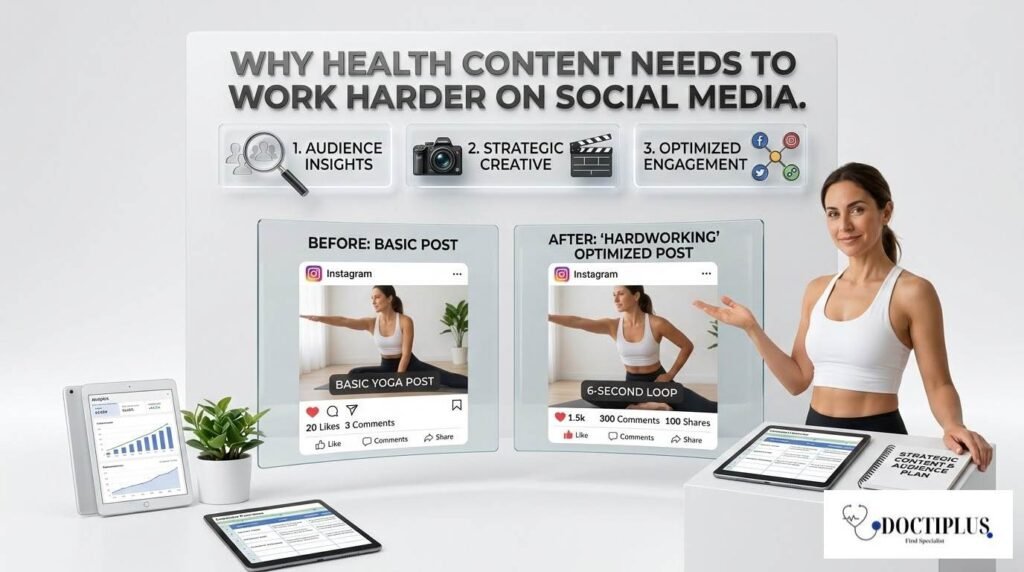
Health and wellness content faces a unique challenge on social media. Not only must it compete for attention in fast-moving feeds, but it must also be accurate, trustworthy, and genuinely useful in a space that frequently rewards sensation over substance. For healthcare professionals, wellness coaches, medical organisations, and health educators, communicating complex information quickly and clearly is not just a marketing challenge. It is a public health responsibility.
Static images and long-form videos each have limitations in this context. A static graphic showing exercise instructions or a medication schedule lacks the movement that helps viewers understand sequence and technique. A five-minute educational video, while thorough, loses most of its potential audience within the first thirty seconds on platforms like Instagram, TikTok, and X (formerly Twitter). There is a growing gap between the depth of health information that professionals want to share and the format that digital audiences will actually consume.
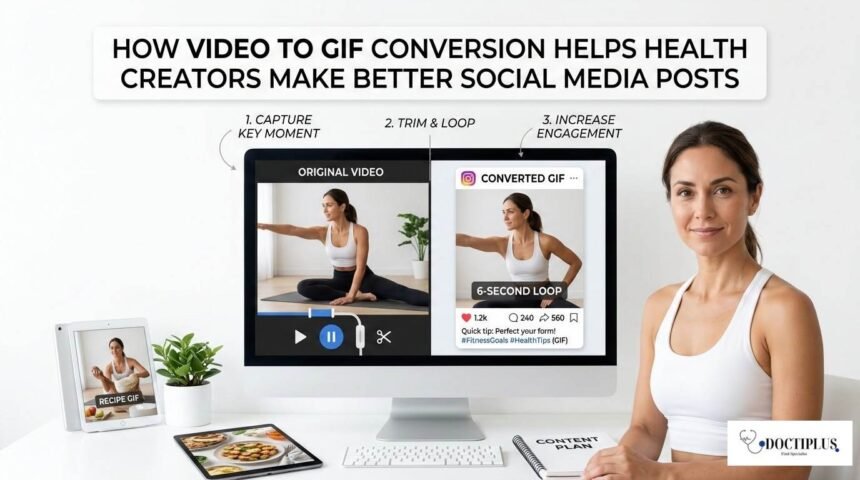
Animated GIFs occupy a valuable middle ground. Converting a brief health education clip using a video-to-GIF tool creates a looping, motion-based visual that grabs attention, communicates a focused health message, and loads instantly without requiring the viewer to press play or commit to watching a full video. For health communicators, this format offers a practical way to deliver clear, accessible health information in the format that social media audiences actually engage with.
Why this matters for health communication: The World Health Organization and public health agencies worldwide have identified social media as a critical channel for health promotion, disease prevention messaging, and health literacy improvement. The format in which health content is delivered directly affects whether it reaches, resonates with, and is understood by the intended audience.
What Are GIFs and Why Do They Work for Health Content?
A GIF (Graphics Interchange Format) is a short, looping animation that plays automatically in most social media feeds without requiring any user action. Unlike video, a GIF does not need to be clicked to start, does not require sound to communicate, and loads almost instantly, even on slower mobile connections.
For health communicators, these properties address several persistent challenges in digital health education. The automatic play removes a barrier to engagement that video content faces. The absence of audio dependency means the content communicates effectively even when a viewer is in a public setting with their phone on silent. The looping nature means that even a viewer who only sees part of the animation catches the key message on the next loop.
Types of health content that work well as GIFs
- Exercise demonstrations: A looping GIF showing correct form for a squat, a breathing exercise, or a posture correction is far more informative than a static image and more accessible than a full workout video
- Medication reminders and adherence tips: Animated reminders about timing, storage, or administration technique for common medications can be delivered in a visually memorable format
- Symptom awareness: Animated infographics showing warning signs of conditions like stroke (FAST), heart attack, or hypoglycaemia can communicate time-sensitive information in a highly shareable format
- Mental health practices: Brief animations guiding box breathing, progressive muscle relaxation steps, or grounding techniques for anxiety can be looped repeatedly as a calming visual tool
- Nutrition guidance: Short animated loops showing portion sizes, food group balance, or hydration reminders communicate dietary guidance more effectively than text alone
- Procedure and technique guidance: Step-by-step animations for hand washing, wound dressing, inhaler use, or blood glucose testing support patient education in an accessible format
1. Stronger Visual Impact in Health Social Media Feeds
Health content competes with an enormous volume of posts in social media feeds, including news, entertainment, and personal updates. The human visual system is disproportionately sensitive to motion. A moving element in an otherwise static feed captures attention almost involuntarily, which is why animated content consistently outperforms static posts on engagement metrics across major platforms.
For health organisations and practitioners, this attention advantage is directly relevant to outcomes. A post about diabetes prevention that is scrolled past reaches no one. The same information presented as a brief, looping animation that pauses a viewer for three seconds creates an opportunity for a message that could genuinely influence health behaviour.
Practical health applications
- A physiotherapy clinic posting a looping GIF of a correct knee raise technique will consistently outperform a static image of the same exercise in terms of saves and shares.
- A mental health awareness organisation using animated text that slowly reveals a reassuring message can create emotional resonance that a static quote graphic cannot
- A GP practice sharing a looping animation of the five symptoms of high blood pressure reaches more patients than a text-only post because movement captures attention in a way that static content does not.
Evidence base: Research published in the journal Computers in Human Behavior found that animated visual content in health messaging significantly increased recall of health information compared to static formats, particularly for procedural health guidance such as exercise technique and medication administration.
2. Delivering Health Messages in Seconds
One of the most significant challenges in digital health communication is the limited time window available to convey meaningful information before a user moves on. Studies of social media behaviour consistently show that the average user spends fewer than three seconds on any given post before deciding whether to engage or scroll past. Long captions, even when well-written, are read by only a small proportion of the audience that sees the post.
GIFs address this directly by embedding the key health message within the visual itself. A looping animation showing the three steps of a wound dressing technique communicates the information without relying on the viewer reading a caption. An animation demonstrating deep diaphragmatic breathing conveys the technique through motion in a way that text description simply cannot.
Examples of health messages suited to GIF format
- Warning signs: A FAST stroke awareness GIF cycling through Face, Arms, Speech, Time elements in a loop reinforces each sign with every repeat
- Technique correction: An animation showing incorrect versus correct posture at a desk communicates the adjustment visually in a format viewers can return to throughout the day
- Medication timing: A brief animated reminder graphic for morning medication, paired with a common daily trigger such as breakfast, is more memorable than a text reminder
- Mental health check-in: A looping breathing guide showing inhale and exhale counts provides a usable tool, not just information, directly in the feed
3. Improved Engagement with Health Content
Engagement in social media terms, meaning likes, comments, saves, and shares, is not purely a vanity metric for health communicators. When the audience spends more time on the post, the platform algorithm interprets this as a signal of value and shows the content to more people. For a health education post, broader algorithmic reach translates directly into greater public health impact. More people seeing accurate health information means more opportunities to influence behaviour, reduce health anxiety, or prompt someone to seek care they might otherwise have delayed.
GIFs generate higher average watch time per post than static images because the looping nature keeps the animation visible and active as the viewer reads the caption or decides whether to engage. This passive viewing time accumulates into measurable improvements in algorithmic reach without requiring additional advertising spend.
Why GIFs outperform static images in health contexts specifically
- Procedural content: Health content that shows a sequence of steps, such as an exercise, a breathing technique, or a self-examination procedure, is inherently better communicated through motion than through a single frozen image
- Emotional resonance: Animated content can carry emotional tone through movement, pacing, and rhythm in a way that static content cannot, which is particularly relevant for mental health and well-being communication
- Repeat exposure: Because GIFs loop, a viewer who pauses on a health post is exposed to the key message multiple times in the same viewing instance, improving retention of health information
- Accessibility without audio: Health information delivered visually through animation does not require sound, making it accessible in public settings, to users with hearing impairments, and on platforms where autoplay audio is muted by default
4. Repurposing Existing Health Education Content
Healthcare professionals and health organisations often invest significant resources in producing video content, including patient education films, procedure demonstrations, clinician interviews, and public health campaign videos. These longer-form assets frequently reach far fewer people than their production cost would justify, partly because the full video format demands more of the viewer than social media audiences are willing to give.
GIF conversion allows health communicators to extract the highest-value moments from existing video content and redeploy them as standalone, shareable animated posts. A two-minute video explaining the benefits of exercise for blood pressure management contains multiple individual moments, such as the key statistic, the recommended duration, and the mechanism of benefit, that can each be extracted and converted into a focused, looping GIF with its own independent social media life.
How health organisations can repurpose existing content
- Patient education videos: Extract the most actionable moment from a wound care or inhaler technique video and convert it to a GIF for use in patient-facing social channels
- Public health campaign footage: Convert key visual moments from existing campaign videos into shareable GIF formats that extend campaign reach without additional production budget
- Clinic explainer videos: Extract the animated diagram or step-by-step sequence from a longer explainer and share it as a focused, easily digestible post
- Conference and webinar recordings: A compelling data visualisation or a key clinical finding presented during a health conference can be clipped and converted into a GIF for professional social media channels
Important for health communicators: When repurposing existing health video content into GIFs, ensure that the extracted clip does not lose clinical context that could lead to misunderstanding. A GIF showing only part of a medication administration technique, for example, should always be accompanied by clear caption text that provides the complete guidance or directs viewers to the full resource.
5. Maintaining Brand Consistency in Health Communication
Trust is the foundational currency of health communication. Patients and the public must be able to identify at a glance that health content comes from a credible, qualified source. Inconsistent or unprofessional visual presentation undermines that trust, even when the underlying information is accurate and evidence-based.
GIF creation tools provide customisation options that allow health organisations to maintain consistent visual branding across all animated content. This includes applying organisational colour schemes, incorporating logos or watermarks, using approved typography, and maintaining a consistent visual tone that aligns with the organisation’s broader identity.
Brand consistency elements for health GIFs
- Organisational logo or watermark: Ensures every shared GIF is identifiably attributed to the source organisation, supporting trust and preventing content misattribution
- Consistent colour palette: Health organisations with established colour identities, such as the NHS blue or the red of the British Heart Foundation, should apply these consistently to animated content
- Professional typography: Text overlays on health GIFs should use clear, accessible fonts at sizes that are legible on mobile screens, where the majority of social media content is consumed
- Evidence attribution: Where a health GIF presents a statistic or clinical finding, the source should be referenced within the post caption or, where format allows, within the animation itself
6. Optimising Health GIFs for Different Social Platforms
One of the practical advantages of the GIF format for health communicators is its technical flexibility. GIF files are significantly smaller than equivalent video files, which means they load quickly on mobile connections and display instantly in feeds, comments, and direct messages without buffering. Short animations can be resized to meet the specific dimensional requirements of different platforms, ensuring that health content appears correctly whether it is shared on Instagram, X, LinkedIn, Facebook, or embedded in a health website or patient-facing digital resource.
Platform-specific considerations for health GIF sharing
- Instagram: Square (1:1) or portrait (4:5) formats perform best in the feed. Stories and Reels dimensions (9:16) suit longer technique demonstrations. Always include caption text with full context for accessibility
- X (Twitter): GIFs play automatically in the timeline and are well-suited to brief awareness messages and visual statistics. Landscape format works best
- LinkedIn: Professional health content, including research highlights, clinical guidelines summaries, and procedure technique GIFs, performs well among healthcare professional audiences on LinkedIn
- Facebook: Health organisation pages benefit from GIFs in awareness and prevention campaigns. Facebook’s broad demographic reach makes it well-suited to public health messaging targeted at general adult populations
- Health websites and patient portals: Embedding GIFs directly in patient education pages on health websites provides dynamic visual guidance without the technical overhead of video hosting
Responsible Health Communication Using GIFs: Key Principles
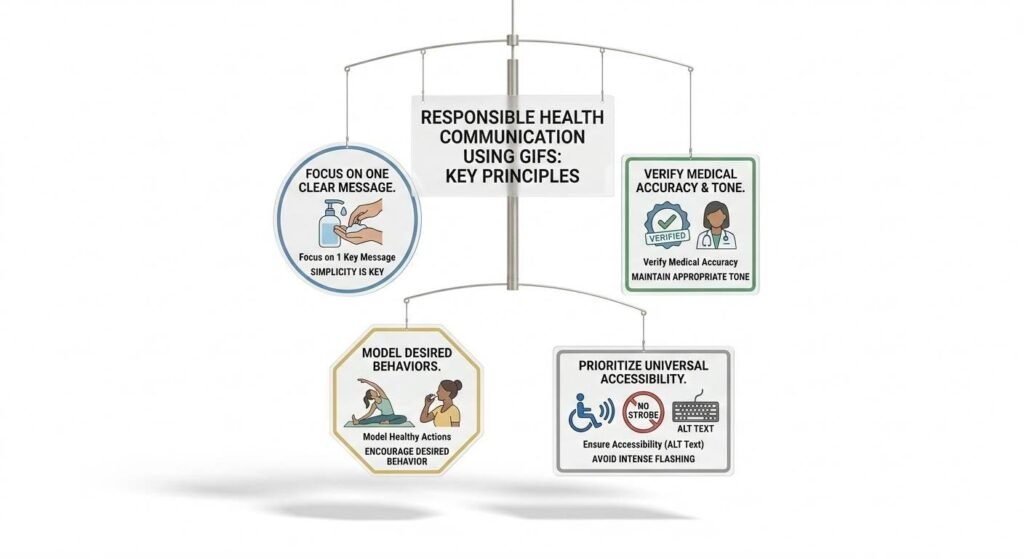
The accessibility and shareability of GIF content create particular responsibilities for health communicators. Health information that is inaccurate, incomplete, or taken out of context can spread rapidly in animated format, reaching audiences who may act on it without the broader context that responsible health guidance requires.
Principles for responsible health GIF creation
- Ensure accuracy: Every health claim presented in an animated GIF must be evidence-based, current, and consistent with published clinical guidelines. Do not create or share GIFs that present unverified health claims, even if the underlying video source appeared credible.
- Provide context in captions: A GIF is a brief visual extract. Always accompany health GIFs with a caption that provides full context, attributes the source, and, where relevant, directs viewers to a more detailed resource.
- Include a call to consult professionals: Health GIFs that cover symptoms, treatment, or clinical guidance should include a clear prompt for viewers to consult a qualified healthcare professional rather than relying solely on social media content for medical decisions.
- Attribute your sources: If a GIF is created from a video produced by another organisation or clinician, attribute it clearly. Unattributed health content creates confusion about source credibility.
- Review accessibility: Ensure that GIFs are not the sole carrier of critical health information. Screen readers cannot interpret GIF content, so all health information in an animated format should also be available in text form for users with visual impairments.
Platform policies on health content: Major social media platforms, including Instagram, X, and Facebook, have implemented policies governing health-related content, including restrictions on medical misinformation and requirements for labelling of health claims. Ensure that your health GIFs comply with current platform community standards, which are regularly updated.
Practical Guide: Creating Health GIFs Step by Step
For healthcare professionals and health organisations new to creating animated content, the following process provides a straightforward starting point.
- Identify the health message: Choose a single, clear health message that benefits from visual demonstration. Exercise technique, symptom recognition, and step-by-step procedures are ideal starting points
- Select the source video: Choose a brief, high-quality video clip of 5 to 15 seconds that captures the key visual element of the health message. Ensure you have the rights to use and adapt the video
- Choose a conversion tool: A range of reputable video-to-GIF conversion tools are available online, including Canva, GIPHY, and Ezgif. Select a tool that offers customisation options for text, sizing, and format
- Trim and focus: Extract only the most relevant portion of the clip. A GIF that is too long loses the conciseness that makes the format effective for health communication
- Add text and branding: Apply a brief, clear text overlay that reinforces the health message and add your organisation’s logo or watermark
- Optimise for platform: Resize the GIF to match the dimensions of the platform where it will be shared
- Write a complete caption: Draft a post caption that provides full context for the health message shown in the animation and includes a prompt to seek professional advice where appropriate
- Review for accuracy: Have the GIF and caption reviewed by a clinically qualified colleague before posting to confirm that the health information is accurate and appropriately contextualised
Conclusion
For health communicators, the challenge of reaching people with accurate, useful health information in the social media environment has never been greater. The volume of competing content, the limited attention window, and the complexity of health information all create barriers to effective digital health communication.
GIF conversion offers a practical, accessible, and evidence-supported approach to improving the reach and impact of health content. By transforming brief video clips into looping animations, health organisations and practitioners can capture attention in busy feeds, communicate procedural and awareness messages in seconds, extend the value of existing health education content, and maintain consistent, professional branding across platforms.
Used responsibly, with accurate information, clear attribution, and appropriate calls to seek professional guidance, health GIFs represent a genuinely useful addition to the digital health communicator’s toolkit. The format meets audiences where they already are and delivers health information in the way that modern social media users actually engage with content.
Disclaimer
This article is provided for general informational and educational purposes only. It is intended to guide health communicators, healthcare organisations, and wellness content creators in the responsible use of animated content formats for health education. It does not constitute medical advice and is not directed at patients seeking clinical guidance. Health information shared on social media in any format, including GIFs, should always be evidence-based, attributed to qualified sources, and accompanied by a recommendation to consult a qualified healthcare professional for personalised medical advice. The mention of specific tools, platforms, or organisations in this article is for illustrative purposes only and does not constitute an endorsement. Platform policies governing health-related content change frequently and should be reviewed directly with each platform before publishing.
References and Resources
Digital Health Communication Research
Chou W-YS, et al. (2013). Social Media Use in the United States: Implications for Health Communication. Journal of Medical Internet Research, 15(1). https://doi.org/10.2196/jmir.1249
Moorhead SA, et al. (2013). A New Dimension of Health Care: Systematic Review of the Uses, Benefits, and Limitations of Social Media for Health Communication. Journal of Medical Internet Research, 15(4). https://doi.org/10.2196/jmir.1933
Paige SR, et al. (2018). Exploring the Influence of eHealth Literacy on Health Behavior: A Systematic Review. Patient Education and Counseling, 101(6), 1026-1037.
Ventola CL. (2014). Social media and health care professionals: benefits, risks, and best practices. Pharmacy and Therapeutics, 39(7), 491-520.
Visual Health Communication and Patient Education
Houts PS, et al. (2006). The role of pictures in improving health communication: A review of research on attention, comprehension, recall, and adherence. Patient Education and Counseling, 61(2), 173-190. https://doi.org/10.1016/j.pec.2005.05.004
Yin HS, et al. (2012). Effectiveness of a pictogram-based discharge instruction sheet for emergency department patients with limited health literacy. Annals of Emergency Medicine, 60(2), 193-199.
Tait AR, et al. (2015). Use of animated computer-generated imaging to supplement the informed consent process. Anesthesiology, 122(1), 56-65.
Social Media Health Communication Guidance
World Health Organization. (2020). Managing the COVID-19 infodemic: Promoting healthy behaviours and mitigating the harm from misinformation and disinformation. WHO Joint Statement. https://www.who.int/news/item/23-09-2020-managing-the-covid-19-infodemic
General Medical Council (GMC). Doctors’ Use of Social Media. https://www.gmc-uk.org/professional-standards/professional-standards-for-doctors/personal-beliefs-and-medical-practice/doctors-use-of-social-media
British Medical Association (BMA). Social Media Guidance for Doctors. https://www.bma.org.uk/advice-and-support/ethics/using-social-media/guidance-on-social-media
NHS England. Digital Health Communication Standards. https://www.england.nhs.uk/digitaltechnology
Content Creation Tools for Health Educators
Canva. Video to GIF Converter and Health Content Templates. https://www.canva.com/features/video-to-gif
GIPHY. GIF Creation and Distribution Platform. https://giphy.com/create/gifmaker
Pew Research Center. Social Media Use in 2023. https://www.pewresearch.org/internet/topic/social-media
Reuters Institute for the Study of Journalism. Digital News Report: Health Misinformation and Engagement. https://reutersinstitute.politics.ox.ac.uk