

Recovering from methamphetamine addiction is one of the most challenging journeys a person can undertake, but it is absolutely possible with the right support system in place. Across New Mexico, thousands of individuals are successfully rebuilding their lives through structured, evidence-based care.
If you or a loved one is searching for a clear path forward, Meth Addiction Treatment in New Mexico offers a comprehensive network of professional programs, peer support communities, and holistic resources designed to meet people exactly where they are.
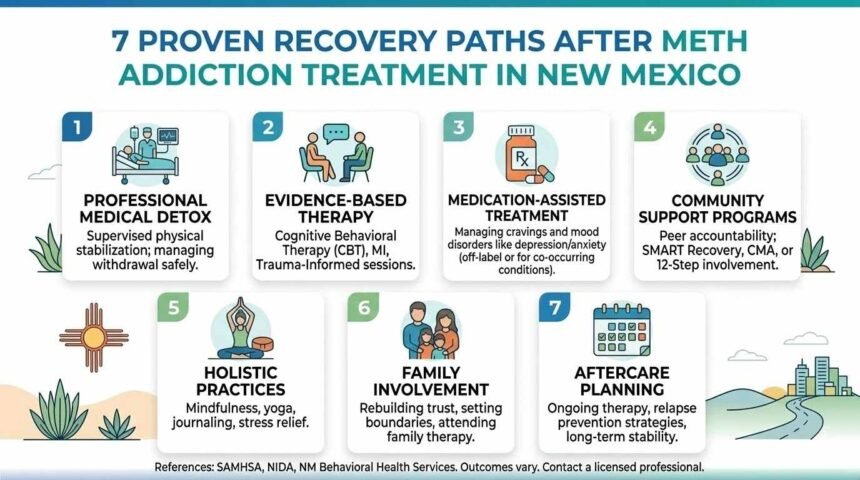
Quick Overview: 7 Recovery Paths at a Glance
| # | Recovery Path | Best For | Timeline |
| 1 | Medical Detox | Physical stabilization | 3 to 10 days |
| 2 | Evidence-Based Therapy | Behavioral and emotional healing | Weeks to months |
| 3 | Medication-Assisted Treatment | Craving and mood management | Ongoing, doctor-supervised |
| 4 | Community Support Programs | Peer accountability and belonging | Ongoing |
| 5 | Holistic Practices | Stress relief and daily balance | Daily, lifelong |
| 6 | Family Involvement | Home environment and trust rebuilding | Ongoing |
| 7 | Aftercare Planning | Long-term stability and relapse prevention | 12+ months post-treatment |
1. Professional Medical Detox: The Foundation of Recovery
What Is Medical Detox?
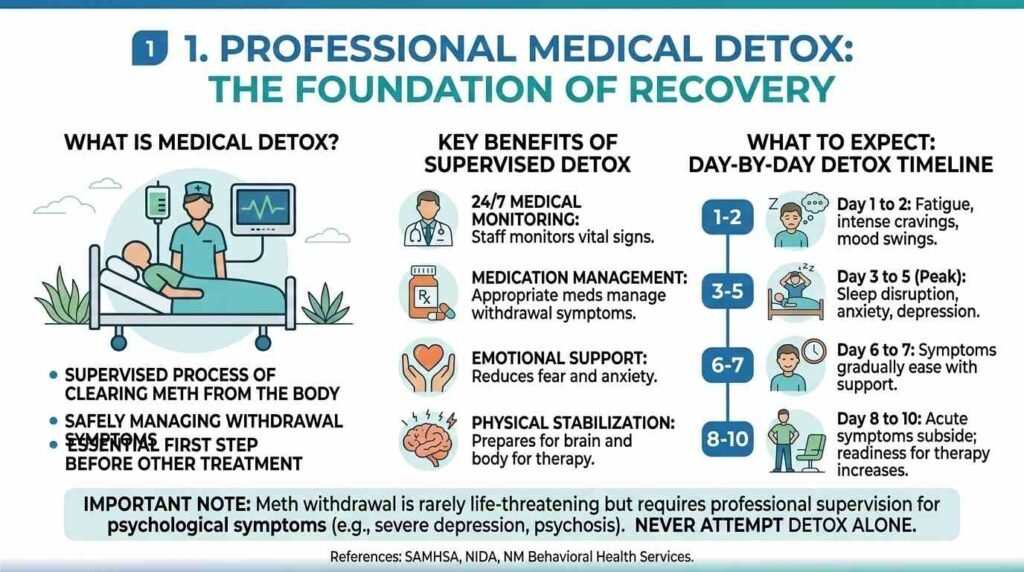
Medical detox is the supervised process of clearing methamphetamine from the body while managing withdrawal symptoms safely. It is almost always the essential first step before any other form of treatment can be effective.
Key Benefits of Supervised Detox
- Trained medical staff monitor vital signs around the clock
- Withdrawal symptoms are managed with appropriate medications
- Emotional support reduces fear and anxiety during the hardest early days
- Physical stabilization prepares the brain and body for therapy
What to Expect: Day-by-Day Detox Timeline
| Day | What Typically Happens |
| Day 1 to 2 | Fatigue, intense cravings, mood swings begin |
| Day 3 to 5 | Peak withdrawal: sleep disruption, anxiety, depression |
| Day 6 to 7 | Symptoms gradually ease with proper medical support |
| Day 8 to 10 | Most acute symptoms subside; readiness for therapy increases |
Important Note: Meth withdrawal is rarely life-threatening on its own, but psychological symptoms such as severe depression and psychosis require professional supervision. Never attempt detox alone.
2. Evidence-Based Therapy: Building Healthier Habits for Life
Why Therapy Is Non-Negotiable in Meth Recovery
Meth addiction rewires the brain’s reward system. Therapy helps reverse those patterns by addressing the thoughts, emotions, and behaviors that fuel substance use. Without therapy, most people relapse because the root causes remain unaddressed.
Most Effective Therapy Types for Meth Addiction
| Therapy Type | How It Helps | Format |
| Cognitive Behavioral Therapy (CBT) | Identifies and rewires harmful thought patterns | Individual or group |
| Motivational Interviewing (MI) | Strengthens personal motivation to stay sober | Individual |
| Contingency Management | Uses positive reinforcement rewards for sobriety milestones | Group-based |
| Trauma-Informed Therapy | Addresses past trauma that contributed to addiction | Individual |
| Dialectical Behavior Therapy (DBT) | Builds emotional regulation and distress tolerance skills | Individual or group |
Clarifying Points: What Therapy Actually Looks Like
- Sessions are confidential. What you share stays between you and your counselor.
- You set the pace. Therapists do not force disclosures; they guide at your comfort level.
- Progress is not linear. Hard sessions often precede the biggest breakthroughs.
- It extends beyond addiction. Therapy also improves relationships, work performance, and mental health.
Tip: Ask your treatment provider specifically for a therapist who has experience with stimulant addiction, not just general substance use disorders. Meth affects the brain differently than alcohol or opioids, and specialized experience matters.
3. Medication-Assisted Treatment: Supporting Long-Term Stability
How Medication Fits Into a Meth Recovery Plan
Unlike opioid addiction, there is currently no FDA-approved medication specifically for meth addiction. However, doctors in New Mexico frequently use medications to treat co-occurring conditions that make recovery harder, such as depression, anxiety, sleep disorders, and ADHD.
Common Medications Used in Meth Recovery Support
| Medication Category | Purpose | Example Uses |
| Antidepressants | Stabilize mood during early recovery | Depression, emotional flatness |
| Sleep aids | Restore healthy sleep patterns | Insomnia common post-meth use |
| Anti-anxiety medications | Reduce panic and hypervigilance | Anxiety disorders |
| ADHD medications | Address attention and impulse control | Underlying ADHD often worsened by meth |
| Naltrexone (off-label) | May reduce cravings in some patients | Being studied for stimulant use |
Clarifying Points: Common Medication Myths Debunked
- Myth: Taking medication means you are not truly sober.
- Fact: Medication is a medical tool, not a moral failure. It supports recovery, it does not replace it.
- Myth: Medications are prescribed forever.
- Fact: Dosages and duration are constantly reviewed and adjusted by your care team.
- Myth: All medications are addictive.
- Fact: Most medications used in meth recovery have no addiction potential when properly prescribed.
Tip: Always disclose your full substance use history to your prescribing physician. Certain medications interact poorly with residual drug effects or other substances.
4. Community Support Programs: Turning Connection Into Strength
Why Human Connection Is a Medical Necessity in Recovery
Addiction thrives in isolation. Research consistently shows that strong social support networks are one of the most powerful predictors of long-term sobriety. Community programs directly address this by providing regular, structured connection.
Types of Community Programs Available in New Mexico
| Program Type | What It Offers | Examples |
| 12-Step Programs | Peer accountability, spiritual framework | Crystal Meth Anonymous (CMA) |
| SMART Recovery | Science-based, self-empowerment tools | Local SMART Recovery chapters |
| Sober Living Homes | Substance-free housing with peer accountability | Available in Albuquerque and Santa Fe |
| Recovery Community Centers | Drop-in support, events, mentorship | New Mexico Recovery Community |
| Faith-Based Programs | Spiritual guidance and community | Various churches and nonprofits statewide |
Clarifying Points: What to Expect at Your First Meeting
- You are never required to speak. Listening is equally valuable.
- Most meetings are completely free to attend.
- You can try different groups until you find one that feels right for you.
- Many groups offer virtual attendance options for those in rural New Mexico.
- Sponsors and mentors are volunteers, not paid professionals.
5. Holistic Practices: Restoring Balance Between Mind and Body
What Does Holistic Recovery Actually Mean?
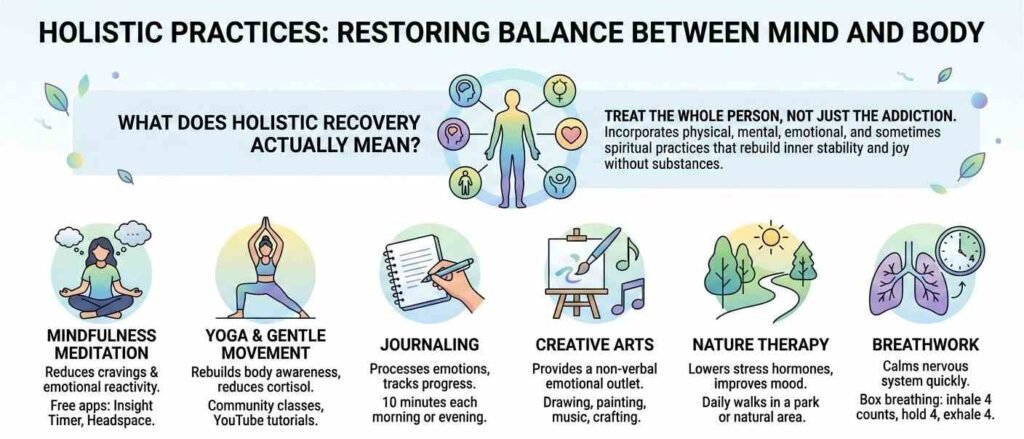
Holistic recovery means treating the whole person, not just the addiction. It incorporates physical, mental, emotional, and sometimes spiritual practices that rebuild a sense of inner stability and joy without substances.
Most Effective Holistic Practices for Meth Recovery
| Practice | Benefit | How to Start |
| Mindfulness Meditation | Reduces cravings and emotional reactivity | Free apps like Insight Timer or Headspace |
| Yoga and Gentle Movement | Rebuilds body awareness and reduces cortisol | Community classes or YouTube tutorials |
| Journaling | Processes emotions and tracks progress | 10 minutes each morning or evening |
| Creative Arts | Provides a non-verbal emotional outlet | Drawing, painting, music, crafting |
| Nature Therapy | Lowers stress hormones and improves mood | Daily walks in a park or natural area |
| Breathwork | Calms the nervous system quickly | Box breathing: inhale 4 counts, hold 4, exhale 4 |
Clarifying Points: Holistic Practices Are Not a Replacement for Treatment
- Holistic tools complement professional care; they do not replace therapy or medical supervision.
- Start with one practice at a time to avoid feeling overwhelmed.
- Consistency matters more than intensity. Ten minutes daily beats one hour weekly.
- Many New Mexico treatment centers incorporate holistic care directly into their programs.
Tip: Breathwork is particularly effective during cravings. When a craving hits, try 5 rounds of box breathing before doing anything else. Most cravings peak and subside within 15 to 20 minutes.
6. Family Involvement: Creating a Home Environment That Supports Healing
Why Family Participation Directly Impacts Recovery Success
Addiction does not happen in isolation, and neither does recovery. The home environment plays a powerful role in either reinforcing or undermining the progress made in treatment. Families who engage actively and learn healthy response patterns dramatically improve outcomes for their loved ones.
How Families Can Get Actively Involved
| Action | Why It Helps |
| Attend family therapy sessions | Rebuilds communication and resolves old conflicts |
| Learn about meth addiction | Reduces blame and increases empathy |
| Establish consistent daily routines | Reduces anxiety and unpredictability at home |
| Set clear, compassionate boundaries | Prevents enabling while maintaining support |
| Join Al-Anon or Nar-Anon | Provides peer support specifically for family members |
| Celebrate recovery milestones | Reinforces motivation and strengthens family bonds |
Clarifying Points: Healthy Support Versus Enabling
- Healthy support means encouraging treatment, attending sessions, and maintaining boundaries.
- Enabling means covering up consequences, providing money that funds use, or excusing harmful behavior out of guilt.
- Saying no is not abandonment. Firm, loving boundaries are one of the greatest gifts a family can offer.
- You cannot force recovery. Your role is to create conditions where choosing recovery feels supported and worthwhile.
7. Aftercare Planning: Keeping Momentum Strong After Treatment Ends
Why Aftercare Is the Bridge Between Treatment and Real Life
Completing a residential or outpatient program is a tremendous achievement. But the transition back to everyday responsibilities, relationships, and stressors is where many people struggle most. A strong aftercare plan is the bridge that prevents that gap from becoming a relapse.
Core Components of an Effective Aftercare Plan
| Component | Purpose | Frequency |
| Ongoing therapy sessions | Maintains psychological support | Weekly or biweekly |
| Support group attendance | Sustains peer accountability | Weekly minimum |
| Regular check-ins with case manager | Tracks progress and adjusts the plan | Monthly |
| Relapse prevention strategies | Prepares for high-risk situations | Reviewed regularly |
| Employment and housing support | Reduces real-world stressors | As needed |
| Emergency contact protocol | Provides a plan for crisis moments | Always available |
Clarifying Points: Relapse Does Not Mean Failure
- Relapse is common during recovery. Studies suggest up to 40 to 60 percent of people in addiction recovery experience at least one relapse.
- A relapse is a signal to reassess, not evidence that recovery is impossible.
- Returning to treatment after a relapse is not starting over. Every day of prior sobriety built real neurological progress.
- The most important thing after a relapse is to reach out immediately rather than hide it out of shame.
Tip: Build a written relapse prevention plan before you need it. Identify your top three triggers, list three people you will call, and write down the exact steps you will take if cravings become overwhelming. Reviewing this plan monthly keeps it sharp and actionable.
Comparing Your Recovery Options
| Recovery Path | Cost Range | Requires Insurance? | Inpatient or Outpatient | Duration |
| Medical Detox | High | Often covered | Inpatient | 3 to 10 days |
| Therapy | Moderate | Partially covered | Outpatient | Ongoing |
| Medication Support | Low to moderate | Often covered | Outpatient | Doctor-determined |
| Community Programs | Free | No | Outpatient | Ongoing |
| Holistic Practices | Free to low | No | Self-directed | Daily |
| Family Programs | Low | Sometimes covered | Outpatient | Weeks to months |
| Aftercare Planning | Low to moderate | Sometimes covered | Outpatient | 12 plus months |
References and Further Reading
- Substance Abuse and Mental Health Services Administration (SAMHSA)
- National Institute on Drug Abuse (NIDA)
- New Mexico Behavioral Health Services Division
- Crystal Meth Anonymous (CMA)
- SMART Recovery
- American Society of Addiction Medicine (ASAM)
- National Alliance on Mental Illness (NAMI) New Mexico
Final Disclaimer:Recovery outcomes vary from person to person. The information presented in this article reflects general best practices and publicly available research but is not a substitute for individualized medical advice. Treatment plans should always be developed in partnership with licensed addiction professionals. If you are in immediate crisis, call 988(Suicide and Crisis Lifeline) or go to your nearest emergency room.