


Have you ever fixed one health problem, but then another one shows up? You improve your sleep, but you still feel stressed. Your digestion gets better, but your energy stays low. This happens because health is often treated in separate parts instead of as one whole system.
Holistic wellness looks at your mind, body, and environment as connected. Everything works together. The food you eat can affect your mood. Your surroundings can change how you feel. The people around you can impact your health. When one area is off, it can affect the others, too.
Today, many people are dealing with stress, anxiety, and low energy. That is why this approach is becoming more important. Holistic wellness is not about being perfect or changing everything at once. It is about understanding your body better and making small changes that improve your overall well-being.
Understanding Holistic Wellness in Today’s World
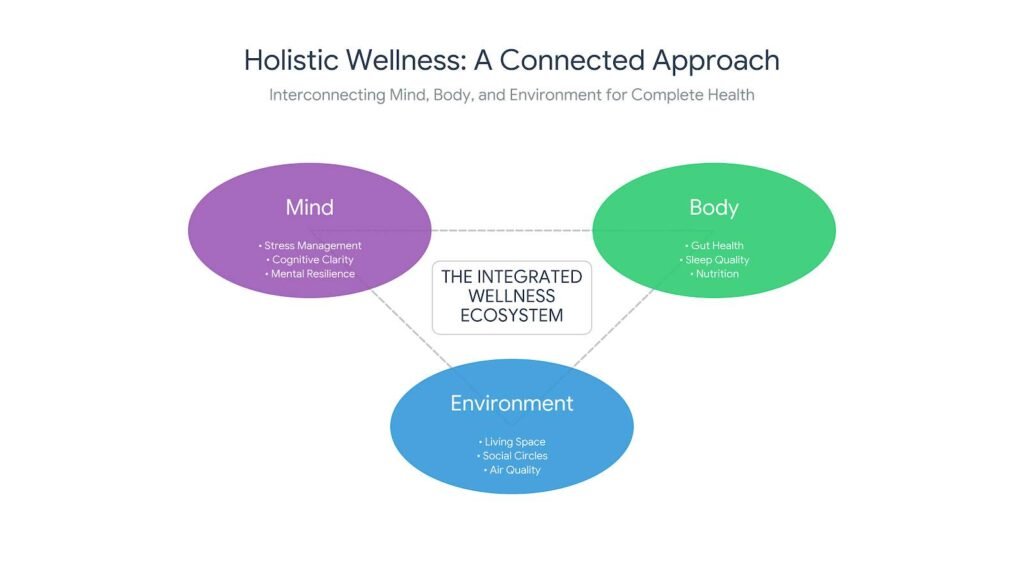
Have you ever walked out of a doctor’s office with a prescription in hand and a feeling that the real problem still has not been addressed? You manage one symptom, and another shows up a few months later. The fatigue does not lift. The anxiety stays low and steady. The digestive issues come and go without a clear reason. Each piece gets treated on its own, but nothing seems to add up to a complete picture.
That experience is more common than most people realize, and it is rarely a sign that something is wrong with you. It is usually a sign that the system has been looking at your health one part at a time. Conventional medicine does many things well, but it often treats the body as a collection of separate organs and the mind as a separate department altogether. The connection between your stress, your sleep, your gut, your relationships, and the air in your home barely gets a mention.
Holistic wellness flips that pattern. It treats your mind, body, and environment as one connected system because that is how they actually function. The food you eat affects how clearly you think. The space you live in shapes your mood. The people around you influence your immune response. None of these threads operates in isolation, and pretending they do leaves real healing on the table.
The need for this approach is not abstract. According to the World Health Organization, roughly 18% of adolescents aged 12 to 17 experienced a major depressive episode in 2023. That figure alone shows why whole-person care has shifted from a fringe idea to a serious response to a real public health concern, not just a wellness trend with nice marketing.
This guide breaks down how holistic wellness actually works in daily life. You will see how your environment shapes your mental state, how your gut talks to your brain, which practices have real evidence behind them, and how to start without overhauling your entire routine. The goal is not perfection. It is a reconnection.
Environmental Wellness: The Missing Piece in Holistic Health
Coastal Southern California offers something rare for healing work. Laguna Niguel sits between ocean ecosystems and protected nature reserves. The microclimate, paired with easy trail access, supports mental health recovery in ways most cities cannot match. People drawn to this kind of environment often see results that extend beyond therapy alone.
How Your Surroundings Shape Your Mental State
Environmental wellness reaches well beyond recycling and conservation. The spaces you occupy directly influence your nervous system, hormone production, and how clearly you can think. Research suggests 80 to 90% of health outcomes depend on external and environmental factors in your wellness ecosystem. Your home’s air quality affects sleep architecture. Office lighting throws off your circadian rhythm. The lack of natural elements in your daily routine creates stress responses you have probably stopped noticing.
Toxic Load You’re Carrying
Endocrine disruptors hide in cleaning products, personal care items, and even furniture. They are quietly damaging because they do not produce immediate symptoms. Instead, they slowly interfere with hormone signaling and contribute to mood disorders, fatigue, and metabolic problems. You do not need to overhaul everything overnight. Start by replacing the products you use most often with cleaner alternatives, then build from there.
Nature as Medicine, Not Recreation
Forest bathing studies published by the National Library of Medicine show that time among trees measurably lowers cortisol, reduces blood pressure, and increases natural killer cell activity. Living near the ocean exposes you to negative ions linked to better mood and energy. Even a window view of greenery has been shown to speed up surgical recovery. These are not placebo effects. They are biological responses to the environments humans evolved within.
Sometimes mental health needs more support than self-care can offer. When that happens, facilities like the Long Term Residential Treatment Center in Laguna Niguel, CA, provide an immersive, structured environment. You can step away from triggering circumstances while receiving comprehensive care. These programs understand something important. Healing requires more than scheduled therapy sessions. It involves rebuilding how you relate to yourself and your surroundings, which is also why a wellness retreat can reset your nervous system in ways daily life rarely allows.
Science Behind the Mind-Body Connection
Modern research keeps confirming what older healing traditions understood instinctively. Your mental state shapes physical health, and your physical health shapes how your mind functions. This is not mystical thinking. It is measurable biology.
How Your Nervous System Links Thoughts and Health
Think of the vagus nerve as an information superhighway. It connects your brain to almost every organ in your body. Chronic stress sends signals down this pathway that trigger inflammation, disrupt digestion, and weaken immune function. The good news is that you have leverage here. According to research from Harvard Medical School, specific breathing patterns and mindfulness practices can directly influence vagal activity. The mind-body connection works through real biological pathways that respond when you intervene with intention.
Gut-Brain Conversation You’re Not Hearing
Your digestive tract holds more neurotransmitter receptors than your actual brain does. The bacteria living there produce roughly 90% of the body’s serotonin. Your mood depends partly on what those microbes are eating. Anxiety and depression often start in your gut, not your thoughts, which is why most people get gut health wrong when they only think about digestion and not about mental wellbeing.
When Stress Becomes Your Body’s Default Setting
Chronic cortisol elevation does more than make you feel anxious. It physically reshapes your brain. It shrinks the hippocampus. It speeds up cellular aging. As the Mayo Clinic explains, your body cannot tell the difference between a real threat and your worry about tomorrow’s meeting. That biological reality explains why holistic practices that calm the nervous system can produce real improvements in health problems that seem completely unrelated.
Essential Holistic Health Practices for Mind-Body-Environment Integration
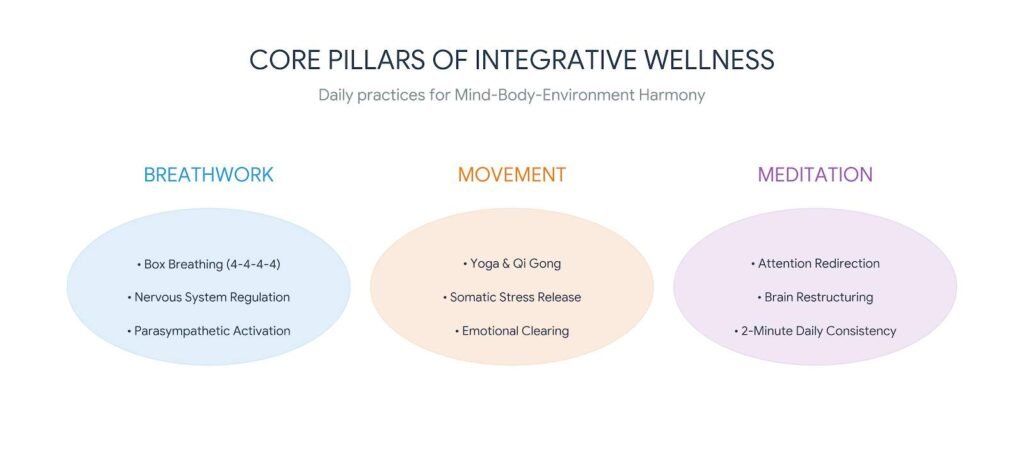
Integrative wellness involves daily practices that address multiple health dimensions at once. You do not need expensive equipment or hours of free time to start.
Breathwork That Rewires Your Stress Response
Your breath is unique. It is the only autonomic function you can consciously control, which makes it a direct gateway into nervous system regulation. Box breathing works like this—Inhale for four counts. Hold for four. Exhale for four. Hold for four. Within minutes, you activate your parasympathetic nervous system. Try it before difficult conversations or when tension starts building. The technique works because you are literally changing blood chemistry and heart rate variability.
Movement That Releases What Talk Therapy Can’t
Trauma and chronic stress get stored in your tissues. They show up as muscle tension and limited movement patterns. Practices like yoga and qi gong benefit body and mind because they do more than stretch you. They release stored stress responses. You might cry unexpectedly during a hip opener or feel anger surge during a spinal twist. That is the practice of doing exactly what it is meant to do. The connection between movement and mental well-being runs deeper than most people realize.
Meditation Without the Mysticism
You do not need to achieve a completely quiet mind. That myth stops most people before they start. Meditation means noticing when your attention wanders and gently bringing it back. Two minutes count. The benefit comes from each moment of noticing, not from reaching a blissed-out state. With consistent practice, your brain literally restructures itself over time. Holistic wellness also recognizes the importance of relaxation and mindful physical experiences in reducing stress and improving emotional balance. Some individuals explore practices such as erotic massage London services as part of a broader self-care routine focused on relaxation, connection, and body awareness.
Creating Your Holistic Wellness Environment
Your home either supports your wellbeing or quietly works against it through dozens of small stressors you have stopped consciously registering.
Making Your Space Support Your Nervous System
Harsh overhead lighting keeps you stuck in sympathetic activation. Synthetic fragrances trigger inflammation. Clutter creates a low-grade anxiety that drains your cognitive reserves. You cannot think your way out of environmental stressors. You have to change the actual space. Add full-spectrum bulbs. Bring in plants that filter air naturally. Create distinct zones for work, rest, and play.
Setting Boundaries With Technology
Your phone hijacks the dopamine system by design. Social media platforms hire entire teams of behavioral psychologists to keep you scrolling. Struggling with screen time is not a personal failing. You are up against billions of dollars in attention research. Set physical boundaries. Charge your phone outside the bedroom. Delete apps that do not serve you. Pick specific times to check messages.
Building Healing Relationships
Blue Zones research consistently shows that strong social ties predict longevity better than diet or exercise. Quality matters more than quantity. Three close friendships protect your health more than dozens of casual ones. According to the American Psychological Association, loneliness produces inflammation comparable to smoking, which is one reason the conversation around behavioral health and holistic recovery keeps gaining momentum.
Common Questions About Holistic Wellness
What’s the difference between holistic wellness and regular healthcare?
- Conventional medicine handles acute injuries and infections well, but it often manages symptoms without examining why they appeared. Holistic wellness considers how multiple parts of your life work together to create either health or illness, and it treats the whole person rather than isolated complaints.
How long before I notice changes from holistic health practices?
- Some effects show up immediately. Breathwork calms anxiety in minutes. Time outdoors lifts mood the same day. bigger changes to chronic conditions usually take 8 to 12 weeks of consistent practice as your body resets inflammatory pathways and stress responses.
Can I do holistic wellness on a budget?
- Yes. Walking outside costs nothing and offers multiple benefits. Breathwork requires no equipment. Library books, free meditation apps, and community classes make most practices available regardless of income.
Comparison Table: Holistic vs. Conventional Wellness Approaches
| Aspect | Conventional Approach | Holistic Wellness Approach |
|---|---|---|
| Treatment Focus | Isolated symptoms | Whole-person integration |
| Root Cause Analysis | Limited investigation | Comprehensive life assessment |
| Environmental Factors | Rarely considered | Central to treatment |
| Prevention Strategy | Periodic screening | Lifestyle-based daily practices |
| Success Measurement | Lab values only | Multiple well-being indicators |
| Mental-Physical Link | Separate specialties | Integrated understanding |
Closing Thoughts
The fragmented approach to health you have been taught, treating mind, body, and environment as separate systems, was never going to produce lasting wellness. Anxiety is linked to gut health. Chronic pain is linked to unprocessed stress. Your surroundings either support your efforts or quietly undermine them.
Real healing happens when you stop trying to fix individual symptoms and start addressing the whole system. You do not need perfection or a complete lifestyle overhaul. Small, steady changes in how you breathe, move, eat, and structure your environment add up to something significant over time.
Pick one practice that fits your day. Notice what shifts. Then add another. Holistic wellness is not about achieving an ideal version of yourself. It is about treating yourself as a connected whole and giving each piece what it needs. The healing happens in the connection.
References
- World Health Organization. (2024). Adolescent mental health. WHO. Retrieved from https://www.who.int/news-room/fact-sheets/detail/adolescent-mental-health
- United States Environmental Protection Agency. (2024). Introduction to Indoor Air Quality. EPA. Retrieved from https://www.epa.gov/indoor-air-quality-iaq/introduction-indoor-air-quality
- Hansen, M. M., Jones, R., & Tocchini, K. (2017). Shinrin-Yoku (Forest Bathing) and Nature Therapy: A State-of-the-Art Review. International Journal of Environmental Research and Public Health, 14(8), 851. Retrieved from https://www.ncbi.nlm.nih.gov/pmc/articles/PMC5580555/
- Harvard Health Publishing. (2023). Relaxation techniques: Breath control helps quell errant stress response. Harvard Medical School. Retrieved from https://www.health.harvard.edu/
- Mayo Clinic Staff. (2024). Chronic stress puts your health at risk. Mayo Foundation for Medical Education and Research. Retrieved from https://www.mayoclinic.org/healthy-lifestyle/stress-management/in-depth/stress/art-20046037
- American Psychological Association. (2019). The risks of social isolation. Monitor on Psychology, 50(5). Retrieved from https://www.apa.org/monitor/2019/05/ce-corner-isolation
- Centers for Disease Control and Prevention. (2024). Health Equity and Social Determinants of Health. CDC. Retrieved from https://www.cdc.gov/about/priorities/health-equity.html
Medical Disclaimer
The information provided in this article is for general educational and informational purposes only. It is not intended to be a substitute for professional medical advice, diagnosis, or treatment. Always seek the guidance of a qualified healthcare provider with any questions you may have regarding a medical condition, mental health concern, or before starting any new wellness practice, supplement, or treatment plan.
Never disregard professional medical advice or delay in seeking it because of something you have read on this site. The strategies, practices, and resources discussed reflect general wellness perspectives and should not replace personalized care from a licensed practitioner. Individual results vary, and what works for one person may not work for another. If you are experiencing a mental health crisis, contact a qualified professional or local emergency services immediately.