


Reproductive healthcare in the UK has historically asked a lot of the people who use it: time off work, travel to a clinic, a seat in a waiting room, and, for many, a scramble to arrange childcare. None of that has disappeared, and in-person care remains essential for procedures, scans, and complex diagnoses. But over the past several years, a meaningful share of reproductive healthcare has moved onto the phone, the video call, and the post. Contraceptive prescribing, abortion consultations and medication, fertility discussions, and menopause management can now, in many cases, begin and sometimes conclude without a person ever entering a clinic.
This shift did not happen by accident, and it has not happened without debate. An emergency accelerated it, the COVID-19 pandemic, formalised through legislation and clinical guidance, and it continues to be shaped by an evolving and at times contested evidence base. A 2025 review of UK policy and grey literature on remote consultations in sexual and reproductive health services found that telephone, video, online, and text-based appointments have expanded considerably across the sector, even as standards and guidance for delivering them safely are still maturing. That mixture of real expansion, genuine clinical support, and ongoing scrutiny is a more accurate picture than either uncritical enthusiasm or blanket suspicion.
Why Remote Reproductive Care Has Grown
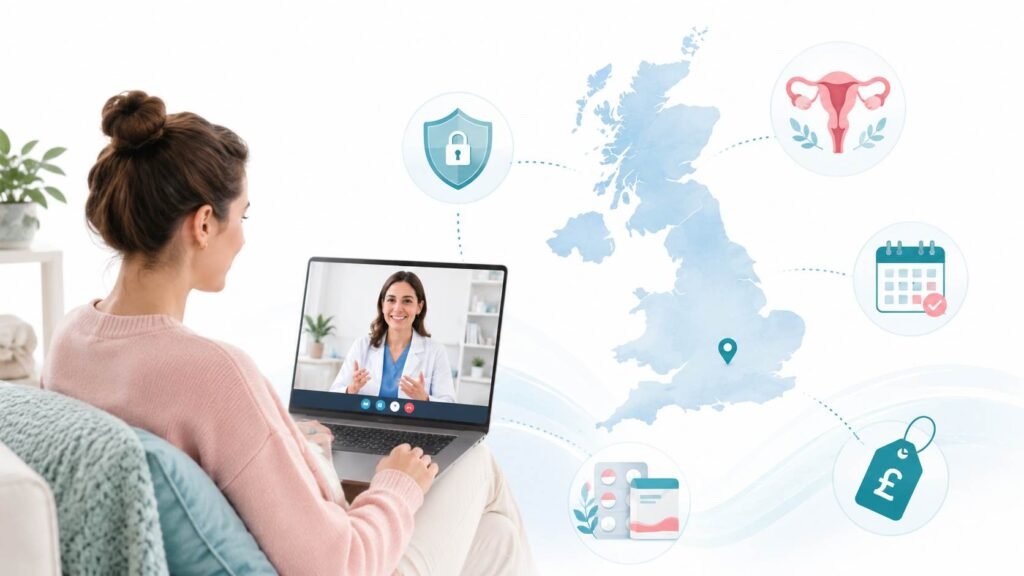
The single biggest driver is access. Long NHS wait times. England’s elective waiting list stood at 7.5 million at the end of 2024, with only 58.9% of patients seen within the 18-week constitutional standard. Combine this with inflexible working patterns, transport costs, and caring responsibilities to make in-person reproductive appointments harder to reach for some people than for others. Geography compounds this: abortion and specialist contraceptive services in England have tended to concentrate in larger towns and cities, leaving people in rural or underserved areas facing longer journeys for time-sensitive care.
Privacy is the second major factor, and it is not a minor one. Qualitative research with people in Great Britain who sought medical abortion documented a recurring set of barriers judgement, cost, distance, and a wish to avoid disclosure, which telemedicine can directly ease by letting the conversation happen in a private setting of the person’s own choosing. The same logic extends to contraception and menopause discussions, where embarrassment or a fear of being overheard can delay someone from seeking care they are already entitled to.
Cost transparency has moved in a similar direction outside the NHS-funded pathway. Most NHS-funded abortion care in the UK remains free at the point of use. Still, for people who choose a private provider instead for speed, discretion, or because they are not NHS-eligible, telemedicine has made the cost of abortion pill in the UK easier to find out in advance. Private clinics increasingly publish a single, fixed price covering the whole post-based pathway consultation, medication, and aftercare support rather than requiring an in-person visit to get a quote.
A third, less-discussed factor is regulatory precedent rather than novelty. Bioethics and law researchers have argued that, before 2020, abortion medication was treated more restrictively than comparable prescription-only medicines, for which UK regulators already accepted that some prescribing could reasonably happen without a face-to-face examination, provided the clinical need was straightforward and a safe prescribing system was in place. Seen this way, the pandemic-era changes mainly brought abortion care into line with prescribing norms that already existed elsewhere in medicine, rather than inventing an entirely new model of care.
Legal and Clinical Turning Point: Abortion Care by Telemedicine
The clearest example of this shift is early medical abortion. In March 2020, the UK government issued a temporary approval allowing eligible people in England to take both stages of early medical abortion medication mifepristone and misoprostol at home, following a remote consultation, rather than requiring at least one clinic visit. Wales and Scotland introduced parallel arrangements. By the time the temporary order was due to expire, the Royal College of Obstetricians and Gynaecologists (RCOG) and the then Faculty of Sexual and Reproductive Healthcare (FSRH) reported that the pathway had already supported well over 100,000 people in ending a pregnancy at home rather than in a clinical setting. Following public consultations and a House of Commons vote, the approach was made permanent in Wales in February 2022, in Scotland, and then in England from 30 August 2022, for pregnancies up to nine weeks and six days’ gestation.
The clinical evidence behind that decision is substantial, though not without nuance. A national cohort study of telemedicine-provided, “no-test” early medical abortion in England and Wales found rates of complete abortion, safety, and patient acceptability broadly comparable with traditional, in-person pathways. A 2019 systematic review of telemedicine for medical abortion across multiple countries reached a similar conclusion, and a Cochrane review of self-administered versus provider-administered medical abortion found no meaningful difference in efficacy or safety between the two approaches. A qualitative study of UK abortion care providers also found that, on balance, clinicians believed the shift to telemedicine had improved both access to care and their ability to identify safeguarding concerns for younger patients, partly because more people were reaching services earlier rather than delaying.
It would be inaccurate, however, to present the evidence as fully settled. A more selective 2025 Cochrane review of telemedicine models for medical abortion, which, unlike earlier reviews, included only studies with a direct comparison group, concluded that while outcomes for telemedicine appear broadly comparable to in-clinic care, much of the underlying data comes from observational studies rather than randomised trials, often with incomplete follow-up. The same review notes that the World Health Organization’s endorsement of telemedicine rests on what Cochrane’s own framework classifies as low-certainty evidence. This is a common and unremarkable feature of fast-moving service innovations: clinical trials are slow, and services often outpace them, but it is worth stating plainly rather than glossing over.
There has also been organised opposition to the policy on safeguarding and process grounds, distinct from the clinical safety question. In written evidence to a House of Commons committee, the campaign group Right To Life UK argued that the 2020 change was introduced without parliamentary scrutiny or public consultation. It raised concerns that self-administration at home removes a degree of clinical control over who takes the medication, when, and in what circumstances. The RCOG and the British Society of Abortion Care Providers’ 2021 statement on safeguarding under-18s in telemedicine abortion care was, in part, a response to this category of concern; it concluded that excluding all under-18s from telemedicine pathways would be disproportionate, while still recommending tailored safeguarding protocols for younger patients.
The scale of this shift shows up in the official statistics. The most recently published figures for England and Wales, covering 2023, recorded 277,970 abortions the highest number, and the highest age-standardised rate (23.0 per 1,000 women aged 15–44), since the Abortion Act 1967 was introduced with 81% of procedures carried out by the independent sector, which includes the telemedicine-led providers, such as BPAS and MSI Reproductive Choices, that now deliver much of this care. Publication of more recent data has itself been delayed: a 2026 compliance review by the Office for Statistics Regulation found that 2024 figures had not yet been released, attributing the delay to a transition to a new data-collection system and a rise in paper-form submissions that take longer to process, a reminder that the reporting infrastructure around reproductive healthcare is still adapting to the scale of remote service delivery.
Scotland, where home abortion is legally permitted up to 12 weeks rather than the 9 weeks and 6 days allowed in England and Wales, offers a useful comparison. A five-year retrospective review of NHS Lothian data found that, for abortions carried out between 10 and 12 weeks, complete abortion rates were identical (97%) whether the procedure happened at home or in hospital, though people who chose home abortion in this later window were somewhat more likely to make unscheduled contact with a clinic afterwards. The study’s authors argue this supports extending the home-abortion gestational limit in England in line with World Health Organization guidance; whether and when policymakers act on that remains an open political question rather than a settled one.
Contraception, Fertility, and Menopause Care Moving Online
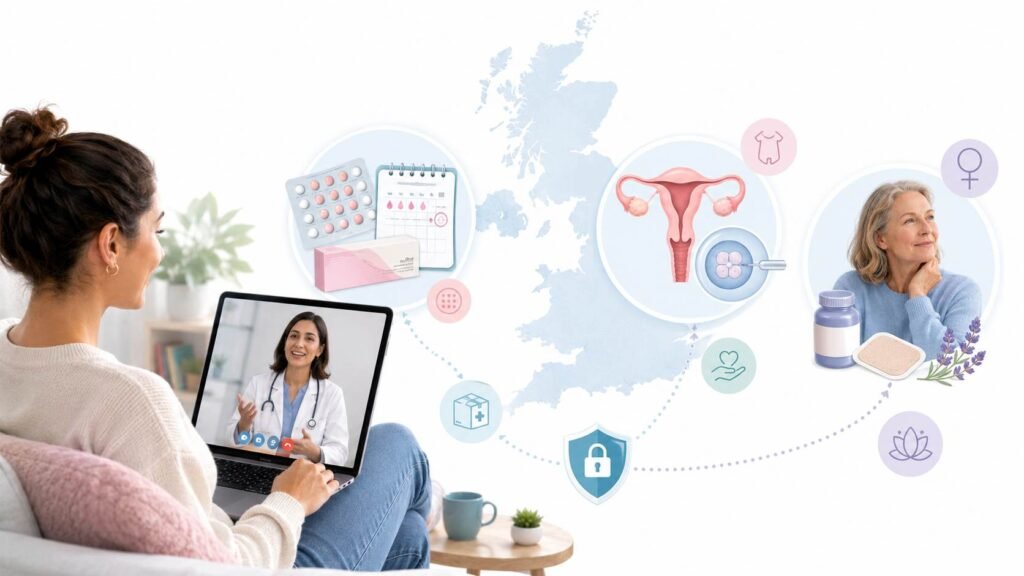
Abortion care is the most legally visible example of this shift, but it is not the only one. UK clinical guidance on contraception explicitly supports remote prescribing in appropriate circumstances: structured self-assessment questionnaires, covering blood pressure, BMI, and medical eligibility criteria, are recognised as a legitimate tool to support safe prescribing by phone or online, with referral pathways in place for anything that needs an in-person check, such as fitting a coil or implant. The organisation that issues much of this guidance changed its name in 2025, from the Faculty of Sexual and Reproductive Healthcare (FSRH) to the College of Sexual and Reproductive Healthcare (CoSRH). However, its clinical guidance role is unchanged.
Menopause care has followed a related but distinct path. NICE’s updated 2024 guideline on menopause clarified that hormone replacement therapy (HRT), used within licensed doses, is unlikely to affect life expectancy meaningfully, and introduced a structured discussion aid to support shared decision-making between patients and clinicians, exactly the kind of conversation that translates reasonably well to a phone or video appointment. Easier access has plausibly contributed to a recovery in HRT prescribing over the past decade, after rates fell sharply following the 2002 Women’s Health Initiative findings,
That said, the data complicate any simple “remote access fixes everything” narrative. A 2025 population-based cohort study of nearly two million women aged 40 to 60 in UK primary care found that only around 19% had received two or more HRT prescriptions over ten years, and that white women and those in less deprived areas were significantly more likely to be prescribed HRT than non-white women and those in more deprived areas. In other words, the existence of a remote-access channel has not, on its own, closed long-standing inequalities in who actually receives appropriate menopause care. This finding should temper any claim that telemedicine is automatically a leveller.
Fertility care is the area where a simple “tests and monitoring have gone remote” framing needs the most qualification. The Human Fertilisation and Embryology Authority (HFEA) regulates every licensed fertility clinic in the UK, and core elements of IVF and related treatment, such as egg collection, embryo transfer, and scans requiring clinical equipment, cannot currently be done remotely. What has changed is the surrounding scaffolding: initial consultations, results discussions, and ongoing treatment planning are increasingly conducted by phone or video. There is also early-stage research into more ambitious remote monitoring: a 2025 feasibility study at a UK NHS trust tested home cardiotocography and home ultrasound for high-risk pregnancies, finding that the large majority of remote scans and heart-rate recordings produced clinically interpretable results. This is a genuinely promising direction, but it remains a small feasibility study, not yet a mainstream NHS service.
What the Evidence Doesn’t Yet Settle
Taken together, the research record supports a measured rather than a triumphant conclusion. Telemedicine-delivered reproductive care, particularly early medical abortion, has, in the studies conducted so far, shown safety and effectiveness broadly comparable to in-person care, and has clearly improved access for many people who would otherwise have faced real practical barriers. At the same time, the certainty of that evidence is lower than headlines sometimes suggest. Safeguarding and process concerns raised by clinicians and by groups opposed to the policy on other grounds have not been fully resolved, and expanding remote access has not, by itself, closed demographic gaps in who receives timely contraceptive or menopause care. None of this amounts to a case against remote reproductive healthcare; it is simply a more complete version of the story than “this has made everything better” allows for.
Toward a Hybrid Model of Reproductive Healthcare
The most likely trajectory, and the one UK clinical bodies are already planning around, is not full replacement of in-person care but a structured hybrid model. The RCOG’s 2022 best-practice paper on telemedicine for abortion care sets out exactly this kind of framework: clear criteria for who is suitable for a fully remote pathway, defined points at which an in-person appointment is required, and explicit guidance on contraception discussion, aftercare, and escalation. The World Health Organization’s 2022 Abortion Care Guideline takes a similar position globally, recommending telemedicine as an option for parts or all of the care pathway eligibility assessment, counselling, medication instruction, and follow-up rather than as a wholesale substitute for clinical judgement about when in-person assessment is needed.
For people using these services, this means the practical reality is one of choice rather than a forced move online: a phone or video consultation where that is appropriate and preferred, with a clinic visit still available, and sometimes still required, for scans, procedures, or situations a remote assessment cannot safely resolve. For the health system, it is a resource-allocation question, making the best use of clinical time and physical clinic space for the things that genuinely need them, while extending access for the things that do not.
Conclusion
The expansion of remote reproductive healthcare in the UK over the past several years is real, well-documented, and, on the specific question of access, broadly supported by clinical research. It is not, however, a story without complications: the underlying evidence is still developing in places, safeguarding and oversight remain live issues, and remote access alone has not erased inequalities in who gets timely care. A fair reading of the evidence points toward a future of structured hybrid care, more choice in how people reach the system, alongside continued investment in the in-person services that some situations will always require, rather than either a full return to the old model or an assumption that the move online has already solved every problem it touches.
Disclaimer: This article is provided for general information and educational purposes only. It does not constitute medical, legal, or financial advice, and it is not a substitute for consultation with a registered doctor, nurse, pharmacist, or other qualified healthcare professional. Eligibility criteria, gestational limits, and service availability for telemedicine-based reproductive care vary by provider and by the UK nations England, Wales, Scotland, and Northern Ireland, which operate under different legal frameworks and are subject to change as legislation and clinical guidance are updated. Always seek individualised advice from a licensed clinician or an official NHS or regulatory source before making decisions about contraception, abortion, fertility treatment, or menopause care. The statistics, studies, and guidance referenced below were accurate as of the date of the sources cited and may have since been revised or superseded.
References
- Spurway C, Williams I, Bohm C, Ayinde OC, Burns F, Gibbs J, Josh J, Munro H, Solomon D, Woode Owusu M, Ross JDC, Jackson LJ. What guidance exists to support remote consultations in sexual and reproductive health services? A review of the policy and practice literature. Sexually Transmitted Infections. 2025. doi: 10.1136/sextrans-2025-056519
- Romanis EC. The case for telemedical early medical abortion in England: dispelling adult safeguarding concerns. Available via PubMed Central: https://pmc.ncbi.nlm.nih.gov/articles/PMC8540868/
- Aiken ARA, Guthrie KA, Schellekens M, Trussell J, Gomperts R. Barriers to accessing abortion services and perspectives on using mifepristone and misoprostol at home in Great Britain. Contraception. 2018;97(2):177–183. doi: 10.1016/j.contraception.2017.09.003
- Royal College of Obstetricians and Gynaecologists (RCOG) and Faculty of Sexual and Reproductive Healthcare (FSRH). RCOG and FSRH welcome telemedicine for early medical abortion care being made permanent in England [news statement]. London: RCOG; 2022. https://www.rcog.org.uk/news/rcog-and-fsrh-welcome-telemedicine-for-early-medical-abortion-care-being-made-permanent-in-england/
- UK Government, Department of Health and Social Care. The Abortion Act 1967 — Approval of a Class of Places [legislative instrument enabling home use of both early medical abortion medications following a telemedicine consultation, amended from 30 August 2022]. GOV.UK.
- Aiken ARA, Lohr PA, Lord J, Ghosh N, Starling J. Effectiveness, safety and acceptability of no-test medical abortion (termination of pregnancy) provided via telemedicine: a national cohort study. BJOG. 2021;128(9):1464–1474. doi: 10.1111/1471-0528.16668
- Endler M, Lavelanet A, Cleeve A, Ganatra B, Gomperts R, Gemzell-Danielsson K. Telemedicine for medical abortion: a systematic review. BJOG. 2019;126(9):1094–1102. doi: 10.1111/1471-0528.15684
- Gambir K, Kim C, Necastro KA, Ganatra B, Ngo TD. Self-administered versus provider-administered medical abortion. Cochrane Database of Systematic Reviews. 2020;(3):CD013181. doi: 10.1002/14651858.CD013181.pub2
- Romanis EC, Parsons J. Early telemedical abortion, safeguarding, and under-18s: a qualitative study with care providers in England and Wales. BMJ Sexual & Reproductive Health. 2023. Available via PubMed Central: https://pmc.ncbi.nlm.nih.gov/articles/PMC10579482/
- Cleeve A, et al. The use of telemedicine services for medical abortion. Cochrane Database of Systematic Reviews. 2025. doi: 10.1002/14651858.CD013764.pub2