

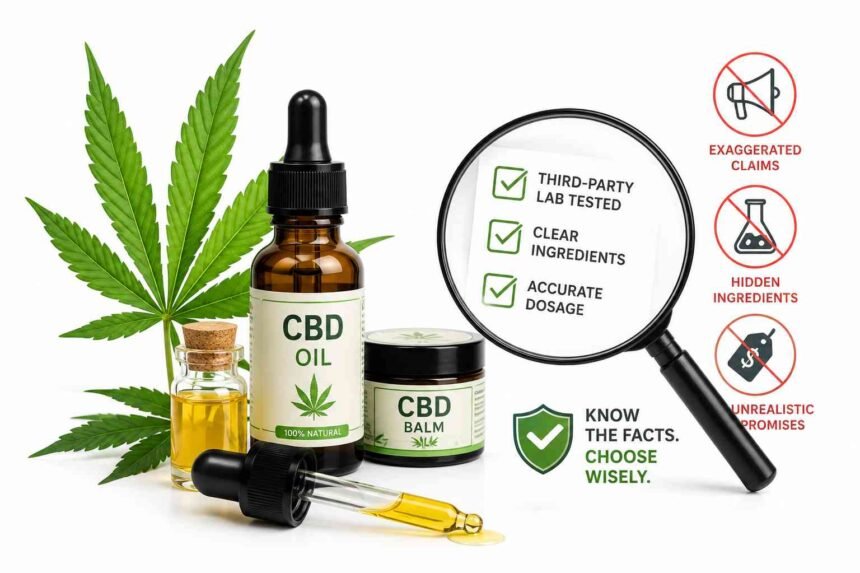
More people are trying CBD than ever, and most of them are not chasing a trend. They are dealing with something real: nagging pain, anxiety that will not switch off, nights spent staring at the ceiling. Surveys keep landing on the same short list of reasons people reach for it, and pain, anxiety, and sleep sit right at the top.
All that demand has produced a flood of content online, and not all of it is honest. Some of it is careful and properly sourced. A lot of it is a product page wearing the costume of health advice. The tricky part is that the good stuff and the sales copy sit side by side and often look identical, right down to the scientific vocabulary.
So this is not a piece telling you CBD is magic or that it is a scam. It is a guide to reading what you find online with clear eyes, so you can spend your money well and, more importantly, avoid the one mistake that really matters: dropping a treatment that works because a website told you a plant would do the job better.
Why The Internet Is A Rough Place To Research CBD
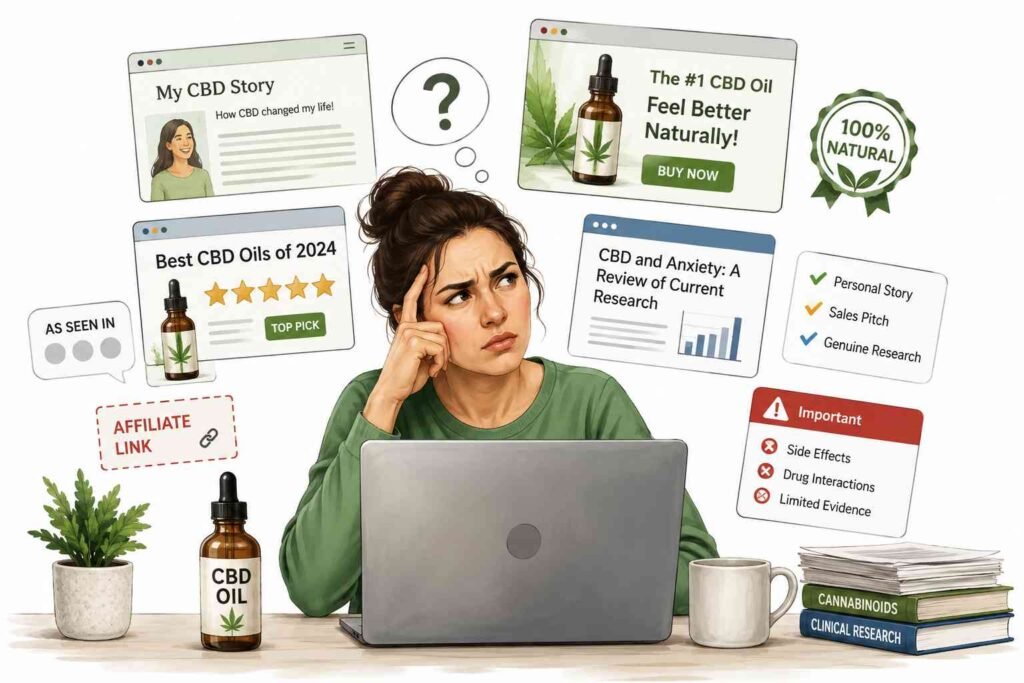
CBD is still being studied, and the rules around it are still being written. That gap is exactly where marketing rushes in. Browse for ten minutes, and you will meet three kinds of content, usually tangled together: someone’s personal story, a company trying to sell you something, and genuine research. Telling them apart is harder than it should be, because a sales page will happily borrow the language of a study to sound like one.
There is also money moving quietly in the background. Plenty of “review” and “best CBD” articles earn a commission on every click that turns into a sale, which shapes what they recommend and how glowing they sound. Star ratings can be gamed. Logos like “as seen in” or “as featured on” often mean a company paid for placement, not that a newsroom vetted the product. None of this makes every site dishonest, but it does mean you should assume a page is trying to sell you something until it proves otherwise.
Sites that sell CBD have an obvious reason to make it sound good. They tend to lead with benefits, go quiet on side effects and drug interactions, and skip the part where the science is still thin. You are not getting the full picture from a page whose job is to close a sale.
First, What CBD Is (And Is Not)
Before judging any claim, it helps to know what you are dealing with. CBD, short for cannabidiol, is one of many compounds found in the cannabis plant. The other one people know is THC, and the difference between them matters. THC is the compound that gets you high. CBD does not. You can take a sensible dose of CBD and feel no intoxication at all.
Most CBD sold for wellness comes from hemp, a variety of cannabis bred to contain very little THC, rather than from marijuana. Your body also makes its own cannabis-like molecules as part of a system that helps regulate things like mood, sleep, appetite, and pain signalling. CBD appears to nudge that system, which is the rough biological reason people think it might help in those particular areas. “Appears to” and “might” are doing real work in that sentence, and the rest of this guide is about respecting that uncertainty rather than papering over it.
“Cures Everything” Problem
Here is the single number worth carrying around with you. When researchers reviewed the medical claims on the most popular cannabis websites, they found that 76% of them were inaccurate and rested on weak evidence.
That is most of them. And the claims tend to be big. You will see CBD sold as a treatment for cancer, Alzheimer’s, multiple sclerosis, autism, anorexia, and AIDS, a lineup of serious diseases with no solid human research behind the promise. If you are in pain or frightened, those are exactly the words you want to read, which is precisely what makes them dangerous.
The real risk is not wasting money on an oil that does very little. It is a person reading one confident sentence online and quietly stepping away from a treatment that was working. A plain rule of thumb covers most of this: the longer the list of diseases a product claims to cure, the less you should trust it.
What The Research Really Shows, Condition By Condition
Research on CBD is real and moving forward, but promising and proven are not the same word. Here is roughly where things stand on the uses people ask about most.
- Pain. This is the number one reason people try CBD, and plenty report it helps with chronic, nerve, and inflammatory pain. Animal studies support the anti-inflammatory idea. Human studies lag: reviews from Harvard Health note there is some support, but not enough yet to pin down the right dose for a specific kind of pain. Useful, possibly. A sure thing, not yet.
- Anxiety And Low Mood. Early studies and a mountain of personal reports suggest CBD may take the edge off anxiety, possibly by acting on the brain’s serotonin system, the same broad target many antidepressants work on. The catch is the one that runs through this entire subject: most of the studies are small, and small studies do not settle questions. Bigger, well-run trials are needed before anyone can call it reliable, and CBD is not a treatment for clinical depression.
- Sleep. Many people use CBD hoping to sleep better, and it may help, though often in a roundabout way. If anxiety or pain is what keeps you awake, easing those can improve sleep as a knock-on effect. As a direct sleep aid in its own right, the evidence is still early and thin.
- Epilepsy: The One Strong Case. This is where CBD has the firmest ground under it. There is a real, tested prescription medicine made mostly of CBD, and it is the only CBD product the FDA has approved, cleared for a few rare and severe forms of childhood epilepsy after proper clinical trials. That is worth sitting with for a second, because it shows the gap plainly. A tested prescription drug for specific seizure disorders is a very different thing from a shelf bottle claiming to treat a dozen unrelated conditions.
- Skin, Inflammation, And The Rest. You will also find CBD sold for acne, eczema, arthritis, gut problems, and more. Some of these have early research attached, often in cells or animals rather than people. Early research is a reason to stay curious, not a reason to treat something serious with a wellness product. For anything specific, and especially anything serious, that decision belongs with your doctor, not a checkout page.
How CBD Can Affect Other Medicines (Read This Before You Start)
This is the part sales pages tend to bury, so here it is up front. CBD is not automatically safe just because it comes from a plant, and its biggest practical risk is how it interacts with other medicines.
Your liver breaks down most drugs using a set of enzymes. CBD can occupy those same enzymes, which can leave other medicines lingering in your system at higher levels than intended. If that sounds abstract, think of grapefruit juice, which interferes with drugs by a similar route and carries warnings on plenty of prescription labels. CBD can behave in a comparable way. That matters a great deal for medicines where the dose has to stay in a narrow band, blood thinners being a common example.
CBD has its own side effects too, including tiredness, changes in appetite, diarrhoea, and irritability. And the safety questions are not purely theoretical. An FDA trial found signs of liver strain in some healthy adults taking CBD at doses that are common on the shelf, which is exactly why this is a conversation to have with a professional rather than a comment section. If you take any regular medication, talk to your doctor or pharmacist before starting CBD, full stop.
Who Should Be Extra Careful
Some people carry more risk than others, and a few should steer clear altogether.
Pregnancy and breastfeeding sit firmly in that last group. The FDA strongly advises against using CBD while pregnant or breastfeeding, because the effects on a developing baby are not understood and some are actively concerning. Children are another group where caution should win, outside of a doctor-supervised situation such as prescribed epilepsy treatment.
Beyond that, take extra care if you are on regular medication, if you have a liver condition, or if you are older and more sensitive to side effects and drug interactions in general. None of this means CBD is off limits for everyone in these groups. It means the sensible move is a professional’s input, not a product review.
How To Judge A Source
You do not need a science degree to read critically. You mostly need to ask two questions: where is this claim coming from, and is there anything real behind it?
Good evidence comes from studies that other experts have checked before publication, in peer-reviewed journals. The strongest formats are randomised controlled trials, systematic reviews, and meta-analyses, which pull many studies together. Research on cells or animals is a useful early signal, but it does not prove something works in humans. And when you see the phrase “studies show” with no name and no link attached, treat it as an opinion until it earns more.
Sources worth leaning on tend to be:
- Health bodies such as the World Health Organization, which reviewed CBD and found it generally well tolerated with a low potential for abuse or dependence.
- Universities and research centres publishing their own findings.
- Non-profit and disease-specific organisations whose material is reviewed by medical staff.
- Medical journals and professional associations for doctors and pharmacists.
Be more careful with shops selling CBD, with forums where every claim is somebody’s personal experience, and with social media, which rewards a confident story far more than a careful one.
Reading The Label
The claims are one thing. What is inside the bottle is another, and this market is loosely regulated, so strength and purity swing widely from brand to brand.
A label worth trusting states, in plain terms:
- How much CBD is inside, in milligrams. Not “hemp extract,” which can mean almost anything, and not a percentage on its own.
- Which type of CBD it is. Full-spectrum keeps the whole range of plant compounds, including trace THC. Broad-spectrum keeps several cannabinoids but strips the THC out. Isolate is pure CBD and nothing else.
- Everything else in the mix, from carrier oils to flavourings.
- The size, the batch number, and who made it, with contact details that reach a real person.
That full-spectrum versus isolate choice is worth understanding rather than guessing at. Some people prefer full- or broad-spectrum on the theory that the plant’s compounds work better together than CBD does alone, an idea often called the entourage effect. It is plausible and popular, but not nailed down by evidence, so treat it as a reasonable preference rather than a proven upgrade. If you are drug tested for work, note that full-spectrum products contain trace THC, and broad-spectrum or isolate are the safer bets.
Two more things quietly separate careful brands from careless ones. The first is how the CBD was extracted. CO2 extraction is clean and well regarded, while cheap solvent extraction can leave residue behind if it is not done carefully. The second is where the hemp was grown, since hemp readily soaks up whatever is in its soil. Brands proud of their sourcing usually say so plainly.
Lab Report Is The Real Test
If you remember one practical habit from this whole guide, make it this one: find the lab report before you buy.
Reputable companies send their products to an independent lab and publish the results as a Certificate of Analysis, usually reachable through a QR code on the box or a link on the website. A COA that means something will:
- Confirm the CBD content matches what the label claims.
- Confirm the THC is within legal limits, and absent if the product says so.
- Show the product was screened for pesticides, heavy metals, solvents, and mould, with results that pass.
- Carry a recent date and a batch number that matches the bottle in your hand, not a generic certificate for a whole product line.
No COA, or one that is old, incomplete, or clearly for a different batch, is a reason to walk away. This is not box-ticking either. Independent analyses have repeatedly found CBD products mislabeled or contaminated, some carrying more CBD than advertised, some far less, and some with none at all. The lab report is the closest thing you have to proof, which is exactly why the sketchier sellers do not provide one. If you want a place to start, look for a specialist that publishes a current lab report for every batch and is open about where its hemp comes from.
Dosing: Start Low, Go Slow
There is no universal correct dose of CBD, and anyone online who quotes you a precise figure for your body and your goal is guessing. What most sensible guidance shares is a simple principle: start with a low amount, give it time, and increase slowly only if you need to and your doctor is comfortable with it.
This is also where labelling in milligrams earns its keep. If a product only says “hemp extract” or gives a percentage with no clear milligram figure, you cannot track what you took or repeat it reliably. You want to be able to say, “I took this many milligrams, and this is how I felt,” which is impossible with vague labelling. Keep it modest, keep notes if it helps, and treat your doctor as part of the process, particularly if you take other medicines.
Spotting Marketing Red Flags
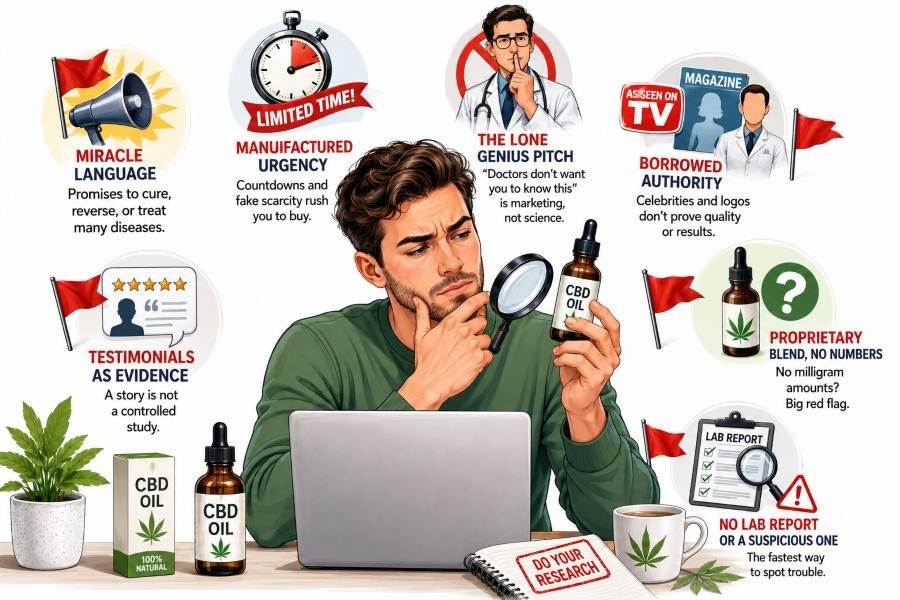
After a while, the dodgy pages start to rhyme. A few patterns show up again and again, and any one of them is a reason to slow down:
- Miracle Language. Anything promising to cure, reverse, or treat a long list of serious diseases. Real medicine does not talk like this.
- Manufactured Urgency. Countdown timers, “only 3 left,” and “sale ends tonight” are there to stop you thinking, not to help you.
- The Lone Genius Pitch. “Doctors don’t want you to know this” and “one weird trick” are marketing costumes, not science.
- Borrowed Authority. Celebrity faces, vague “as seen on” logos, and stock-photo people in white coats prove nothing about a product.
- Testimonials As Evidence. A glowing story is a story. It is not a controlled study, and it might be paid for or invented.
- Proprietary Blend, No Numbers. If a brand will not tell you how many milligrams of CBD you are getting, assume there is a reason.
- No Lab Report, Or A Suspicious One. Covered above, and worth repeating, because it is the fastest tell of all.
None of these guarantees a scam on its own. Stack two or three together, and you have your answer.
Where The Law Stands
Regulation is patchy and depends heavily on where you live, which is part of why the market can feel like the Wild West. In many places CBD is not cleanly classed as a medicine, a supplement, or a cosmetic, and that ambiguity leaves health claims sitting in a grey zone.
In the United States, the principle regulators apply is straightforward: make a health claim, and you need real evidence to back it, and companies that make unproven medical claims can receive warning letters or face legal action.
In the United Kingdom, ingestible CBD is treated as a novel food, which means products are meant to pass a safety assessment to stay on sale. The Food Standards Agency oversees that process, and separately, advertising rules mean sellers are not allowed to make medical claims for general CBD products. In practice, much of the therapeutic language you see online would not pass a compliance check, which is a useful lens whichever country you are reading from.
Whatever the region, the throughline is the same. Because there is often no strict approval step before these products reach a shelf, a lot of the checking lands on you; that is the whole reason honest labels and real lab reports matter as much as they do.
Questions Worth Asking A Seller
If a company has a contact form or a chat window, a few questions will tell you most of what you need to know, and how they answer tells you the rest:
- Where is your hemp grown, and can you tell me about the soil or farming standards?
- How is the CBD extracted?
- Do you have a current Certificate of Analysis for this specific batch, and can I see it?
- Exactly how much CBD, in milligrams, is in this product, and how much THC?
- What is your returns policy if the product is not right for me?
A brand that answers these clearly and without dodging is showing you something. A brand that gets vague, defensive, or steers you back to testimonials is showing you something too.
A Quick Gut-Check Before You Buy
Run anything you are considering through a short set of questions:
- Does it promise to fix a long list of serious illnesses? Be suspicious.
- Where is the claim coming from: a health body or research group, or a shop with something to sell?
- Is there a named study behind it that you can open and read?
- Can you find and check the COA for that batch?
- Does the label give CBD in milligrams, plus the type and the other ingredients?
- Have you run it past your doctor, especially if you take other medication?
That last question carries more weight than people tend to give it. Your doctor knows your history and your prescriptions, and can tell you in a minute whether CBD is a reasonable fit or a bad idea for you specifically. No article, this one included, can do that.
Keep It In Perspective
CBD is usually one small part of looking after yourself, not the whole answer, and the honest brands tend to say as much. For most people, the basics still do the heavy lifting: decent sleep, moving your body, eating reasonably, and keeping stress in check. CBD might sit alongside those as a modest addition for some people. It is rarely the thing that fixes a complicated health problem by itself, and any product sold that way is overpromising.
Disclaimer
This article is for general information and education only. It is not medical advice, and it is not a substitute for a consultation with a qualified doctor, pharmacist, or other healthcare professional. Reading it does not create a doctor-patient relationship of any kind.
CBD affects people differently, and nothing here is a promise of any particular result. CBD is not intended to diagnose, treat, cure, or prevent any disease. If you have a health condition, take prescription or over-the-counter medication, or are pregnant or breastfeeding, speak to your doctor before using any CBD product.
The legal status of CBD, along with the rules for selling it and making claims about it, varies from country to country and can change over time. It is your responsibility to check the laws that apply where you live. Any products or third-party sources mentioned are referenced for context, and inclusion is not an endorsement.
The publisher and author accept no liability for any loss, injury, or damage arising from the use of, or reliance on, the information in this article. Always do your own checks and take professional advice before acting.
References
- Boatwright KD, Sperry ML. Accuracy of Medical Marijuana Claims Made by Popular Websites. Journal of Pharmacy Practice. 2020;33(4):419-424. https://doi.org/10.1177/0897190018818907
- Bonn-Miller MO, Loflin MJE, Thomas BF, Marcu JP, Hyke T, Vandrey R. Labeling Accuracy of Cannabidiol Extracts Sold Online. JAMA. 2017;318(17):1708-1709. https://doi.org/10.1001/jama.2017.11909
- Whiting PF, Wolff RF, Deshpande S, et al. Cannabinoids for Medical Use: A Systematic Review and Meta-analysis. JAMA. 2015;313(24):2456-2473. https://doi.org/10.1001/jama.2015.6358
- Shannon S, Lewis N, Lee H, Hughes S. Cannabidiol in Anxiety and Sleep: A Large Case Series. The Permanente Journal. 2019;23:18-041. https://doi.org/10.7812/TPP/18-041
- Iffland K, Grotenhermen F. An Update on Safety and Side Effects of Cannabidiol: A Review of Clinical Data and Relevant Animal Studies. Cannabis and Cannabinoid Research. 2017;2(1):139-154. https://doi.org/10.1089/can.2016.0034
- Hoeper S, Crosbie E, Holmes LM, et al. “The Perfect Formula:” Evaluating Health Claims, Products and Pricing on Cannabis Dispensary Websites in Two Recently Legalized States. Substance Use & Misuse. 2022;57(8):1207-1214. https://doi.org/10.1080/10826084.2022.2069267