


Ask a clinic owner what a medical director actually does and the answer usually involves paperwork. Someone signs the standing orders. A license number goes on the collaborative agreement. The state is satisfied, and everyone gets back to seeing patients.
That answer is not wrong. It is just incomplete in a way that tends to surface at the worst possible moment. A board changes a supervision rule, and the physician who signed your agreement no longer qualifies. A new injector asks whether a patient on anticoagulants is a candidate for filler, and nobody is sure who decides. An adverse event lands in a chart, and the protocol that should have prevented it turns out to exist only in someone’s head.
Clinical oversight is a function, not a signature. The practices that treat it that way tend to be the ones that survive a rule change, an inspection, or a bad week without losing momentum. That distinction explains most of why providers outsource oversight to a dedicated partner rather than hunting for a physician willing to lend a name.
Oversight Is a Job Description, Not a Formality

Strip away the compliance vocabulary and the work of a medical director is fairly concrete. Someone has to decide what treatments the practice will and will not offer. Someone has to write the screening criteria, approve the consent language, define what happens when a patient reacts badly, and then check periodically whether any of it is being followed.
Federal regulators look at it the same way. The HHS Office of Inspector General’s general compliance program guidance treats quality of care as part of compliance rather than a separate department, and it puts responsibility for oversight squarely with leadership rather than with a binder on a shelf. The guidance is voluntary, but it is a fair preview of what a regulator expects to find when it starts asking questions.
For a small clinic, that is a lot of unbilled work for a physician to absorb between patients. It is also work that does not scale down cleanly. A two-room med spa needs the same protocol library as a ten-room one. It just needs fewer hours of attention against it.
Rules Are Not the Same in Any Two States
The single hardest thing about clinical oversight in the United States is that there is no national version of it.
Nurse practitioners are the clearest example. In a majority of states, NPs practice under the sole authority of the state board of nursing and need no physician agreement at all. In the rest, a collaborative or supervisory relationship is a permanent condition of practice, and the specifics vary from chart co-signature ratios to how far away the physician may be. The AANP state practice environment map is the reference most clinic owners should have bookmarked, because “we did it this way in Arizona” is not a defense in New York.
Physician assistants sit on a similar spectrum. Nearly every state still requires some form of collaboration or supervision, though a growing number now let the practice site define what that looks like instead of writing it into statute. The AAFP’s overview of legal requirements for NP and PA supervision is a useful starting point for understanding where the responsibility actually sits.
Telehealth adds another layer. The practice of medicine is generally considered to occur where the patient is sitting, not where the clinician is, which means a virtual weight loss program serving six states is operating under six regulatory regimes at once. HHS maintains a plain-language explainer on licensing across state lines covering full licensure, temporary practice allowances, telehealth registration, and compacts.
None of this is exotic. It is just detailed, changeable, and expensive to get wrong.
Risk Concentrates Where the Needles Are
Aesthetics and medical weight loss are the two service lines where thin oversight has produced the most public damage, and both offer a useful lesson in what a medical director is really guarding against.
The CDC investigated a cluster of harmful reactions to counterfeit or mishandled botulinum toxin that ultimately involved 17 people across nine states, 13 of whom were hospitalized. Two threads ran through the cases. Some product had been bought through large online marketplaces rather than authorized suppliers. Some injections were given by people who were not following state or local requirements. Neither of those is a clinical skill problem. Both are governance problems with a clinical outcome.
Compounded GLP-1 medications tell a similar story. The FDA has documented safety concerns with unapproved GLP-1 products used for weight loss, including adverse events serious enough to require hospitalization. Notably, the dosing errors were not all patient errors. Clinicians miscalculated doses too, often when converting between milligrams, milliliters, and syringe units.
A physician reviewing that service line asks a specific set of questions. Where is the product coming from, and can you produce the invoice? Does the protocol state the dose in the same unit the patient will actually measure? Are you dispensing the syringe size that makes the intended dose easy to draw? Is titration documented, or is it happening over text message? Those questions take a few minutes to ask and prevent the kind of event that ends a practice.
What a Working Chart Review Program Looks Like
Most clinics say they do chart reviews. Fewer can describe the sampling method, and fewer still can say what happened to the last finding.
A functional review program has a cadence tied to risk rather than to the calendar alone, so a new injector or a newly launched service line gets looked at more often than a mature one. It has a defined sample rather than whatever charts happen to be open. It produces written findings. And it closes the loop, meaning the protocol actually changes and someone verifies the change stuck.
That last part is where most programs quietly fail. AHRQ’s Patient Safety Network primer on root cause analysis is unusually candid about this: investigations frequently fail to produce durable systems-level fixes because teams reach for weak interventions, such as re-educating staff or restating an existing policy, instead of changing the process that allowed the error. A medical director who has run these before knows the difference between “we reminded everyone” and “we changed the intake form so the question cannot be skipped.
Where Fractional Oversight Fits
For most independent clinics, the practical question is not whether they need physician oversight. It is how to buy an appropriate amount of it.
This is the gap Medical Director Co services are built to fill. The company, which is nurse-owned, places state-licensed physicians with clinics under three broad arrangements: fractional or part-time oversight for small and mid-sized practices, full-time dedicated directorship for organizations that need daily clinical leadership, and program-based coverage for multi-site groups and franchises. Pricing is published rather than quoted case by case, starting at $799 per month according to the company, with no setup fee, physician malpractice coverage included, and month-to-month terms. The company states it matches most clinics with a qualified physician within 24 hours.
The structural advantage of a fractional model is not only cost. It is that the physician arrives already familiar with the service line. A director who has written laser protocols before knows which device settings need a written parameter range. One who has run a metabolic practice knows what labs belong in a GLP-1 screening panel. Specialty fit is the variable that most affects whether the relationship produces real guidance or just a countersignature.
Make QAPI a Habit, Not a Binder
Practices that fall under long-term care, hospice, home health, or skilled nursing rules already know the term. Everyone else should borrow the framework anyway.
CMS built its Quality Assurance and Performance Improvement approach around five elements: design and scope, governance and leadership, feedback and data systems, performance improvement projects, and systematic analysis and action. It is a deliberately unglamorous structure, and that is the point. It converts quality from an annual scramble into a set of standing meetings where someone looks at the same handful of indicators every month and asks what changed.
A medical director is usually the person who makes that meeting happen and who keeps it from becoming a status update. Left to itself, the agenda drifts toward operations. Left to a physician who owns the clinical outcome, it stays on falls, medication events, documentation gaps, and complication rates.
Growing Across State Lines Without Starting Over
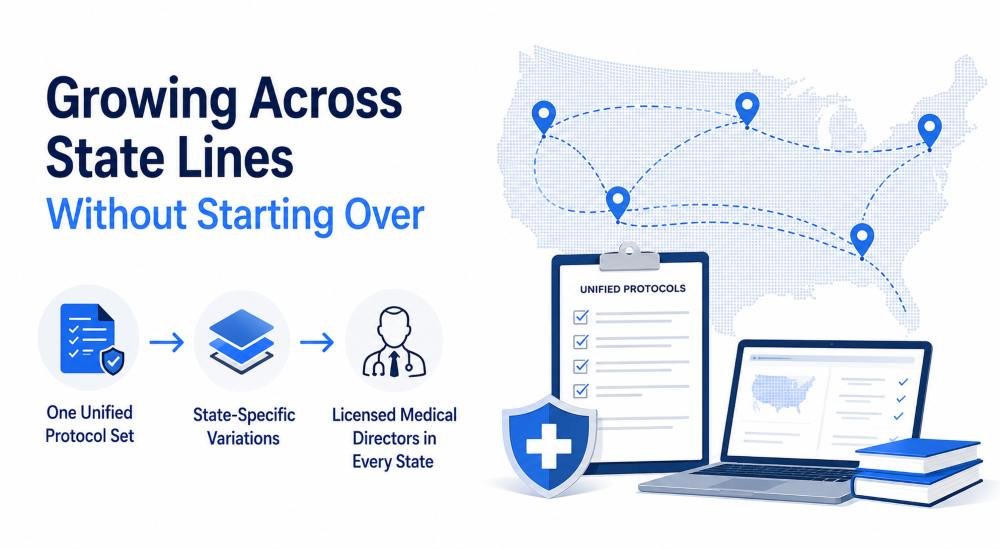
Multi-state expansion is where oversight either compounds in value or becomes an ongoing tax. Clinics that build a separate compliance structure for every new state end up maintaining several incompatible protocol libraries, which is both expensive and dangerous, because staff moving between locations will inevitably apply the wrong one.
The alternative is to write one protocol set to the strictest applicable standard and layer state-specific variations on top. That requires a partner who can see all the jurisdictions at once. A nationwide physician network makes this practical: the same organization can supply a licensed director in each state while keeping the underlying documentation unified.
Questions Worth Asking Before You Sign
Whatever partner you choose, a short due diligence conversation separates real oversight from a rented signature:
- Is the physician licensed and in good standing in every state where my patients will be located, and can I verify that myself?
- Have they overseen this specific service line before, or only adjacent ones?
- What is the chart review cadence and sample size, and do I receive written findings?
- Who drafts and updates protocols, standing orders, and consent forms, and how often are they revisited?
- What is the response time when a clinical question comes up mid-shift?
- Is physician malpractice coverage included, and does it extend to the delegated providers?
- What happens to my documentation if we part ways?
- If a state rule changes, who notices first?
A partner who answers all eight easily is doing the job. A partner who hesitates on more than one or two is selling compliance theater.
Bottom Line
Physician oversight has quietly become one of the higher-leverage decisions a clinic owner makes. It determines which services you can legally offer, how quickly you can open in a new state, whether your documentation survives an audit, and, most importantly, whether the person injecting a patient at 4 p.m. on a Friday has a protocol to follow and someone to call.
Medical Director Co approaches that as an ongoing clinical relationship rather than a document to file, pairing clinics with specialty-matched, state-licensed physicians and staying involved through chart reviews, protocol updates, and regulatory monitoring. For practices that want clinical leadership without the cost structure of a full-time hire, that is a reasonable place to start.
This article is for general informational purposes and does not constitute legal, regulatory, or medical advice. Scope of practice, supervision, and delegation requirements vary by state and change frequently. Verify current requirements with your state medical board, board of nursing, and qualified healthcare counsel before making decisions about clinical oversight arrangements.