

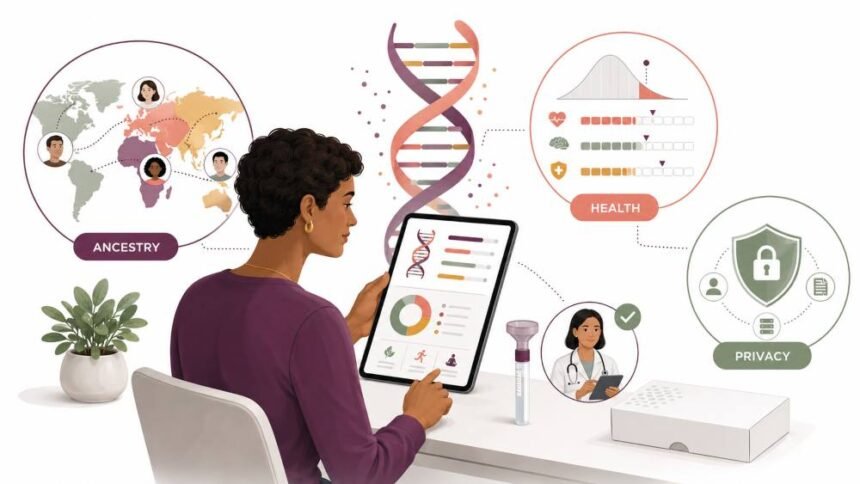
An at-home DNA report can feel surprisingly personal, yet its findings are rarely as final as they appear on screen. An ancestry percentage may change, a health marker may represent only one small part of your risk, and a relative match may raise unexpected family questions. Knowing what the test examined, what it may have missed, and when to seek professional guidance can help you use the results without giving them more certainty than they deserve.
Why At-Home DNA Tests Are Popular
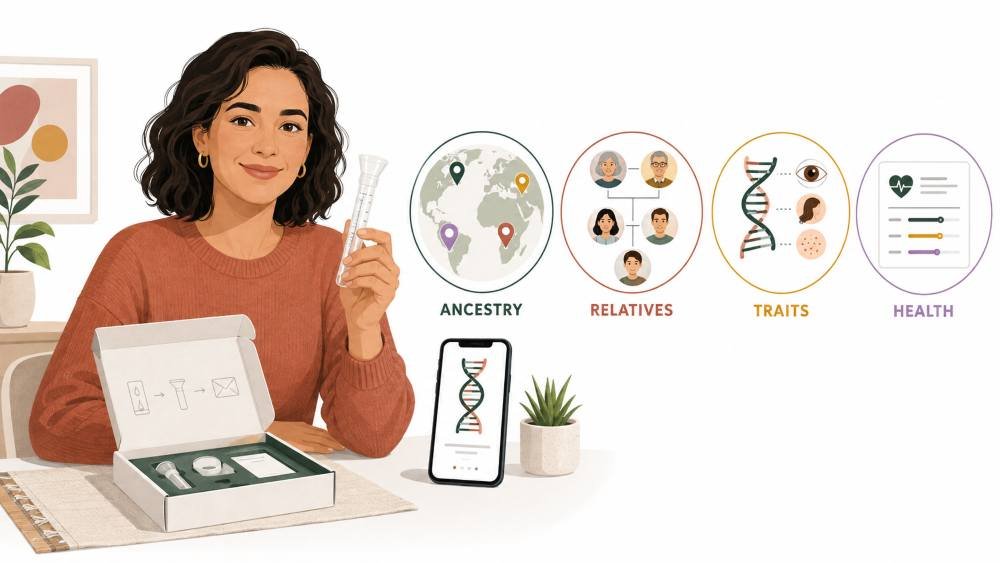
At-home DNA testing makes genetic information more accessible. A saliva sample, a prepaid package, and an online account can provide ancestry estimates, relative matches, and selected reports about traits or health markers. Services offered by the 23andMe company and other consumer testing providers have made DNA testing a familiar starting point for people exploring family history.
Convenience can be valuable, especially for someone who wants to organize genealogy research or begin a conversation with a clinician. Still, a consumer test is not automatically equivalent to comprehensive medical genetic testing. The value of any result depends on what was tested, how it was interpreted, and how it fits with the rest of a person’s history.
What These Tests Usually Check
Most consumer DNA reports fall into several broad categories:
- Ancestry testing: Estimates genetic connections to geographic regions or population groups.
- Relative matching: Identifies users who may share DNA segments and a possible family relationship.
- Trait testing: Reports selected markers associated with features such as taste sensitivity or hair characteristics.
- Carrier screening: Looks for certain variants that could be passed to biological children.
- Health risk screening: Reviews selected variants associated with a higher or lower likelihood of particular conditions.
Many kits use genotyping, which examines specific regions of DNA rather than reading every gene. Targeted clinical testing may focus on a known gene or variant, while sequencing can examine a much broader portion of genetic material. Those differences affect what a test can find and what it can miss.
How DNA Results Are Calculated
After a laboratory receives a usable sample, it analyzes selected DNA markers and compares them with research data, reference populations, or other opted-in customers. An algorithm then creates the report. This process usually produces probabilities and estimates, not absolute proof.
- You provide a saliva or cheek-swab sample.
- The laboratory examines selected genetic locations.
- The findings are compared with a database or known markers.
- Software estimates ancestry, relationship ranges, or trait associations.
- The report is delivered through your account.
For example, a result may indicate that you are more likely to have a certain trait, but genes are only one influence. Environmental, developmental, age, and other genetic factors can affect whether a trait appears and how strongly it appears.
Why Ancestry Results Can Change
Your DNA does not change when an ancestry estimate changes. The company may have updated its reference panel, added more participants, or refined the statistical model used to compare DNA patterns. Small regional percentages are often more likely to shift than broad patterns.
- Some populations are more represented in databases than others.
- Neighboring groups may have long, overlapping genetic histories.
- Ethnicity labels are modern descriptions, not precise records of every ancestor.
- A DNA estimate may not exactly match family stories, surnames, or official documents.
Use ancestry reports alongside birth certificates, census records, immigration documents, photographs, oral history, and other genealogy evidence. DNA can point research in a useful direction, but it cannot independently document every branch of a family tree.
How to Read Health-Related Results
Read health reports slowly and begin with the test description. Identify the gene or marker tested, determine whether the report concerns risk, carrier status, or a current condition, and review the stated limitations before concluding. FDA’s guidance on direct-to-consumer tests emphasizes that a positive genetic health-risk result does not mean a person will develop a disease.
Health outcomes can reflect family history, other genetic variants, lifestyle, environment, and access to preventive care. A report may be meaningful, but it represents one piece of a much larger health picture.
What Positive and Negative Results Mean
A Positive Result
- It may indicate a tested marker associated with increased risk or carrier status.
- It does not prove that you currently have, or will develop, a condition.
- It may require confirmation through clinician-ordered testing.
- It should not be used alone to start, stop, or change treatment.
A Negative Result
- It generally means that the specific marker tested was not detected.
- It may not address other variants linked to the same condition.
- It does not eliminate the risk associated with symptoms or family history.
- It does not replace regular checkups or recommended screening.
An unclear result is also possible. It may mean that science does not yet know whether a particular variant is important. As direct-to-consumer testing limitations indicate, significant findings generally need confirmation before they are used to inform medical decisions.
Preparing for Unexpected Family Discoveries
Relative matching can reveal unknown siblings, adoption connections, donor conception, or unexpected parentage. Before activating matching, decide how much information you feel ready to receive and consider how a discovery could affect relatives who did not take the test.
- Review relative-matching and contact settings before opting in.
- Pause before messaging a potential relative while emotions are high.
- Confirm possible relationships using additional DNA evidence and records.
- Seek counseling or trusted support if the information causes distress.
Questions to Ask About Privacy
Genetic data is personal, durable, and connected to relatives. Read the company’s privacy policy and terms before mailing a sample. Ask who controls the sample, how long data is stored, whether research participation is optional, and whether deletion includes both the account and stored biological material.
You should also understand whether data can be shared with research partners, transferred if the business changes ownership, or disclosed in response to legal requests. Save a copy of the policy that applies when you make your decision.
When to Seek Professional Help
Contact a physician, genetic counselor, or qualified genetics professional when a report suggests inherited disease risk, conflicts with symptoms or family history, raises pregnancy-planning questions, or creates concerns about medication. Professional guidance is especially important when close relatives have had cancer, heart disease, neurological conditions, or other potentially inherited illnesses.
Do not stop medication, begin treatment, skip screening, or make major diet and health decisions based only on a consumer’s DNA report.
A Careful Way to Use DNA Information
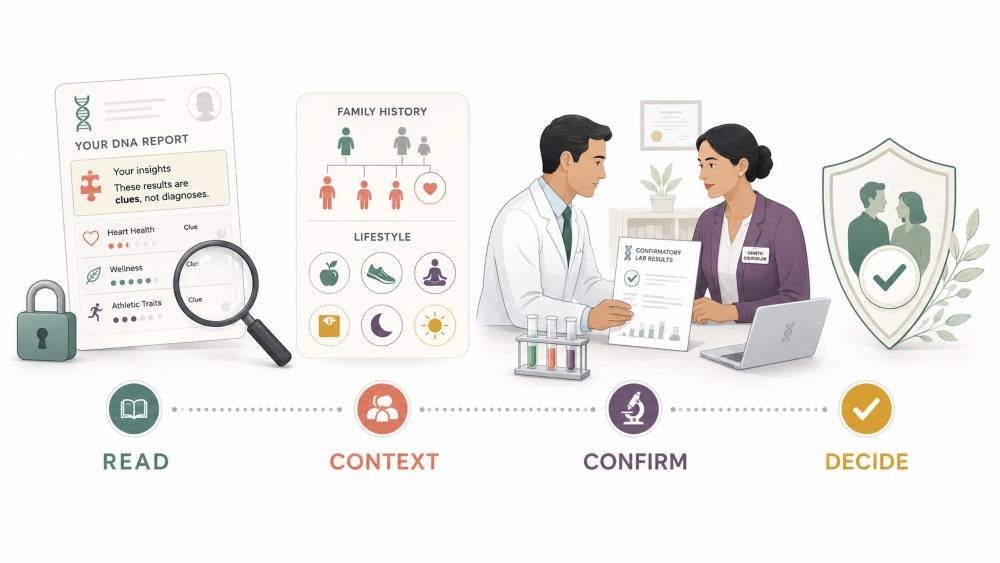
At-home DNA tests can be useful tools for curiosity, family research, and informed health conversations. The most responsible approach is to treat each result as a clue, not a final answer. Read the limits, protect your privacy, compare ancestry findings with records, and discuss meaningful health-related results with a qualified professional. Good decisions require context, not just DNA data.
Disclaimer
The information in this article is provided for general educational purposes only and does not constitute medical, genetic, or legal advice. It is not a substitute for a consultation with a physician, genetic counselor, or other qualified healthcare professional. Consumer DNA test results can be incomplete or open to interpretation, and they should not be used on their own to diagnose a condition, to begin or stop treatment, or to make family planning decisions. Always confirm significant findings through clinician-ordered testing and seek professional guidance before acting on any result. External links are included for reference only and do not imply endorsement of any company, product, or service. Neither the author nor the publisher accepts liability for decisions made on the basis of this content.