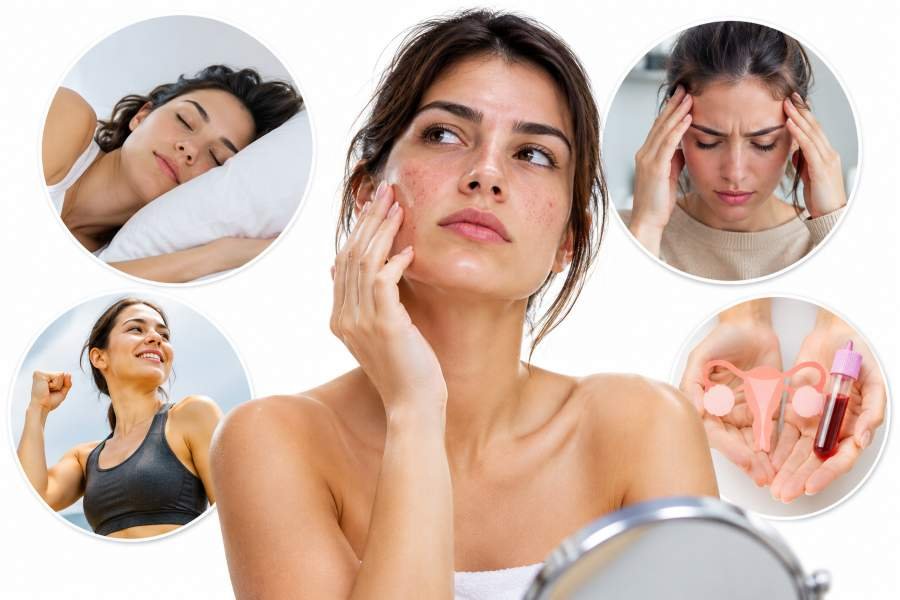

You’ve switched moisturizers three times this year. Your skin feels tight by lunchtime, there’s a cluster of spots along your jaw that you haven’t seen since your teens, and there seems to be more hair in the shower drain than there used to be. At the same time, you’re waking at 3 a.m., snapping at people you love, and fading by mid-afternoon.
It’s natural to treat each of these as its own problem: a new serum for the dryness, a stronger coffee for the slump, a firm word with yourself about the mood. But for many women in their late 30s, 40s and early 50s, perimenopause skin changes are the most visible part of a shift that is also affecting sleep, mood and energy. Seeing the connection can change what actually helps.
Your skin is often where the rest of your body shows up first.
Summary
- Skin changes are common in perimenopause: dryness, itch, sensitivity, breakouts and thinning hair often start before periods stop.
- Estrogen supports collagen, moisture and your skin barrier, so its ups and downs show up in the mirror.
- Broken sleep and stress slow skin repair: studies link poor sleep and higher stress hormones with a weaker skin barrier.
- Your thyroid can look like perimenopause: dry skin, thinning hair and fatigue are classic signs of an underactive thyroid too.
- Patterns matter more than any single symptom: tracking skin, sleep, mood and energy together gives you and your clinician a clearer picture.
Perimenopause Skin Changes You May Be Noticing
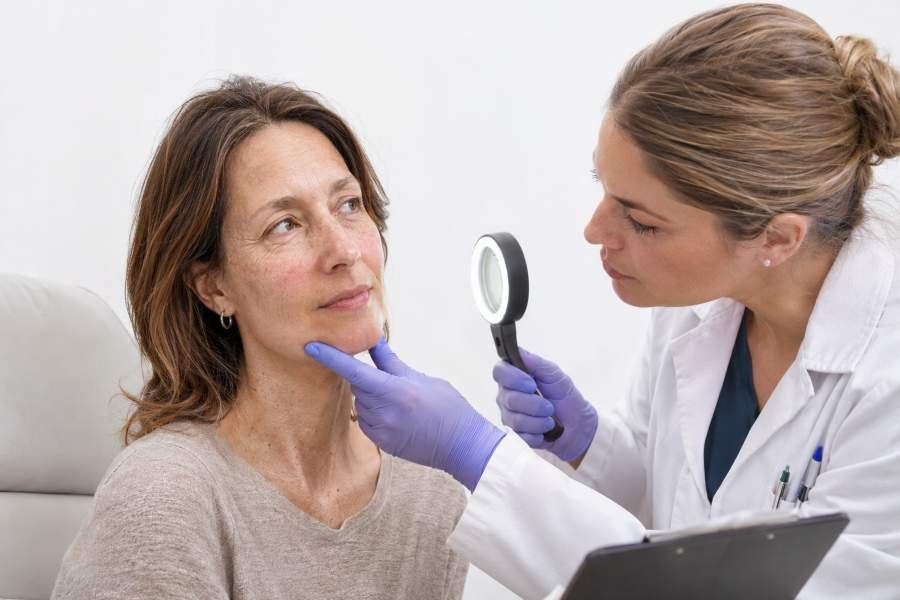
If your skincare routine has suddenly stopped working, you’re not imagining it, and you’re far from alone. In one survey of women attending a menopause clinic, every single participant reported at least one skin symptom: 78% had itchy skin and 76% had dry skin. Almost half (48%) had been managing it on their own without mentioning it to a doctor. It was a small study, but it captures something many women recognize: skin changes feel too “cosmetic” to bring up.
The most common changes include:
- Dryness and tightness, sometimes with flaking, even if you’ve always had normal or oily skin
- Itching, often on the arms, legs, chest or back, with no obvious rash
- Sensitivity and redness: products you’ve used for years suddenly sting
- Breakouts along the jaw and chin, as the balance between estrogen and androgens shifts
- Dullness and uneven tone, including new pigmentation
- Fine lines that appear faster and skin that feels less firm
- Slower healing of blemishes, scratches and irritation
- Thinning hair on the scalp, and sometimes new hairs on the chin or upper lip
These can come and go. Perimenopause is a time of fluctuation, so you may have a few good weeks followed by a run where nothing seems to calm your skin.
Why Your Skin Is Often the First Place It Shows
You may have been told this is “just aging.” Age plays a part, but hormones explain why the change can feel so sudden.
Estrogen has a direct effect on skin. It helps maintain collagen (the protein that keeps skin firm), supports the skin’s ability to hold water, and helps keep the outer barrier intact. When estrogen levels drop, skin changes measurably. According to a review in Dermato-Endocrinology, skin collagen may fall by as much as 30% in the first five years after menopause, with skin thickness dropping by around 1.13% and collagen by about 2% for every postmenopausal year.
That 30% figure appears on almost every article about menopause skin changes, usually without a source. Two things are worth adding to it:
- The change begins earlier than menopause itself. During perimenopause, estrogen doesn’t decline in a straight line. It rises and falls unpredictably, which is why skin can swing between dry and congested from one month to the next.
- Estrogen is only one part of the repair system. Your skin does most of its repair work overnight and depends on good sleep and steady stress hormones to do it. That’s where the rest of the picture comes in.
Overnight Repair Problem: Sleep and Your Skin
If you’re lying awake at 3 a.m., kicking off the covers, then dragging yourself through the next day, you’re in very large company. In the Study of Women’s Health Across the Nation (SWAN), which surveyed more than 12,600 women aged 40 to 55, difficulty sleeping peaked at 45.4% in late perimenopause, and menopausal stage remained a factor on its own after accounting for age and other influences.
That broken sleep shows up on your skin. In a study from University Hospitals Cleveland, researchers compared women who regularly slept five hours or less with women who slept seven to nine hours. After a mild skin barrier challenge, the good sleepers had 30% greater barrier recovery after 72 hours. Poor sleepers also lost more water through their skin to begin with, showed more signs of skin aging, and recovered more slowly from sun-induced redness.
Put these together and you get a chain that many women live through without anyone naming it:
- Fluctuating estrogen contributes to night sweats and lighter, more broken sleep
- Less deep sleep means less time for overnight skin repair
- A weaker barrier lets moisture escape and irritants in
- Skin feels drier, more reactive and slower to heal, and the products that used to work no longer seem to
This is why a richer moisturizer alone often doesn’t solve it. The skin is being asked to repair itself with less of the conditions it needs.
Stress, Mood and the Cortisol Connection
Many women describe feeling more irritable, anxious or low in perimenopause, sometimes before any other sign. You might feel like your patience has a shorter fuse, or that small stresses land harder than they used to. That’s a recognized part of the transition, and it has a skin side too.
Stress raises cortisol, and cortisol affects how skin repairs itself. In a study published in the Journal of Investigative Dermatology, women who went through a stressful interview showed slower skin barrier recovery along with higher cortisol and inflammatory markers. In the same research, a single night without sleep also slowed barrier recovery. A separate study found that during exam periods, the students whose stress rose most had the biggest drop in barrier function.
In other words, the mood changes and the skin changes of perimenopause can feed each other. Poor sleep raises stress, stress weakens the barrier, flare-ups add to the stress, and round it goes. It isn’t a lack of discipline or the wrong cleanser. It’s physiology, and it deserves to be taken seriously.
When Tiredness, Dry Skin and Thinning Hair Point to Your Thyroid
If you’re exhausted no matter how much you sleep, your skin is dry and pale, and your hair is thinning, it’s easy to assume it’s all perimenopause. Sometimes it is. But these are also classic signs of an underactive thyroid.
According to the US Office on Women’s Health, one in eight women will develop thyroid problems during her lifetime. Symptoms of an underactive thyroid include dry skin, dry and thinning hair, tiredness and low mood, and the same source notes that thyroid symptoms are often mistaken for menopause symptoms. Hypothyroidism also becomes more likely after menopause.
That’s why it’s worth looking at the whole picture before deciding on a single explanation. A simple blood test can check thyroid function, and if your results come back “normal” but you still don’t feel like yourself, that’s a reason to keep the conversation going. A normal range is a starting point. How you feel counts too.
Connecting the Dots: A Symptom Map
Skin often gets sent to the dermatologist, sleep to your primary care doctor, mood to a therapist and energy to a better diet. Each step can help, but no one is looking at how they connect. This map is a starting point for seeing the pattern:
| What you notice in the mirror | What else may be going on | Worth asking about |
|---|---|---|
| Dry, tight or itchy skin | Night sweats, waking at 3 a.m. | Where you are in perimenopause; how your sleep is being disrupted |
| Products suddenly stinging; redness | Higher stress, shorter fuse, anxiety | How stress and sleep are affecting your skin barrier |
| Breakouts along the jaw and chin | Irregular or changing periods | Hormonal shifts in perimenopause |
| Dry, pale skin and thinning hair | Constant tiredness, feeling cold, low mood | Thyroid function |
| Thinning hair on the scalp | Heavy periods, fatigue | Thyroid and iron levels |
| Dullness and slower healing | Poor sleep, low energy, feeling run down | The overall pattern: sleep, stress and hormones together |
If two or three rows sound familiar, that’s useful information to bring to an appointment.
What Can Help Right Now
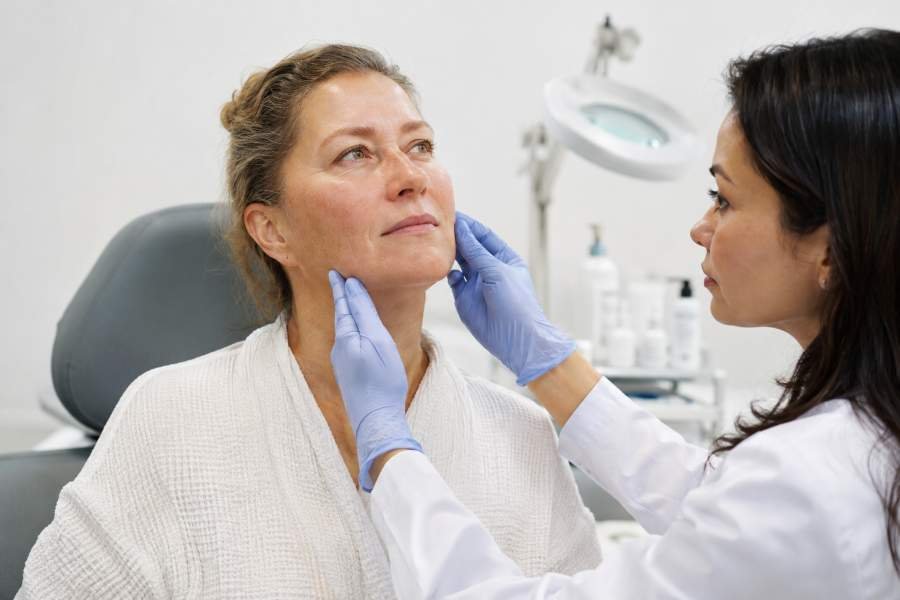
You don’t need to overhaul your life. A few changes support your skin’s repair system from the outside and the inside.
For your skin
- Switch to a gentle, non-foaming cleanser and lukewarm water
- Use a moisturizer with barrier-supporting ingredients such as ceramides, glycerin or hyaluronic acid, applied to slightly damp skin
- Keep daily broad-spectrum sunscreen, since collagen loss and pigmentation both speed up with sun exposure
- Introduce active ingredients like retinoids or exfoliating acids slowly, especially if your skin has become more sensitive
For your sleep
- Keep your bedroom cool and use layers you can remove easily if night sweats wake you
- Aim for a consistent wake-up time, even after a bad night
- Limit alcohol in the evening, which can trigger night sweats and fragment sleep
DoctiPlus has more on how sleep and stress affect each other, and on why menopause weight changes are metabolic, which often arrive alongside skin changes.
For the bigger picture
- For two to three months, jot down a quick daily note: skin (good, okay, flaring), sleep, mood, energy and, if you still have periods, cycle day
- Look for patterns: do flare-ups follow bad nights or certain points in your cycle?
That record will tell you, and any clinician you see, far more than a single bad day ever could.
When It’s Worth Talking to a Clinician
Many women hold off because skin changes feel too minor to mention. They aren’t minor if they’re affecting how you feel about yourself, and they’re especially worth raising if they come with changes in sleep, mood or energy.
Consider booking an appointment if:
- Your skin changes arrived alongside changes to your periods, sleep or mood
- You’re tired most of the time, even with enough sleep
- Your hair is thinning noticeably or quickly
- Itching is persistent or keeping you awake
A good appointment looks at the whole picture: your symptoms, your cycle, your sleep, and relevant blood tests such as thyroid function.
Hormone therapy may come up in that conversation. Studies have found estrogen can increase skin thickness and collagen content, but skin is rarely the main reason to consider it. The things worth weighing are:
- The other symptoms you’re living with, such as night sweats, broken sleep or mood changes
- Your personal and family health history, including blood clots, breast cancer and heart disease
- The type and dose that would suit you, since there are several options
- How it would be followed up, and how you’d know whether it’s helping
It’s a decision to make with a clinician who knows your full history.
Most of all, you deserve someone who takes the full picture seriously, so you can start feeling like yourself again.
Patient Questions
Can perimenopause skin changes start before your periods stop?
Yes. Perimenopause can begin several years before your final period, and because estrogen fluctuates during this time, dryness, sensitivity and breakouts often appear while your cycles are still fairly regular.
Does lack of sleep really show on your skin?
Research suggests it does. In one study, women who slept seven to nine hours had 30% greater skin barrier recovery than women who slept five hours or less, and poor sleepers showed more signs of skin aging.
Can thyroid problems cause dry skin and hair loss?
They can. Dry skin, dry and thinning hair, and fatigue are common signs of an underactive thyroid, and they’re often mistaken for menopause. A blood test can check.
Is perimenopause hair loss permanent?
It depends on the cause. Hair thinning in perimenopause can be linked to hormonal changes, thyroid function, iron levels or stress, and each has a different outlook. A clinician can help you work out which factors apply to you.
About the authors
Dr. Rand McClain, DO, and Kristin Sewnig, MSN, FNP-BC, are clinicians at Regenerative & Hormone Medicine, a physician-led US practice that looks at hormones, thyroid, sleep and metabolism together. Dr. McClain has more than 20 years of experience in regenerative and hormone medicine. Kristin is a board-certified family nurse practitioner with over 25 years in hormone therapy and menopause care. They focus on finding the root cause of symptoms and building care around the whole person.