


Orthopedic surgeons face a 14.8% annual malpractice claim rate. Because procedure-related incidents drive 76% of all allegations, the choice of malpractice insurance is a major clinical and financial decision.
The selected insurer must be able to defend claims involving varying procedure complexity, inherent surgical risk, subspecialty-specific exposure, and layered policy structures. A well-structured policy helps protect against high-severity claims and safeguard a surgeon’s professional livelihood. This article compares five malpractice insurance carriers and platforms worth reviewing in 2026 and helps orthopedic surgeons choose the option that best fits their practice.
What Orthopedic Surgeons Should Compare Before Choosing a Malpractice Insurance Provider

Before comparing specific brands, it is important to evaluate how policies are structured.
To compare options, review six variables beyond the introductory premium:
- Financial Strength and Stability: Carriers should have the financial strength to operate over the long term. Many practices look for at least an A rating from A.M. Best, along with high net income and policyholder surplus.
- Experience with Surgical Specialties: Insurers should understand specialty-specific procedural risks. Effective defense requires experience handling claims tied to high-severity orthopedic procedures.
- Claims Support and Defense Reputation: Many surgeons prioritize defense outside the limits so legal fees do not erode the policy limits available for indemnity payments. It is also important to evaluate the carrier’s consent-to-settle language and defense reputation.
- Claims-Made vs. Occurrence Options: Occurrence coverage is triggered by when the medical incident took place, while claims-made coverage is triggered when a claim is filed while the policy is active.
- Tail Coverage Availability: Exiting a claims-made policy creates transitional risk. Make sure tail coverage is available, and note that it is often priced at roughly 1.5 to 2 times the annual premium, though the cost can vary by specialty, carrier, and state.
- Quote Transparency and Ease of Comparison: Providers that offer a clear quote comparison document showing exclusions, coverage differences, and multi-year premium projections can make the review process much easier.
With those criteria in mind, here are five malpractice insurance carriers and platforms orthopedic surgeons may want to review in 2026.
1. DocShield
DocShield operates as a specialized platform that helps orthopedic surgeons compare malpractice insurance options side by side. Rather than relying on a generalist brokerage process, surgeons can use it to review quotes more efficiently and compare coverage structures more clearly. Orthopedic practices that want a simpler way to review multiple options may start by comparing the best malpractice insurance for orthopedic surgeons through a platform designed around faster quote evaluation and clearer coverage comparisons.
For procedure-heavy specialties, visibility into underlying coverage structure and long-term pricing is paramount. The platform is designed to make shopping more transparent by helping practices compare what is covered, what is excluded, and how pricing may change over time, rather than focusing only on first-year premiums.
Geographic location is one of the biggest drivers of premium volatility, and malpractice costs can vary dramatically from one state to another over the course of a career. Access to multiple carrier quotes can help practices avoid overpaying because of a limited view of the market. It also helps practices evaluate how claims-made step-up pricing could affect costs over time. DocShield may be appealing for surgical teams wanting visibility into the broader market outside of standard broker relationships. This system even lets practicing physicians validate sub-limits, defense options, and tail availability before finalizing their critical medical liability commitments.
2. The Doctors Company
The Doctors Company is frequently mentioned in physician malpractice discussions because of its physician-focused positioning. It is the nation’s largest physician-owned medical malpractice insurer and operates on a member-based model rather than a traditional shareholder model. That structure supports its physician-centered positioning and broad market presence.
The carrier is worth considering for orthopedic surgeons who value defense resources, member support, and established scale. It is backed by roughly $3.1 billion in member surplus, which supports its ability to absorb large claims and provide financial stability to insured physicians.
3. MedPro Group
MedPro Group often makes the shortlist because of its longstanding presence in malpractice insurance. Founded in 1899, it is widely recognized as the first company in the United States dedicated to medical professional liability insurance. Orthopedic surgeons often consider MedPro because of its financial strength and stability, underscored by its A++ (Superior) rating from A.M. Best. Backed by Berkshire Hathaway, it remains a major national player and may appeal to surgeons looking for an established carrier with significant resources.
MedPro may be especially relevant to practices that value strong defense and broad policy depth. The company also publicly highlights a 90% trial win rate and says 80% of claims are closed without payment.
4. Coverys
Coverys is often associated with proactive physician risk management in addition to claims protection. It may appeal to practices that value educational resources, risk-management support, and broader quality-improvement tools alongside insurance coverage.
With broad malpractice experience, it may be a useful option for practices that want support beyond the policy itself, including risk-management resources and quality-improvement tools.
5. CNA
CNA remains a national insurer that’s often relevant as a second or third review for physicians considering big names. Its broader commercial insurance background may make it relevant for some healthcare liability needs, depending on the structure of the practice. Some practices may also evaluate CNAs when they want to review professional liability coverage alongside other business insurance needs.
CNA may be worth reviewing based on state, underwriting appetite, and practice profile. As with any carrier, surgeons should review sublimits, policy wording, and consent-to-settle language carefully because those terms can vary by product and jurisdiction.
Which Malpractice Insurance Provider Is Best for Your Orthopedic Practice?
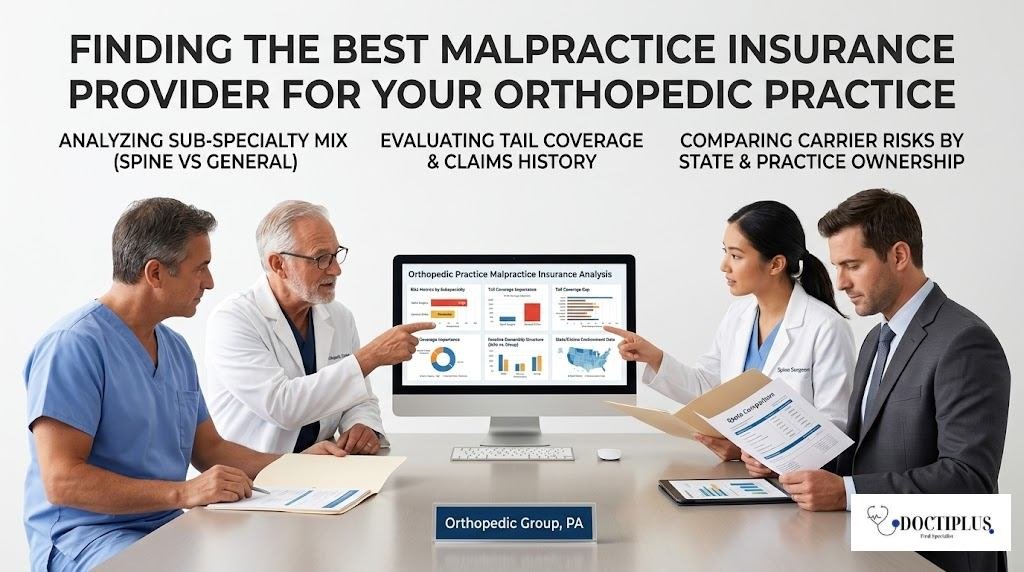
There’s no one “best” for medical malpractice coverage. Much depends on the above risk metrics and specific practice factors:
- Subspecialty Mix: A general orthopedic surgeon may be comfortable with standard limits, while higher-risk subspecialties such as spine surgery may warrant closer review of higher limits.
- Practice Ownership Structure: Solo practices, group practices, and affiliated entities may all require different coverage structures, so entity limits and individual physician limits should be reviewed carefully.
- State/Claims Environment: Cost is heavily influenced by practice geography. Higher-risk venues may require an insurer with strong local defense counsel and courtroom experience.
- Tail Coverage Importance: Surgical-related lawsuits can emerge years later, so tail coverage is critical when leaving a claims-made carrier. Exiting without tail protection can create a serious coverage gap.
- Quote Comparison Support: Practices should also consider how much help they want in reviewing quotes, exclusions, renewal increases, and final policy decisions.
Final Conclusion
Malpractice insurance for orthopedic surgeons is not just a routine expense. It is an important long-term protection against one of the highest-risk areas in healthcare. Because many claims come from surgical procedures, the quality and structure of the policy can directly affect both financial safety and professional security.
Different carriers and platforms offer useful benefits, but the right choice depends on how well the coverage matches your specific needs. Things like your subspecialty, location, type of practice, and plans all matter. A lower premium may look appealing at first, but it may not provide enough protection if the coverage limits or legal support are weak.
It is also important to clearly understand what is included in the policy. This means reviewing exclusions, tail coverage, and how costs may increase over time. Comparing multiple quotes side by side can make it easier to see the real value of each option instead of focusing only on the starting price.
In the end, choosing malpractice insurance should be a careful and informed decision. By focusing on strong financial backing, reliable legal defense, and coverage that fits your actual practice, orthopedic surgeons can protect their career, income, and peace of mind.
References
- Jena, A. B., Seabury, S., Lakdawalla, D., & Chandra, A. (2011). Malpractice risk according to physician specialty. New England Journal of Medicine, 365(7), 629 to 636.
- Studdert, D. M., Mello, M. M., Gawande, A. A., et al. (2006). Claims, errors, and compensation payments in medical malpractice litigation. New England Journal of Medicine, 354(19), 2024 to 2033.
- Seabury, S. A., Chandra, A., Lakdawalla, D. N., & Jena, A. B. (2013). On average, physicians spend nearly 11 percent of their careers with an open malpractice claim: Health Affairs, 32(1), 111 to 119.
- Mello, M. M., Chandra, A., Gawande, A. A., & Studdert, D. M. (2010). National costs of the medical liability system: Health Affairs, 29(9), 1569 to 1577.
- Carroll, A. E., & Budnitz, D. S. (2017). Malpractice claims involving surgical specialties. JAMA, 318(6), 527 to 528.
- Kachalia, A., Gandhi, T. K., Puopolo, A. L., et al. (2007). Missed and delayed diagnoses in the ambulatory setting—Annals of Internal Medicine, 145(7), 488 to 496.