

Every year, falling trees and tree limbs cause thousands of injuries and significant property damage across the United States. According to OSHA, more than 100 people die annually from tree-related incidents, making this a serious and underappreciated public safety concern. Yet many victims are unaware that they may have a legal right to pursue compensation from the responsible party.
Whether a branch crashes onto your car, a neighbor’s diseased oak collapses onto your fence, or a city tree falls on a pedestrian, the law does not always treat these events as simple acts of nature. Liability can often be traced to a specific person, entity, or agency whose failure to act caused or contributed to the incident.
Falling tree injuries are often preventable. When Negligence is involved, victims have the legal right to seek financial compensation for medical expenses, lost wages, property damage, and pain and suffering.
Who Is Liable for a Falling Tree Injury?
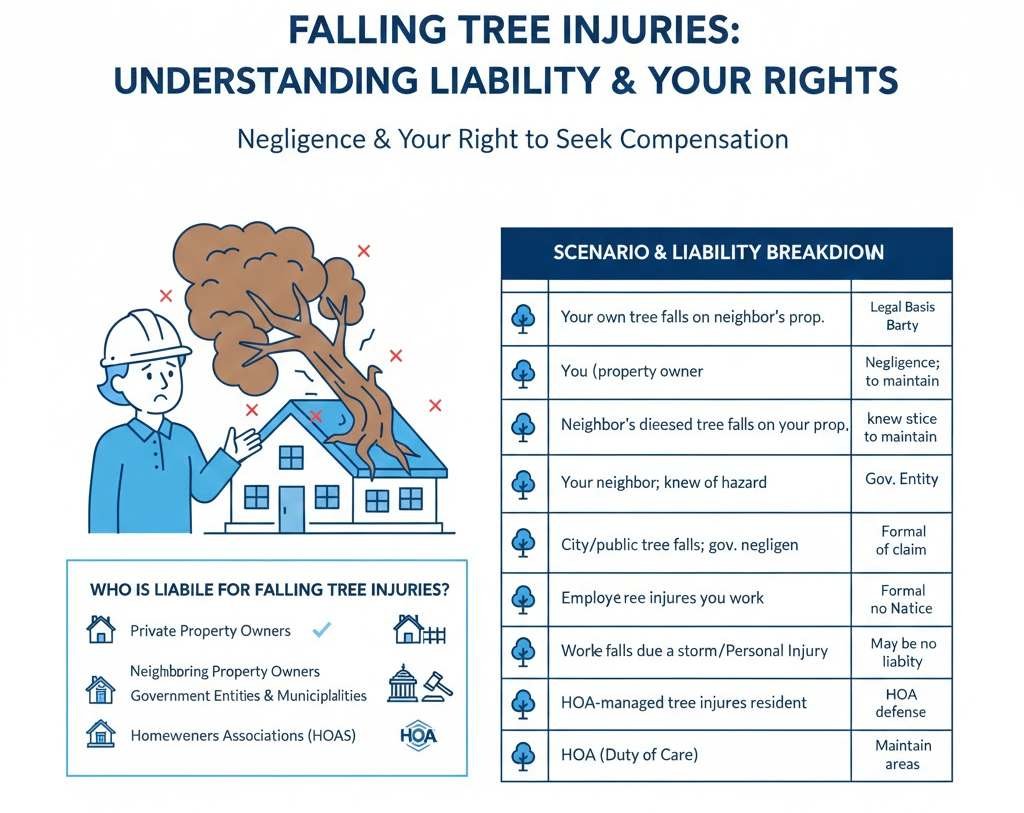
Liability in falling tree cases depends on several interconnected factors, including who owns the tree, whether there were visible signs of decay or danger, and whether the responsible party received prior warning. Below is a breakdown of the most common scenarios and which party may be held responsible.
Private Property Owners
If a tree on your own property falls and injures a guest, neighbor, or passerby, you may be held liable under premises liability law. Property owners have a legal duty to maintain their land in a reasonably safe condition. This includes identifying and removing or treating trees that show signs of disease, structural weakness, or storm damage. Ignoring a visibly decaying tree that later falls and causes harm is a classic example of Negligence.
Neighboring Property Owners
If your neighbor’s tree falls onto your property or injures you, your neighbor may be responsible if they knew or should have known the tree was dangerous. This is commonly established by showing that you or others previously notified the neighbor about the tree’s condition. Written notice, such as a certified letter or email, is especially valuable evidence in these cases.
Government Entities and Municipalities
Trees lining public sidewalks, parks, and roadways are typically the responsibility of the city, county, or municipality. When a government-owned tree causes injury, the legal process becomes more complex. Claims against government entities often require filing a formal notice of claim within a strict and much shorter deadline than standard personal injury claims, sometimes as few as 30 to 90 days after the incident. Consulting an attorney immediately is critical in these cases.
Homeowners Associations (HOAs)
In planned communities, condominiums, and subdivisions, the HOA may be responsible for maintaining trees in common areas. If an HOA-managed tree falls and injures a resident or visitor, the association’s duty to inspect and maintain common-area landscaping becomes a central question in any legal claim.Falling tree injuries are often preventable. When Negligence is involved, victims have the legal right to seek financial compensation for medical expenses, lost wages, property damage, and pain and suffering.
Who Is Liable for a Falling Tree Injury?
Liability in falling tree cases depends on several interconnected factors, including who owns the tree, whether there were visible signs of decay or danger, and whether the responsible party received prior warning. Below is a breakdown of the most common scenarios and which party may be held responsible.
Private Property Owners
If a tree on your own property falls and injures a guest, neighbor, or passerby, you may be held liable under premises liability law. Property owners have a legal duty to maintain their land in a reasonably safe condition. This includes identifying and removing or treating trees that show signs of disease, structural weakness, or storm damage. Ignoring a visibly decaying tree that later falls and causes harm is a classic example of Negligence.
Neighboring Property Owners
If your neighbor’s tree falls onto your property or injures you, your neighbor may be responsible if they knew or should have known the tree was dangerous. This is commonly established by showing that you or others previously notified the neighbor about the tree’s condition. Written notice, such as a certified letter or email, is especially valuable evidence in these cases.
Government Entities and Municipalities
Trees lining public sidewalks, parks, and roadways are typically the responsibility of the city, county, or municipality. When a government-owned tree causes injury, the legal process becomes more complex. Claims against government entities often require filing a formal notice of claim within a strict and much shorter deadline than standard personal injury claims, sometimes as few as 30 to 90 days after the incident. Consulting an attorney immediately is critical in these cases.
Homeowners Associations (HOAs)
In planned communities, condominiums, and subdivisions, the HOA may be responsible for maintaining trees in common areas. If an HOA-managed tree falls and injures a resident or visitor, the association’s duty to inspect and maintain common-area landscaping becomes a central question in any legal claim.
| Scenario | Liable Party | Legal Basis |
| Your own tree falls on a neighbor’s property | You (property owner) | Negligence; failure to maintain tree in safe condition |
| Neighbor’s diseased tree falls on your property | Your neighbor | Negligence; knew or should have known of hazard |
| City or public tree falls on your property | Municipality | Government negligence; must file formal notice of claim |
| Falling tree injures you at work | Employer or third party | Workers compensation and/or personal injury claim |
| Tree falls due to storm on a maintained property | May be no liability | Act of nature defense; depends on prior notice of hazard |
| HOA-managed tree falls and injures a resident | Homeowners Association | Duty of care to maintain common-area trees |
Expert Legal Perspective: Orange County Falling Tree Injury Attorney
Falling tree injury cases can be deceptively complex. What appears to be a straightforward accident often involves disputes about tree ownership, prior notice of hazard, and the extent of each party’s legal duty. An experienced Orange County falling tree injury attorney can help victims cut through this complexity and identify the clearest path to compensation.
According to an Orange County falling tree injury attorney, victims injured by a falling tree limb or landscaping structure may be entitled to compensation for their injuries. However, proper legal representation is essential. Without it, insurance companies and opposing counsel are well-positioned to minimize or deny your claim entirely.
In Orange County and throughout California, property owners have a non-delegable duty to maintain their trees and landscaping in a safe condition. This means that even if a property owner hires a landscaping company, they cannot fully transfer their legal responsibility if a poorly maintained tree later causes injury. Both the property owner and the tree care company may share liability.
Why Early Legal Action Matters in Falling Tree Cases
Evidence in tree injury cases deteriorates quickly. After a storm or incident, city crews or property owners may clear trees before anyone has a chance to document the extent of decay, root damage, or structural failure. An attorney can dispatch arborist experts and accident reconstruction professionals quickly to preserve critical evidence before it disappears.
Common Causes of Falling Tree Injuries
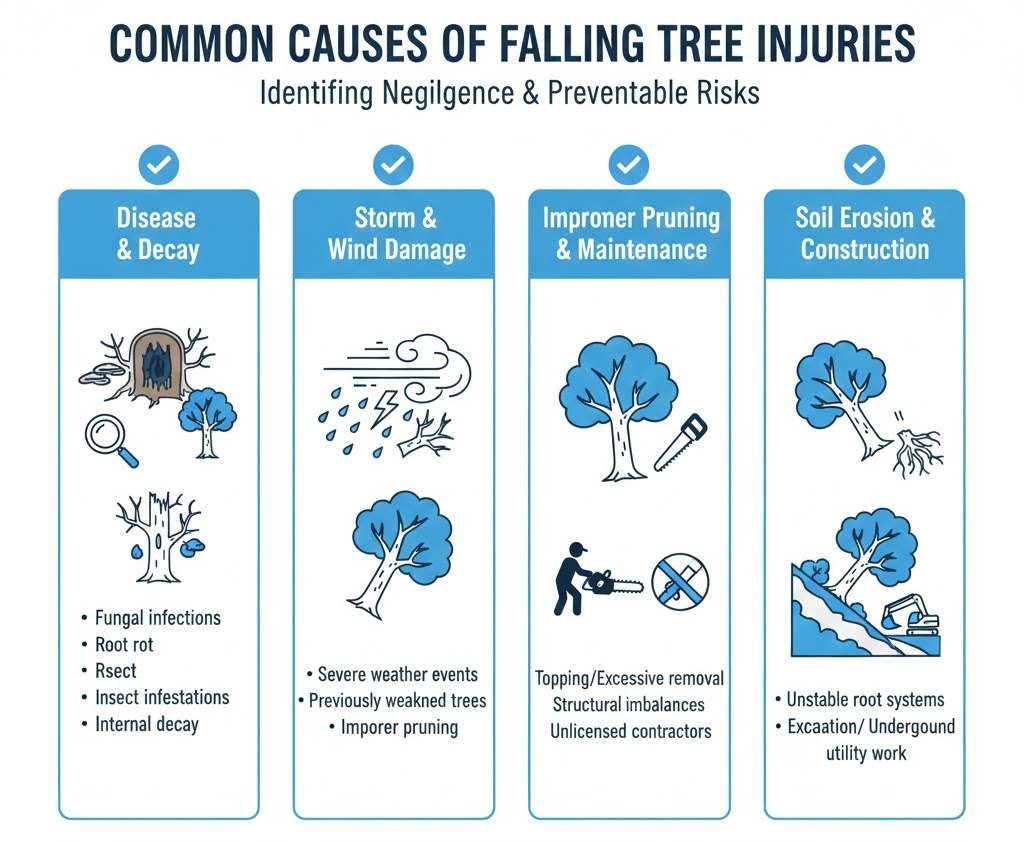
Understanding what causes trees to fall unexpectedly is important for both prevention and establishing Negligence. In most successful legal claims, the plaintiff must show that the tree’s hazardous condition was not simply the result of an unforeseeable natural event, but rather a known or discoverable risk that went unaddressed.
Disease and Decay
Trees affected by fungal infections, root rot, insect infestations, or internal decay gradually lose structural integrity. A trained arborist can often identify these warning signs months or even years before a tree actually falls. When a property owner ignores visible signs of disease or fails to schedule regular inspections, they may be found negligent when the tree eventually causes harm.
Storm and Wind Damage
While severe weather is often cited as an act of nature, storm-related tree failures are not always unpredictable. A tree that has been previously weakened by disease, improper pruning, or root damage is far more likely to fail during a storm than a healthy, properly maintained tree. Courts often examine whether the tree was already in a compromised state before the weather event.
Improper Pruning and Poor Maintenance
Improper pruning techniques, such as topping or excessive crown removal, can stress a tree and make it more susceptible to failure. Trees pruned by unlicensed or inexperienced contractors may develop structural imbalances, increasing the risk of branch or trunk failure. Poor maintenance practices can create liability for both property owners and the tree service companies they hire.
Soil Erosion and Construction Activity
Soil erosion on slopes can destabilize tree root systems over time, significantly increasing the risk of falls. Similarly, nearby construction activity, such as excavation, grading, or underground utility work, can sever or compact root systems in ways that are not immediately visible, but that weaken the tree fatally over months or years. These construction-related tree failures may expose contractors or developers to liability in addition to the property owner.
How to Determine Whether You Have a Valid Legal Claim
Not every falling tree incident results in a successful lawsuit. The strength of your claim depends on several key legal elements that must each be established with evidence.
Establish the Tree’s Ownership and Location
The first step is identifying who owns the tree. Was it rooted in private, commercial, or public land? Where the trunk originates determines the primary responsible party. When a tree sits on or near a property line, ownership disputes can arise, but courts generally look to where the tree was predominantly rooted.
Prove the Property Owner Knew or Should Have Known of the Hazard
This is often the most contested element. You must show that the responsible party either had actual notice, meaning they were directly informed of the tree’s dangerous condition, or constructive notice, meaning the hazard was obvious enough that a reasonable property owner exercising ordinary care would have discovered and addressed it.
Document Your Legal Presence at the Injury Location
Your legal status at the location of the injury matters. Whether you were on a public sidewalk, a private property as a guest, or on someone else’s land without permission affects the duty of care the property owner owed you. Invitees receive the highest duty of care, while trespassers receive the lowest, though even trespassers may have some legal protections in certain circumstances.
Workplace Falling Tree Injuries and Workers Compensation
If you were injured by a falling tree while on the job, such as during landscaping, construction, or utility work, you may have rights under both the workers’ compensation system and the personal injury legal system.
According to workers’ compensation lawyer Gregory John Plumides, it is always advisable to seek the assistance of an experienced workers’ compensation attorney as soon as possible after a workplace tree injury. Prompt action protects your benefits, preserves your right to pursue third-party claims, and ensures you receive the full scope of medical and wage replacement coverage available to you.
Workers’ compensation benefits typically cover medical expenses and a portion of lost wages regardless of fault. However, if a third party, such as a negligent tree-trimming contractor or a property owner separate from your employer, contributed to the incident, you may also be entitled to file a personal injury lawsuit seeking additional damages beyond what workers’ compensation provides.
Critical Evidence to Build a Strong Falling Tree Injury Case
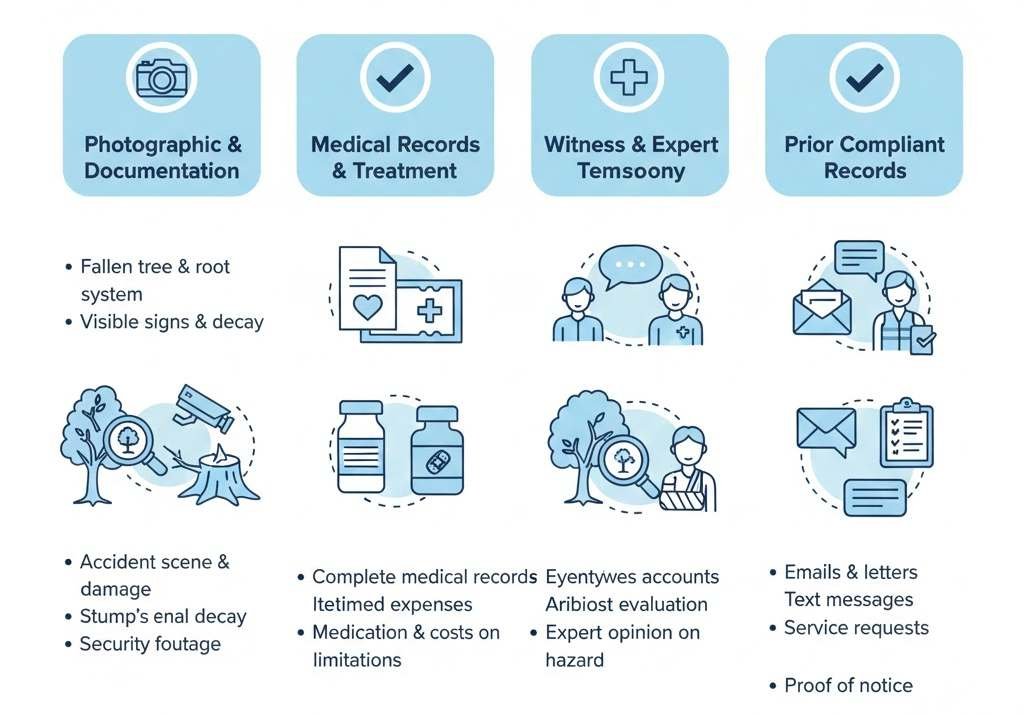
The success of your legal claim depends heavily on the quality and completeness of your evidence. Begin gathering documentation as soon as it is safe to do so, following the incident.
Photographic and Video Documentation
- Photograph the fallen tree or branch from multiple angles, capturing its full length and, if visible, its root system.
- Document any visible signs of decay, fungal growth, hollow sections, or discoloration on the tree.
- Photograph the accident scene, including nearby property damage, pavement markings, and sight lines.
- Photograph the tree stump or root ball showing internal decay that would have been visible to a trained inspector.
- Request any available surveillance or security camera footage from nearby businesses or residences immediately, as footage is often overwritten within days.
Medical Records and Treatment Documentation
- Obtain complete records from every healthcare provider who treated your injuries, including the emergency room, specialists, and physical therapy
- Request itemized billing statements showing all medical expenses
- Keep a record of all prescription medications, medical devices, and out-of-pocket health-related costs
- Ask your treating physician to document how the injuries affect your ability to work and perform daily activities
Witness and Expert Testimony
Eyewitness accounts are valuable, particularly from neighbors or passersby who observed the tree’s condition before the incident. Even more important in many cases is expert testimony from a certified arborist who can evaluate the tree’s condition, estimate how long the hazardous condition existed, and explain why a reasonable property owner should have identified and addressed it.
Prior Complaint Records
If you or anyone else previously notified the property owner, HOA, or city about the tree’s condition, those records are among the most powerful evidence you can present. Gather emails, letters, text messages, 311 service request records, and any responses or lack thereof from the responsible party. This documentation directly establishes that the owner had actual notice of the hazard and failed to act.
What Compensation Can You Recover After a Falling Tree Injury?
The damages available to falling tree injury victims can be substantial, depending on the severity of the injuries and the circumstances of the Negligence involved. Below are the primary categories of compensation you may be entitled to pursue.
Economic Damages
- Medical expenses: Emergency care, surgery, hospitalization, specialist consultations, physical therapy, and ongoing treatment
- Future medical costs: Projected expenses for long-term care, surgeries, or rehabilitation needed as a result of the injury
- Lost wages: Income lost while recovering from the injury
- Loss of future earning capacity: If the injury results in a permanent disability or limitation that affects your ability to work
- Property damage: Repair or replacement costs for vehicles, structures, fencing, or other property damaged by the falling tree
Non-Economic Damages
- Pain and suffering: Compensation for the physical pain experienced as a result of the injury
- Emotional distress: Psychological impact, including anxiety, depression, and post-traumatic stress disorder
- Loss of enjoyment of life: Compensation for the inability to participate in hobbies, activities, and daily routines you enjoyed before the injury
- Loss of consortium: Damages available to spouses or close family members for the impact the injury has had on their relationship with you
Punitive Damages
In cases where the responsible party’s conduct was particularly reckless or egregious, courts may award punitive damages in addition to compensatory damages. These are intended not to compensate the victim but to punish the wrongdoer and deter similar behavior. Punitive damages are not available in every case, but they can significantly increase total compensation when warranted.
The severity of your injuries determines the total value of a falling tree injury claim, the degree of Negligence involved, the strength of your evidence, and the skill of your legal representation. An experienced attorney can help you identify and quantify every category of damage you are entitled to pursue.
Steps to Take Immediately After a Falling Tree Injury
The actions you take in the hours and days following a falling tree injury can significantly affect the outcome of your legal claim. Follow these steps to protect both your health and your legal rights.
- Seek medical attention immediately, even if injuries seem minor. Internal injuries and soft tissue damage are not always immediately apparent.
- Contact emergency services and request that a police or incident report be filed at the scene.
- Photograph and video record everything before any cleanup, removal, or repairs begin.
- Identify and obtain contact information from any eyewitnesses.
- Notify the property owner or responsible party in writing, creating a documented record of the incident.
- Report the incident to your insurance company, but avoid providing detailed recorded statements until you have spoken with an attorney.
- Contact a personal injury or workers’ compensation attorney as quickly as possible to preserve your legal rights and ensure key evidence is protected.
Final Conclusion
A falling tree injury can be a life-altering event, one that results in serious physical harm, significant financial strain, and lasting emotional trauma. While it is tempting to view such incidents as unavoidable accidents, the reality is that Negligence often plays a decisive role in whether a tree was properly maintained, inspected, and made safe before it caused harm.
The law holds property owners, municipalities, employers, and other responsible parties to a duty of care. When that duty is breached, and someone is hurt as a result, the victim has every right to seek accountability and financial recovery through the legal system. However, the window to act is not unlimited. Evidence disappears, deadlines pass, and opportunities for compensation close quickly.
Whether you are dealing with a neighbor’s fallen tree, a city-owned hazard, or a workplace incident, consulting an experienced attorney who handles falling tree injury cases in your area is the most important step you can take. An Orange County falling tree injury attorney or a workers’ compensation lawyer, such as Gregory John Plumides, can evaluate your unique circumstances, advise you on your legal options, and advocate aggressively on your behalf to secure the compensation you deserve.
Do not let someone else’s Negligence go unanswered. You have rights, and those rights are worth protecting.
Legal Disclaimer
This article is provided for general informational and educational purposes only and does not constitute legal advice. The content presented here may not reflect the most current legal developments in your jurisdiction, and the applicable laws governing falling tree injury liability vary significantly by state, county, and municipality.
Reading this article does not create an attorney-client relationship with any attorney or law firm referenced herein. Every legal case is unique and depends on the specific facts and circumstances involved. Always consult with a licensed personal injury or workers’ compensation attorney in your jurisdiction before taking or refraining from any legal action related to a falling tree injury.