

In digital healthcare, visual trust is just as important as medical accuracy. When patients visit a healthcare website, they often decide within seconds whether the platform feels reliable. A professional logo plays a major role in shaping this first impression.
Artificial intelligence has made logo creation easier, more accurate, and better aligned with healthcare standards. AI-powered logo design enables healthcare websites to create visual identities that convey a sense of safety, calmness, and professionalism. This is especially important for medical platforms, clinics, wellness services, and health information portals that aim to build long-term trust with users.
What is an AI-generated logo in Healthcare Design?
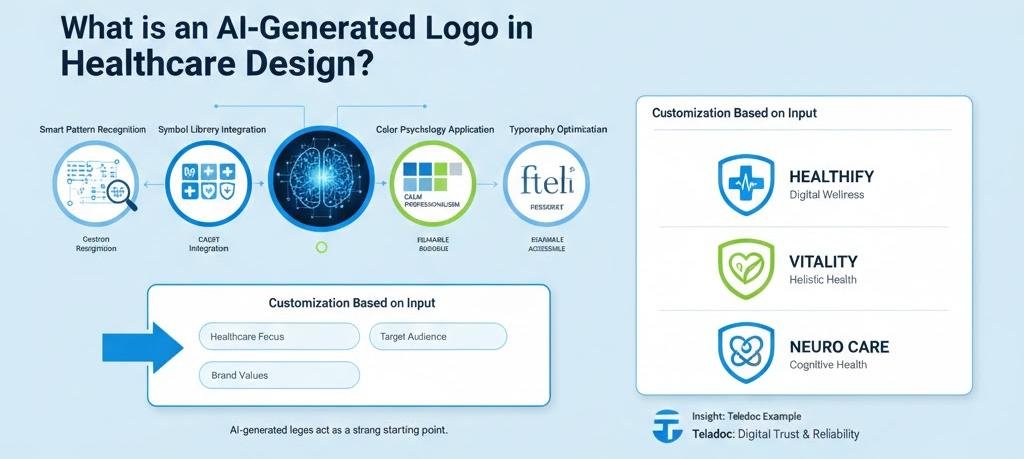
An AI logo is created using intelligent systems that analyze design patterns, healthcare symbols, color psychology, and typography. These systems are trained on large collections of existing healthcare and wellness branding to understand what works well in medical environments.
Key characteristics include:
- Smart pattern recognition – AI identifies visual elements that consistently perform well in healthcare branding
- Symbol library integration – Access to medically appropriate icons like heartbeats, crosses, shields, and wellness imagery
- Color psychology application – Automatic selection of colors that evoke trust, calmness, and professionalism
- Typography optimization – Fonts chosen for readability across all age groups and accessibility needs
- Customization based on input – Designs reflect the specific healthcare focus, target audience, and brand values provided by the user.
When a user provides basic details such as healthcare focus, audience type, or brand values, the AI suggests logo designs that reflect professionalism and care. These designs often include balanced layouts, clear symbols, and readable fonts, which are essential in healthcare communication.
Insight: Telemedicine platform Teladoc uses a simple, clean logo with soft blue tones that immediately communicates digital trust and medical reliability. While not AI-generated, this design represents the principles AI tools now automate: clarity, appropriate color choice, and professional simplicity.
AI-generated logos are not final by default. They act as a strong starting point that can be refined to reflect the mission and tone of a healthcare website.
Why AI Logo Design Matters for Healthcare Websites
Healthcare websites deal with sensitive topics such as illness, treatment, and patient well-being. Because of this, the visual presentation must feel reassuring and credible.
Critical reasons the AI logo design matters:
- Builds immediate trust – Patients make snap judgments about credibility; a professional logo validates the platform’s legitimacy.
- Reduces emotional friction – Appropriate visual elements prevent anxiety or confusion when patients are already stressed
- Ensures regulatory alignment – AI tools can be programmed to avoid symbols or claims that violate healthcare advertising standards
- Maintains cross-platform consistency – Unified branding across websites, apps, and patient portals strengthens recognition
- Prevents costly mistakes – Automated checks catch design errors that might undermine professional appearance
AI logo design helps maintain this balance by avoiding overly aggressive colors, confusing symbols, or complex layouts. AI tools also help healthcare platforms maintain consistency across websites, mobile apps, patient portals, and educational content.
Example: Cleveland Clinic’s logo uses a soft, professional color palette and clear typography. An AI system trained on similar successful healthcare brands would automatically suggest these same design principles, avoiding harsh reds or complicated graphics that might create unease.
A consistent logo helps patients recognize and remember a healthcare service more easily. In addition, AI reduces common design mistakes that may unintentionally harm trust, such as poor contrast, unreadable text, or emotionally inappropriate imagery.
How AI Improves Healthcare Logo Design Quality
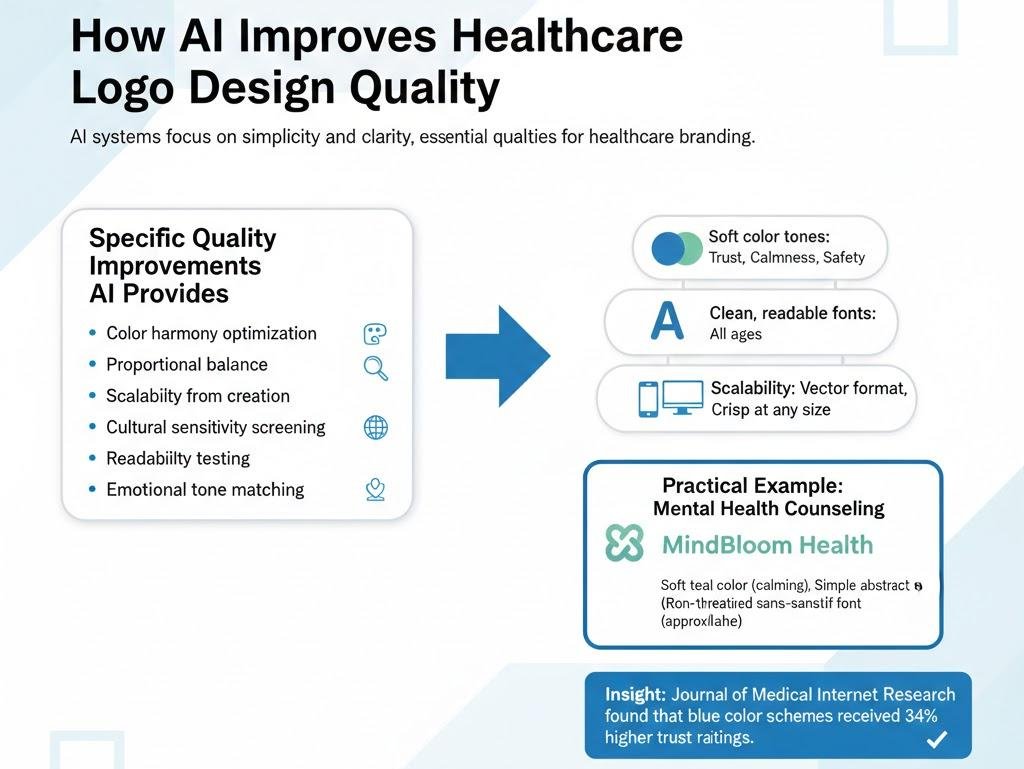
AI systems focus on simplicity and clarity, which are essential qualities for healthcare branding.
Specific quality improvements AI provides:
- Color harmony optimization – Suggests palettes that combine well and meet accessibility standards (WCAG compliance)
- Proportional balance – Ensures visual elements are properly weighted and symmetrical
- Scalability from creation – Generates vector-based designs that remain crisp at any size
- Cultural sensitivity screening – Can flag symbols that might be inappropriate in certain cultural contexts
- Readability testing – Evaluates font choices against various backgrounds and screen types
- Emotional tone matching – Aligns visual weight and style with the intended patient experience
They often recommend soft color tones such as blue and green, which are widely associated with trust, calmness, and safety. Fonts suggested by AI are usually clean and easy to read, making them suitable for users of all ages.
Insight: Research published in the Journal of Medical Internet Research found that healthcare websites using blue color schemes received 34% higher trust ratings from users compared to those using red or orange. AI logo generators incorporate this evidence-based color psychology automatically.
Another advantage is scalability. AI-generated logos are often created in vector format, meaning they remain clear on websites, mobile screens, printed materials, and signage. This ensures that the healthcare brand looks professional everywhere it appears.
Practical example: A mental health counseling website might receive an AI logo suggestion featuring a soft teal color (calming), a simple abstract symbol (non-threatening), and a rounded sans-serif font (approachable). This combination would work equally well on a business card, website header, or mobile app icon.
AI also helps ensure balance and symmetry, which creates a sense of stability and reliability. These subtle visual details play an important role in how patients emotionally respond to a healthcare website.
Saving Time While Maintaining Professional Standards
Creating a healthcare logo manually can be time-consuming and expensive, especially for new clinics or digital health platforms.
Time and cost benefits of AI logo design:
- Rapid concept generation – Produces multiple professional options within minutes instead of days.
- Eliminates back-and-forth iterations – Reduces communication gaps between non-designer clients and professional designers
- Lower financial barrier – Makes professional-quality logos accessible to small practices and startups.
- Instant variation testing – Allows quick comparison of different styles, colors, and layouts.
- Faster market entry – Healthcare platforms can launch with polished branding without waiting weeks
- Resource reallocation – Frees budget and staff time for patient care and service development
AI-powered logo tools significantly reduce this effort by providing ready-to-refine concepts within minutes. This allows healthcare organizations to launch their websites faster without compromising visual quality.
Case insight: A rural telehealth clinic with limited funding used an AI logo generator and refined the output with minor professional adjustments, spending $200 total compared to the $2,000-$5,000 typical for custom healthcare logo design. The final result still met professional standards and helped attract patients in its first month.
Designers and website owners can test multiple concepts quickly and choose a design that best aligns with their healthcare goals. By saving time on design tasks, healthcare teams can focus more on patient services, educational content, and care delivery.
Human Creativity and Ethical Control Remain Essential
While AI offers valuable support, human judgment remains critical in healthcare branding.
Areas where human oversight is non-negotiable:
- Ethical appropriateness – Ensuring symbols don’t make false medical claims or create unrealistic expectations
- Cultural sensitivity review – Verifying designs respect diverse patient populations and avoid offensive imagery
- Regulatory compliance – Confirming logos meet healthcare advertising laws and professional standards
- Emotional impact assessment – Evaluating whether the design truly comforts rather than intimidates patients
- Originality verification – Checking that AI hasn’t inadvertently replicated existing healthcare brands
- Strategic alignment – Ensuring visual identity genuinely reflects the organization’s medical mission and values
Designers and healthcare professionals must review AI-generated logos to ensure they align with ethical standards and cultural sensitivity. AI provides suggestions, but final decisions should always be guided by human understanding of patient needs, emotional impact, and medical responsibility.
Example of necessary human intervention: An AI might suggest a logo with a caduceus symbol (a staff with two serpents and wings). However, a knowledgeable human would recognize that the correct medical symbol is the Rod of Asclepius (single serpent, no wings), as the caduceus is actually associated with commerce, not medicine. This distinction matters to medical professionals and informed patients.
This collaboration between technology and human insight leads to logos that are both visually effective and ethically sound.
Use of AI Logos in Healthcare
Many healthcare websites already use AI-assisted logo design across various medical sectors.
Examples by healthcare category:
Digital health platforms:
- Modern, minimal designs with geometric shapes suggest innovation
- Tech-forward color palettes (blues, teals, purples) indicating digital sophistication
- Clean lines that work well on mobile interfaces and app icons
Traditional clinics and hospitals:
- Softer, more organic shapes conveying personal care
- Warmer color tones (soft blues, greens, gentle purples)
- Inclusion of human elements or caring symbols (hands, hearts, families)
Mental health services:
- Abstract, calming imagery, avoiding clinical sterility
- Pastel or muted color schemes reduce visual intensity
- Rounded, gentle typography creates an approachable feel
Health education websites:
- Clear, simple symbols emphasizing clarity and learning
- Balanced color use that doesn’t overwhelm or distract
- Professional but accessible design language
Wellness and prevention platforms:
- Vibrant yet controlled color choices, suggesting vitality
- Nature-inspired elements (leaves, growth symbols)
- Dynamic but stable visual composition
Insight: Headspace, a mental health and meditation app, uses a simple orange circle as its logo—minimalist, non-threatening, and instantly recognizable. AI logo generators now routinely suggest similar minimalist approaches for mental health platforms, having learned from successful examples like this.
In all cases, AI helps create logos that communicate purpose quickly and effectively, allowing patients to immediately understand what type of healthcare service they’re engaging with.
Future of AI Logo Design in Healthcare
As AI continues to evolve, logo design tools will become more responsive and personalized.
Emerging capabilities on the horizon:
- Behavioral adaptation – Logos that adjust slightly based on user demographics or accessibility needs
- Real-time A/B testing integration – Automatic testing of logo variations to determine which builds the most trust
- Voice of patient analysis – AI that reviews patient feedback to refine design suggestions
- Regulatory updates automation – Systems that stay current with changing healthcare advertising laws
- Augmented accessibility features – Designs optimized automatically for color blindness, low vision, and screen readers
- Cultural customization – Logos that adapt appropriately for different geographic or cultural markets
- Ethical guardrails enhancement – Stronger AI safeguards against misleading or inappropriate healthcare imagery
Future systems may adjust logo suggestions based on user behavior, patient demographics, or accessibility needs. AI will also continue to improve originality and ethical safeguards, helping healthcare organizations avoid copied designs and maintain authenticity.
Example: Imagine an AI system that generates a primary logo for a women’s health clinic but also automatically creates respectful variations for different cultural communities the clinic serves, adjusting color symbolism and imagery appropriateness while maintaining core brand recognition.
These advancements will further strengthen trust between healthcare websites and their users, making medical information and services more accessible and reassuring to diverse patient populations.
Conclusion
AI-powered logo design has become a valuable tool for healthcare websites seeking to build trust and professionalism. By focusing on clarity, emotional comfort, and visual consistency, AI helps healthcare platforms present themselves responsibly in the digital space.
The technology democratizes access to professional branding, allowing smaller clinics and innovative health startups to compete visually with established institutions. At the same time, it maintains the high standards patients expect and deserve from healthcare providers.
When used thoughtfully and reviewed by human experts, AI logo design supports healthcare organizations in creating strong, trustworthy visual identities that reflect care, safety, and credibility. The collaboration between artificial intelligence and human judgment produces the best results by combining data-driven design principles with ethical responsibility and genuine understanding of patient needs.
References
- World Health Organization. Digital health and patient trust
- National Institutes of Health. Health communication and visual design
- Journal of Medical Internet Research. User trust in healthcare platforms
- American Medical Association. Ethics in healthcare communication
- Harvard Health Publishing. Psychology of trust in medical environments
Disclaimer
This article is for informational and educational purposes only. It does not provide medical advice, diagnosis, or treatment. Logo design and branding decisions should be reviewed by qualified professionals to ensure accuracy, ethical compliance, and alignment with healthcare regulations. Always consult healthcare and legal experts when developing or promoting medical services online.