

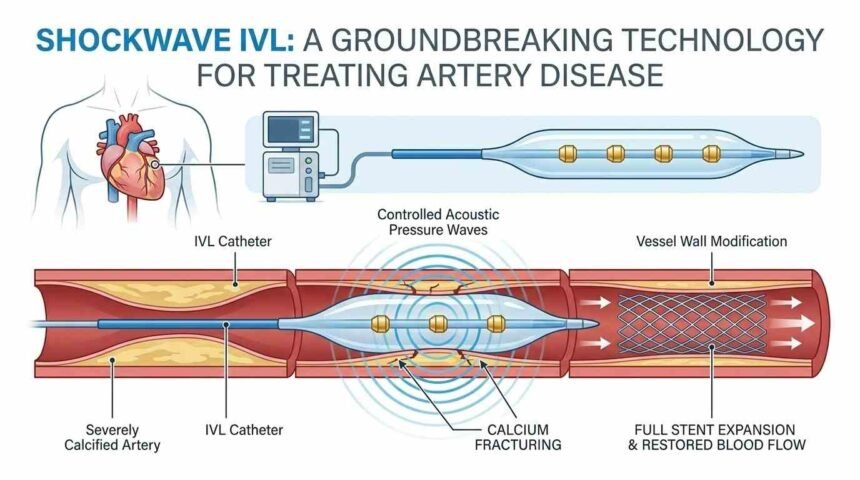
Peripheral artery disease (PAD) affects around 200 million people worldwide, often coexisting with coronary artery disease (CAD). Both are circulatory conditions caused by narrowed arteries, typically due to plaque buildup. In CAD, the coronary arteries that supply blood to the heart become narrowed and blocked. In PAD, arteries outside the heart, especially those in the legs, become restricted.
The good news for patients is that new medical technologies are improving treatment outcomes. One such innovation is Shockwave Intravascular Lithotripsy (IVL), a minimally invasive technology that uses ultrasonic acoustic pressure waves to break up calcified plaque in arteries. This technology is helping cardiologists treat complex arterial blockages more safely and effectively than many traditional techniques.
PAD and CAD in the US
Shockwave IVL is useful for treating both peripheral artery disease and coronary artery disease. Calcium buildup associated with PAD increases the risk of CAD and cerebrovascular disease, which may lead to heart attacks or strokes.
One of the most severe forms of PAD, chronic limb-threatening ischemia (CLTI), affects nearly two million patients in the United States. This condition is responsible for approximately 40% of major amputations within one year. The long-term prognosis is also concerning, with a five-year mortality rate of about 50%, which is higher than that of many types of cancer.
Shockwave peripheral IVL enables doctors to modify calcified plaque while maintaining predictable safety during procedures.
Coronary artery disease is also widespread. Globally, CAD affects hundreds of millions of people, and it remains one of the leading causes of death. Calcified plaque in coronary arteries can significantly complicate procedures by:
- Limiting blood flow to the heart
- Making stent placement more difficult
- Preventing proper stent expansion
- Increasing procedural complications
Currently, over 30% of coronary lesions show moderate to severe calcification, making treatment more complex for cardiologists.
Replacing the Traditional Atherectomy
When arteries become blocked, doctors often perform a heart stent procedure to widen the artery and restore blood flow.
In many cases, stents can be placed directly. However, when severe calcification is present, additional procedures may be necessary.
One traditional option is atherectomy, a technique that removes plaque using specialized devices inserted into the artery. Another option is balloon angioplasty, where a small balloon catheter is inflated to widen the artery.
However, the issue with traditional atherectomy procedures is that they can be technically complex and sometimes risky for patients with severe arterial calcification. These procedures may increase the likelihood of vessel injury or other complications.
While these treatments are effective in many cases, their limitations have encouraged the development of safer and more precise technologies.
New Shockwave IVL Technology
Shockwave IVL enhances traditional balloon catheter procedures by incorporating ultrasonic acoustic pressure waves.
These waves are designed to create tiny fractures in hardened calcium deposits inside the artery wall while passing safely through surrounding soft tissue.
The process works because healthy tissue and the saline-contrast mixture in the balloon share similar densities, allowing the pressure waves to target calcified plaque without damaging nearby structures.
Once these tiny cracks form in the plaque:
- The artery becomes more flexible
- The vessel can expand more easily
- Stents can be deployed more effectively
- The risk of complications decreases
Importantly, the calcium is not removed from the artery. Instead, it is modified, allowing the artery to stretch safely during treatment.
How Shockwave IVL Works During a Procedure
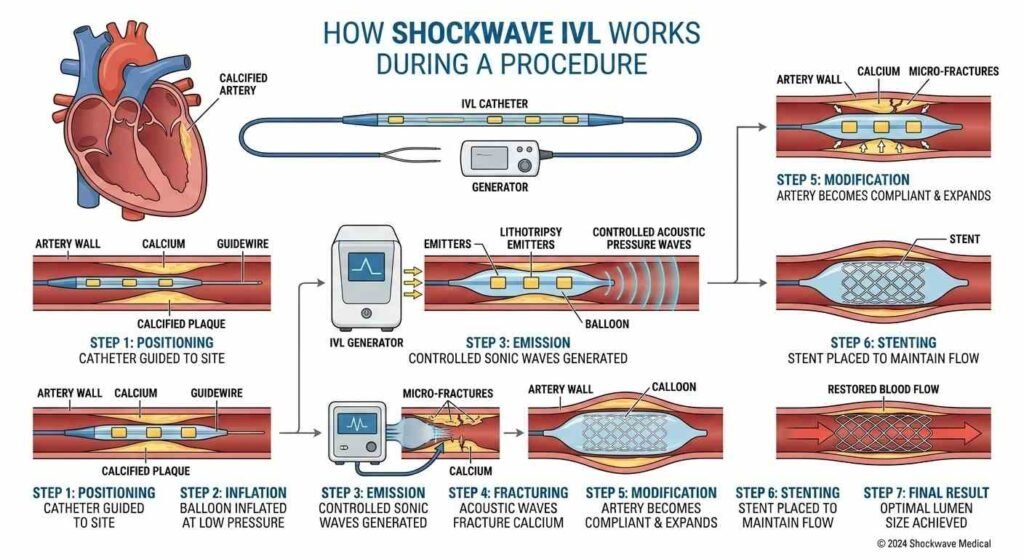
Shockwave IVL procedures follow a similar process to standard angioplasty but include specialized lithotripsy technology.
Step-by-Step Process
- A catheter with an integrated balloon is inserted into the affected artery.
- The balloon is positioned at the site of calcified plaque.
- The balloon is inflated with a saline and contrast mixture.
- The IVL system emits controlled acoustic pressure waves.
- These waves fracture the calcium within the arterial wall.
- The artery becomes more compliant and easier to expand.
- A stent may then be placed to maintain proper blood flow.
This approach allows cardiologists to treat severe calcification while minimizing trauma to the vessel.
Comparison: Shockwave IVL vs Traditional Plaque Treatment Methods
| Treatment Method | How It Works | Advantages | Limitations |
|---|---|---|---|
| Balloon Angioplasty | Inflates a balloon to widen the artery | Minimally invasive and widely available | May struggle with heavily calcified plaque |
| Atherectomy | Removes plaque using cutting or grinding devices | Effective for certain blockages | Higher technical complexity and risk of vessel injury |
| Stent Placement | Metal mesh stent keeps artery open | Long-term support for blood flow | Difficult to place if severe calcification exists |
| Shockwave IVL | Uses acoustic waves to fracture calcified plaque | Improves vessel flexibility and safer stent expansion | Requires specialized equipment and training |
Helping Doctors and Patients
Cardiologists often face significant challenges when treating calcified arteries. Severe calcification increases the risk of complications such as:
- Vessel perforation
- Artery dissection
- Incomplete stent expansion
- Poor long-term outcomes
Shockwave IVL reduces these risks by gently modifying calcium deposits before stent placement.
In one recorded medical intervention by a leading cardiologist, only four pulses of Shockwave IVL were required to allow the balloon to expand successfully. This demonstrates how efficiently the technology can improve vessel compliance.
For physicians, the technology provides greater confidence during procedures. For patients, it offers a safer treatment option with potentially better outcomes.
Reaching Tight Spaces
In extremely severe cases of arterial calcification, cardiologists may struggle to insert a balloon catheter into the artery.
To address this challenge, developers created an advanced IVL catheter with the Shockwave emitter located near the tip. This design allows the device to:
- Access tighter arteries
- Deliver acoustic waves earlier in the procedure
- Treat lesions previously considered extremely difficult
This advancement expands the number of patients who can benefit from IVL treatment.
Clinical Benefits and Future Potential
Shockwave IVL is rapidly gaining recognition in cardiovascular medicine because it addresses one of the most difficult aspects of artery treatment: calcified plaque.
Key benefits include:
- Minimally invasive treatment
- Improved stent expansion
- Lower risk of vessel injury
- Better procedural success rates
- Increased treatment options for complex cases
As clinical research continues, IVL may become a standard tool for treating calcified coronary and peripheral artery disease.
Conclusion
Shockwave Intravascular Lithotripsy represents a significant advancement in the treatment of atherosclerotic disease. By using acoustic pressure waves to fracture hardened calcium deposits, this technology allows cardiologists to improve vessel flexibility and facilitate effective stent placement safely.
Compared to traditional methods such as atherectomy or balloon angioplasty alone, Shockwave IVL provides a safer and more controlled approach to treating heavily calcified arteries. For patients with complex coronary or peripheral artery disease, this innovation offers new hope for improved outcomes and reduced procedural risks.
As cardiovascular medicine continues to evolve, technologies like Shockwave IVL demonstrate how modern engineering and medical science can work together to address some of the most challenging conditions affecting millions of people worldwide.
References
- World Health Organization (WHO). Global cardiovascular disease statistics.
- American Heart Association. Peripheral artery disease and coronary artery disease guidelines.
- National Institutes of Health (NIH). Clinical research on coronary artery calcification.
- Shockwave Medical Inc. Intravascular Lithotripsy clinical data and device information.
- Journal of the American College of Cardiology (JACC). Research on calcified coronary lesions and interventional cardiology.