


So gut health is everywhere now. Hard to scroll through anything without someone trying to sell a supplement, a protocol or a 7-day reset. With that much content floating around, people would have figured it out by now. They haven’t, mostly.
Fiber Thing

Boring topic. But it matters, and almost nobody’s hitting their numbers. Fiber consumption data from the USDA puts the average American at something like 58 percent of the target. And that number hasn’t really moved in about two decades, which tells you something.
Here’s the thing with fiber, though. The bacteria in your gut literally eat it. That’s their fuel source. When there’s not enough coming in, the beneficial colonies shrink and digestion starts going sideways in ways people don’t always connect back to diet. Lots of folks figure the “whole grain” label on their bread covers it. Eh. Probably not.
Probiotic Problem
This one’s frustrating because the marketing around probiotics is so aggressive. People buy a bottle, take it religiously for two or three weeks, nothing happens, and they give up. The probiotic itself was fine. The problem is what’s missing alongside it.
Prebiotics are the part most people skip. They act as fuel for bacteria already hanging out in your digestive system. No prebiotics means those bacteria don’t have much to work with, even if a probiotic just dumped new ones in there. A physician-led guide on prebiotic supplements gets into which compounds feed which bacterial populations. More nuanced than the “take this one pill” messaging would have you believe.
Research looking at the health benefits of prebiotic dietary fibers backs this up. Multiple types of prebiotic compounds exist, and they don’t all do the same thing. So yeah. “Just take a probiotic” isn’t bad advice per se. It’s just not the whole story.
Your Gut Isn’t Only About Digestion
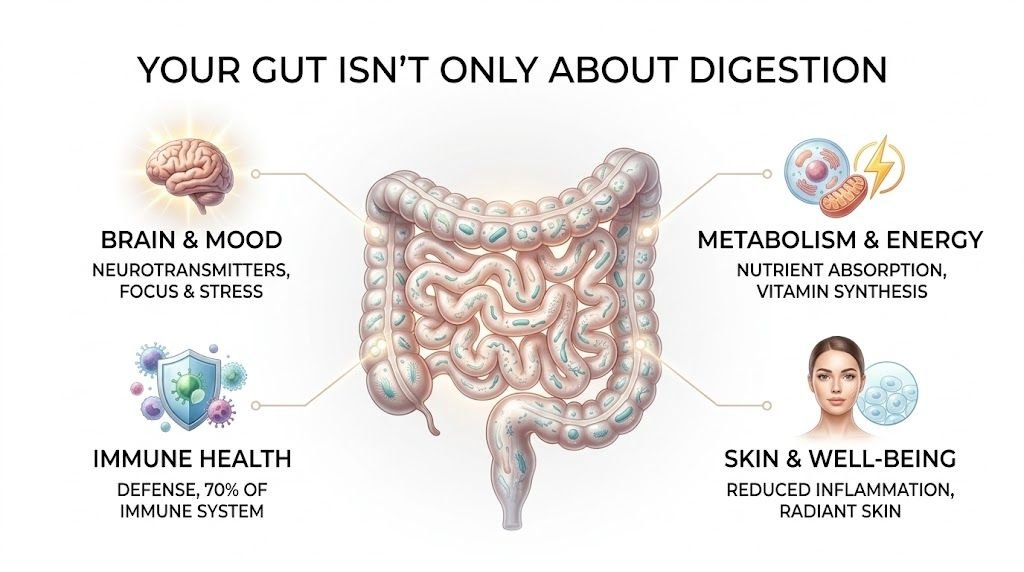
Most people hear “gut health” and think bloating. Maybe constipation. Which, fair enough.
But there’s this whole communication system between the GI tract and the brain. Researchers call it the gut-brain axis, and when things are off in the gut, it can show up as mood problems, brain fog and lousy sleep. Some of the claims around this get overhyped. There’s a lot of marketing running ahead of the actual science. But the underlying connection seems real enough that it’s worth taking seriously. If the broader supplement angle is interesting, there’s a solid piece on understanding MCT oil that gets into some of this.
Patience. Seriously.
Probably the biggest one. Someone tries a new supplement for ten days and writes it off. That’s not how the gut microbiome works, though. It took a while to get out of balance; it’s going to take a while to shift back. One or two consistent changes over a month will tell you more than swapping between five different products in the same timeframe.
Not exactly thrilling guidance. But it beats chasing whatever supplement is trending on social media this week.
Final Conclusion
Most people get gut health wrong because they’re looking for fast fixes to what is fundamentally a slow, adaptive system. The microbiome doesn’t respond overnight, and it definitely doesn’t thrive on isolated solutions.
If there’s a takeaway here, it’s this: consistency beats complexity. Getting enough fiber, pairing probiotics with prebiotics, understanding the broader role of the gut beyond digestion, and giving your body time to adjust will take you further than any short-term “reset.”
Gut health isn’t about hacks. It’s about habits.
Disclaimer
This content is for informational purposes only and does not constitute medical advice, diagnosis, or treatment. Always consult a qualified healthcare professional before making changes to your diet, supplement routine, or lifestyle, especially if you have underlying health conditions.
Responses to dietary fiber, probiotics, and prebiotics can vary between individuals. What works for one person may not work for another, and long-term digestive symptoms should be evaluated by a licensed clinician.
References
- Makki, K., Deehan, E. C., Walter, J., & Bäckhed, F. (2018). The impact of dietary fiber on gut microbiota. Cell Host & Microbe, 23(6), 705–715.
- Gibson, G. R., et al. (2017). The concept of prebiotics and their role in gut health. Nature Reviews Gastroenterology & Hepatology, 14(8), 491–502.
- Hill, C., et al. (2014). Expert consensus on probiotics. Nature Reviews Gastroenterology & Hepatology, 11(8), 506–514.
- Cryan, J. F., & Dinan, T. G. (2012). Mind-altering microorganisms and the gut-brain axis. Nature Reviews Neuroscience, 13(10), 701–712.
- Valdes, A. M., et al. (2018). Role of the gut microbiota in nutrition and health. BMJ, 361, k2179.