

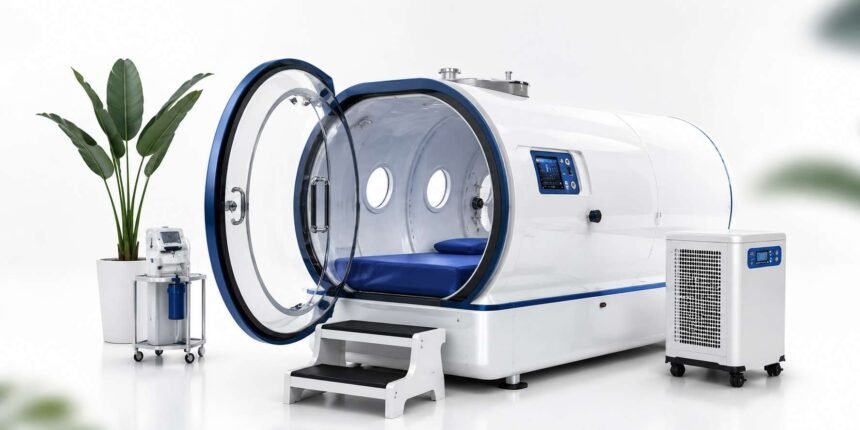
Hyperbaric oxygen therapy has traveled a long way from its original home in navy decompression bays and hospital burn units. Today, it shows up in athlete recovery routines, executive wellness programs, and a growing number of living rooms. The market reflects that shift: according to Fortune Business Insights, the global HBOT market is projected to grow from $8.53 billion in 2026 to $14.79 billion by 2034.
Consumer interest is real and accelerating. But many people buying home chambers are making a $10,000 to $20,000 decision based on athlete endorsements and wellness marketing rather than on clinical evidence. That’s a problem.
How Hyperbaric Oxygen Therapy Works
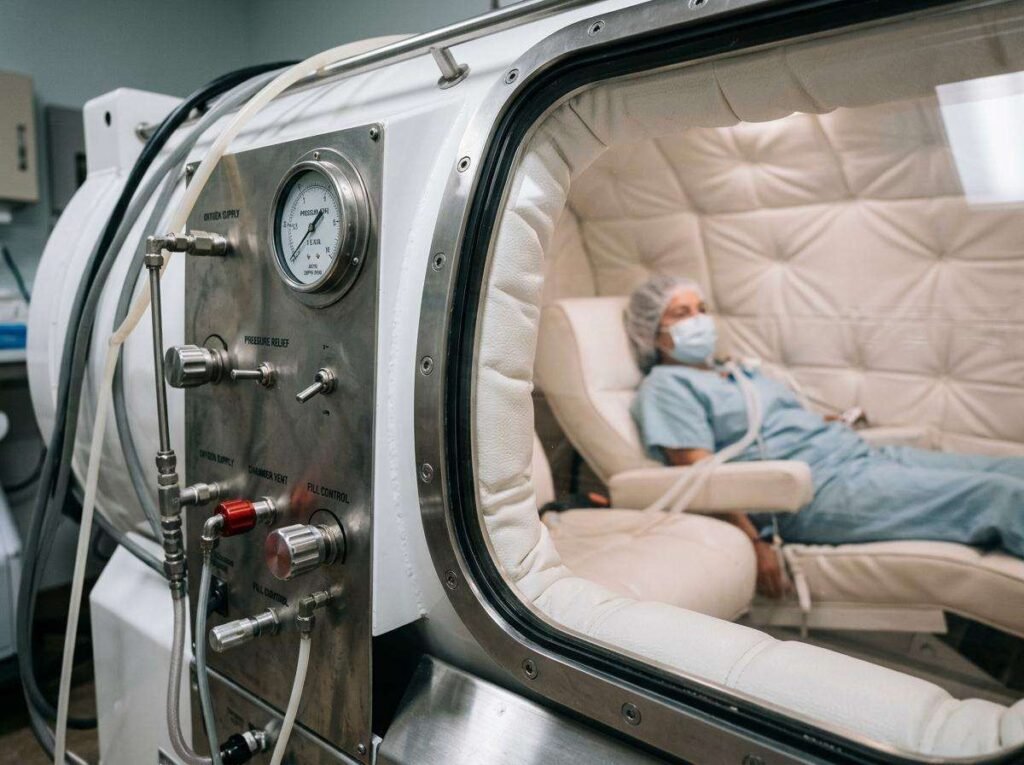
The mechanism is straightforward. You enter a sealed chamber, the pressure rises to two to three times normal atmospheric levels, and your lungs absorb far more oxygen than usual. That excess oxygen dissolves into blood plasma – not just red blood cells – and reaches damaged, inflamed, or poorly-circulated tissue that wouldn’t otherwise receive an adequate oxygen supply.
When someone starts looking for a hyperbaric chamber for sale, they typically encounter a wide spectrum of units – from compact soft-shell home models to large clinical-grade hard-shell systems. The pressure rating of each one determines what it can actually do therapeutically, which makes understanding the therapy itself the necessary first step.
The U.S. Food and Drug Administration has cleared HBOT for 14 specific medical conditions, including diabetic foot ulcers, decompression sickness, carbon monoxide poisoning, radiation tissue injury, severe burns, and gas gangrene. Outside those indications, you’re in off-label territory – which matters a great deal when evaluating what a home unit can realistically deliver.
One number to keep in mind: home soft-shell units operate at 1.3 to 1.5 ATA (atmospheres absolute), while clinical chambers run at 2.0 to 3.0 ATA. That gap isn’t cosmetic. Most FDA-approved treatment protocols require higher clinical pressures. A home unit at 1.3 ATA may support recovery and wellness goals, but it won’t replicate what happens in a hospital hyperbaric suite.
What the Evidence Actually Says

The evidence varies quite a bit depending on the application. Some uses are well-supported. Others are not.
For wound healing, the case is solid. Johns Hopkins Medicine documents HBOT’s role in stimulating angiogenesis (new blood vessel formation), boosting collagen production, and reducing tissue edema – mechanisms that explain why it works for diabetic foot ulcers and radiation injuries.
Athletic recovery has picked up meaningful research momentum. A 2025 meta-analysis published in the Turkish Journal of Sports Medicine examined 10 studies covering 299 subjects and found HBOT significantly accelerated recovery from exercise-induced muscle injury. 100-minute sessions outperformed 60-minute sessions. That’s specific, reproducible data – the kind of evidence that’s worth weighing.
The off-label claims are a different story. HBOT is marketed for autism, Alzheimer’s disease, Lyme disease, and post-COVID symptoms, among others. Harvard Health is direct on this: the FDA has not cleared HBOT for these conditions, and seeking it as a substitute for proven treatments carries real risk. That doesn’t mean no research exists – it means the evidence isn’t strong enough for regulatory approval, and buyers should weigh that honestly.
Hard Shell vs. Soft Shell: Which Type Fits Your Needs
The two main chamber categories serve genuinely different purposes, and the price gap between them is enormous.
Soft-shell chambers (mild HBOT, 1.3 to 1.5 ATA) are portable, fabric-based units typically costing $5,000 to $20,000. They don’t require a prescription in most U.S. states for units operating below 1.5 ATA. Most buyers pair them with a separate oxygen concentrator, which adds $1,000 to $2,500 to the total cost. These units suit wellness users, athletes managing recovery, and people looking to supplement (not replace) medical treatment.
Hard-shell chambers operate at 2.0 to 3.0 ATA – the pressure range where FDA-approved clinical protocols live. Prices run from $40,000 to $250,000. They require a physician’s prescription and professional installation. This is Class II medical device territory, and the purchase process reflects that.
A useful data point: monoplace chambers (single-person units) held 80.98% of the device market share in 2024, according to Precedence Research. They’re the dominant consumer format because they’re practical – one person, one session, no staffing required.
For people exploring this as part of a broader approach to their health, it helps to think about holistic wellness practices that complement HBOT rather than expecting any single therapy to carry the full load.
Five Things to Check Before You Buy

Most buyers focus on price and aesthetics. These five points matter more.
- Pressure rating: The difference between 1.3 ATA and 2.0 ATA isn’t a technical footnote – it determines which therapeutic effects are achievable. Know what your goals require before choosing a unit.
- Certifications: Look for FDA 510(k) clearance, CE marking, or ISO certification. Not every manufacturer holds U.S. FDA clearance, and that distinction matters for both safety and insurance purposes. Ask for documentation, not claims.
- Safety features: Any unit worth buying should include an emergency pressure-release valve, automatic pressure control, door sensors, and a metal safety relief valve. Don’t skip this checklist.
- Long-term costs: The sticker price isn’t the total cost. Budget for oxygen concentrator purchase or rental, maintenance contracts, periodic inspections, and warranty coverage. Soft-shell units need regular inspection of seams and zipper closures.
- Prescription status: Soft-shell home units generally don’t require a prescription. Hard-shell clinical units are used in most U.S. states. Confirm this with your supplier and your physician before purchasing.
The financial commitment also highlights something worth considering: why so many people are turning to home devices to manage ongoing health concerns. A lot of it ties back to gaps in day-to-day wellness habits – including managing chronic nutrient deficiencies that leave people feeling run-down and reaching for adjunctive solutions.
Who Should – and Shouldn’t – Use a Home Chamber
Home HBOT makes sense for a specific set of people. Athletes managing post-training recovery, individuals with wound-healing conditions already under physician supervision, and wellness users who’ve spoken with their doctor and have realistic expectations are reasonable candidates for a soft-shell home unit.
It’s not right for everyone. Cleveland Clinic flags several contraindications: a collapsed or untreated pneumothorax, recent ear or sinus surgery, and untreated fever all rule out HBOT. Pregnancy is another concern – potential placental effects mean the therapy isn’t recommended without strong medical justification.
Side effects are worth knowing before you commit. Ear pain and pressure injury to the eardrum are the most common complaints, particularly for users who don’t equalize pressure properly. Less known but documented: Cleveland Clinic reports temporary nearsightedness in 20 to 40% of patients who complete 20 or more HBOT treatments. It typically resolves after sessions end, but it’s not a trivial effect. Claustrophobia in monoplace units is also real – try before you buy if possible.
The key rule is simple: consult a physician before purchasing, not after. Getting clearance after you’ve already received delivery isn’t a plan.
What to Ask Before You Buy
Ask your supplier these questions directly: What certifications does this unit hold, and can you provide documentation? What does the warranty cover, and for how long? Is there a trial period or return policy? Who provides setup, training, and ongoing technical support?
Ask your physician: Is my condition among the 14 FDA-approved indications for HBOT? Will a home unit’s pressure range (1.3 to 1.5 ATA) be sufficient for my goals? Are there contraindications given my current medications or health conditions?
If either party gives you vague answers, that tells you something.
It’s also worth putting this purchase in the broader context of your overall health management. Devices like these work best when they’re part of a consistent approach to managing stress and physical recovery – not a substitute for the fundamentals.
Invest Informed, Not Impulsively
The home HBOT market is growing fast – the home-care segment is expanding at a 9.42% CAGR through 2031, according to Mordor Intelligence’s 2025 analysis. More options are coming, prices will keep shifting, and the marketing will keep outpacing the clinical evidence on some fronts.
The therapy has genuine, well-documented value in wound healing, decompression medicine, and increasingly in athletic recovery. It’s also heavily marketed for conditions where the evidence is thin. Knowing the difference is what separates a purchase that supports your health from one that empties your account.
Verify certifications. Understand the pressure ratings and what they enable. Talk to a licensed physician before writing a check. Those three steps alone put you ahead of most buyers in this market.
Disclaimer
This article is for general educational and informational purposes only. It should not be taken as medical advice, diagnosis, treatment guidance, or a replacement for consultation with a licensed healthcare professional.
Hyperbaric oxygen therapy may not be suitable for everyone. People with existing medical conditions, recent surgery, ear or sinus problems, lung conditions, pregnancy, implanted medical devices, or those taking certain medications should speak with a qualified physician before using any hyperbaric chamber.
Home hyperbaric chambers may differ from clinical-grade systems in pressure level, oxygen delivery, safety features, and approved medical use. Readers should verify product certifications, safety documentation, warranty terms, prescription requirements, and local regulations before purchasing any chamber.
Do not use hyperbaric oxygen therapy as a substitute for emergency care, prescribed treatment, wound care, or professional medical supervision. If you have a serious wound, breathing issue, carbon monoxide exposure, decompression sickness, infection, or any urgent health concern, seek medical help immediately.
References
- U.S. Food and Drug Administration. “Follow Instructions for Safe Use of Hyperbaric Oxygen Therapy Devices: Letter to Health Care Providers.” FDA Medical Devices Safety Communication. Publisher: U.S. Food and Drug Administration. Published August 25, 2025. Accessed May 19, 2026.
- Catanese, Lisa, ELS. “Hyperbaric Oxygen Therapy: Evidence-Based Uses and Unproven Claims.” Harvard Health Publishing. Reviewed by Robert H. Shmerling, MD. Publisher: Harvard Medical School. Published December 9, 2024. Accessed May 19, 2026.
- Cleveland Clinic. “Hyperbaric Oxygen Therapy: What It Is, Benefits and Side Effects.” Cleveland Clinic Health Library. Medically reviewed. Publisher: Cleveland Clinic. Last updated January 7, 2023. Accessed May 19, 2026.
- Johns Hopkins Medicine. “Hyperbaric Oxygen Therapy for Wound Healing.” Johns Hopkins Medicine Health Library. Publisher: Johns Hopkins Medicine. Publication date not listed. Accessed May 19, 2026.
- Mayo Clinic. “Hyperbaric Oxygen Therapy.” Mayo Clinic Tests and Procedures. Publisher: Mayo Foundation for Medical Education and Research. Published December 6, 2024. Accessed May 19, 2026.
- Luo, Xiaoqin; Yu, Ying; Zhang, Shibin; Qi, Fengxue. “Effects of Hyperbaric Oxygen Therapy on Exercise-Induced Muscle Injury and Soreness: A Systematic Review and Meta-analysis.” Archives of Physical Medicine and Rehabilitation. Publisher: Elsevier. Published 2025. DOI: 10.1016/j.apmr.2025.07.017. Accessed May 19, 2026.
- Canarslan Demir, Kübra; Avci, Ahmet Uğur. “Sports Injuries and Hyperbaric Oxygen Therapy: Physiological Effects and Previous Findings.” Turkish Journal of Sports Medicine. Volume 60, Issue 2. Publisher: Turkish Journal of Sports Medicine. Published February 18, 2025. DOI: 10.47447/tjsm. 0856. Accessed May 19, 2026.
- Fortune Business Insights. “Hyperbaric Oxygen Therapy Market Size, Share and Analysis by Product, Application, End Users and Regional Forecast, 2026–2034.” Fortune Business Insights Industry Report. Report ID: FBI101103—publisher: Fortune Business Insights. Last updated March 30, 2026. Accessed May 19, 2026.
- Mordor Intelligence. “Hyperbaric Oxygen Therapy Devices Market Size and Trends.” Mordor Intelligence Industry Report. Publisher: Mordor Intelligence. Page last updated January 12, 2026. Accessed May 19, 2026.