

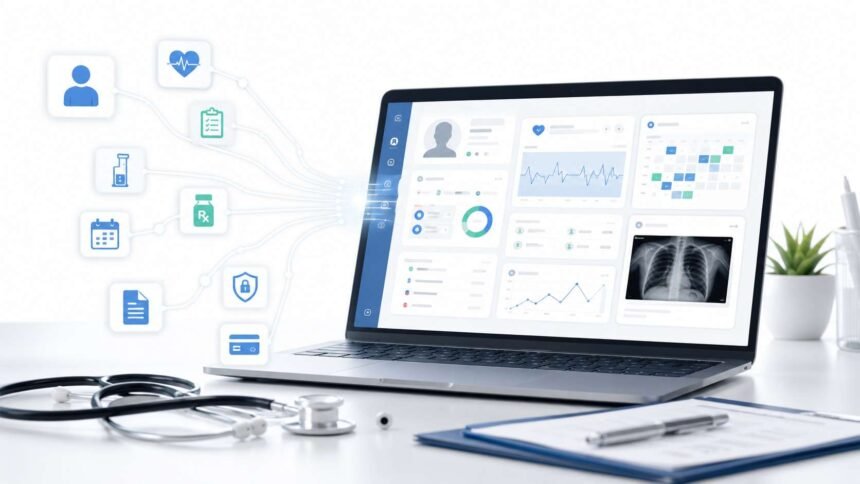
Modern medical practices generate massive amounts of patient data every day. From lab results to medication histories, imaging reports, and clinical notes, managing it all efficiently is critical-not just for operations, but for delivering safe, timely care. Without a centralized system, providers risk delays, errors, and fragmented care that can directly affect patient outcomes.
Electronic Health Record (EHR) systems provide a centralized hub for this information, allowing providers to access, share, and act on patient data instantly, improving both workflow and patient outcomes. These platforms also enable seamless collaboration between specialists, laboratories, and pharmacies, ensuring continuity of care. By consolidating clinical, administrative, and billing data, EHRs empower practices to make informed decisions faster while reducing administrative burdens.
Understanding the Core of Digital Patient Records
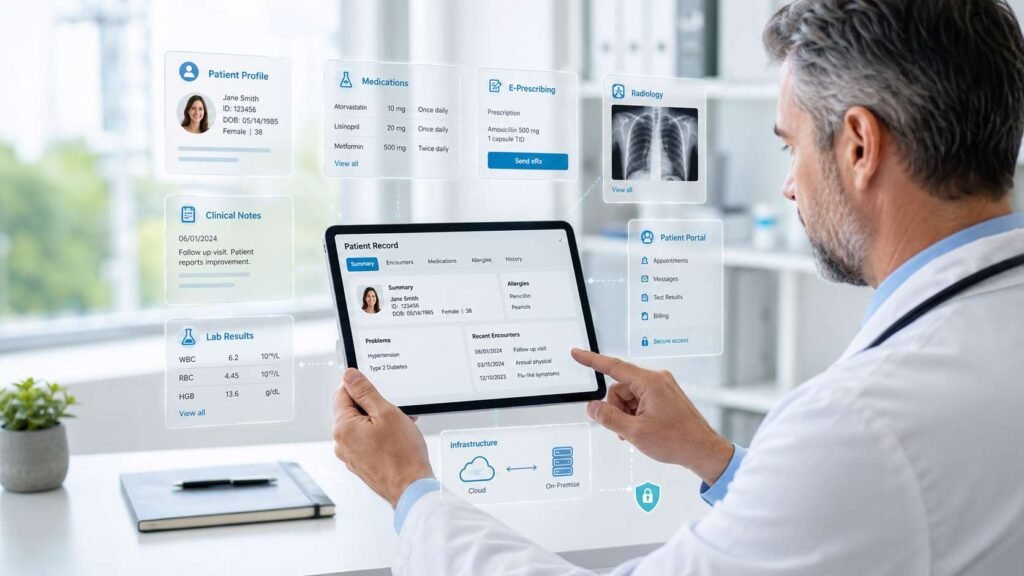
Here’s the thing about modern medicine: it drowns in information. The practices that thrive? They’ve figured out how to swim. An electronic health record system becomes your lifeline-the central nervous system where every piece of patient data converges and connects.
Breaking Down the EHR System Definition
Understanding the definition of an EHR system helps clarify its critical role in modern healthcare. An Electronic Health Record (EHR) system is a digital platform that centralizes all patient information, making it accessible, shareable, and actionable across healthcare settings. It’s far more than just a digital filing cabinet; it serves as a hub for coordinating care, improving safety, and supporting efficient clinical workflows.
The EHR system definition describes real-time, patient-focused records that authorized users can access instantly, anywhere. Forget locked filing cabinets and basement storage rooms. These digital ecosystems place comprehensive patient histories at your fingertips precisely when decisions need to be made. Built around the HITECH Act’s Meaningful Use standards, EHRs promote connectivity, collaboration, and interoperability. Imagine a living chronicle that grows with every patient interaction: lab work, medication prescriptions, radiology images, and doctors’ observations, all converging into one comprehensive snapshot.
Key Components That Power These Platforms
Multiple critical modules collaborate inside these frameworks. You’ve got patient demographics and registration handling the foundational details. Clinical documentation features let providers capture notes without breaking their workflow. Computerized Provider Order Entry (CPOE) simplifies requesting labs, imaging studies, and medications.
E-prescribing functionality links straight to pharmacies, slashing errors while boosting medication compliance. Decision support mechanisms deliver instant warnings about drug conflicts or missed preventive screenings. Patient portals give people round-the-clock access to their medical information, test outcomes, and direct messaging with providers.
Cloud vs On-Premise Infrastructure
Your deployment choice carries real weight. Cloud-hosted options minimize initial investment, deliver automatic software updates, and enable access from any internet-connected device. According to NovoPath, a vendor of pathology laboratory software, “cloud-based systems are perfect for smaller operations lacking dedicated IT departments.”
On-premise installations grant total sovereignty over information and customization potential but demand substantial infrastructure spending and perpetual maintenance. Today, plenty of organizations pursue hybrid strategies that merge control with flexibility.
EHR vs EMR – What’s the Real Difference?
Most people toss these acronyms around like they’re twins. They’re not. Grasping the distinction between EHR vs EMR shapes your entire technology roadmap.
How Electronic Medical Records Function
EMRs digitize paper charts within a single practice’s walls. They house medical and treatment records for patients at one location. Physicians rely on them to monitor trends longitudinally and flag who needs upcoming preventive visits.
But here’s the catch: EMRs struggle to broadcast information beyond their bubble. They’re self-sufficient ecosystems built for internal clinical processes at individual organizations.
Why Electronic Health Records Go Further
EHRs pack everything EMRs offer, then crank things up considerably. They’re engineered to transmit information across diverse healthcare environments-specialists, laboratories, pharmacies, emergency rooms, you name it. This connectivity means your complete medical narrative follows you everywhere.
When visiting a new specialist, they immediately see your current medications, known allergies, and recent test findings from your family doctor. No redundant bloodwork. No conflicting information. Everyone’s reading from the same playbook.
Quick Comparison: EMR vs EHR
| Feature | EMR | EHR |
| Scope | Single practice | Multiple providers |
| Information sharing | Limited | Extensive |
| Patient access | Minimal | Full portal access |
| Interoperability | Low | High |
| Best for | Solo practitioners | Integrated care networks |
Tangible Benefits of Electronic Health Records
Why do healthcare organizations pour resources into these platforms? Because the benefits of electronic health records deliver measurable, bankable results that extend miles beyond eliminating paper cuts.
Clinical Quality and Patient Safety Wins
Digital documentation slashes medical errors through embedded safety mechanisms. A physician enters a prescription, and boom, the system instantaneously cross-references allergies and hazardous drug combinations. Clinical decision support features recommend evidence-based protocols and highlight concerning lab abnormalities demanding attention.
Comprehensive patient timelines empower better diagnostic reasoning. Providers spot emerging patterns and intercept problems during their treatable early stages.
Operational Efficiency That Saves Time and Money
Automated workflows obliterate redundant typing and accelerate administrative functions. Even smaller or resource-strapped facilities have found that digital record systems significantly streamline operations and reduce manual workload. The efficiencies gained extend beyond speed-they improve accuracy and free up staff to focus on patient care rather than paperwork.
Practices experience faster billing turnarounds, fewer claim rejections, and enhanced revenue capture through superior documentation quality. Digital archives eliminate physical storage costs and reduce the hours staff spend managing mountains of paper, creating both financial and operational benefits.
Better Patient Engagement Tools
Patient portals revolutionize the therapeutic relationship. People schedule visits online, request prescription refills, examine test outcomes, and contact providers without endless phone tag. This convenience elevates satisfaction metrics and motivates patients to stay invested in their wellness.
Secure messaging cuts unnecessary office appointments for straightforward questions. Patients feel genuinely connected to their healthcare team and demonstrate higher adherence to treatment plans.
How Electronic Health Record Systems Work Behind the Scenes
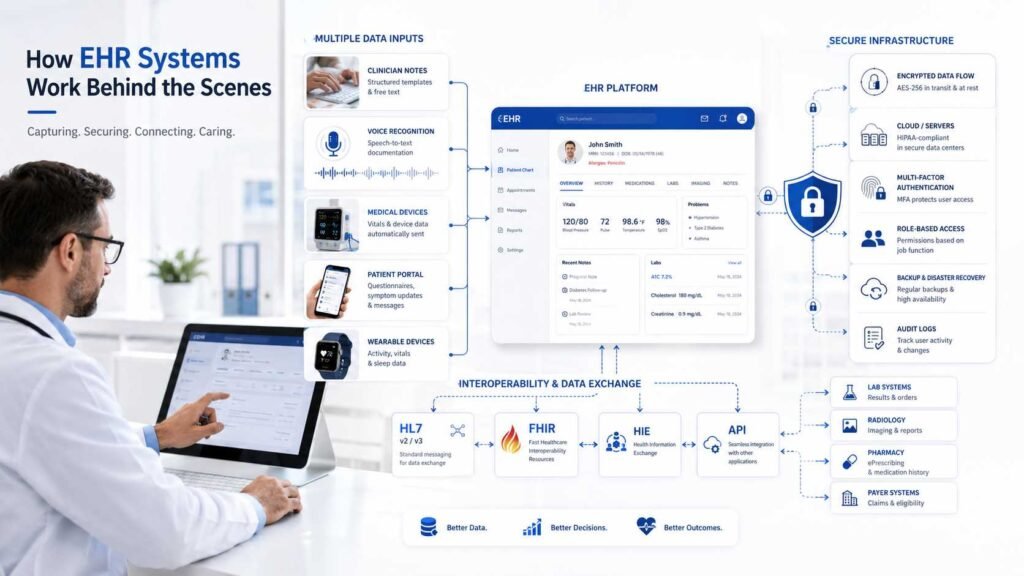
Peering behind the curtain at how electronic health record systems work exposes the sophisticated technology machinery powering routine clinical activities. We’re not discussing simple spreadsheets here-these are intricate platforms juggling enormous volumes of protected health information.
Data Input Methods
Information flows in through diverse pathways. Providers type directly into adaptable templates or harness voice recognition for accelerated documentation. Medical equipment like blood pressure cuffs and glucometers can automatically stream readings into patient files.
Patients supply data through portal questionnaires and wearable technology integrations. Historical paper records undergo scanning and digitization during system transitions.
Storage and Security Protocols
Patient information demands Fort Knox-level safeguarding. Systems deploy encryption whether data rests in storage or travels across networks. Multi-factor authentication confirms that only credentialed users can view records. Role-based permissions restrict what various staff members see based on job functions.
Automated backup infrastructure and disaster recovery blueprints shield against information loss. Audit logs document every single access to patient files for HIPAA compliance verification.
Interoperability Standards
Contemporary systems converse using standardized languages like HL7, FHIR (Fast Healthcare Interoperability Resources). These protocols enable different vendors’ platforms to swap information dependably. Health Information Exchanges (HIE) function as traffic directors, channeling data between organizations running incompatible systems.
API integrations allow third-party applications to connect with EHR platforms, multiplying capabilities without custom coding marathons.
Choosing the Right System for Your Practice
The vendor marketplace contains dozens of contenders at wildly different price brackets and capability tiers. Smart selection demands understanding what exists and what your practice genuinely requires, not what salespeople promise.
Popular Vendor Options
Epic Systems dominates with powerful enterprise functionality for massive health networks. Oracle Cerner provides cloud-native solutions packed with robust analytics. Athenahealth targets ambulatory practices with integrated revenue cycle orchestration.
Smaller operations typically gravitate toward intuitive platforms like SimplePractice, which fuse practice management with telehealth and client engagement utilities. These solutions emphasize usability over enterprise bells and whistles.
Essential Features to Look For
Any respectable system needs solid documentation capabilities with customizable templates. E-prescribing is absolutely non-negotiable today. Hunt for integrated billing that accelerates claims submission and payment reconciliation.
Patient portal functionality has become a baseline expectation, not a luxury. Reporting horsepower matters for quality metric tracking and financial dissection. Mobile access empowers providers to work flexibly from tablets or smartphones.
FAQs
How long does implementation typically take?
- Small practices can launch in 3-6 months with cloud platforms, whereas large hospitals require 18-24 months. Your timeline hinges on complexity, customization depth, data migration scope, and staff training intensity.
Can my patient data move if I switch vendors?
- Absolutely, you own your patient information. Most vendors supply export utilities in standard formats. Data migration specialists help transfer everything to new systems, though they expect some manual cleanup work.
Does the law require these systems?
- No federal statute mandates EHR adoption, but Medicare and Medicaid link incentive dollars to usage. Dodging penalties and maximizing reimbursement make them practically mandatory for most providers.
References
- Office of the National Coordinator for Health Information Technology. “Electronic Health Records and Their Benefits.” HealthIT.gov. Updated December 10, 2025. Accessed May 19, 2026.
- Office of the National Coordinator for Health Information Technology. “What Are Electronic Health Records?” HealthIT.gov. Accessed May 19, 2026.
- Office of the National Coordinator for Health Information Technology. “What Information Does an Electronic Health Record Contain?” HealthIT.gov. Accessed May 19, 2026.
- Office of the National Coordinator for Health Information Technology. “What Are the Advantages of Electronic Health Records?” HealthIT.gov FAQ. Accessed May 19, 2026.
- Office of the National Coordinator for Health Information Technology. “Improved Patient Care Using EHRs.” HealthIT.gov. Updated 2026. Accessed May 19, 2026.
- U.S. Department of Health and Human Services, Office for Civil Rights. “The HIPAA Privacy Rule.” HHS.gov. Reviewed September 27, 2024. Accessed May 19, 2026.
- U.S. Department of Health and Human Services, Office for Civil Rights. “Summary of the HIPAA Security Rule.” HHS.gov. Reviewed December 30, 2024. Accessed May 19, 2026.
- Centers for Medicare & Medicaid Services. “Promoting Interoperability Programs.” CMS.gov. Updated 2026. Accessed May 19, 2026.
- Centers for Medicare & Medicaid Services. “Electronic Clinical Quality Measures Basics.” CMS.gov. Accessed May 19, 2026.
- HL7 International. “FHIR Overview.” FHIR Release 5.0.0. Accessed May 19, 2026.
- Bright, T. J., et al. “Effect of Clinical Decision-Support Systems: A Systematic Review.” Annals of Internal Medicine, vol. 157, no. 1, 2012, pp. 29–43. DOI: 10.7326/0003-4819-157-1-201207030-00450.