


Most people walk into a hospital or clinic trusting that the people caring for them will do their job properly. That trust is usually well placed. But sometimes, things go wrong in ways that should not have happened, and patients are left dealing with consequences that were never part of the plan.
If you or someone you love has come out of a medical encounter feeling that something was off, whether that is an unexplained complication, a treatment that made things worse, or a diagnosis that came far too late, this guide is here to help you think clearly about what happened and what your options are.
Difference Between a Complication and Negligence
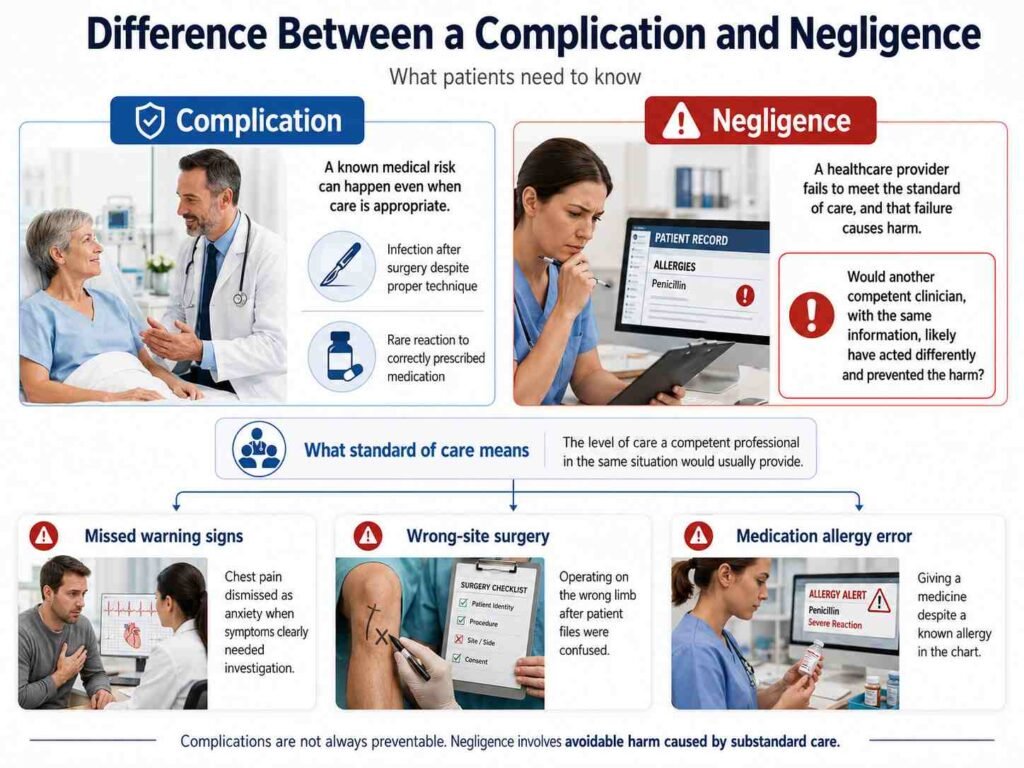
This is the first and most important distinction to understand, because it changes everything.
Medicine is not a perfect science. Complications happen even when doctors and nurses do everything right. A surgery can go smoothly in terms of technique, yet the patient still develops an infection. A medication can be prescribed correctly and still cause a rare adverse reaction. These outcomes are painful, but they are not necessarily anyone’s fault.
Medical negligence is different. It occurs when a healthcare provider fails to meet the standard of care that a competent professional in the same situation would have provided, and that failure directly causes harm to the patient.
A practical way to think about it: if another experienced doctor, given the same patient and the same information, would have made a different decision that would have prevented the harm, that is the kind of gap negligence claims examine.
What “Standard of Care” Looks Like in Practice
A GP who repeatedly dismisses a patient’s chest pain as anxiety, and that patient later has a heart attack, may have failed the standard of care if the symptoms clearly warranted investigation. A surgeon who operates on the wrong limb because two patient files were confused has obviously deviated from what is expected. A nurse who administers a medication a patient is known to be allergic to, without checking the chart, has made an error that should not have happened.
These are not edge cases. They are among the most commonly reported medical errors across the world.
Medical Errors That Occur More Often Than Most People Realise
Misdiagnosis and Delayed Diagnosis
A missed diagnosis is one of the most damaging errors a healthcare provider can make, because it means the underlying condition continues to worsen while the patient is either untreated or treated for the wrong thing entirely.
Conditions that are frequently misdiagnosed include heart attacks in women (whose symptoms often differ from the classic presentation described in textbooks), appendicitis in younger patients, sepsis in the early stages, and various cancers that are initially attributed to less serious causes.
Time matters enormously with these conditions. A cancer caught six months earlier may be treatable. The same cancer diagnosed six months too late may not be.
Surgical Errors
These range from operating on the wrong site to leaving surgical instruments inside a patient after a procedure is closed. Post-operative monitoring failures are also common. A patient showing early signs of internal bleeding who is not properly assessed in the hours following surgery may suffer preventable harm.
Elective and cosmetic procedures carry particular risk when clinics are running high volumes with limited follow-up care built into the process.
Medication Errors
An incorrect dosage, a drug that reacts badly with another medication the patient is already taking, or a prescription that ignores a documented allergy. These errors happen across hospitals, pharmacies, and GP practices, and they often come down to poor communication between different providers involved in one patient’s care.
Childbirth Injuries
Errors during labour and delivery can have permanent consequences for both mother and baby. Failure to recognise foetal distress, delays in performing an emergency caesarean, or improper use of delivery instruments can result in brain injuries or other serious harm that the child will live with for the rest of their life.
Emergency Department Errors
Emergency rooms are high-pressure environments where clinicians are making fast decisions with incomplete information. This creates real vulnerability to rushed assessments, premature discharge, and overlooked test results. A patient sent home from A&E with a “pulled muscle” who returns two days later with a fractured vertebra is a scenario that plays out more regularly than the system likes to admit.
What to Do If You Think Something Went Wrong
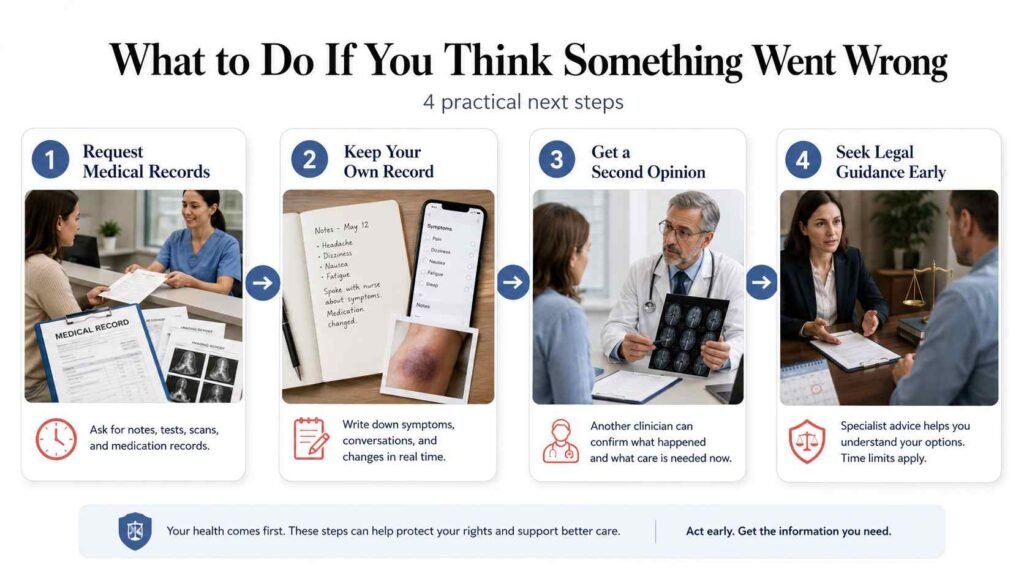
Step One: Request Your Medical Records Immediately
This is the single most important practical action you can take. You have the right to access your complete medical records, and you should exercise that right without delay.
Ask for everything: doctor’s notes, nursing logs, medication administration records, laboratory results, imaging reports, and any internal incident reports related to your care. Put your request in writing and keep a copy.
The reason for urgency is that hospitals and clinics often manage temporary electronic files, draft notes, and activity logs on a rolling deletion cycle. Evidence that exists today may not exist in six weeks.
Step Two: Keep Your Own Written Record
From the moment you suspect something went wrong, begin writing things down. Date and time every entry. Record what symptoms you are experiencing, what you were told by medical staff, what instructions were given or not given, and any conversations that felt significant.
Photograph any visible injuries, wound changes, or physical symptoms as they evolve. These contemporaneous records, ones you created in real time, are often more credible in an investigation than accounts reconstructed months later.
Step Three: Get a Second Medical Opinion
If your current provider is telling you that your outcome was unavoidable, or if you simply feel uncertain, see another qualified clinician independently. A second opinion can either reassure you that the care was appropriate or confirm that something was missed.
This step is also medically valuable in its own right. If you were mismanaged, you need a clear-eyed assessment of your current health status and the best path forward, regardless of what happens legally.
Step Four: Seek Legal Guidance Sooner Rather Than Later
Many patients wait far too long before speaking to a lawyer, often because they are not sure whether what happened to them “counts” or because the idea of taking legal action feels overwhelming while they are still dealing with health consequences.
You do not need a confirmed case to have a conversation. An initial consultation with a specialist gives you an objective assessment of whether your situation warrants further investigation, and most work on a no-win, no-fee basis. If you are in the Miami area or dealing with a Florida-based provider, you can get help from a medical malpractice attorney who specialises in exactly these cases.
Time limits apply to medical negligence claims in every jurisdiction. In many places, you have two to three years from the date of the harm, or from when you reasonably discovered it, to bring a claim. Missing that window typically means losing the right to do so entirely.
Red Flags That Are Worth Taking Seriously
Not every medical concern rises to the level of negligence, but these situations deserve careful follow-up:
You experienced a sudden and unexplained deterioration during or after treatment. You were discharged despite ongoing or worsening symptoms. Staff seemed uncertain or inconsistent about what medication you had received or why. You later discovered that test results were available but were not acted upon. What you were told verbally does not match what appears in your written discharge summary. A family member was told conflicting information by different members of the care team.
None of these automatically means negligence occurred. But each one is a reasonable basis for requesting your records and getting an independent review.
What Investigators Look For When Building a Case
If a claim proceeds, investigators work through several layers of evidence to understand what actually happened. Medical records are the foundation, but the analysis goes much deeper. Timelines are reconstructed by cross-referencing multiple documentation sources, because discrepancies between different records, for example, between a medication order and a pharmacy dispensing log, often reveal the moment a protocol broke down.
Expert clinicians review the case to assess whether the care fell below the accepted standard. The most credible experts are those who work in comparable clinical environments, because they can speak from genuine experience about what is and is not acceptable in that setting.
Witness statements from other clinical staff involved in the care can also be significant. These interviews require careful handling, as hospital employees sometimes face institutional pressure not to cooperate with patient inquiries.
A Word to Anyone Still Unsure
If you are reading this because you suspect something went wrong with your care, or a family member’s care, it is worth saying plainly: your concern is valid enough to investigate. You are not being dramatic. You are not attacking a profession. You are trying to understand what happened to you.
Healthcare providers are human, and most of them are doing their best. But systems fail, people make errors, and patients bear the consequences. Seeking answers is not just your right. In many cases, it is how patterns of unsafe care come to light and eventually get corrected, protecting future patients too.
Start with your records. Write everything down. Get a second clinical opinion. And if the picture that emerges raises serious concerns, speak to someone with the legal knowledge to help you evaluate what your next steps should be.
Medical Disclaimer: This article is for general informational purposes only and does not constitute legal or medical advice. If you believe you have experienced harm due to substandard medical care, please consult a qualified healthcare professional and a licensed legal representative in your jurisdiction.