


The practice details in this editorial are presented as an anonymized composite to protect patient and staff confidentiality.
Claim Was Not the First Thing That FailedI Had Confused Authorization With EligibilityMaternity Billing Could Not Be Treated Like an Ordinary Office ClaimCoding Software Had Given Me False ConfidenceNote Was Accurate but Not DefensibleWe Had Been Working Denials Without Learning From ThemWhat I Would Examine Before Hiring Outside Billing SupportFailure Changed More Than Our Billing ProcessFinal NoteDisclaimer
The denial arrived at 4:17 on a Thursday afternoon, just as I was preparing to leave the office.
It concerned a maternity claim that had already been corrected twice. The patient had transferred to the practice late in her pregnancy, received several prenatal visits and delivered under the care of one of our physicians. From the clinical side, nothing about the case appeared unusual. The care had been completed, the notes had been signed, and the claim had passed through our billing software without an obvious error.
The payer still refused payment.
My first reaction was irritation rather than curiosity. I assumed someone had entered the wrong modifier, selected an incorrect diagnosis code or missed a box during claim submission. I expected a quick correction followed by payment.
Instead, the denial exposed a chain of problems that began before the patient ever entered an examination room.
Claim Was Not the First Thing That Failed
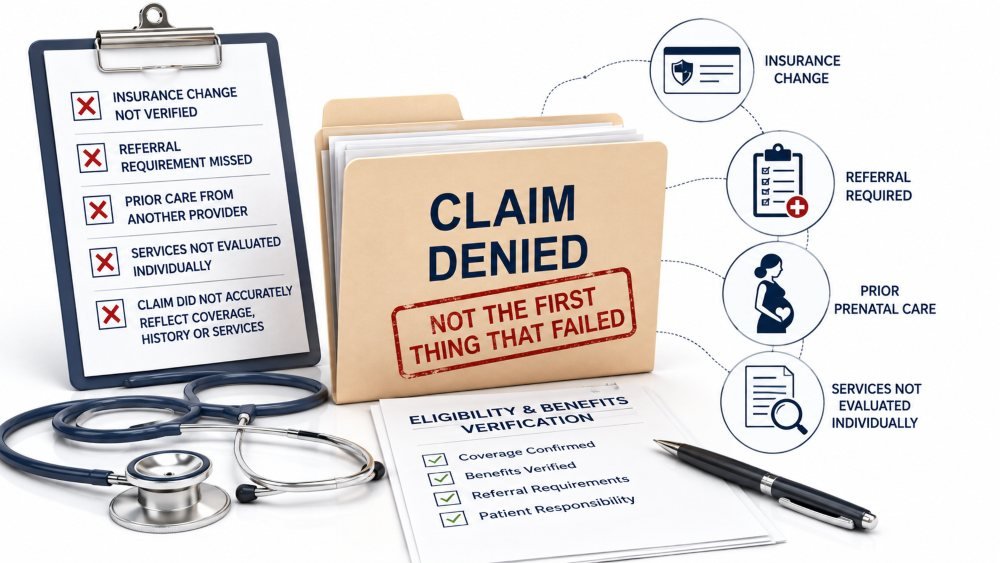
When I reviewed the account from the beginning, I found that the patient’s coverage had changed during pregnancy. Our front desk had copied the new insurance card, but the updated plan information had not been fully verified against the services scheduled for that day.
The new plan required a referral for part of the care. That requirement had not been identified before the appointment.
The patient had also received earlier prenatal care from another provider. Our claim had been prepared as though our practice had supplied a more complete portion of the maternity episode than the record could support. Some services needed to be evaluated individually rather than assumed to belong within one global arrangement.
None of these problems looked dramatic when viewed separately. Together, they produced a claim that did not accurately represent the patient’s coverage, care history or documented services.
That was the first lesson I took from the failure. A denial that appears to be a coding problem may actually begin with registration, eligibility verification, referral handling, scheduling or incomplete communication between departments.
Federal eligibility and benefits transaction standards exist so providers can request information about coverage, benefits and patient financial responsibility. The transaction itself, however, is only useful when the result is reviewed and connected to the service being scheduled.
We had treated eligibility verification as a routine administrative step. After the denial, I began to see it as the first clinical revenue decision made on every account.
I Had Confused Authorization With Eligibility
The account also forced me to confront a mistake I had made for years. I often used “eligible” and “authorized” as though they meant almost the same thing.
They do not.
A patient may have active insurance coverage while a particular procedure, test or course of treatment still requires referral, notification or prior authorization. Confirming that a plan is active does not necessarily confirm that every planned service will be reimbursed.
CMS explains in its prior authorization and pre-claim review guidance that supporting information may be reviewed before a service or claim proceeds. Although requirements vary among programs and payers, the operational lesson is wider: approval questions are easier to resolve before care than after a denial.
In our case, the referral issue had been discovered only after the service. By then, the billing team was trying to repair a decision that should have been made during scheduling.
I stopped asking the front desk whether insurance had merely been “checked.” I wanted to know what had been checked, which service was being verified, whether a referral or authorization applied, who had confirmed it and where that confirmation had been recorded.
That change sounded minor, but it made the workflow more accountable.
Maternity Billing Could Not Be Treated Like an Ordinary Office Claim
The next problem was the maternity timeline.
OB/GYN practices handle preventive visits, diagnostic encounters, pregnancy care, imaging, procedures, delivery and postpartum services. Those services may occur over many months, involve more than one provider and fall under different payer rules.
California’s Department of Health Care Services describes a broad range of Medi-Cal maternal and perinatal health care services, including standard obstetric visits, hospital care, laboratory services, miscarriage care and postpartum support.
The state also directs providers to Medi-Cal obstetric billing resources that distinguish areas such as global billing, per-visit billing, early pregnancy services and postpartum care. That distinction mattered in our case because the patient’s care had been divided between providers.
Our mistake was not simply choosing a wrong code. We had failed to reconstruct the episode of care.
We needed to know when the patient entered our practice, how many prenatal visits we had actually provided, who performed the delivery, whether postpartum care was included and what another provider may already have billed.
Once I saw the claim as a timeline rather than a form, the denial made more sense.
Coding Software Had Given Me False Confidence
Before this incident, I placed too much confidence in claim-scrubbing software. When a claim passed the automated checks, I assumed it was clean.
The software could identify an invalid field, a missing entry or a known code conflict. It could not always determine whether the claim accurately reflected the story in the medical record.
During our review, the coder checked the current National Correct Coding Initiative edits to assess whether reported services were subject to procedure-to-procedure or unit-related edits. CMS maintains these edits to support correct coding and reduce improper payments, with published files updated during the year.
We also checked the applicable official ICD-10 code files rather than relying only on remembered code descriptions or an outdated internal reference.
The coding review was necessary, but it did not solve everything. A valid code is not automatically the right code for a particular record. A modifier should not be added simply because it causes a claim to pass an edit. The medical note, payer policy and actual circumstances must support what is submitted.
That distinction changed the way I evaluated billing performance. I no longer considered a low rejection rate enough. Was the team comparing codes with the documented care, reviewing payer rules, and questioning claims that were technically valid but clinically incomplete?
Note Was Accurate but Not Defensible
The physician’s note was not false, careless or clinically unsafe. It was written for another clinician rather than for someone trying to understand why each billed service had been performed.
One part of the record mentioned an additional problem addressed during a routine encounter, but it did not fully show the separate assessment and work behind that service. Another section recorded a procedure without clearly connecting it to the diagnosis and medical necessity represented on the claim.
The billing team could guess what had happened, but a payer should not have to rely on a guess.
This experience taught me why clear clinical documentation is not clerical decoration. HHS Office of Inspector General guidance identifies proper coding, billing and documentation among the core compliance concerns for physician practices.
I had previously believed that documentation education meant asking physicians to write longer notes. That was the wrong goal.
A longer note can still be vague. What matters is whether the record clearly shows what was done, why it was done, how the patient’s condition affected the decision and how the documented service connects with the submitted claim.
HHS also recognizes that medical, billing, payment and claims information form part of the broader set of records maintained about a patient. Its guidance on medical and billing records reinforced for me that clinical and financial records are not completely separate worlds.
After the denial, our coders stopped silently correcting every documentation gap. When clarification was genuinely needed, the issue was returned through an appropriate query process. More importantly, recurring gaps were discussed with the practice so the next note could be clearer at the time of care.
We Had Been Working Denials Without Learning From Them
The claim was eventually corrected, but recovering one payment was not the most valuable result.
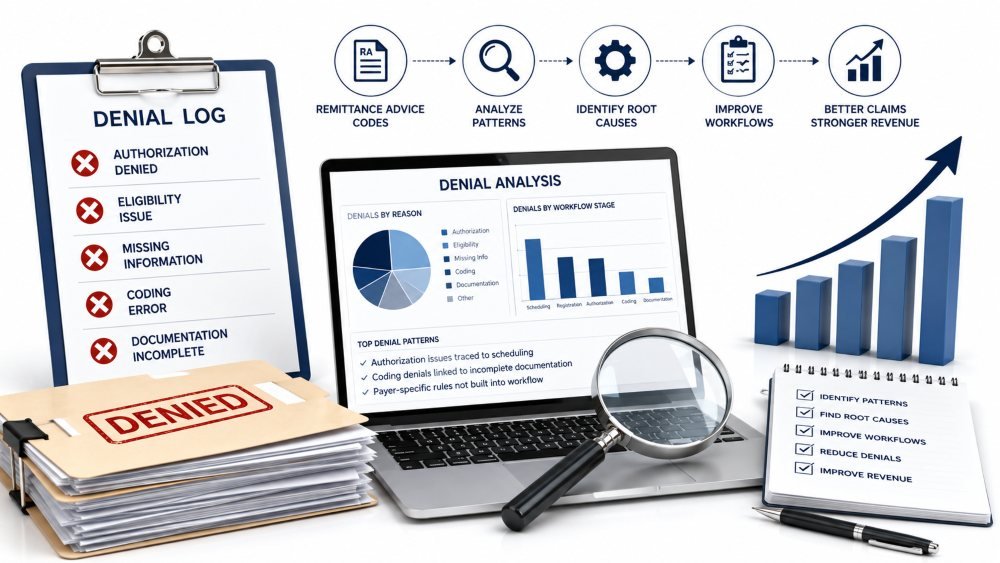
When I looked at our denial log, I discovered that we had received similar messages before. They had been assigned to different staff members, corrected individually and closed. No one had grouped them by payer, provider, procedure, authorization status or underlying workflow failure.
We were processing denials, but we were not managing them.
The CMS payment and remittance advice guidance explains how claim and line-level adjustments are communicated through standardized group codes, Claim Adjustment Reason Codes and Remittance Advice Remark Codes. Those codes are more than accounting labels. Read carefully; they can help a practice separate eligibility problems from coding issues, missing information, contractual adjustments and patient responsibility.
CMS also publishes standardized review reason codes and statements to make certain denied or non-affirmed decisions easier for providers to understand.
We began reviewing denial patterns monthly rather than discussing only the largest unpaid accounts. The questions changed from “Who will fix this claim?” to “Where did this type of failure begin?”
Several authorization denials traced back to scheduling. Some coding denials reflected incomplete documentation. Others came from payer-specific rules that had not been added to our internal workflow.
The data became useful only when we stopped treating every denial as an isolated event.
What I Would Examine Before Hiring Outside Billing Support
After this experience, I understood why a busy practice might consider outside help. I also learned that outsourcing does not automatically repair a weak process.
A billing company can submit claims quickly while still missing eligibility changes, fragmented maternity care, documentation gaps or payer-specific requirements. A polished dashboard does not prove that the people behind it understand obstetric and gynecologic billing.
When reviewing providers of OB/GYN Medical Billing Services in California, I would now ask for an explanation of the full workflow, not just a percentage-based promise about collections.
I would want to understand how the company verifies benefits, identifies referral and authorization requirements, handles transferred maternity patients, reviews global and per-visit billing, queries documentation problems, monitors filing deadlines and reports repeat denials.
I would also ask how responsibilities are divided. A practice should know whether eligibility is checked by the billing company or the front desk, who owns authorization follow-up, who reviews coding edits and how quickly unanswered payer requests are escalated.
During that comparison, BillingFreedom may be considered alongside other options because its website describes eligibility verification, OB/GYN coding support, claim submission, denial handling and accounts receivable services. Those descriptions are a starting point, not proof of performance. A practice should still request clear service boundaries, reporting examples, security information, staff qualifications, references and contract terms before making a decision.
The provider I would trust now is not necessarily the one promising the highest collection rate. It is the one willing to show how a denial moves backward through the workflow until its real cause is found.
Failure Changed More Than Our Billing Process
The maternity denial did not happen because one person failed to do a job. It happened because several reasonable assumptions met in the same account.
The front desk assumed active coverage was enough. The scheduler assumed the service did not require further approval. The coder assumed the care history supported the claim structure. I assumed that a claim passing through the software was ready to submit.
Each assumption was understandable. Together, they delayed payment and created avoidable work for the front office, billing staff and physician.
The most useful lesson was not that denials can be eliminated. They cannot. Payer policies change, coverage information can be incomplete and legitimate disagreements occur.
The lesson was that many denials leave evidence before they happen.
That evidence may appear in an eligibility response, an unresolved authorization, an incomplete maternity timeline, an unclear note, an unexpected code combination or a repeated remittance message. A strong billing process notices those signals while there is still time to act.
I used to see revenue cycle work as something that began after the physician finished caring for the patient. I now see it as a connected process that begins with the first insurance inquiry and continues until the claim is accurately resolved.
The denied claim on my screen that Thursday afternoon was frustrating, but it made one weakness impossible to ignore: we had become good at correcting individual errors without learning why they kept returning.
Once we changed that, fewer accounts reached the denial stage, staff spent less time reopening old work and conversations between clinical and billing teams became more useful.
That improvement did not come from one code, one software tool or one outside provider. It came from finally treating every denial as information about the process that produced it.
Final Note
The denied maternity claim changed how I judged the health of a billing process. A full schedule and steady claim submissions did not mean the revenue cycle was working properly. The more useful signs were accurate eligibility checks, timely authorizations, defensible documentation, correct claim structure and a clear process for identifying repeated denial patterns.
Practices considering internal improvements or outside billing support should look beyond broad promises about faster payments. They should examine how each provider handles OB/GYN-specific coding, maternity timelines, payer requirements, documentation questions, denial reporting and communication with practice staff. The right process should not simply correct rejected claims. It should help the practice understand why those claims failed and reduce the chance of the same problem happening again.
Disclaimer
This article is provided for general educational and informational purposes only. It does not constitute medical, legal, financial, coding, compliance or reimbursement advice.
Billing requirements, payer policies, coding guidance, authorization rules and California healthcare program requirements may change. Healthcare practices should verify current information through applicable payer contracts, official government guidance and qualified coding, billing, legal or compliance professionals before making operational or claim-submission decisions.
The practice and patient circumstances described in this article are anonymized and presented as a composite example. They do not describe a specific patient encounter or disclose protected health information. References to billing service providers are included for editorial discussion and comparison purposes and should not be interpreted as a guarantee, endorsement or promise of particular financial results.