

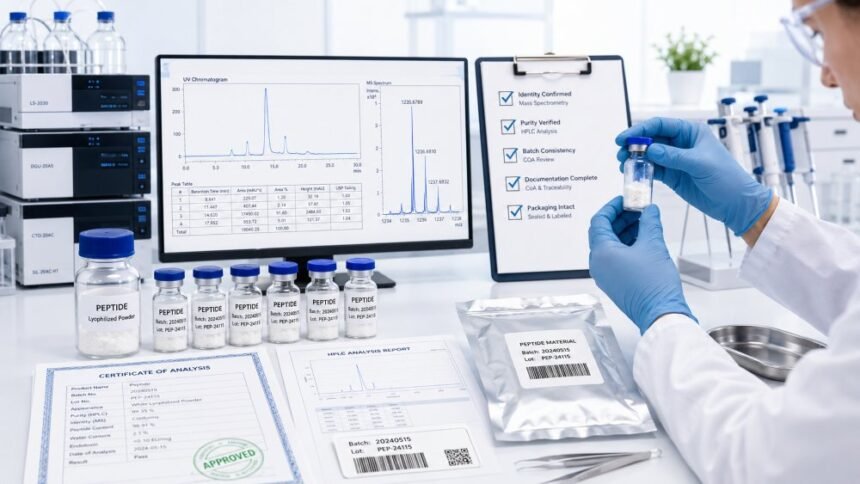
A polished website can create a strong first impression, but it cannot confirm the identity, purity, stability, or suitability of a peptide material. Laboratory teams need evidence that can be reviewed, questioned, and connected to the exact batch they receive.
That review should form part of an institution’s established procurement, biosafety, legal, and quality-management procedures. It should never be treated as confirmation that a material is safe for personal, clinical, veterinary, cosmetic, or human use.
Begin With the Intended Research Purpose
Before reviewing analytical reports, the research team should clearly define what the material will be used for.
A peptide suitable for an early-stage analytical experiment may not meet the requirements of a cell-based study, an animal protocol, a regulated investigation, or a project requiring exceptionally low endotoxin levels. “High purity” is therefore not a complete specification.
The laboratory should document:
- The intended experimental application
- The required peptide sequence and molecular mass
- Acceptable purity and impurity limits
- Required salt form or counterion
- Solubility and handling limitations
- Sterility or endotoxin requirements, where applicable
- Storage temperature and expected stability
- Institutional approval and disposal procedures
This specification gives the quality team something meaningful to compare against the supplied documentation.
Confirm That Reports Belong to the Exact Batch
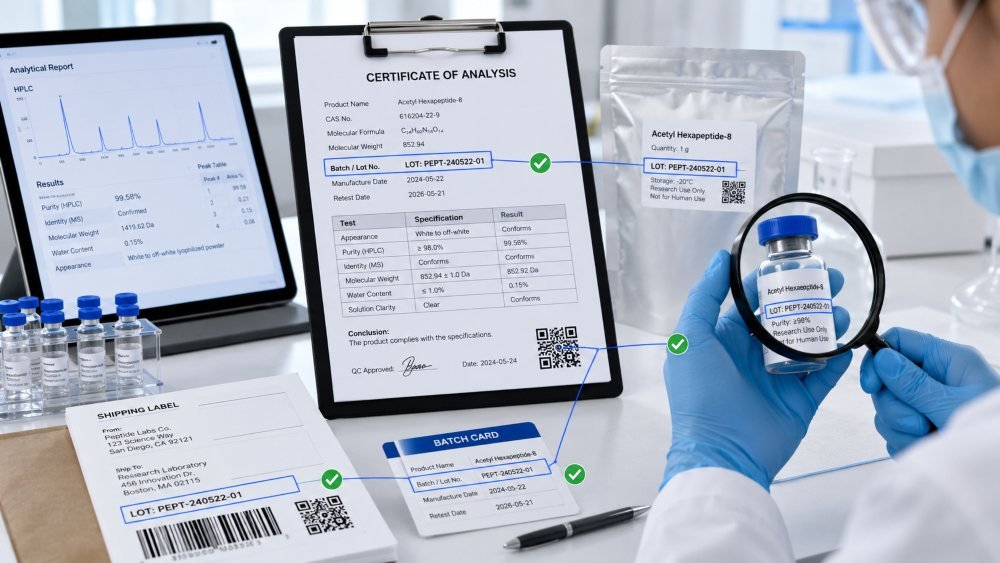
A Certificate of Analysis is useful only when it can be connected to the material in front of the researcher.
The report should identify the peptide, batch or lot number, testing date, analytical method, acceptance criteria and actual results. The batch number on the document should match the label and supporting shipment records.
Generic reports deserve caution. A certificate showing impressive results from an earlier batch does not prove that a newly received batch has the same composition or quality.
Good documentation should also be traceable. Researchers should be able to determine who performed the analysis, which method was followed and whether the report was approved through a defined quality process.
Understand What Purity Testing Can and Cannot Show.
High-Performance Liquid Chromatography, commonly called HPLC, is frequently used to separate a peptide from detectable impurities. The resulting chromatogram can help estimate how much of the measured sample is represented by the principal peak.
However, a single purity percentage does not answer every quality question.
A prominent peak may indicate that one component dominates the chromatogram, but it does not automatically confirm that the component has the intended molecular identity. The result can also be influenced by the method, detector, integration settings, reference standards and impurities that the method cannot adequately separate.
The American Chemical Society’s explanation of analytical chemistry provides useful background on how analytical scientists determine what a substance contains and how much is present.
Look for Identity Testing Alongside Purity Data
Mass spectrometry can provide evidence about molecular identity by measuring mass-to-charge characteristics. Liquid chromatography combined with mass spectrometry can be especially useful because it joins chromatographic separation with molecular analysis.
For peptide materials, reviewing HPLC and mass-spectrometry data together generally provides a fuller analytical picture than relying on either result alone. Depending on the project, researchers may also need sequence confirmation, water-content testing, residual-solvent analysis, counterion determination or peptide-content measurements.
The United States Pharmacopeia’s material on peptide-fragment impurity analysis illustrates why chromatographic and mass-spectrometry methods may be combined when impurities overlap or cannot be interpreted confidently through a basic chromatogram.
Verify the Competence of the Testing Laboratory
“Third-party tested” sounds reassuring, but the phrase alone reveals very little.
The report should identify the testing laboratory rather than referring vaguely to an unnamed independent facility. The laboratory’s accreditation scope should also be reviewed because accreditation for one field does not necessarily cover every analytical method performed at the facility.
ISO/IEC 17025 addresses the competence, impartiality and consistent operation of testing and calibration laboratories. Accreditation does not guarantee that every result is flawless, but it provides a recognized framework for evaluating laboratory competence and the reliability of its processes.
Research teams should check whether:
- The laboratory can be independently identified
- Its accreditation is current
- The relevant test falls within its accreditation scope
- The report contains traceable sample and batch details
- The analytical method and results are clearly stated
- Alterations, missing pages or unexplained formatting are present
For example, Eternal Peptides has a dedicated Lab Tests page where they list Certificates of Analysis from the latest tests. They work with accredited labs in the U.S., and this independent testing includes tests for sterility, endotoxin levels, and heavy metals. That level of peptide purity and quality gives researchers a broader view of each product’s analytical profile.
Review Quality Systems, Not Just Individual Numbers
One excellent report cannot prove that every batch has been handled consistently. Laboratory teams should also consider the quality system surrounding sampling, testing, storage, documentation and record retention.
The OECD Principles of Good Laboratory Practice describe standards for organizing, managing, recording and reporting certain laboratory studies. GLP and ISO/IEC 17025 serve different purposes, but both reinforce the importance of controlled procedures, traceable records and dependable data.
Useful documentation may include:
- Written specifications
- Approved analytical procedures
- Batch and sample identifiers
- Deviation records
- Change-control records
- Storage-monitoring information
- Equipment calibration records
- Corrective and preventive actions
- Document approval and revision histories
The strongest quality systems do not merely produce attractive certificates. They make it possible to reconstruct what happened to a material, when it happened and who reviewed it.
Examine Sterility, Endotoxin and Contaminant Claims Carefully
Purity does not mean sterility.
A chromatogram may show the proportion of detectable chemical components without revealing microbial contamination, endotoxin, particulate matter or every possible hazardous impurity. Claims involving sterility, endotoxin levels, heavy metals or residual solvents require appropriate, separately identified test methods.
The relevance of these tests depends on the experiment. Researchers should not assume that a material is appropriate for biological work merely because it carries a high chromatographic purity figure.
Check Storage and Stability Information
Peptides can be sensitive to moisture, temperature, repeated freeze-thaw cycles, oxidation and other environmental conditions. The label should provide clear storage instructions, but a temperature statement by itself is not necessarily evidence of stability.
A meaningful stability claim should be supported by documented studies or a scientifically justified assessment. The team should know whether the stated shelf life applies to unopened lyophilized material, a prepared solution or both.
Receiving procedures matter as well. Laboratories should document the condition of the shipment, packaging integrity, temperature-control evidence where required and the date the material entered controlled storage.
Keep Research Materials Separate From Human-Use Products
A “research use only” label does not establish that a product is safe, effective, sterile or legally authorized for treatment. It also does not correct promotional claims suggesting that an unapproved product can diagnose, prevent or treat a medical condition.
The FDA’s information about unapproved GLP-1 products explains that unapproved versions do not undergo the agency’s review for safety, effectiveness and quality before reaching consumers.
Health Canada has issued a similar warning about the serious risks associated with unauthorized injectable peptides purchased online.
Anyone seeking medical treatment should speak with a qualified healthcare professional and use appropriately authorized medicines through lawful healthcare channels.
Treat Marketing Claims as Claims, Not Evidence
Terms such as “pharmaceutical grade,” “premium quality,” “clinical strength” or “laboratory grade” can sound scientific without providing a measurable specification.
A careful reviewer asks what each term means, which standard defines it and what evidence supports it. Statements about purity, sterility, stability or identity should lead to a test method and a batch-specific result.
Researchers should be particularly cautious when technical documentation is accompanied by human transformation claims, dosing discussions, before-and-after photographs or testimonials describing medical outcomes.
The FDA maintains information about warning letters involving unsafe online drug sales, which can help institutional compliance teams understand the types of practices that attract regulatory scrutiny.
Review the Scientific Context
Peptides have legitimate and important roles in biochemical research and medicine, but they are not a single uniform category. Their properties can vary considerably according to sequence, structure, modifications, formulation and intended application.
A peer-reviewed overview of therapeutic peptide research discusses both the scientific potential of peptides and the challenges associated with their development and production. It offers useful context without turning product marketing into scientific proof.
Warning Signs That Justify Further Investigation
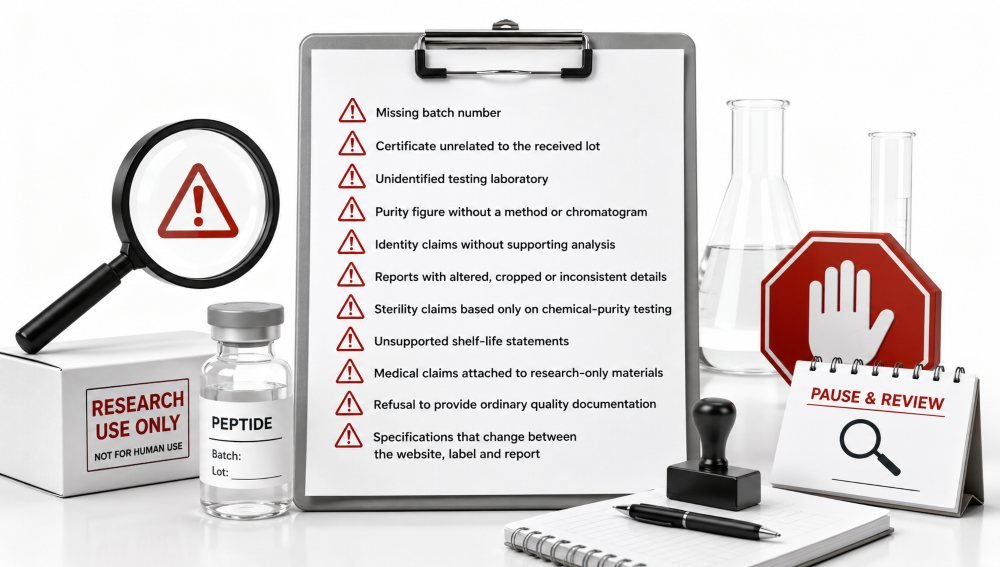
A laboratory’s quality or compliance team should pause its review when it finds:
- A missing batch number
- A certificate unrelated to the received lot
- An unidentified testing laboratory
- A purity figure without a method or chromatogram
- Identity claims without supporting analysis
- Reports with altered, cropped or inconsistent details
- Sterility claims based only on chemical-purity testing
- Unsupported shelf-life statements
- Medical claims attached to research-only materials
- Refusal to provide ordinary quality documentation
- Specifications that change between the website, label and report
One inconsistency may have a reasonable explanation. Several inconsistencies suggest that the material should not be accepted until the concerns have been formally investigated.
Build a Documented Acceptance Process
The safest institutional approach is a written review process rather than an informal decision made by one researcher.
Responsibility can be divided among scientific, quality, procurement, legal and biosafety personnel. The team can then document whether the material meets the project specification, whether the analytical evidence is adequate and whether any remaining uncertainty affects the proposed research.
The central question is not whether a company’s marketing appears convincing. It is whether the laboratory can independently trace, interpret and defend the evidence connected to the exact material it plans to accept.
That shift from reputation to documentation creates a more reliable foundation for responsible research.
Disclaimer
This article is for general educational and informational purposes only and does not constitute medical, legal, clinical, or regulatory advice. Any peptides mentioned are discussed solely for legitimate research use and should not be used for human consumption, self-administration, diagnosis, treatment, cosmetic, or veterinary purposes. Laboratories should independently verify all batch-specific testing, documentation, quality, safety, and regulatory information. Mentioning any company, laboratory, product, or external resource does not imply endorsement, and readers are responsible for conducting their own due diligence.
Scientific References
- Wang L, Wang N, Zhang W, Cheng X, Yan Z, Shao G, Wang X, Wang R, Fu C. Therapeutic peptides: Current applications and future directions. Signal Transduction and Targeted Therapy. 2022;7:48. DOI: 10.1038/s41392-022-00904-4.
- Lau JL, Dunn MK. Therapeutic peptides: Historical perspectives, current development trends, and future directions. Bioorganic & Medicinal Chemistry. 2018;26(10):2700–2707. DOI: 10.1016/j.bmc.2017.06.052.
- Fosgerau K, Hoffmann T. Peptide therapeutics: Current status and future directions. Drug Discovery Today. 2015;20(1):122–128. DOI: 10.1016/j.drudis.2014.10.003.
- Lian Z, Wang N, Tian Y, Huang L. Characterization of synthetic peptide therapeutics using liquid chromatography-mass spectrometry: Challenges, solutions, pitfalls, and future perspectives. Journal of the American Society for Mass Spectrometry. 2021;32(8):1852–1860. DOI: 10.1021/jasms.0c00479.
- McCarthy D, Han Y, Carrick K, Schmidt D, Workman W, Matejtschuk P, Duru C, Atouf F. Reference standards to support quality of synthetic peptide therapeutics. Pharmaceutical Research. 2023;40(6):1317–1328. DOI: 10.1007/s11095-023-03493-1.
- Zapadka KL, Becher FJ, Gomes Dos Santos AL, Jackson SE. Factors affecting the physical stability and aggregation of peptide therapeutics. Interface Focus. 2017;7(6):20170030. DOI: 10.1098/rsfs.2017.0030.
- Bolden JS, Warburton RE, Phelan R, Murphy M, Smith KR, De Felippis MR, Chen D. Endotoxin recovery using the Limulus amebocyte lysate assay. Biologicals. 2016;44(5):434–440. DOI: 10.1016/j.biologicals.2016.04.009.
- Mitra MS, DeMarco S, Holub B, Thiruneelakantapillai L, Thackaberry EA. Development of peptide therapeutics: A nonclinical safety assessment perspective. Regulatory Toxicology and Pharmacology. 2020;117:104766. DOI: 10.1016/j.yrtph.2020.104766.