

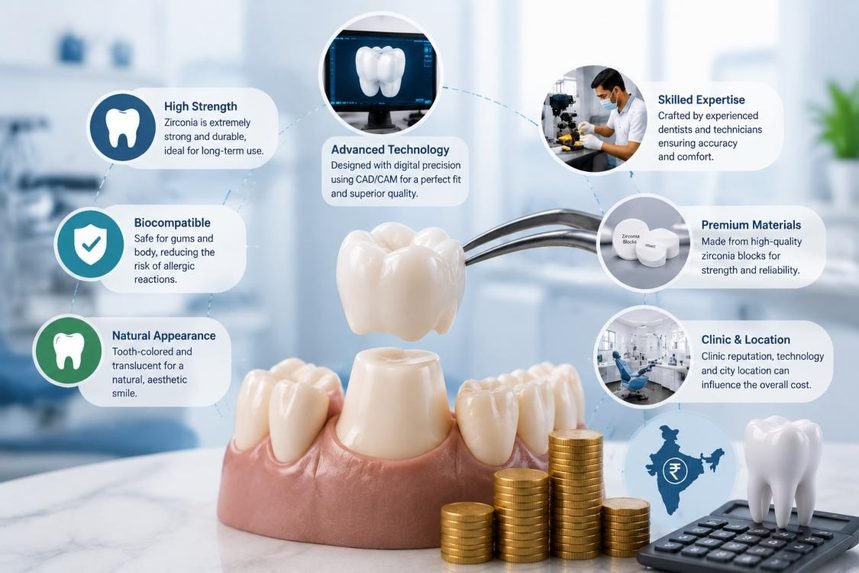
The number usually arrives without much explanation. Your dentist finishes the root canal, mentions that the tooth now needs a cap, and quotes a figure. Maybe it is ₹9,000. Maybe it is ₹22,000. Either way, you walk out holding a number and very little sense of what sits behind it, which is an awkward position to be in when the same tooth in the same mouth can be quoted at either end of that spread depending on which clinic you happened to walk into.
That gap is rarely a case of one clinic simply overcharging. A crown quote bundles together at least five separate decisions, most of them made in a laboratory you will never visit, using a material whose grade nobody thought to ask you about. Learning to read the quote is the difference between paying more and paying more for something.
Short Answer On Price
Most published figures put the zirconia crown price in india somewhere between ₹8,000 and ₹25,000 per tooth. That range is honest rather than evasive. Entry-level quotes from smaller practices using local laboratories can begin near ₹6,500. In contrast, a case involving a specialist prosthodontist, an intraoral scan and an internationally accredited laboratory can cross ₹30,000 for a single unit.
Before worrying about the figure, it helps to be clear on what the restoration is for. The American Dental Association’s patient guidance on when a crown is recommended is a useful reference point: a crown holds together a tooth that no longer has enough structure to hold a filling, protects one that is cracked or weakened, or covers a tooth that is badly shaped or discoloured. A root canal-treated molar generally falls into the first category, and leaving it uncrowned is usually the more expensive decision in the long run.
Why Two Clinics Quote Two Different Numbers For The Same Tooth
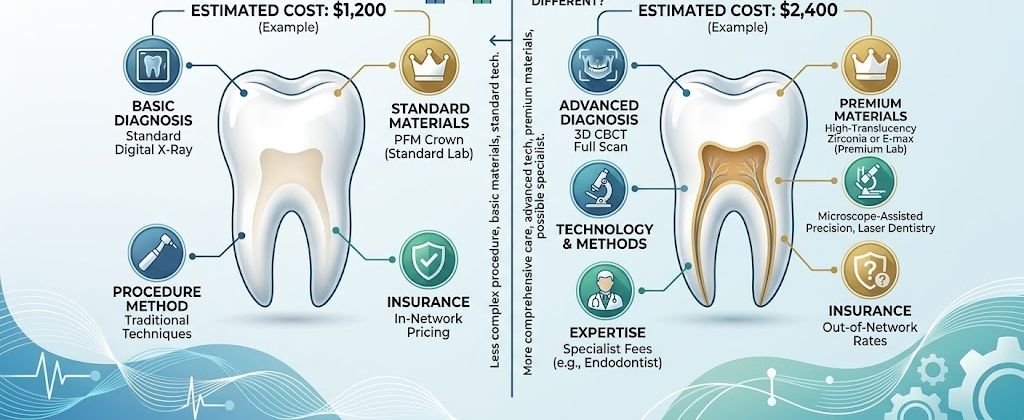
Four variables account for most of the spread, and only one of them is the material itself.
The first is who is doing the work. A general dentist and an MDS prosthodontist will both prepare a tooth competently, but the specialist is charging for judgement about margin placement, bite forces and shade matching. That judgement matters most on front teeth and in mouths with complicated occlusion, and matters less on a straightforward lower molar.
The second is which laboratory receives the file or the impression. This is the single largest hidden variable in Indian crown pricing, and it is covered in more detail below.
The third is where the tooth sits. A first molar taking heavy chewing load and a lateral incisor sitting in your smile line are different engineering problems, and the material chosen for each is priced differently.
The fourth is the clinic itself. Rent in Bandra or Indiranagar is not the same as rent in a tier three town, and it lands in your bill whether or not anyone says so out loud.
Not All Zirconia Is The Same Material
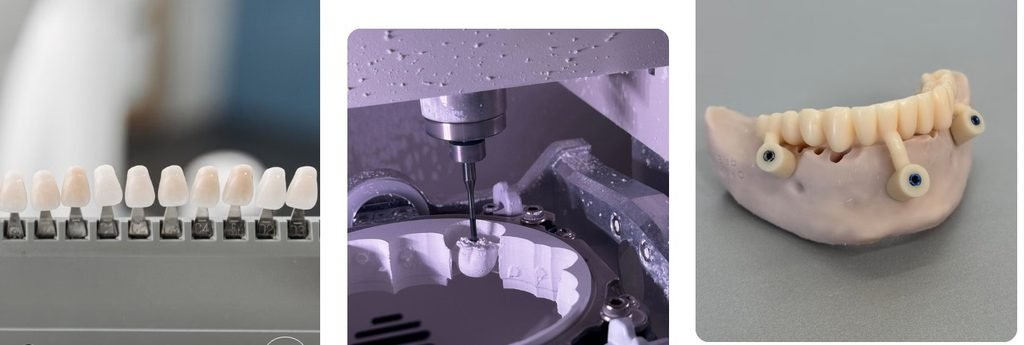
This is where most cost guides go wrong, and it is worth getting right because it is the part your quote almost never spells out.
Zirconia is sold in generations, distinguished by how much yttria has been added to stabilise the crystal structure. The relationship is a straight trade. Lower yttria zirconia, known as 3Y-TZP, is the strongest option, with flexural strength commonly cited in the region of 900 to 1,200 MPa. Still, it is also the most opaque, which is why 3Y front teeth have a reputation for looking a little flat. Raising the yttria content to 4 or 5 mol per cent increases the proportion of cubic phase in the microstructure, which lets light through and looks far more natural, but reduces strength. A review of zirconia generations and their clinical indications sets out this trade-off in detail. No generation wins on both counts.
Two further distinctions matter, and they are routinely confused with each other.
- A multilayer zirconia crown is still a single solid piece. The laboratory mills it from a disc that has been manufactured with graded yttria content, stronger material at the dentine end and more translucent material at the incisal end, producing a natural shade gradient without any separate ceramic being applied. It is monolithic.
- A veneered or layered zirconia crown is a genuinely different construction: a zirconia core with porcelain fired over the top. It can look superb, and it introduces a second material and a bonded interface. That interface is the weak point. A systematic review comparing monolithic against porcelain veneered zirconia restorations across more than six thousand units found the veneered group experienced noticeably more technical complications, with the difference most pronounced for chipping of the porcelain.
So if you are quoted for a “layered” crown, ask which of the two the laboratory means. They carry different prices and different failure profiles.
Where The Laboratory Fits Into Your Bill
Patients tend to assume the dentist sets the price. In practice, the laboratory often sets more of it.
A crown milled on a well-maintained five-axis unit from a certified disc, sintered to the manufacturer’s protocol and finished by an experienced ceramist is a different object from one milled cheaply and rushed through a speed sintering cycle. That difference is invisible in the mouth on day one and becomes visible around year five.
You will also see claims about certification, and these are worth reading precisely. ISO 13485 certifies a manufacturer’s quality management system, not any individual crown. A US FDA 510(k) clearance means a device has been found substantially equivalent to something already on the market, which is a regulatory pathway rather than a quality award. Both are meaningful signals that a laboratory operates under documented process control. Neither is a guarantee about the piece of ceramic going into your tooth, and any clinic presenting them as one is overselling.
The genuinely useful question is narrower: which laboratory, which zirconia brand and grade, and is the warranty claimable anywhere or only at this clinic?
What Zirconia Buys You Compared With Metal Ceramic
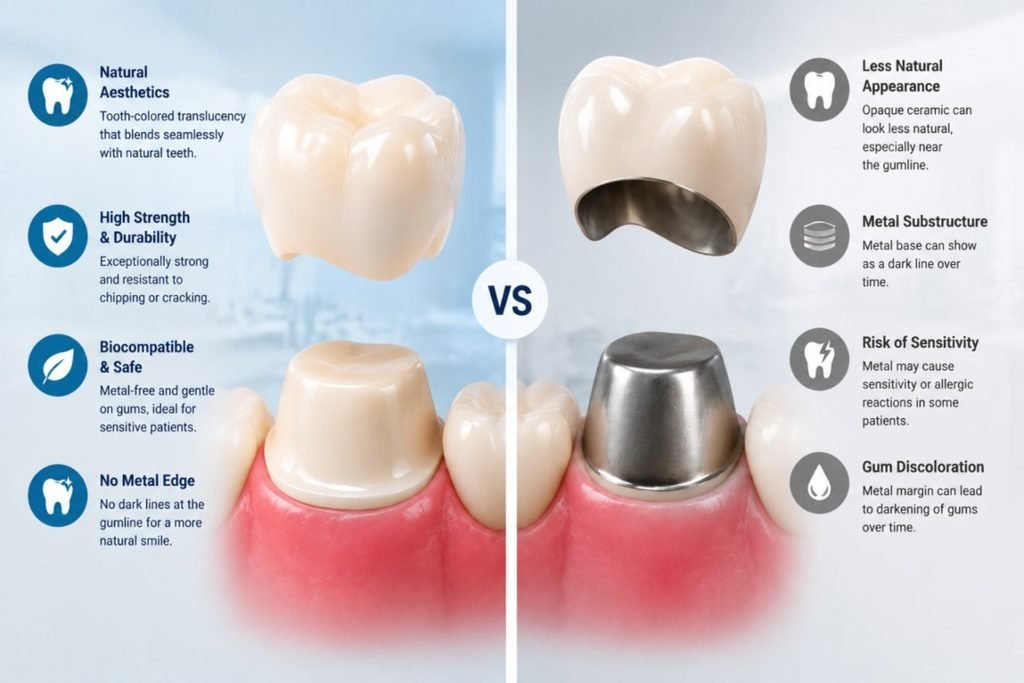
Porcelain fused to metal remains the cheaper option in India, often ₹5,000 to ₹15,000, and for many back teeth it is a perfectly reasonable restoration. The case for spending more on zirconia rests on three things.
- Chipping. The porcelain layer on a PFM crown can fracture away from its metal substructure, and this has been the material’s characteristic long-term complication for decades. A 2026 systematic review of tooth-supported single crown survival across materials concluded that zirconia-based all-ceramic crowns achieve five-year survival comparable to metal-ceramic, while monolithic designs showed significantly fewer ceramic fractures and chipping episodes than veneered alternatives. Note the qualifier: the advantage belongs to monolithic construction, not to zirconia in the abstract.
- The grey margin. Over time, gums can recede slightly from the crown edge, and on a PFM crown that exposes the metal collar underneath as a dark line at the gum. It is a cosmetic problem rather than a clinical failure, but it is a permanent one short of remaking the crown, and it is the complaint that sends most patients looking for a metal-free alternative in the first place.
- Metal content. Zirconia is zirconium dioxide, a ceramic, and a zirconia crown contains no metal alloy substructure. This matters for the minority of patients who are sensitised to nickel or cobalt. Worth keeping in proportion, though: sensitisation to nickel is common in the general population, particularly among women, but a clinical review of nickel allergy and its exposure routes makes clear that the oral cavity behaves differently from skin, and documented allergic reactions to nickel-containing dental prostheses are considerably rarer than skin sensitisation rates alone would suggest. If you have a confirmed metal allergy, a metal-free crown is a sound clinical decision. If you do not, it is a preference rather than a medical necessity.
If You Grind Your Teeth
Bruxism is the situation where material choice genuinely earns its cost difference. Grinding loads a crown in ways ordinary chewing does not, and a thin translucent ceramic on a molar in a heavy grinder is asking for trouble.
Monolithic zirconia is the usual answer here, and its performance in this specific group has been studied directly. Researchers have followed monolithic zirconia restorations in bruxing and non-bruxing patients precisely because clinicians needed to know whether the material holds up under those forces rather than assuming it does. If you wake with a sore jaw or your partner has mentioned the noise, say so before the material is chosen, not afterwards.
How India Compares With Other Markets
Cross-border comparisons circulate freely in dental marketing and are often muddled, usually by presenting a foreign market price as though it were a currency conversion of the Indian one. They are not the same thing. ₹8,000 to ₹25,000 converts to roughly US$90 to US$285 at current rates. The reason a crown costs US$1,000 to US$2,500 in the United States is not exchange rates; it is labour costs, clinical overheads and insurance structures.
The United Kingdom illustrates the point neatly, because it has two prices running in parallel. Privately, a zirconia crown typically runs £550 to £1,200. On the NHS, a crown falls under a Band 3 course of treatment at a fixed charge of £332.10 from April 2026, and that single charge covers the entire course regardless of how many crowns are involved. The official NHS guidance on dental treatment costs sets out the banding and the exemptions. Comparing an Indian private fee against a UK private fee tells you something. Comparing it against the NHS band charge tells you almost nothing, because they are structurally different products.
Costs That Are Not On The Quote
A crown quote is frequently just the crown. Ask specifically whether the following are included, because each can add meaningfully to the total:
- Root canal treatment, if the tooth has not already had one
- A post and core build-up, common on heavily broken-down teeth.
- Scaling or gum treatment needed before impressions can be taken.
- The temporary crown worn between appointments
- Digital scanning, where the clinic uses it
- Follow-up visits and bite adjustment.
- Replacement terms if the crown fails, and whether that warranty travels if you move city
About Those Zero Cost EMI Offers
Instalment plans have become standard in Indian dentistry, and for a genuine ₹25,000 outlay they can be sensible. The phrase “zero cost” deserves scrutiny, though.
The Reserve Bank of India has taken a clear position on this. Its master circular on interest rates on advances instructs banks to refrain from offering low or zero per cent interest rates achieved by adjusting a discount available from the seller, on the grounds that such schemes lack transparency and distort the pricing of loan products. The regulator’s reasoning is straightforward: the cost has not disappeared; it has moved into a processing fee or into the price you were quoted in the first place.
There is a simple test. Ask the clinic what the price is if you pay in full, in one payment, today. If that number is lower than the EMI total, you now know what the finance actually costs. If it is identical, the scheme may well be as advertised. Either way you have the information, which is the point.
Questions Worth Asking Before You Agree
Take these to the consultation. They take two minutes, and they change the quality of the answer you get:
- Which zirconia grade is this, and monolithic or veneered?
- Which laboratory, and are they ISO 13485 certified?
- Is the warranty claimable only here, or at any associated clinic?
- What is the total including any build-up, temporary and follow-ups?
- Given this specific tooth, would you choose differently if it were yours?
That last question is the useful one. A dentist who engages with it properly is one worth listening to.
A Sensible Way To Think About The Spend
Zirconia crowns are strong, they look convincing, and the clinical evidence for monolithic designs in particular is genuinely good. What that evidence does not support is the idea that spending more automatically buys you more. A ₹22,000 crown fitted to a tooth with a poor margin, or set into a bite nobody adjusted properly, will fail sooner than a ₹10,000 crown fitted carefully.
Most of what determines whether a crown lasts is not the price of the ceramic. It is the accuracy of the preparation, the fit at the margin, whether the bite was checked, and whether you clean around it afterwards. Those things cost the dentist time rather than money, which is exactly why they are the hardest part of the service to see on a quote.
Ask better questions, understand which grade of material you are buying and which laboratory is making it, and the number in front of you stops being arbitrary. That is a more useful outcome than finding the cheapest quote in your city, and considerably more useful than assuming the most expensive one must be the best.
Disclaimer: This article is intended for general information only and does not constitute dental or medical advice. Prices quoted are indicative private clinic ranges and vary by city, clinic, material grade and individual clinical circumstances. Government dental colleges typically charge substantially less. Always consult a registered dentist for diagnosis and a written treatment quote specific to your case.