

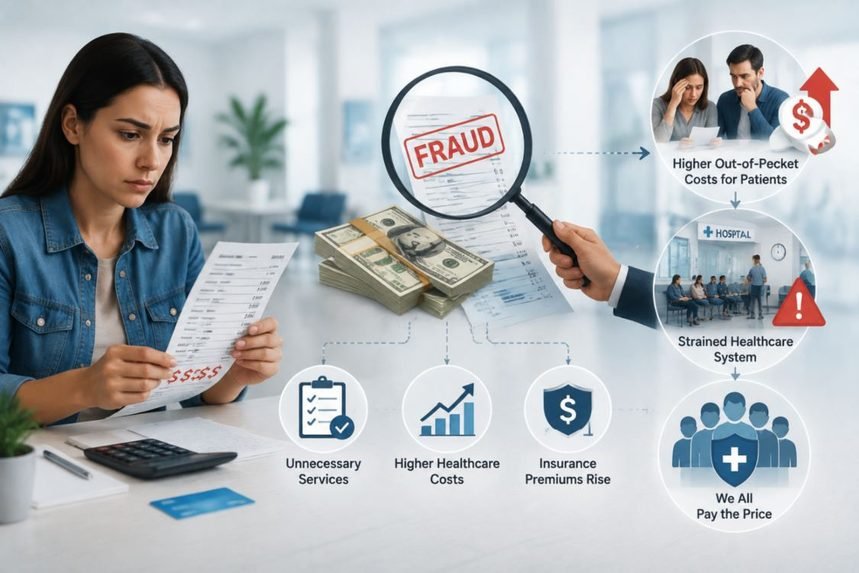
A bill arrives for a procedure you have no memory of having. You call the office, a little confused, and someone tells you in a flat, practiced voice that this is how insurance billing works. Most people hear that, sigh, and pay. That instinct is exactly what the system counts on.
Healthcare fraud drains tens of billions of dollars a year from the United States, and very little of that loss stays with the insurers who first absorb it. It travels downhill, to you, in the form of higher premiums, denied claims, faster-burning deductibles, and once in a while a test or an operation performed for no reason other than to lengthen an invoice. Noticing when the numbers on your own paperwork stop making sense is not paranoia. It is basic financial and medical self-defense.
What Healthcare Fraud Actually Looks Like
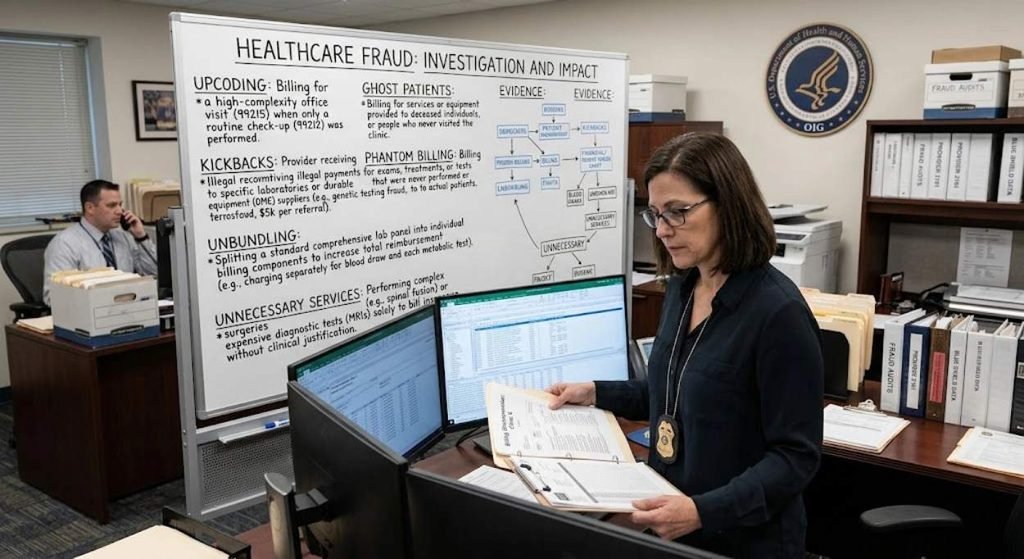
There is rarely anything cinematic about it. No masked figure, no dramatic reveal. Just ordinary medical paperwork with figures that quietly refuse to add up.
Being Billed For Care You Never Got
This is the plainest version of the problem. A provider bills your insurer, or you, for a test or a procedure that never happened. Sometimes it is a duplicate charge for a single visit, sometimes a follow-up appointment that exists only on paper, sometimes a lab test that was ordered and then never run. People tend to catch this only when they read every line of the Explanation of Benefits instead of skimming to the amount due.
Upcoding: Small Visit, Big Charge
Here the service is real, but the code attached to it is inflated. A fifteen-minute check-up is billed as a forty-five-minute consultation. A routine X-ray is written up as a more advanced imaging study. Nothing about the appointment felt unusual, yet the codes sent to your insurer tell a more expensive story than the one you lived.
Procedures You Never Needed
This category is the dangerous one, because it costs you money and health at the same time. Some providers order scans, tests, or operations that a patient does not need, driven by the revenue each one generates rather than any clinical reason. The classic examples run from cardiologists ordering unnecessary stents to physical therapy clinics stacking appointments that add nothing to a recovery.
The harm is not only financial. Imaging that uses ionizing radiation carries a small but real increase in lifetime cancer risk, which is precisely why the FDA advises that X-ray and CT exams be performed only when they answer a genuine medical question. An unnecessary scan is not a free second opinion. It is exposure you did not need to accept.
Kickbacks And Steered Referrals
Occasionally a doctor is paid to send you to a particular specialist, imaging center, or laboratory. Those arrangements are illegal under the federal Anti-Kickback statute, for a straightforward reason: the moment a referral is bought, your care starts answering to someone’s profit margin rather than to your symptoms.
Why Telehealth Deserves A Closer Look

Virtual care addressed a genuine need, letting people get a clinician’s judgment without surrendering half a day to a waiting room. It also opened a fresh set of billing seams that investigators have been trying to close ever since the pandemic normalized the format.
The most common trick is coding a quick phone call as something far more involved. A five-minute conversation to renew a prescription gets billed as a full evaluation. A form you filled out on a clinic’s website, with no clinician on the other end, shows up as a completed virtual visit. A newer wrinkle is bundling, where one short call is split into separate charges labeled “evaluation,” “counseling,” and “care coordination,” each modest enough on its own to slip past a tired eye.
Why This Is Your Problem, Not Just Your Insurer’s
It is tempting to picture fraud as a contest between providers and insurers, with patients watching from the stands. That framing is comfortable and wrong. When false or inflated claims wash through the system, insurers price the loss into everyone’s premiums. Anti-fraud analysts at the National Health Care Anti-Fraud Association put the toll conservatively at three percent of all health spending, and some government figures run far higher. Everyone helps pay that bill.
If you carry a high-deductible health plan, the damage is even more direct. A duplicate or padded charge eats through your deductible faster, or clears it entirely, moving real money out of your own pocket. It is worth separating this from the ordinary shock of an unexpected out-of-network bill, since many of those are now covered by federal protections against surprise medical bills. Fraud is a different animal, and it does not come with a built-in safeguard.
There is a slower cost too, harder to price but just as corrosive. Good medicine runs on trust. Once you find yourself wondering whether a recommendation is about your health or about someone’s quarterly numbers, that trust frays, and it is difficult to rebuild.
What To Do When Something Looks Off
Start With The Billing Office
Most discrepancies are honest mistakes, not schemes. Call the provider’s billing department and ask them to explain or justify the charge. If it was an error, request corrected paperwork, and write down who you spoke with and when.
Escalate To Your Insurer
If the office cannot justify the charge, or gives you an answer that does not hold together, take it to your insurer. Most carriers run fraud units that take patient reports seriously.
Report It To The Right Authority
When the charges involve Medicare or Medicaid, you can report suspected fraud to Medicare directly or take it to the Department of Health and Human Services Office of Inspector General. For private coverage, your state’s insurance fraud bureau is the right door. These bodies look for patterns across many patients, so a single odd bill may not move them on its own unless it fits something larger they are already watching.
When Employees Are The Ones Who Notice
Patients catch a share of fraud, but a great deal of it surfaces from inside the practice, spotted by billing clerks, nurses, and office managers who watch the same padded charges repeat month after month. This is a different situation from disputing one bill. It usually means a clinic has been overbilling systematically over a long stretch of time.
Federal law protects those people and, through the False Claims Act, can award them a share of whatever the government recovers. Firms that concentrate in this area, such as Oberheiden P.C., work with healthcare employees who have witnessed fraud and want to understand the protections available to them before they come forward.
How To Read A Bill Like An Investigator
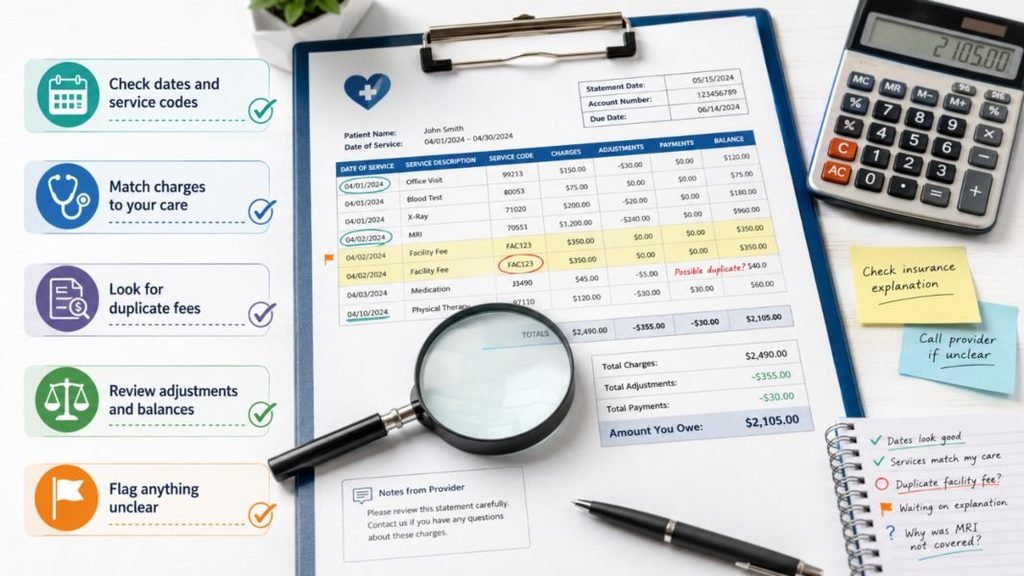
You do not need a coding certificate to catch most of this. A few changes to your routine do most of the work.
Read your Explanation of Benefits for more than the balance owed. Line by line, match what it lists against what you actually remember happening in the room. Watch for duplicated charges, which show up most often after admissions that span several departments. Flag any service dated to a day you were nowhere near the clinic. Question suspiciously round totals, and ask for an itemized bill you can compare against your own notes or discharge papers. Be wary of vague buckets like “supplies” or “miscellaneous” that carry large numbers. And pay attention if a provider keeps steering you toward one specific lab, pharmacy, or specialist, especially when the pitch is about location rather than a medical reason.
No single line proves fraud. It is the pattern, the accumulation of things that do not fit, that tells you something is wrong.
This is also where a good question does real work. Before you accept a test or treatment that seems out of step with your symptoms, ask what it is for, what happens if you decline, and whether a cheaper option would answer the same thing. Medical societies spent years cataloguing exactly these overused tests and procedures through the ABIM Foundation’s Choosing Wisely project, and a clinician acting in good faith will welcome the conversation. Defensiveness is its own kind of answer.
Building A Habit Of Vigilance
The surest defense is to stop treating your records as something you glance at only when a bill looks strange. Ask for a copy of your medical records after an appointment or procedure and check them against your memory of the visit. Any gap between the chart and what you recall is worth a question.
If your insurer or provider offers an online portal, use it. New claims often appear there well before the paper Explanation of Benefits reaches your mailbox, which buys you time to catch a problem early. Keep a bare-bones log of your appointments too, just the date, the provider, and the reason you went. It feels like a chore, but two sentences written down in the moment will save you a great deal of guessing when a questionable charge turns up months later.
Vigilance is not distrust of your doctor. It is the ordinary attention that keeps an honest system honest, and it costs you almost nothing.
A Closing Note
Most billing errors are just that, errors, and most clinicians are trying to do right by you. The point of paying attention is not to treat every provider as a suspect, but to make sure the rare bad actor cannot count on your silence. A patient who actually reads the paperwork is the cheapest fraud-prevention tool the system has.
Disclaimer
This article is for general informational purposes only and does not constitute medical, legal, or financial advice. It is not a substitute for guidance from a licensed physician, attorney, or other qualified professional who understands the details of your situation. If you believe you have experienced healthcare fraud, or you are considering reporting it, consult the appropriate authority or a qualified professional before acting.
References
- Federal Bureau of Investigation. “Health Care Fraud.” FBI, White-Collar Crime. https://www.fbi.gov/investigate/white-collar-crime/healthcare-fraud
- Harvard Health Publishing. “When Do You Really Need an Angioplasty and Stenting?” Harvard Medical School. https://www.health.harvard.edu/heart-health/when-do-you-really-need-an-angioplasty-and-stenting
- U.S. Food and Drug Administration. “Medical X-ray Imaging.” FDA, Radiation-Emitting Products. https://www.fda.gov/radiation-emitting-products/medical-imaging/medical-x-ray-imaging
- Office of Inspector General, U.S. Department of Health and Human Services. “Fraud and Abuse Laws.” OIG Physician Education. https://oig.hhs.gov/compliance/physician-education/fraud-abuse-laws/
- Doctiplus. “How Virtual IOPs for Addiction Benefit Residents in Remote Areas.” Doctiplus. https://doctiplus.net/how-virtual-iops-for-addiction-benefit-residents-in-remote-areas/
- National Health Care Anti-Fraud Association. “The Challenge of Health Care Fraud.” NHCAA. https://www.nhcaa.org/tools-insights/about-health-care-fraud/the-challenge-of-health-care-fraud/
- HealthCare.gov. “High Deductible Health Plan (HDHP), Glossary.” U.S. Centers for Medicare and Medicaid Services. https://www.healthcare.gov/glossary/high-deductible-health-plan/