

Ask a practice manager what went wrong with their phototherapy program and the answer is rarely that the equipment failed. More often, the equipment worked exactly as specified, and the fit was wrong: a full body cabinet bought for a caseload that turned out to be mostly palmoplantar disease, or a single panel expected to carry a referral base full of generalized psoriasis.
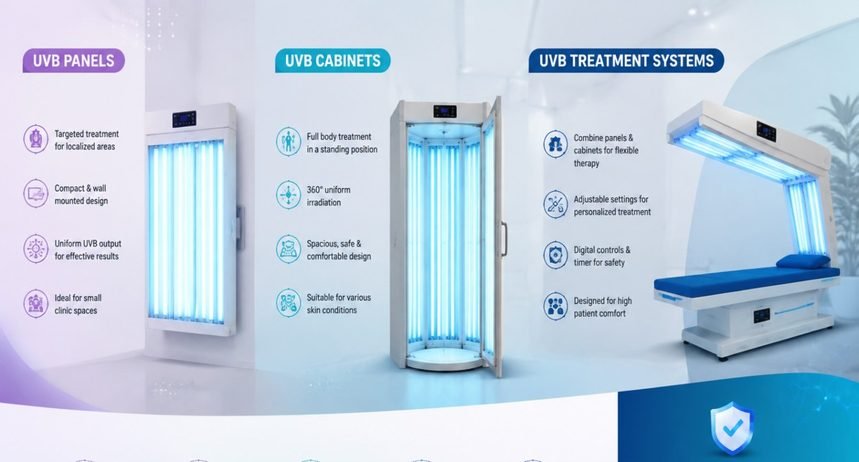
The three device formats in routine clinical use, localized panels, enclosed full body cabinets, and targeted 308 nm systems, are not competing versions of the same product. They differ in how much skin they irradiate, and that one variable propagates outward into session length, room requirements, cumulative dose management, and how many patients a service can realistically absorb in a week. Understanding that relationship is the first practical step in building a phototherapy service that fits the patients rather than the other way around.
What Clinical UVB Phototherapy Actually Does
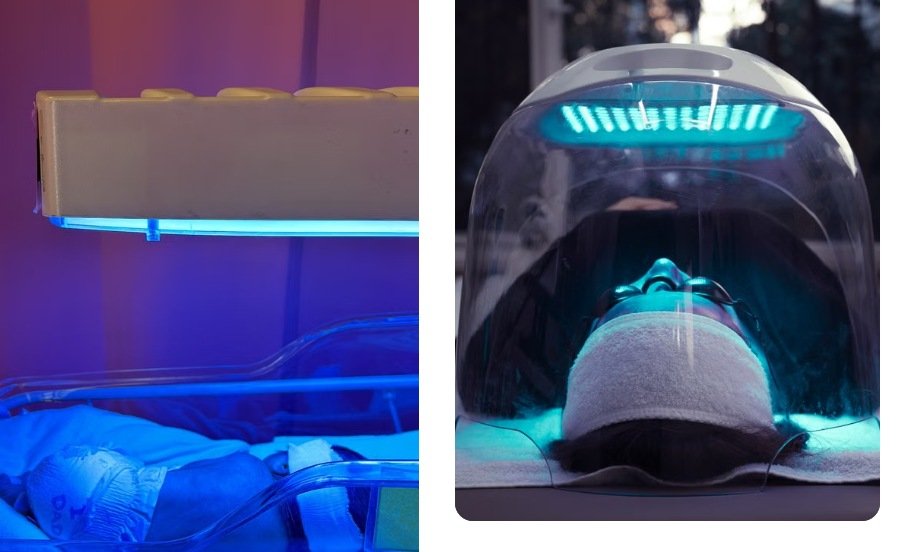
Narrowband UVB occupies a deliberately narrow slice of the ultraviolet B spectrum, centered on roughly 311 to 313 nm, and is delivered through fluorescent lamps engineered for that window. The choice of band was not arbitrary. In the 1981 monochromator study that mapped therapeutic against erythemal wavelengths, Parrish and Jaenicke found that 254, 280 and 290 nm radiation produced erythema without clearing psoriatic plaques, even at 10 to 50 times the minimal erythema dose (1). Those wavelengths burn and do not treat. Broadband UVB spans approximately 290 to 320 nm and carries them; narrowband UVB does not. That is the whole argument for the shift, and it explains why the 311 nm lamp became the clinical default rather than a marketing preference.
The therapeutic mechanism in inflammatory disease is immunological. Exposure drives apoptosis in activated T lymphocytes in the epidermis and dermis, alters the number and antigen-presenting function of epidermal Langerhans cells, and shifts local cytokine signaling away from the pathways sustaining psoriasis and related conditions.
Vitiligo works on entirely different biology, which matters when specifying equipment. Narrowband UVB acts on melanocyte precursors residing in the outer root sheath of hair follicles, prompting them to proliferate and migrate outward. Clinically, this appears as perifollicular pigment islands that gradually coalesce, and it is why response tracks hair-bearing skin so closely. As a recent state-of-the-art review of UVB phototherapy in vitiligo sets out, facial and cervical lesions repigment far more reliably than acral sites, where follicular density is low or absent (3). A clinic treating a lot of hand and foot vitiligo should build its expectations, and its counseling scripts, around that.
On indications, the joint AAD and National Psoriasis Foundation phototherapy guidelines position narrowband UVB as first-line phototherapy for plaque psoriasis (2). It also serves as a second-line option in moderate to severe atopic dermatitis, and as a skin-directed therapy in early cutaneous T-cell lymphoma. The United States Cutaneous Lymphoma Consortium consensus statement is specific on that last point: UVB is appropriate for patch and thin plaque mycosis fungoides, while thicker plaques are generally directed to PUVA (4). Response varies by patient, skin phototype, disease distribution and adherence, and relapse after a completed course is common enough that it belongs in the initial conversation rather than the follow-up one.
UVB Panels Compared With Full Body Cabinets
The distinction between the two formats is one of treatment field and clinical intent. Neither is a downgrade of the other.
A UVB panel is a compact fixture built around a limited lamp count, designed to irradiate a defined region rather than the whole skin surface. Scalp, hands, feet, elbows and knees are the usual targets: sites that resist topical therapy or that represent a small fraction of body surface area in otherwise localized disease. Because a panel irradiates only the treatment field, uninvolved skin is spared, which matters for lifetime cumulative dose in patients likely to return for repeated courses. The smaller footprint and simpler installation also suit clinics working with constrained space or a mixed caseload.
A full body cabinet is an enclosed booth lined with vertical narrowband lamps positioned to expose the entire body surface in one standing position. This is the format for extensive plaque psoriasis, generalized non-segmental vitiligo, and early mycosis fungoides involving large body surface area. Each session is short because everything is irradiated at once, which is the throughput advantage. The trade-offs are floor area, ceiling clearance, heat dissipation and ventilation, and a larger lamp array with more components to monitor, log and eventually replace.
For clinics comparing UVB Panels and Cabinets during a phototherapy build-out, the productive question is not which format is better but which one matches the disease patterns actually presenting. Assuming a single configuration will cover every patient tends to surface as a problem eighteen months later, when a stubborn palmoplantar cohort has no efficient pathway.
There is a third format worth naming here. The 308 nm excimer laser or lamp delivers a monochromatic beam to isolated, treatment-resistant lesions or small vitiligo patches at doses well above what whole-body irradiation permits, frequently clearing a localized area in fewer sessions while leaving surrounding skin entirely untouched. It is not a substitute for either panel or cabinet, but it closes a gap neither one covers well.
How To Choose The Right UVB Phototherapy System
Disease Distribution Comes First
Audit the existing patient panel before specifying anything. A practice weighted toward palmoplantar psoriasis and scalp involvement needs different hardware than one managing generalized vitiligo or extensive plaque disease. Many clinics discover they need both localized and full-body capability to cover the range of presentations already walking through the door.
Patient Volume And Throughput
Cabinets support higher caseloads because per-session exposure is short and the entire surface is treated in a single positioning. Panels treat a smaller field and are proportionate to lower-volume or lesion-specific use. A cabinet running at low utilization is expensive idle capacity; a panel carrying a whole-body caseload becomes a scheduling bottleneck.
Space, Power And Ventilation
Cabinets need adequate floor footprint, ceiling clearance, and ventilation sufficient to manage the heat produced by a large lamp array. Electrical capacity should be verified against manufacturer specifications before installation rather than discovered on delivery day. Panels are considerably more compact and can often be absorbed into an existing treatment room.
Dose Control And Dosimetry
Dose control is a clinical safety requirement, not a premium feature. Narrowband UVB dosing is individualized, established either through minimal erythema dose testing or through standardized starting doses keyed to Fitzpatrick skin phototype, with incremental escalation as the course progresses. The British Association of Dermatologists and British Photodermatology Group narrowband UVB guidelines set out both protocols in detail and remain the most practical published reference on regimen design (5). Equipment should offer programmable timers and reliable dose tracking as standard.
Lamp Life And Recalibration
Fluorescent narrowband lamps lose output steadily across their service life, which makes calibration an ongoing clinical necessity rather than a maintenance formality. The BAD and BPG guidance on measuring ultraviolet radiation levels in phototherapy units is instructive on the tolerances involved: dose measurement accuracy of around 10 percent is generally considered adequate for clinical work. In comparison, output differences between individual lamps in an array can reach 15 percent, and non-uniformity from patient positioning and skin curvature can exceed that again (6). Lamp replacement intervals and recalibration schedules belong in the equipment budget from the outset.
Regulatory Status
In the United States, ultraviolet lamps intended for dermatologic disorders are Class II devices classified under 21 CFR 878.4630 and subject to 510(k) premarket notification (7). This is a separate classification from sunlamp products used for tanning. Confirm clearance status and documentation for any unit under consideration before purchase, and retain it for the device file.
Building A Phototherapy Setup That Matches Your Case Mix
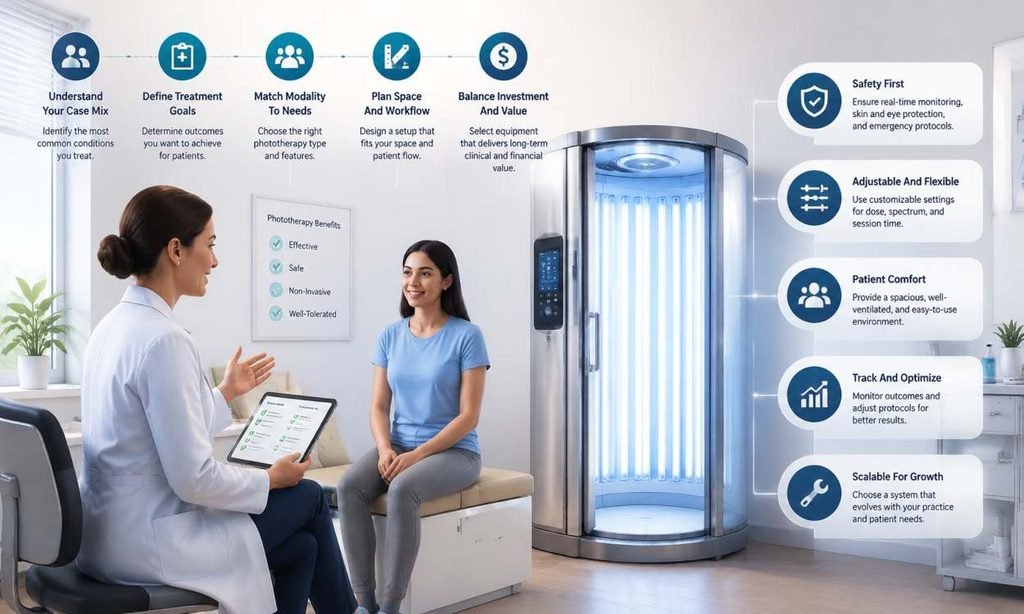
Most dermatology practices see localized and widespread disease within the same patient pool, which is why effective setups usually combine formats rather than asking one device to do everything. A full-body cabinet handles widespread disease efficiently; panels or a 308 nm targeted device absorb the scalp, palmoplantar and treatment-resistant sites that respond better to concentrated dosing. The combination also covers a scenario that recurs constantly in practice: a patient completes a whole-body course, and one stubborn plaque or patch has not cleared with the rest and still needs targeted follow-up.
Phototherapy also rarely runs alone. Emollients, vitamin D analogues, and topical calcineurin inhibitors for vitiligo commonly run alongside it as part of a broader plan. Whatever the combination, the operational discipline is the same across every device in the room: consistent dose recording, lamp-hour logging, scheduled calibration, and a treatment record that lets any clinician review cumulative exposure at a glance. The BAD’s published phototherapy service guidance and standards provide a workable template for the governance side of this, including named clinical leadership, dosimetry traceability, and lamp replacement logging (8).
Closing Note
The equipment question is ultimately a question about case mix. Matching device format to the disease patterns a clinic actually treats, rather than defaulting to whichever configuration is most familiar or most impressive on a spec sheet, is what allows panels, cabinets and targeted systems to do the job each was engineered for: treating the right amount of skin, at the right dose, for the condition in front of the clinician. Practices planning a build-out benefit from auditing twelve months of presentations before writing a specification, and from budgeting for lamp replacement and recalibration as recurring line items rather than surprises.
Disclaimer
This article is intended as general educational information for clinical and administrative professionals evaluating phototherapy equipment. It is not medical advice, does not constitute a treatment recommendation for any individual patient, and is not a substitute for the clinical judgment of a qualified dermatologist. Treatment decisions, dosing protocols and device selection should be made by appropriately trained clinicians in accordance with current national guidelines, local regulatory requirements and manufacturer instructions for use. Regulatory classifications and clearance requirements vary by jurisdiction and change over time; confirm current status with the relevant authority before purchase or deployment.
References
- Parrish JA, Jaenicke KF. Action spectrum for phototherapy of psoriasis. Journal of Investigative Dermatology. 1981 May;76(5):359-362. doi:10.1111/1523-1747.ep12520022. PMID: 7229428. Available at: https://pubmed.ncbi.nlm.nih.gov/7229428/
- Elmets CA, Lim HW, Stoff B, Connor C, Cordoro KM, Lebwohl M, et al. Joint American Academy of Dermatology-National Psoriasis Foundation guidelines of care for the management and treatment of psoriasis with phototherapy. Journal of the American Academy of Dermatology. 2019 Sep;81(3):775-804. doi:10.1016/j.jaad.2019.04.042. Epub 2019 Jul 25. Erratum in: Journal of the American Academy of Dermatology. 2020 Mar;82(3):780. PMID: 31351884. Available at: https://www.jaad.org/article/S0190-9622%2819%2930637-1/fulltext
- Bouceiro Mendes R, Alpalhão M, Filipe P. UVB phototherapy in the treatment of vitiligo: state of the art and clinical perspectives. Photodermatology, Photoimmunology & Photomedicine. 2022 May;38(3):215-223. doi:10.1111/phpp.12740. Epub 2021 Oct 16. PMID: 34626483. Available at: https://pubmed.ncbi.nlm.nih.gov/34626483/
- Olsen EA, Hodak E, Anderson T, Carter JB, Henderson M, Cooper K, et al. Guidelines for phototherapy of mycosis fungoides and Sézary syndrome: a consensus statement of the United States Cutaneous Lymphoma Consortium. Journal of the American Academy of Dermatology. 2016 Jan;74(1):27-58. Epub 2015 Nov 4. PMID: 26547257. Available at: https://www.jaad.org/article/S0190-9622%2815%2902206-9/fulltext
- Goulden V, Dawe RS, Eadie E, et al. British Association of Dermatologists and British Photodermatology Group guidelines for narrowband ultraviolet B phototherapy 2022. British Journal of Dermatology. 2022 Sep;187(3):295-308. doi:10.1111/bjd.21669. PMID: 35604545. Available at: https://academic.oup.com/bjd/article/187/3/295/6966564
- British Association of Dermatologists and British Photodermatology Group. Guidelines on the measurement of ultraviolet radiation levels in ultraviolet phototherapy: report issued by the British Association of Dermatologists and British Photodermatology Group 2015. British Journal of Dermatology. 2015 Aug;173(2):333-350. doi:10.1111/bjd.13937. Available at: https://doi.org/10.1111/bjd.13937