


When a tooth cracks at 9 PM or someone finally decides to fix their smile, the first thing they do is grab their phone and search. That single moment determines whether your dental clinic gets the call or your competitor does.
According to a 2025 industry report, 89.7% of patients now start their search online before choosing a new dentist. That is not a trend. That is the entire game.
Winning in competitive search markets requires more than a decent website. It takes local trust signals, purposeful content, and technical credibility, all working together. This guide breaks down exactly how to build that system, layer by layer.
Why Local SEO Is a Must-Have for Dental Practices in 2025
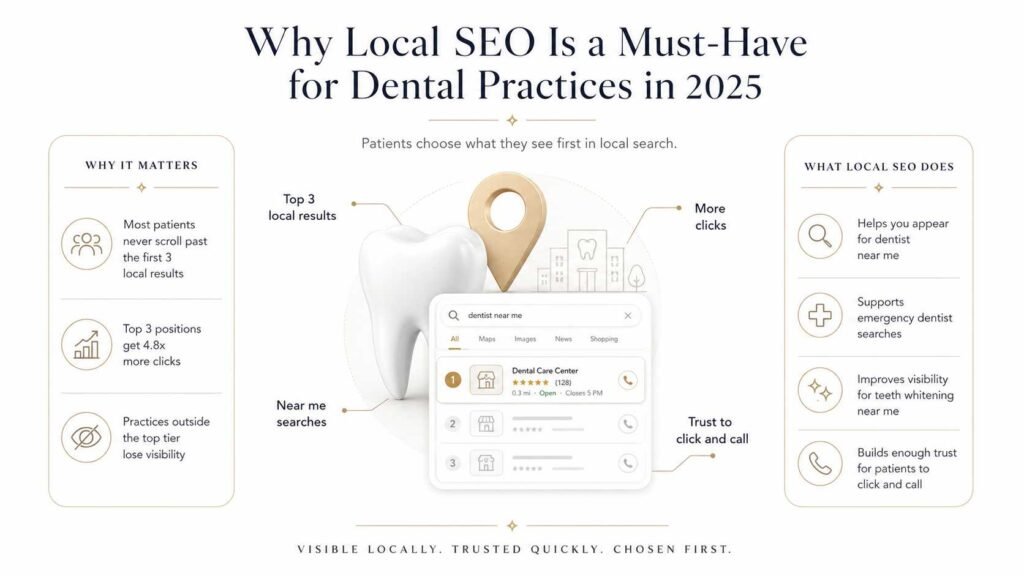
Most patients never scroll past the first three local results. Dental practices ranking in the top three Google local pack positions receive 4.8 times more clicks than those in positions four through ten. If you are not in that top tier, you are invisible to most of your market.
Effective local seo for dentists means showing up when patients search “dentist near me,” “emergency dentist,” or “teeth whitening near me” and giving them enough trust to click and call.
For deeper context on how local search works, Google’s own Local Search documentation is the most authoritative starting point for understanding how the algorithm evaluates and ranks local businesses.
Local Search Mastery That Drives Real Patient Action
How to Optimize Your Google Business Profile for Maximum Conversions
Most clinics treat their Google Business Profile as an afterthought. For many patients, it is the first and only impression they get before deciding whether to call.
A conversion-ready Google Business Profile includes a primary category of Dentist with secondary categories such as Emergency Dental Service, Cosmetic Dentist, and Dental Implants Provider. Clinics should upload more than 100 high-quality images of treatment rooms, team headshots, and before-and-after results, refreshed on a rolling basis. Weekly posts covering services, office hours, and community involvement keep the profile active and signal to Google’s algorithm that the practice is engaged and relevant.
NAP consistency is equally critical. Your Name, Address, and Phone number must match exactly across every directory listing, citation, and social profile. Moz’s Local Search Ranking Factors research consistently shows that citation accuracy and GBP completeness are among the strongest drivers of local pack visibility.
How to Build Review Velocity and Not Just Review Volume
Reviews are a direct ranking signal. Recency matters more than raw volume. A clinic with 12 reviews in the last 30 days will often outrank one with 300 reviews from three years ago.
Build review velocity with a multi-channel system that includes in-office prompts at checkout, SMS follow-ups within 24 hours of the appointment, and post-visit email sequences. Aim for roughly one new review for every three to five patients.
When responding to reviews, weave in service names and neighborhood context naturally. This reinforces local relevance to Google’s algorithm. Three detailed, recent reviews per week tend to outperform a large but stale archive. BrightLocal’s annual Local Consumer Review Survey provides useful benchmarks on patient review behavior that practices can use to calibrate their outreach strategy.
Hyper-Local Content and Service Pages That Capture Patient Intent
Why Neighborhood-Specific Landing Pages Work
Generic content does not win local search. Surgically relevant, location-specific content does.
Build dedicated landing pages for surrounding suburbs and neighborhoods. Each page should include local landmark references, parking details, community-specific context such as nearby schools or commuter routes, and service information tailored to that area’s search intent.
A page targeting dental care near a specific neighborhood, written with authentic local detail, almost always outperforms a broad city-wide service page. Over time, these pages build topical authority. Google begins recognizing your clinic as the trusted regional resource, which compounds into a lasting ranking advantage that your competitors frequently underestimate.
How to Write Dental Service Pages That Answer Real Questions
Every core service needs its own dedicated page, and each one should lead with the answer the patient is actually searching for.
Someone searching for the cost of dental implants is not looking for a marketing pitch. They want a clear, honest figure within the first 40 words.
High-intent pages to prioritize include emergency dentist near me, teeth whitening near me, dental implants cost, Invisalign versus braces, and same-day dental appointments. Each page should address who qualifies, what to expect during treatment, financing options, and a clear path to booking an appointment.
Search Engine Journal’s guide on local SEO provides a strong framework for understanding intent-based content strategy that service businesses can apply directly to page structure and copy.
Generative Engine Optimization and Getting Found in AI Search Results
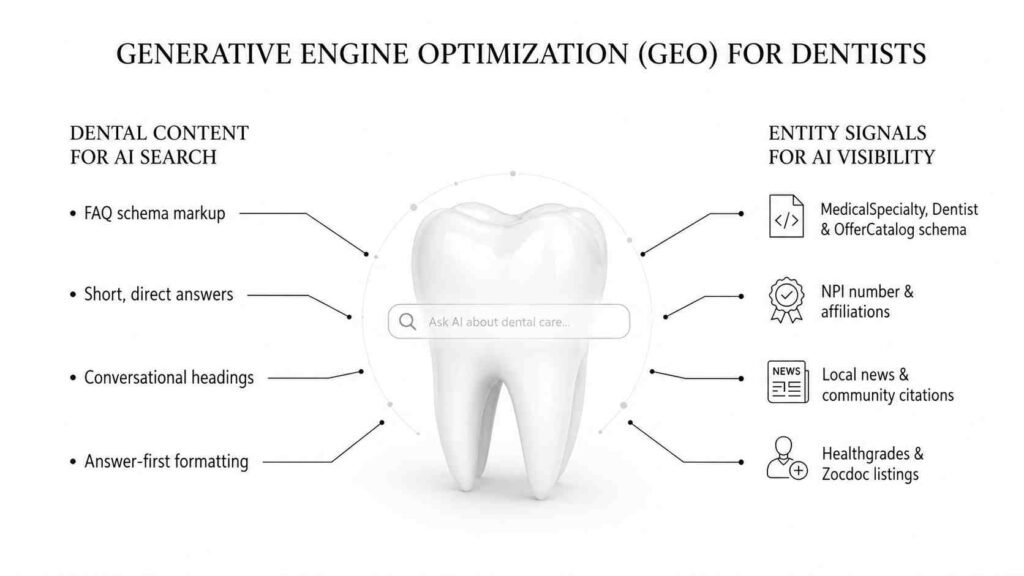
What Is Generative Engine Optimization and Why Dentists Need It Now
AI search overviews are reshaping how patients discover dental practices, when someone asks an AI assistant which dentist to call, the clinics that get recommended share one trait: structured, answer-first content.
Semrush research on Google AI Overviews shows that structured FAQ content and direct-answer formatting significantly increase the chances of appearing in AI-generated results.
How to Format Dental Content for AI and Voice Search
Use FAQ schema markup throughout your service pages. Write short, bulleted answers to common patient questions and use conversational headings that mirror how patients actually phrase their searches.
Think like your patient. A question like “What does a dental implant cost near me?” deserves a direct, clearly formatted answer on your implant page. AI systems favor content that addresses questions cleanly and directly rather than keyword-heavy paragraphs written for old-school ranking signals.
How to Strengthen Your Entity Signals for AI Visibility
To be recognized as a credible, verified dental authority by both AI engines and Google, practices should implement MedicalSpecialty, Dentist schema, and OfferCatalog markup. Reference your NPI number and professional affiliations. Include local news mentions and community citations where available.
Listing your practice on Healthgrades and Zocdoc adds further credibility, as both platforms are trusted sources AI engines frequently reference for healthcare providers. Schema.org’s Dentist markup documentation is the authoritative reference for implementing structured data correctly.
Technical SEO Foundations That Support Long-Term Discoverability
Why Mobile Performance Is Non-Negotiable for Dental Websites
Your patients are searching on phones, often in urgent situations. Your site must load fast, respond instantly, and display cleanly on every screen size.
Google’s INP (Interaction to Next Paint) standard evaluates how quickly your site reacts to user inputs. Sites with poor INP scores lose rankings regardless of content quality. Google’s Core Web Vitals documentation explains exactly what to measure and how to fix common performance issues that affect dental clinic websites.
Schema Markup and Video SEO for Dental Clinics
Two technical elements that stack compounding value over time are the VideoObject schema for educational or procedural videos and geo-tagged image alt text. For example, an image file named emergency-dentist-chicago-treatment-room.jpg reinforces local relevance in ways that generic file names never can.
Embedding a live Google Map on your contact page also drives direction requests, which are strong behavioral signals Google uses to validate your local relevance. These technical details are easy to overlook but quietly build authority that your competitors frequently underestimate.
Tracking the Metrics That Actually Matter
Rankings alone are a vanity metric. The numbers that reflect genuine practice growth are inbound calls, direction requests, online appointment bookings, brand search volume, and AI referral visits.
Tracking these data points over time gives practices a clear picture of whether their search visibility is translating into real patient actions. Ahrefs’ guide to tracking local SEO covers practical tracking setups for service businesses at the local level and is a useful reference for setting up a measurement framework.
FAQs
What is the 80/20 rule in dentistry?
- Roughly 80% of a practice’s revenue comes from 20% of its patients. Similarly, about 20% of your marketing effort, when focused on the highest-impact activities, generates approximately 80% of your new patient inquiries. Prioritizing your Google Business Profile, review strategy, and core service pages typically delivers the biggest return for the time and resources invested.
What is the rule of seven in dentistry?
- It refers to the recommended age of around seven years for a child’s first orthodontic evaluation. While it sounds early, some children genuinely benefit from early intervention at that stage, making awareness of this milestone useful for practices that want to capture family dental patients.
How quickly do new reviews impact local pack rankings?
- Fresh reviews can influence rankings within days. Google weights recency heavily, meaning consistent review velocity, even a few quality reviews weekly, tends to move rankings faster than a large but outdated review history.
How long does dental SEO take to show results?
- Most practices see measurable movement in local pack rankings within 60 to 90 days of consistent effort. Significant gains in organic rankings for competitive terms typically take 4 to 6 months. The compounding nature of SEO means early investment continues paying dividends long into the future.
Practices Worth Finding Should Be the Easiest to Find
Competing in local dental search is not a one-time project. It is an ongoing system. A well-maintained Google Business Profile, AI-ready content, neighborhood landing pages, and a technically sound website all reinforce one another.
Clinics that treat search visibility as a core business function rather than a background task are the ones patients find first, call first, and book with first. Make sure yours is one of them.
Disclaimer
The information provided in this article is intended for general educational and informational purposes only. It does not constitute professional legal, medical, or financial advice. Search engine algorithms and digital marketing best practices change frequently. Dental practices are encouraged to consult a qualified SEO professional or digital marketing specialist before implementing any strategy. Results mentioned, including click-through rates and ranking improvements, are drawn from publicly available industry research and may vary significantly depending on market conditions, geographic location, competition level, and implementation quality. The inclusion of third-party links and resources does not constitute an endorsement of those platforms or their services.
References
- BrightLocal. (2025). Local Consumer Review Survey 2025. BrightLocal Research. Retrieved from https://www.brightlocal.com/research/local-consumer-review-survey/
- Google Developers. (2025). Get started with local search. Google Search Central Documentation. Retrieved from https://developers.google.com/search/docs/fundamentals/get-started-qa
- Google. (2025). Core Web Vitals. web.dev. Retrieved from https://web.dev/vitals/
- Moz. (2025). Local Search Ranking Factors. Moz Research. Retrieved from https://moz.com/local-search-ranking-factors
- Rosemont Media. (2025). Local SEO for Dentists. Rosemont Media Dental Marketing Resources. Retrieved from https://www.rosemontmedia.com/search-engine-optimization/dental/
- Schema.org. (2025). Dentist schema markup specification. Schema.org Structured Data Vocabulary. Retrieved from https://schema.org/Dentist
- Search Engine Journal. (2025). What is local SEO, and why does it matter? Search Engine Journal. Retrieved from https://www.searchenginejournal.com/local-seo/what-is-local-seo/
- Semrush. (2025). Google AI Overviews: What they are and how to appear in them. Semrush Blog. Retrieved from https://www.semrush.com/blog/google-ai-overviews/
- Ahrefs. (2025). Local SEO: A simple guide for ranking in local search. Ahrefs Blog. Retrieved from https://ahrefs.com/blog/local-seo/
- Zocdoc. (2025). Find and book local doctors and dentists. Zocdoc Healthcare Platform. Retrieved from https://www.zocdoc.com/
- Healthgrades. (2025). Find a dentist near you. Healthgrades Provider Directory. Retrieved from https://www.healthgrades.com/