

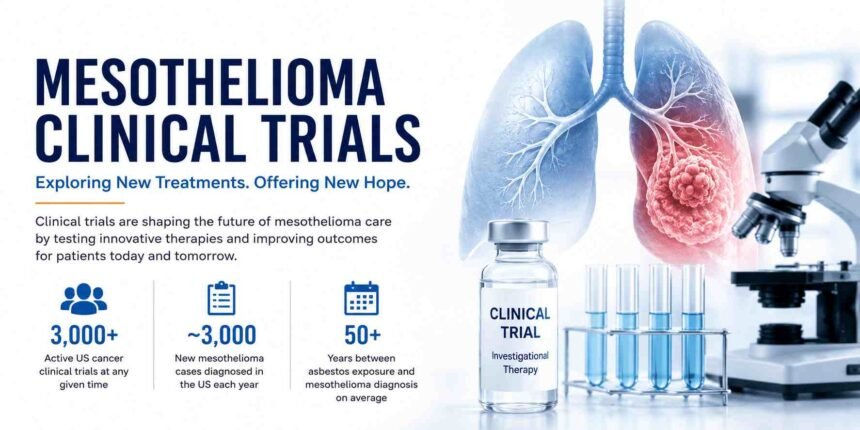
Mesothelioma is a rare and serious cancer that is often linked to asbestos exposure. Because it can take many years to develop and is sometimes found at a late stage, treatment can be difficult. For many patients, clinical trials may offer another possible path. These trials test new treatments under expert medical supervision and may give patients access to options that are not widely available yet. This article explains what mesothelioma clinical trials are, who may consider joining one, what benefits they may offer, and what patients should know before taking part.
What Are Mesothelioma Clinical Trials and Why Do They Matter?Who Should Consider Joining a Mesothelioma Clinical Trial?Real Benefits of Participating in a Mesothelioma Clinical TrialAccess to Therapies Not Available Anywhere ElseExpert, Specialized CarePotential for Better OutcomesContributing to Medical ProgressFinancial ConsiderationsUnderstanding the 3 Phases of a Clinical TrialHow to Find the Right Mesothelioma Clinical Trial for YouUnderstanding Eligibility CriteriaQuestions to Ask Before Joining a TrialYour Rights as a Trial ParticipantDisclaimer
What Are Mesothelioma Clinical Trials and Why Do They Matter?
If you or someone you love has just been diagnosed with mesothelioma, the word clinical trial may sound intimidating, like something reserved for laboratory scientists or last-resort situations. But that perception is changing rapidly, and it is worth taking a closer look.
A clinical trial is a carefully designed medical research study that tests new treatments in human volunteers. For mesothelioma specifically, these studies are critically important because the disease is rare, often diagnosed late, and has historically been resistant to standard therapies. Clinical trials represent the frontier of treatment science, sometimes offering access to therapies that do not exist anywhere else.
Good to Know: Standard treatment is the medicine doctors already know works reasonably well. A clinical trial is the next version of that medicine being carefully tested under expert supervision. It may work better for your specific case.
According to the National Cancer Institute (NCI), clinical trials are the primary way that new cancer treatments move from laboratory research into everyday medical practice. They are not experiments conducted haphazardly. They are structured, regulated, and overseen by ethics boards to protect participants at every step.
The long latency period, often 20 to 50 years between asbestos exposure and diagnosis, is one reason the disease is so difficult to catch early. That history makes research and trials all the more urgent today.
| 3,000+ Active US cancer clinical trials at any given time | ~3,000 New mesothelioma cases diagnosed in the US each year | 50+ Years between asbestos exposure and mesothelioma diagnosis on average |
Who Should Consider Joining a Mesothelioma Clinical Trial?

There is no single profile of who is right for a clinical trial. However, they tend to be especially worth exploring in certain situations.
- Newly diagnosed patients. Even if standard treatment is available to you, some trials compare new therapies head-to-head with existing ones, meaning you may receive excellent care either way, with the added benefit of contributing to research.
- Patients with advanced or recurrent mesothelioma. When conventional options like surgery, chemotherapy, or radiation have been exhausted, a clinical trial may be one of the few remaining pathways to active, evidence-based treatment.
- Those with specific tumor subtypes. Epithelioid, sarcomatoid, and biphasic mesothelioma each respond differently to treatments. Some trials are designed specifically around tumor type.
- Patients seeking cutting-edge immunotherapy. Many of the most promising new mesothelioma treatments, particularly checkpoint inhibitors and CAR-T cell therapies, are currently only available through clinical trials.
| Pro Tip: Do not wait until all other options are exhausted before asking about trials. Earlier enrollment often means access to more studies and better baseline health, both of which can affect eligibility and outcomes. |
Real Benefits of Participating in a Mesothelioma Clinical Trial
It is easy to feel hesitant about joining a trial. But when you weigh the potential benefits clearly, many patients find that participation aligns well with their goals, both personal and medical.
Access to Therapies Not Available Anywhere Else
This is perhaps the most compelling reason. U.S. mesothelioma clinical trials provide access to therapies that have not yet been approved for general use. These may include:
| Immunotherapy Drugs that help your immune system identify and attack cancer cells, including checkpoint inhibitors like pembrolizumab and nivolumab. | Targeted Therapy Treatments engineered to attack specific molecular targets within cancer cells, sparing more healthy tissue than traditional chemotherapy. |
| Gene-Based Treatments Experimental therapies that work at the DNA or RNA level, including CAR-T cell therapy and other genetic reprogramming approaches. | Novel Chemotherapy Combos Researchers test new combinations and dosing strategies to improve on standard pemetrexed-cisplatin regimens. |
Expert, Specialized Care
Clinical trials are almost always conducted at leading cancer centers and research institutions. Participating means your care team often includes oncologists who specialize exclusively in mesothelioma. You typically receive more frequent monitoring, advanced imaging, and personalized attention throughout the process.
Potential for Better Outcomes
It is important to be honest: clinical trials do not guarantee better results. But some breakthrough therapies have already shown genuinely promising outcomes for mesothelioma patients. The American Cancer Society notes that participation in clinical trials is often how patients gain access to tomorrow’s standard-of-care treatments today.
Contributing to Medical Progress
Many patients find deep meaning in knowing that their participation helps future patients. According to the National Institutes of Health, clinical trial participants are essential partners in making new treatments available for everyone.
Financial Considerations
Trial sponsors often cover the cost of the experimental treatment itself. You may still be responsible for standard care costs, but this can meaningfully reduce the financial burden of treatment. Always clarify cost coverage before enrolling.
Understanding the 3 Phases of a Clinical Trial
Clinical trials do not happen all at once. They move through structured phases, each with a specific purpose. Understanding where a trial sits in this process helps you make a more informed decision about participation.
| PHASE ISafety and Dosage Small group (20-80 patients) receives treatment to establish safety and appropriate dosage. ~20-80 patients | PHASE IIEffectiveness and Side Effects Larger group tests whether the treatment works against the cancer and monitors side effects. Up to 300 patients | PHASE IIIComparison to Standard Treatment Treatment is directly compared to current standard-of-care across thousands of participants. 1,000+ patients |
Most patients who join trials at Phase II or III are receiving treatments with an already-established safety baseline. The U.S. Food and Drug Administration (FDA) provides detailed guidance on how each phase works and what protections are in place for participants throughout the process.
How to Find the Right Mesothelioma Clinical Trial for You

Finding a trial that is both eligible and appropriate for your specific situation takes some navigation, but you do not have to do it alone. Here is a step-by-step process that works.
- Start with your oncologist. Your current medical team is your first resource. They know your diagnosis, your treatment history, and your overall health. Ask directly: Are there any clinical trials you would recommend for my situation? If your doctor is not a mesothelioma specialist, request a referral to one.
- Search ClinicalTrials.gov. The U.S. National Library of Medicine’s ClinicalTrials.gov is the most comprehensive database of ongoing trials in the world. You can search specifically for mesothelioma, filter by location, phase, and treatment type, and read full eligibility criteria.
- Get matched through a mesothelioma specialist firm. Organizations and legal firms that specialize in mesothelioma can help match you to trials not widely advertised. Firms experienced in mesothelioma cases found through mesothelioma clinical trials resources can guide both your legal and medical navigation at once.
- Contact major cancer centers directly. Institutions like MD Anderson, Memorial Sloan Kettering, and others often have mesothelioma-specific programs running trials not yet in public databases. The Mayo Clinic mesothelioma treatment page is one place to start.
- Check mesothelioma advocacy organizations. The Mesothelioma Applied Research Foundation (MARF) maintains a dedicated clinical trial finder specifically for mesothelioma patients.
- Get a second or third opinion. Mesothelioma is rare enough that even experienced oncologists may not know every available trial. The American Society of Clinical Oncology (ASCO) oncologist finder can help you locate mesothelioma specialists near you.
Understanding Eligibility Criteria
Every clinical trial has a specific set of inclusion and exclusion criteria. These are not arbitrary. They exist to ensure safety and to produce clean, interpretable research data. Understanding them upfront saves time and manages expectations.
| Factors That May Help You Qualify | Factors That May Limit Eligibility |
|---|---|
| ✔ Confirmed mesothelioma diagnosis with pathology report | ✘ Certain prior treatments that may interfere with the study drug |
| ✔ Specific mesothelioma subtype targeted by the trial | ✘ Active autoimmune disease, especially for some immunotherapy trials |
| ✔ Adequate organ function, including liver, kidneys, and heart | ✘ Significant uncontrolled infections |
| ✔ Good performance status and overall physical condition | ✘ Pregnancy or breastfeeding |
| ✔ Prior chemotherapy completion, if required by the trial | ✘ Severe organ dysfunction |
| ✔ Tumor tissue available for biomarker testing | ✘ Inability to travel to the trial site regularly |
If you do not qualify for one trial, do not give up. Eligibility criteria differ significantly between studies. The Cancer.net guide on eligibility criteria by ASCO is an excellent resource for understanding the logic behind these requirements.
Questions to Ask Before Joining a Trial
Walking into a conversation with your oncologist or a trial coordinator armed with the right questions transforms you from a passive recipient of information into an active, informed decision-maker. Here are the questions that matter most.
| Questions to Ask Your Trial Team |
| Q What is the primary goal of this trial, and what phase is it in? |
| Q What treatments might I receive, and what are the possible side effects? |
| Q Is there a placebo group, or does every participant receive active treatment? |
| Q How often will I need to come in for visits, and where? |
| Q What costs are covered by the trial, and what might I be responsible for? |
| Q What happens to my care if the trial is stopped early? |
| Q Can I continue my current medications alongside the trial treatment? |
| Q What does informed consent mean practically, and can I withdraw at any time? |
| Q How will my quality of life be monitored throughout the study? |
| Q Are there travel assistance programs if the trial site is far from home? |
Your Rights as a Trial Participant
One concern many patients express is feeling locked in once they enroll in a trial. The reality is quite the opposite. Your rights are protected by federal law and institutional ethics boards. Here is what you need to know.
| Your Rights | What It Means |
|---|---|
| Your Right to Withdraw | You can leave a clinical trial at any time and for any reason. There is no penalty, and your decision will not stop you from getting other medical care or treatments. Informed consent continues throughout the trial, not just when you first sign the form. |
| Before You Sign | Read the consent forms carefully before agreeing. It is helpful to review them with a family member, patient advocate, doctor, or legal professional. You have the right to ask questions, take time to decide, and get a second medical or legal opinion. |
If you were exposed to asbestos through your work, a family member’s occupation, or contaminated products, you may also have legal rights that are separate from your medical situation. Getting mesothelioma clinical trials guidance from specialists who understand both the legal and medical landscape can make a significant difference in the path forward.
Disclaimer
This article is intended for informational purposes only and does not constitute medical or legal advice. Always consult a qualified oncologist and legal professional before making treatment decisions.