


A useful 5 amino 1mq research example starts long before a vial is opened. The real work begins with the question behind the compound: what, exactly, is being tested, under what conditions, and with which readouts?
For researchers evaluating 5-Amino-1MQ, the difference between a credible study model and a weak one usually comes down to mechanism alignment, material quality, and endpoint selection.
What Is 5-Amino-1MQ?
5-Amino-1MQ (5-amino-1-methylquinolinium) is a synthetic small-molecule compound studied for its role as a selective inhibitor of nicotinamide N-methyltransferase (NNMT), an enzyme involved in metabolic regulation and cellular energy processes. Unlike peptides, 5-Amino-1MQ belongs to the methylquinolinium class of compounds and was developed through medicinal chemistry research focused on NNMT-targeted pathways.
Researchers have explored the compound in preclinical studies related to metabolism, adipose tissue biology, and cellular energy activity. Because it is membrane-permeable, 5-Amino-1MQ can enter cells efficiently, making it useful for laboratory investigations into NNMT-related mechanisms and metabolic signaling.
As of April 2026, 5-Amino-1MQ has no FDA-approved medical use and has not completed any registered human clinical trials. Most published research surrounding the compound originates from early-stage academic studies, including work conducted by researchers at the University of Texas Health Science Center beginning around 2017.
Today, 5-Amino-1MQ is primarily discussed in research settings where scientists are investigating how NNMT inhibition may influence metabolic markers, fat-cell activity, and broader pathway behavior under controlled experimental conditions.
What 5 Amino 1MQ is being researched for
5-Amino-1MQ is commonly discussed in relation to nicotinamide N-methyltransferase, or NNMT. That matters because NNMT has been investigated in metabolic regulation, cellular energy handling, and adipose biology. Researchers do not approach 5-Amino-1MQ as a general wellness ingredient. They approach it as a targeted research compound that may help clarify how NNMT inhibition influences downstream metabolic markers.
- That distinction is not academic wording. It shapes the entire study design.
- If the goal is to examine body composition signals, lipid handling, or metabolic activity in a controlled setting, then the model needs to isolate those variables.
- If the goal is to study pathway behavior at the cellular level, then tissue relevance and assay sensitivity become more important than broad physiological outcomes.
A practical 5 amino 1mq research example
One reasonable 5 amino 1mq research example would be an early-stage in vitro and in vivo translational workflow focused on adipocyte metabolism. The project begins with cultured preadipocytes or mature adipocytes to assess whether exposure to 5-Amino-1MQ changes markers associated with lipid accumulation, cellular respiration, or expression of genes linked to metabolic regulation.
In the in vitro phase, the research team might compare a vehicle control group against multiple concentration groups of 5-Amino-1MQ. The key objective would not be to force a headline result. It would be to establish a concentration-response relationship while screening for cytotoxicity, off-target stress, and reproducibility across replicates. If the compound shows a signal in lipid staining assays or oxygen consumption measurements, that creates a basis for moving into an animal model.
The second phase might involve a diet-induced obesity model in rodents, where the central question is whether NNMT modulation corresponds with measurable changes in weight trajectory, fat mass, feed efficiency, or metabolic biomarkers. In that setting, the protocol would typically include a control arm, a treatment arm, and ideally a pair-fed or caloric-monitoring component. Without that extra control, it becomes harder to tell whether any observed change reflects a direct pathway effect or simply reduced food intake.
Why this example makes scientific sense
This type of staged design works because it respects how mechanism-based compounds should be evaluated. A cell model offers cleaner pathway visibility. An in vivo model adds biological complexity, including hormonal signaling, tissue cross-talk, and behavior effects. Using both creates a stronger chain of evidence than jumping straight to a single endpoint.
It also helps answer a question serious buyers ask all the time: what kind of result would actually be meaningful? A modest change in one surface-level marker is rarely enough. More convincing data would show consistent movement across several related outcomes, such as lower lipid accumulation in vitro, improved metabolic marker profiles in vivo, and evidence that the target pathway was actually engaged.
Endpoints that matter in a 5 amino 1mq research example
Researchers often weaken otherwise promising work by measuring too little or measuring the wrong thing. With 5-Amino-1MQ, endpoint selection should reflect the proposed NNMT-related mechanism rather than broad speculation.
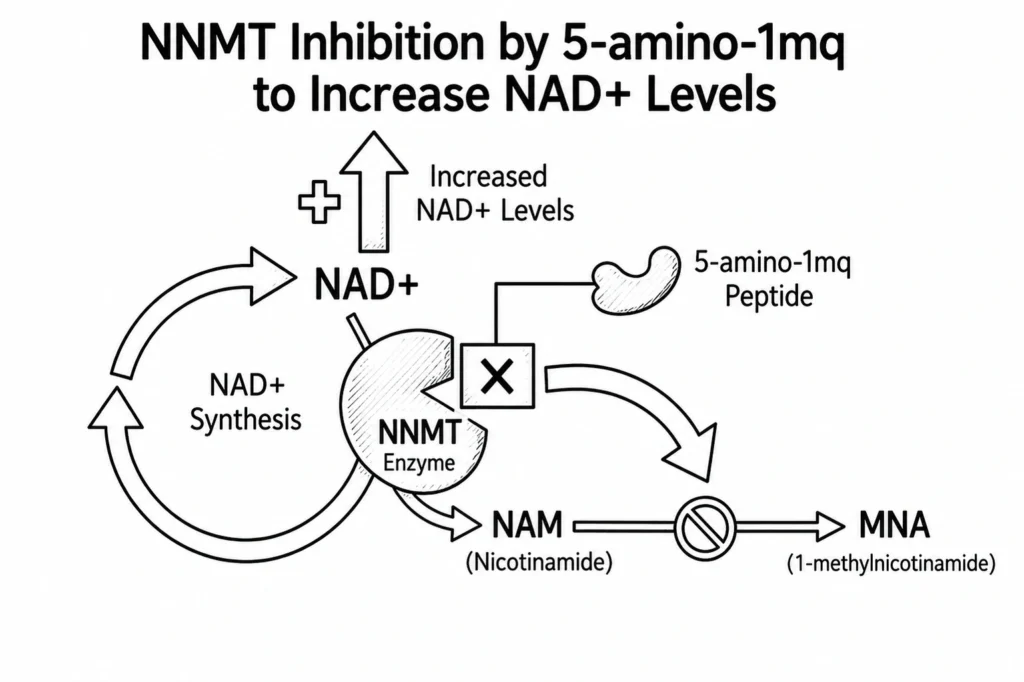
At the cellular level, useful endpoints may include intracellular lipid staining, mitochondrial respiration metrics, viability assays, and expression analysis of genes relevant to adipogenesis and metabolic function. If the assay platform allows it, measuring NNMT-associated pathway changes directly is even better. That helps separate mechanistic action from general stress responses.
In animal work, body weight alone is not enough. A better framework includes body composition analysis, food intake tracking, serum metabolic markers, tissue histology, and enzyme or transcript-level data from relevant tissues. Some studies also benefit from energy expenditure measurements, but those systems are more demanding and not always practical for every lab.
The trade-off is straightforward: more endpoints improve interpretability, but they also raise cost, handling complexity, and data-management burden. For smaller labs, a narrower but well-controlled panel is usually better than a broad panel with weak consistency.
Where research examples often go wrong
The most common failure point is overreading preliminary data. If a compound shifts one metabolic marker in a short study window, that does not automatically establish a durable or pathway-specific effect. Another common issue is underpowered group sizing. Metabolic research can produce noisy data, especially when diet, housing conditions, and baseline variability are not tightly controlled.
Material quality is another major variable. A research compound can look inconsistent when the real problem is purity variance, poor storage, incomplete documentation, or lot-to-lot differences. For compounds like 5-Amino-1MQ, sourcing standards should be treated as part of the research method, not as a purchasing afterthought.
That is why serious procurement teams prioritize identity, purity, and third-party verification. A certificate alone is useful, but it means more when paired with a supplier that operates with clear research-use positioning, manufacturing discipline, and quality-control transparency. In a mechanism-driven study, weak source material can erase the value of an otherwise well-built protocol.
Designing around confounders
A strong 5 amino 1mq research example also accounts for confounders early. In cell work, passage number, differentiation timing, media conditions, and solvent effects can all distort signal quality. In animal work, diet composition, feeding schedules, environmental stress, and sex-based response differences may influence outcomes.
Researchers should also think carefully about duration. Short studies can capture acute biochemical changes but miss adaptation effects. Longer studies offer a better look at sustained outcomes, though they introduce more operational variability. There is no universal perfect duration. It depends on whether the study aims to detect pathway engagement, phenotype change, or both.
Dose selection deserves the same discipline. Too low, and the study risks a false negative. Too high, and the data may reflect stress or off-target exposure rather than a meaningful mechanism. A pilot dose-finding phase often saves time later, especially when moving from in vitro observations into in vivo translation.
Interpreting results without overstating them
Suppose a study shows reduced lipid accumulation in adipocytes and improved body composition markers in an animal model. That would be interesting, but the interpretation still needs restraint. It would suggest that 5-Amino-1MQ merits deeper investigation under controlled research conditions. It would not erase the need for replication, orthogonal assays, or broader safety evaluation.
This is where experienced buyers and researchers separate signal from marketing noise. A compound can be promising without being simple. Mechanism-driven compounds often look strongest when the discussion stays close to the data, the model, and the assay limitations.
For educational content and sourcing decisions alike, precision matters. A lab evaluating 5-Amino-1MQ should ask whether the available example fits its own objective. A cellular metabolism screen, a body composition study, and an enzyme-focused pathway analysis are not interchangeable projects. The right example is the one that matches the question.
Quality considerations before the study begins
Before any protocol is finalized, it is worth reviewing the procurement side with the same seriousness as the analytics plan. Research-use-only compounds should come from suppliers that emphasize batch consistency, third-party testing, and manufacturing controls such as GMP-aligned processes and ISO-oriented quality systems. For a specialized catalog supplier like Pure Peptides Shop, those credibility markers are part of how researchers reduce avoidable uncertainty at the front end.
This does not guarantee a successful experiment. It does improve the odds that negative or mixed data reflect the biology being studied rather than preventable quality issues. In metabolic pathway research, that distinction is expensive and worth protecting.
A good research example is never just a model on paper. It is a chain of choices, from sourcing and storage to controls, endpoints, and interpretation. When those choices are aligned, 5-Amino-1MQ becomes easier to evaluate on its actual scientific merits, which is where serious research should stay.
Reference:
- https://www.ncbi.nlm.nih.gov/pmc/articles/PMC6893646/
- https://pubmed.ncbi.nlm.nih.gov/28798545/
- https://www.frontiersin.org/articles/10.3389/fendo.2019.00448/full
- https://www.sciencedirect.com/science/article/pii/S2212877820300569
- https://www.nature.com/articles/s41598-019-47039-1
- https://www.mdpi.com/1422-0067/22/7/3679
- https://www.cell.com/cell-metabolism/fulltext/S1550-4131(10)00347-9
- https://www.sciencedirect.com/science/article/pii/S0026049515003344
- https://www.frontiersin.org/articles/10.3389/fphar.2021.701525/full