

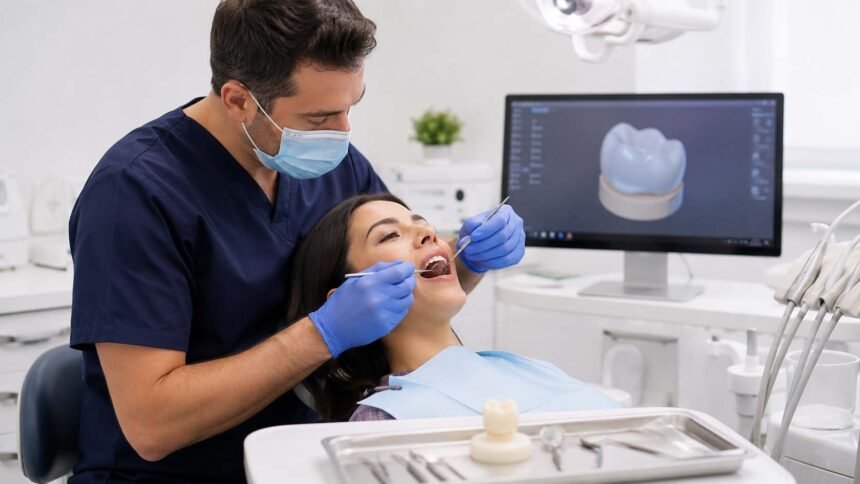
If your dentist has recommended a crown, you probably have questions. Will it hurt? How long does it take? What’s the cap actually made of, and how long will it last? A crown is one of the most common dental restorations, yet a lot of people walk into the appointment unsure of what to expect, and that uncertainty is usually what makes the whole thing feel bigger than it is.
What a Dental Crown Is and Why You Might Need One
A crown is a custom-made cover that fits over a tooth like a snug helmet, restoring its shape, strength, and appearance. Unlike a filling, which patches a small portion of a tooth, a crown wraps the whole visible part. That’s why dentists turn to crowns when a tooth is too damaged for a filling to hold.
Common reasons a crown gets recommended include:
- A tooth that’s cracked, worn down, or weakened by a large old filling
- A tooth that’s recently had a root canal and has become brittle
- A badly decayed tooth where there isn’t enough healthy structure left for a filling
- Covering a dental implant or anchoring a bridge
- Restoring a tooth that’s broken below the gumline or chipped significantly
Think of it this way: a filling repairs damage, while a crown reinforces a tooth that can no longer protect itself. If you’re grinding through old fillings or feeling a sharp edge from a cracked molar, a crown is often the long-term fix.
What Happens During the Procedure
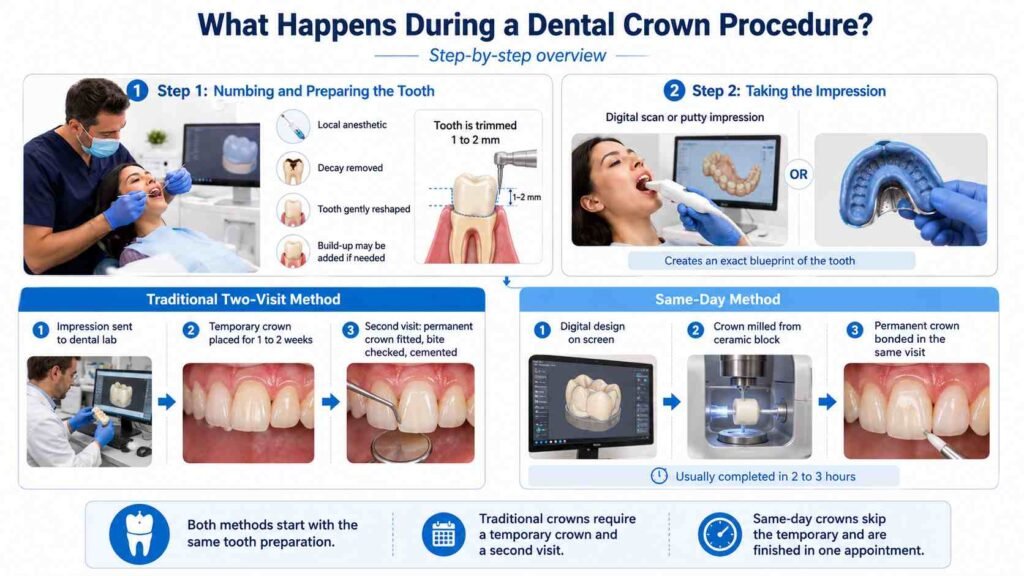
Crowns are placed in one of two ways: the traditional two-visit method or the newer same-day approach. Both start the same way, with careful preparation of the tooth.
Step 1: Numbing and Preparing the Tooth
Your dentist numbs the area with a local anesthetic, so the work itself is painless. You’ll feel pressure and vibration, but not sharpness. Once you’re numb, the dentist removes any decay and gently reshapes the tooth, trimming a thin layer (roughly one to two millimeters) from its surfaces. This creates room for the crown to fit without making the tooth feel bulky. If a large part of the tooth is missing, the dentist may build it back up with filling material first to give the crown a solid base.
Step 2: Taking the Impression
Next, the dentist captures the exact shape of your prepared tooth. Some offices still use a soft putty that you bite into for a few seconds; many now use a small digital scanner that maps the tooth in a few minutes. This blueprint tells the lab or the in-office milling machine precisely how to build your crown.
Traditional Two-Visit Method
With the traditional approach, your impression goes to a dental lab, where a technician crafts your permanent crown over the next couple of weeks. In the meantime, you wear a temporary crown made of acrylic or composite. It protects the tooth and lets you chew, but it’s not built for heavy use. It’s held on with weaker, removable cement on purpose.
At the second visit, the dentist takes off the temporary, sets the permanent crown in place, checks that your bite feels even, and then bonds it firmly with dental cement. The fit is fine-tuned before anything is permanently sealed.
Same-Day Method
Some offices use computer-aided design and milling technology, which lets them design and mill a ceramic crown on-site while you wait. After preparing the tooth and taking a digital scan, the dentist designs the crown on a screen, and a milling unit carves it from a solid ceramic block. The whole appointment usually runs two to three hours, and you leave with the permanent crown already bonded, no temporary, no second trip.
Same-day technology suits a lot of people, especially those juggling busy schedules or who’d rather not deal with a temporary. For example, someone who lives far from the dental office or travels often may find it far more practical to handle everything in one sitting. If that’s your situation, ask whether your dentist offers practices such as those providing same day crown solutions in Temecula build their workflow around finishing the restoration in a single appointment.
Crown Materials: What They’re Made Of and How to Choose
The material your crown is made from affects how it looks, how long it lasts, and how it handles the pressure of chewing. Here’s how the main options compare.
All-Ceramic and Porcelain Crowns
These are the go-to choice for front teeth and any tooth that shows when you smile, because they mimic the translucency of natural enamel and blend in beautifully. Zirconia and lithium disilicate are popular, strong ceramics. Zirconia is especially tough and works well even on back teeth, while lithium disilicate is prized for its natural look. The trade-off: some ceramics can chip under very heavy grinding, so they pair best with people who protect their teeth.
Porcelain-Fused-to-Metal (PFM)
PFM crowns put a porcelain shell over a metal core, combining decent looks with solid strength. They’ve been a reliable workhorse for decades, especially on back teeth. One thing to watch over the years: if your gums recede, a faint dark line can appear at the gumline where the metal meets the tooth.
Metal and Gold Crowns
Metal crowns, usually gold alloys, are the most durable option of all and rarely crack, even under serious bite force. They’re not pretty, so they’re mostly used on out-of-sight molars or for people who grind heavily. They’re also gentle on the opposing teeth, wearing them down less than harder materials can.
Resin Crowns
Resin is the budget option. It costs less upfront but wears down and breaks more easily, so it tends to last only a handful of years compared with the much longer lifespan of ceramic or metal. It can be a reasonable short-term or temporary solution, but it’s rarely the best long-term value.
A quick rule of thumb: for a front tooth, prioritize how natural it looks; for a molar that does the heavy chewing, prioritize strength. Your dentist can help you weigh appearance, durability, and cost against your specific bite.
Recovery and Aftercare
Most people bounce back from a crown quickly and return to normal life the same day. Still, a little care in the first week or two goes a long way.
First Few Days
It’s normal to feel mild soreness or sensitivity to hot and cold for a day or two, particularly with ceramic crowns. An over-the-counter pain reliever usually handles it, and the sensitivity typically fades within a week as the tooth settles. Your bite may also feel slightly “off” at first while your jaw adjusts to the new shape, which is common and usually sorts itself out.
Eating Tips
- For the first 24 hours after a permanent crown is cemented, go easy and stick to softer foods while the bond fully sets.
- Avoid sticky foods like caramel, taffy, and chewing gum, which can tug a fresh crown loose.
- Skip very hard items, ice, hard candy, popcorn kernels that can stress the restoration before you’ve adjusted.
- Most people are back to a normal diet within a week or so, but staying cautious with extremely hard or sticky foods long term helps the crown last.
Keeping the Crown Healthy
The crown itself can’t get a cavity, but the natural tooth underneath it still can, especially right at the edge where the crown meets your gum. That’s where decay tends to sneak in. So daily flossing matters as much as ever. Slide the floss gently around the crowned tooth rather than snapping it down, and consider a water flosser if regular floss feels awkward around the new crown. Brushing twice a day and keeping up with cleaning rounds out the routine.
Risks, Complications, and When to See a Dentist
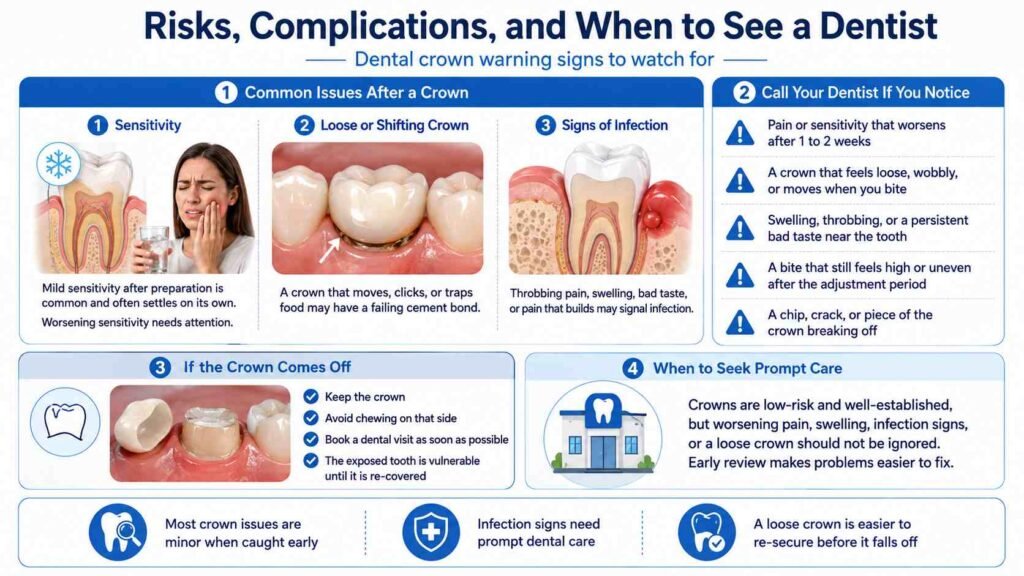
Crowns are a low-risk, well-established treatment, but no dental work is completely free of complications. Knowing the warning signs helps you catch issues early, when they’re easiest to fix.
Sensitivity
Some lingering sensitivity after preparation is the most common minor issue. It usually calms down on its own. But sensitivity that gets worse over time, rather than better, is worth a call.
A Loose or Shifting Crown
If a crown feels like it moves, clicks, or traps food around the edge, the cement bond may be failing. This doesn’t happen often, but when it does, it’s usually in the first year. Don’t ignore it. A crown that’s working loose is easier to re-secure than one that falls off entirely.
Signs of Infection
This is the one to take seriously. A throbbing ache, swelling, a bad taste, or pain that builds rather than fades can point to an infection or an underlying problem that wasn’t fully resolved before the crown went on. This may need a root canal or further treatment, so see your dentist promptly.
Call your dentist if you notice any of these:
- Pain or sensitivity that worsens instead of improving after a week or two
- A crown that feels loose, wobbly, or moves when you bite
- Swelling, throbbing, or a persistent bad taste near the tooth
- A bite that still feels high or uneven after the adjustment period
- A chip, crack, or piece of the crown breaking off.
If the crown comes off completely, keep it, avoid chewing on that side, and get in to be seen soon. The exposed tooth is vulnerable until it’s re-covered.
How Long Crowns Last and How to Make Yours Last Longer
A well-made crown is a long-term investment. Dental research generally shows that most crowns are still going strong roughly nine times out of ten at the ten-year mark, with the exact lifespan depending on the material, your habits, and your home care. Metal crowns often last the longest, sometimes two decades or more, while ceramic crowns commonly serve well for many years before needing replacement.
What’s largely in your control is how you maintain it. People with steady oral hygiene and regular checkups tend to get the most years out of a crown, while heavy grinding, skipped cleanings, and plaque buildup at the margins shorten its life. If you grind your teeth at night, ask about a custom nightguard. It’s one of the simplest ways to protect both crowns and natural teeth.
Simple Prevention Habits That Pay Off
- Floss daily around the crown to keep decay away from the margin where it meets the tooth.
- Keep up with cleanings and exams (typically every six months) so small problems get caught early.
- Wear a nightguard if you clench or grind.
- Don’t use your teeth as tools. Opening packages or biting nails puts unnecessary stress on a crown.
- Mention new sensitivity or bite changes at your next visit rather than waiting for them to grow.
The crown-tooth edge is the part most worth protecting. The leading reason crowns ultimately fail is new decay creeping in at that border, which is exactly why daily cleaning and routine dental visits do so much to extend the life of the restoration.
Bottom Line
A dental crown restores a damaged tooth so it can chew, bite, and look like it should again. Whether you go with the traditional two-visit route or a same-day ceramic crown, the core of the process is the same: numb, prepare, fit, and bond. Recovery is usually quick and mild, the main risks are uncommon and manageable, and good daily care is what turns a crown into a restoration that lasts for years. Knowing what’s ahead and what to watch for afterward puts you in a far better position to make confident choices about your own care.
This article is for general information only and isn’t a substitute for professional dental or medical advice. Every mouth is different, and the right treatment depends on your specific situation. Talk to a licensed dentist about your symptoms and options before making any decisions about your care.