

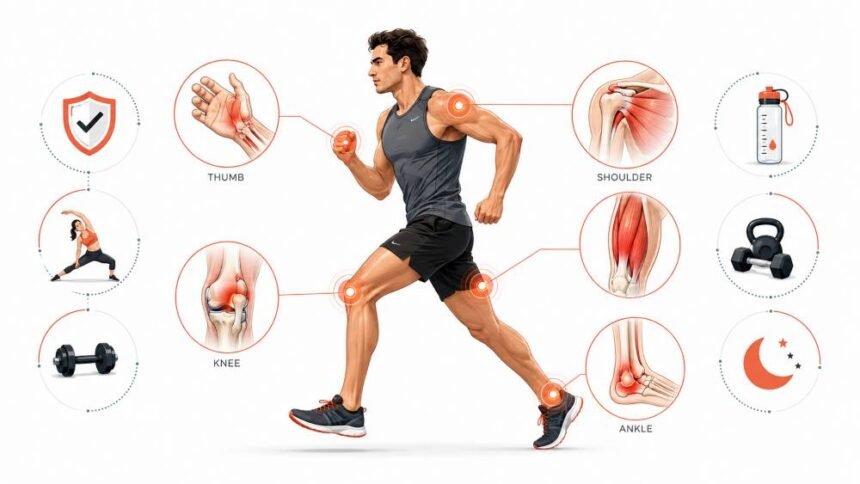
Most people do not go looking for an article like this until something already hurts. Maybe you jammed a thumb catching a pass, and it has swollen into something you barely recognize. Maybe your knee puffed up overnight after five-a-side and you are quietly hoping it settles by Thursday. Maybe your heel has been shouting at you for the first ten steps of every morning for three weeks.
Or maybe nothing hurts yet, and you have watched enough teammates vanish for a season to want to stay ahead of it.
Either way, the version of this topic that actually helps is not a list of alarming diagnoses. It is knowing which injuries genuinely happen, what each one feels like from the inside, which ones you can sensibly manage at home, and which ones need someone with an X-ray machine. That is what follows.
One thing worth saying before any of it: staying active remains overwhelmingly worth doing. The National Institute of Arthritis and Musculoskeletal and Skin Diseases makes the point plainly, noting that most physical activity is safe for almost everyone and that the health benefits far outweigh the risks. The goal here is not to make you cautious. It is to keep you playing.
Acute Injuries Versus Overuse Injuries
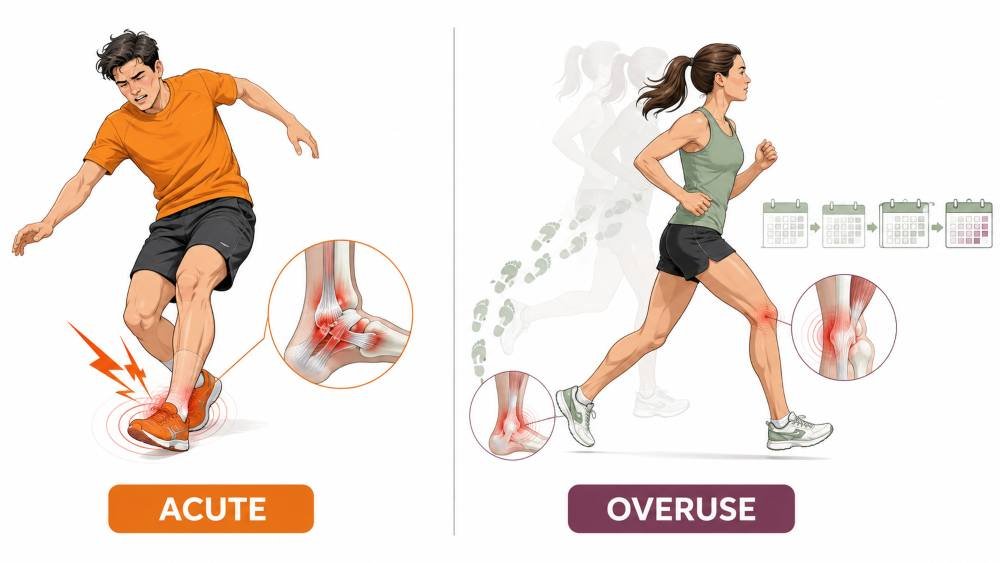
Almost every sports injury falls into one of two groups, and telling them apart changes what you should do next.
- An acute injury has a moment. You can point to it: a twist, a collision, a landing, a sudden sprint. Something tore, cracked, or shifted in a single second, and you usually knew about it straight away.
- An overuse injury has no moment. It accumulates. Tissue is loaded slightly faster than it can repair itself, week after week, until it starts complaining. There is no dramatic story to tell, which is exactly why these get ignored, blamed on age, and allowed to become genuinely stubborn.
The practical difference: an acute injury raises the question “what did I damage?” An overuse injury raises a different one, “what did I change in the last month?” A new hill route, a jump from two sessions a week to four, a return after six weeks off, a switch to a different court surface. The answer is almost always somewhere in the preceding four to six weeks.
Thumb Injuries
The thumb accounts for roughly half of hand function, which is why an injury that looks minor can quietly interfere with everything from opening a jar to holding a steering wheel. High-impact and ball sports (netball, football, basketball, rugby, skiing) produce most of them, usually through a fall onto an outstretched hand or a ball striking the thumb at an unhelpful angle.
Broken Thumb
You can fracture any of the thumb’s bones: the distal phalanx near the tip, the proximal phalanx in the lower part of the thumb, or the metacarpal at the base. Location matters more than most people expect. A break through the shaft of a bone is usually straightforward. A break that runs into the joint surface, known as an intra-articular fracture, is a different problem, because the joint has to be reassembled almost perfectly or the surface heals with a step in it. Two of these patterns at the base of the thumb metacarpal, called Bennett and Rolando fractures, frequently need pins or screws rather than a cast.
Signs that point toward a fracture rather than a sprain include:
- A crack or pop felt or heard at the moment of injury
- A thumb that looks crooked, shortened, or set at a wrong angle
- Swelling that arrives fast rather than creeping in over the day
- Sharp pain that does not ease off at all
- Bruising that spreads beyond the point of impact
- Numbness or pins and needles afterward
The question most people end up typing into their phone at 11 pm is how do you know your thumb is broken rather than badly sprained, and the honest answer is that you often cannot be sure without imaging. Bone and ligament sit directly on top of each other there, so a severe sprain can swell and hurt just as convincingly as a mild break. Being able to move the thumb rules out nothing.
Two things worth doing immediately: take rings off before swelling makes that a small ordeal, and resist any instinct to straighten or “pop back” a thumb that looks wrong. Support it, ice it, and get it imaged.
Sprained Thumb
A sprain means the ligaments have been stretched past their limit. The one that matters most sits on the inner side of the knuckle at the base of the thumb, the ulnar collateral ligament, which is what stops your thumb folding away from your hand when you pinch or grip.
Sprains are graded in three steps:
- Grade one: overstretched, still intact
- Grade two: partially torn, often with noticeable looseness
- Grade three: completely torn or pulled off the bone
Expect tenderness, swelling, and bruising around the base of the thumb. With grade two and grade three injuries, you will also lose pinch strength, which shows up in small, annoying ways long before you notice it in sport.
Two names for this injury get used interchangeably and should not be. Skier’s thumb is the acute version, classically from falling with a ski pole in your hand, though a fall onto an outstretched hand in any sport does it just as well. Gamekeeper’s thumb originally described the chronic version, where the same ligament gradually loosens through repeated stress. Neither term means “texting thumb,” which is a loose label for tendon irritation on the other side of the thumb and is a separate problem entirely.
One reason not to walk this one off: in a complete tear, the torn end of the ligament can flip out of position and lodge above a layer of tissue that then blocks it from ever reattaching. That situation, a Stener lesion, will not heal in a splint no matter how long you wait. If your thumb feels loose or unstable rather than just sore, that is the finding worth getting checked early.
Knee Injuries
The knee does an enormous amount of unglamorous work, and it pays for it. One figure cited in the British Journal of Sports Medicine holds that 41% of all sports injuries are knee injuries, with roughly one in five of those involving the anterior cruciate ligament.
- ACL tears usually happen without contact. You plant, pivot, decelerate, or land awkwardly, and the knee rotates over a fixed foot. Many people hear or feel a pop, the knee swells within a few hours because the joint fills with blood, and it feels unreliable when you try to turn on it.
- Meniscus tears come from twisting through a loaded knee, and they behave differently. Swelling tends to build over a day rather than an hour, and the standout symptom is mechanical: catching, clicking, or the knee briefly locking in one position where the tear sits matters, since the outer rim has a blood supply and can heal, while the inner portion largely cannot.
- Medial collateral ligament sprains follow a blow to the outside of the knee, common in contact sport, and produce pain and tenderness along the inner side of the joint. Most settle with bracing and rehabilitation.
- Patellofemoral pain, often called runner’s knee, is the odd one out, because there is usually nothing torn at all. It is an aching pain at the front of the knee that worsens on stairs, hills, squats, and long periods sitting with the knee bent. It responds to strength work and load management rather than surgery, which is genuinely good news even though it rarely feels that way at the time.
A useful rule of thumb across all of these: swelling that appears within the first hour suggests bleeding inside the joint, and bleeding inside a joint usually means something structural. That knee deserves an assessment rather than a wait-and-see week.
Shoulder Injuries
Your shoulder trades stability for range of movement. The ball is considerably larger than the socket it sits in, held in place by a rim of cartilage and a sleeve of muscle and tendon. That design lets you throw, serve, and swim, and it also means the shoulder comes apart more readily than any other major joint.
- Dislocations and instability typically follow a fall or a forced overhead position. The first dislocation matters more than people realize, because it stretches or tears the structures meant to prevent the next one, and recurrence rates in athletes under about 25 are high.
- Rotator cuff injuries can be sudden, from a fall onto an outstretched arm, but are more often the slow kind. Rotator cuff tears tend to announce themselves as weakness lifting the arm, pain in a specific arc of movement, and an unmistakable ache when you roll onto that side in bed. Night pain is the symptom that finally sends most people to a clinic.
- Labral and SLAP tears damage the cartilage rim around the socket. SLAP tears show up in throwing athletes, swimmers, and weightlifters, often as clicking or catching, deep pain at the back of the shoulder, and in throwers, a “dead arm” where the velocity is gone.
- AC joint sprains get overlooked in most injury lists despite being extremely common. Land directly on the point of your shoulder and you can separate the small joint where the collarbone meets the shoulder blade, leaving a tender lump on top. Most are managed without surgery.
Foot And Ankle Injuries
Ankle sprains are the most common sports injury there is, usually rolling the foot inward and damaging the ligaments on the outer side. The part people get wrong is the recovery. A sprained ankle that is rested until the pain stops, and then taken straight back into sport, has a real chance of becoming a chronically unstable ankle that keeps giving way. Balance and proprioception work is what closes that loop, and it is the step almost everyone skips.
- Achilles problems come in two very different forms. Tendinopathy builds gradually as stiffness and pain a few centimeters above the heel, worst in the morning and at the start of a run. A rupture is sudden, often described as being kicked or shot in the back of the leg, frequently with an audible snap, and it leaves you unable to push off properly. A suspected rupture needs same-day assessment.
- Plantar fasciitis has a signature that is hard to mistake: sharp pain under the heel for the first steps out of bed, easing as you move, returning after you have been sitting. It is stubborn and slow, and it responds better to calf and foot loading work than to rest alone.
- Turf toe is a sprain of the big toe joint from forcing it into extension, usually pushing off hard on a firm surface. It sounds trivial and is not, because you push off through that joint with every stride.
- Stress fractures deserve their own warning. These are overuse injuries in bone, and they creep in as pain that is fine at rest, builds during activity, and can be pinpointed with one finger. Some sites, including the navicular in the midfoot, the femoral neck, and the front of the shin, are considered high risk and need prompt imaging rather than a fortnight of hoping.
Muscle Strains And Tears
Muscles that cross two joints and work hard while lengthening are the ones that tear. That means hamstrings, calves, quadriceps, and adductors in the groin, and it explains why sprinting and sudden changes of direction cause most of them.
The grading follows the same pattern as ligament sprains: overstretched fibers with pain but full strength, a partial tear with weakness and often visible bruising a day or two later, and a complete tear with a palpable gap and near-total loss of function.
The number worth internalizing is not the grade. It is the reinjury rate. Hamstring strains in particular have a stubborn habit of recurring in the first few weeks back, usually because the athlete returned when the pain stopped rather than when the strength returned. Eccentric strengthening, most famously the Nordic hamstring curl, is one of the better-supported interventions in the whole of sports medicine for reducing that risk.
What Actually Raises Your Risk
- Previous injury. The single strongest predictor of getting hurt is having been hurt before, especially if rehabilitation was cut short.
- Sudden jumps in training load. Not total volume, but change. The dangerous weeks are the ones right after illness, holiday, or an enthusiastic new year.
- Fatigue and poor sleep. Tired athletes land differently, react later, and lose the coordination that protects joints.
- Under-fueling and dehydration. Consistently eating less than your training demands weakens bone over time, and dehydration accelerates fatigue.
- Technique breakdown. Form usually fails at the end of sessions rather than the start, which is when most non-contact injuries happen.
- Equipment that no longer does its job. Worn studs, dead running shoes, ski bindings set wrong.
Worth saying honestly: some injuries are luck. A ball hits your thumb, an opponent lands on your ankle, and no amount of preparation would have changed it. The list above is about shifting odds, not guarantees.
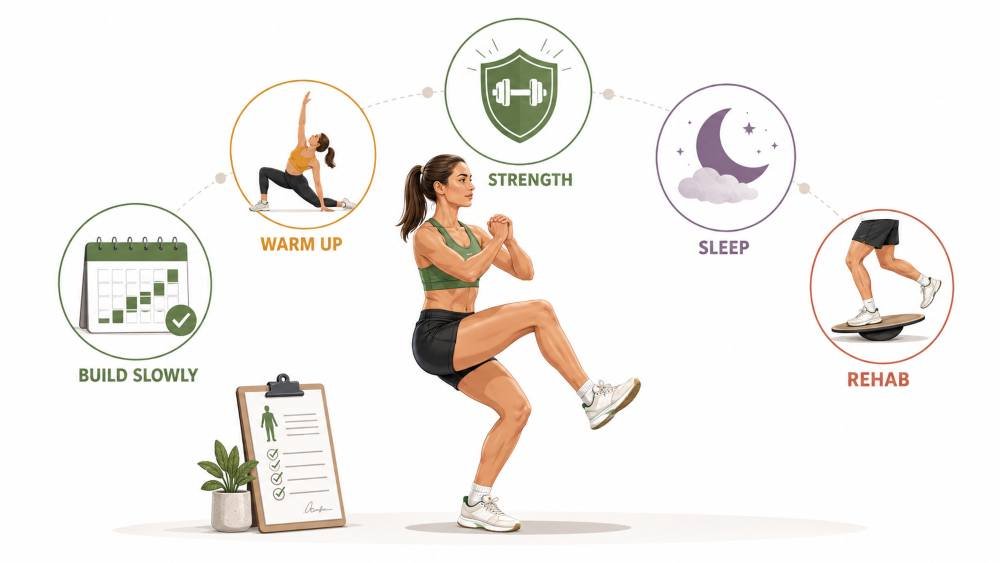
How To Genuinely Lower Your Risk
- Strength train, and treat it as the main event. A systematic review in the British Journal of Sports Medicine found that strength training reduced sports injuries to less than a third and cut overuse injuries roughly in half. The same analysis found no significant protective effect from stretching, which is worth knowing before you spend another season on hamstring holds and skip the squats.
- Warm up to prepare, not to stretch. Ten minutes of raising your heart rate, moving joints through their range, and rehearsing the actual movements of your sport at increasing intensity does more than static stretching does.
- Change your training load slowly. The old advice about increasing by around 10% a week is a rough heuristic rather than a law, but the principle behind it holds. Look at what you did over the previous month, not the previous session.
- Sleep. It is the least glamorous and most consistently underrated item on any injury prevention list.
- Rehabilitate properly, not partially. Finish the ankle balance work. Finish the hamstring program. The last 20% of rehabilitation is the part that stops you reading this article again next season.
- Stop distinguishing “sore” from “wrong” too casually. Muscle soreness is diffuse, symmetrical, and improves as you move. Sharp, localized pain that worsens with load is information.
First Few Days After An Injury
For most sprains and strains, the NHS recommends PRICE therapy in the first two to three days: protect the injury, rest it, apply an ice pack for up to 20 minutes every two to three hours, use a compression bandage during the day, and keep the limb elevated. It also advises avoiding heat, alcohol, and massage early on, all of which increase swelling.
The important update to add: rest is a short-term measure, not a treatment plan. Current thinking moves toward gentle, pain-free movement as soon as it can be tolerated, because immobilized tissue stiffens and weakens quickly. Painkillers are reasonable for comfort, but using them to get through a match is how a manageable injury becomes a long one.
Realistic timelines help too. A mild sprain or strain often settles in one to three weeks. Significant ligament tears and fractures run in months, not weeks, and full return to sport usually lags well behind the point where daily life feels normal again.
When To Stop Guessing And Get Seen
Seek medical assessment promptly if any of the following apply:
- You cannot bear weight, or cannot use the limb at all.
- The joint or limb looks deformed, crooked, or out of place.
- Swelling appeared within an hour of the injury.
- The joint feels unstable, loose, or gives way.
- There is numbness, tingling, or the area looks pale or cold.
- Pain is severe, or is getting worse rather than better after a few days.
- Symptoms have not meaningfully improved after two weeks.
Two situations that need same-day attention rather than a wait: any suspected head injury, where the rule remains that if you are in doubt, you sit out for the day and get assessed; and calf pain with swelling, warmth, or redness that did not follow a clear moment of injury, because a blood clot can convincingly imitate a calf strain.
For children and teenagers, pain close to a joint deserves a lower threshold for assessment. Growth plates are the weak link in a young skeleton, and injuries there are easy to dismiss as “growing pains.”
Returning To Sport Without Getting Hurt Again
Come back on criteria, not on the calendar. Before you play again, you should have full pain-free range of movement, strength that is comparable to the uninjured side, and the ability to perform the specific movements of your sport at close to full speed without hesitating. Hesitation is a legitimate red flag; a body that does not yet trust a limb will compensate somewhere else.
Then build back in stages: training, then partial participation, then full. The temptation to skip the middle stage is understandable and is exactly where reinjuries cluster.
Short Version
Most sports injuries fall into a handful of predictable patterns, and most of those are influenced by things you control: how fast you increase your training, how strong the supporting muscles are, how much you sleep, and whether you finish rehabilitation or abandon it once the pain fades. Learn the difference between soreness and a signal, take swelling and instability seriously, and get the ambiguous injuries imaged rather than tested with another game.
The aim is not to play carefully. It is to keep playing.
Disclaimer
This article is for general information only and is not medical advice. It cannot account for your individual circumstances and should not be used to diagnose or treat any condition. Always speak with a qualified healthcare professional about an injury, and seek emergency care immediately for severe injuries, suspected fractures, head injuries, or loss of sensation or circulation.
References
- National Institute of Arthritis and Musculoskeletal and Skin Diseases. Sports Injuries. National Institutes of Health. https://www.niams.nih.gov/health-topics/sports-injuries
- Kadow TR, Fowler JR. Thumb Injuries in Athletes. Hand Clinics. 2017;33(1):161-173. PMID: 27886832. https://pubmed.ncbi.nlm.nih.gov/27886832/
- Complete Care. How to Tell if You Have a Broken Thumb. Reviewed by Jeffrey Peebles, MD. https://www.visitcompletecare.com/blog/is-my-thumb-broken-or-sprained/
- American Academy of Orthopaedic Surgeons. Sprained Thumb. OrthoInfo. https://orthoinfo.aaos.org/en/diseases–conditions/sprained-thumb
- Conference abstract on knee and shoulder injuries in sport. British Journal of Sports Medicine. 2010;44(Suppl 1):i1. https://bjsm.bmj.com/content/44/Suppl_1/i1.1
- Mayo Clinic. ACL Injury: Symptoms and Causes. https://www.mayoclinic.org/diseases-conditions/acl-injury/symptoms-causes/syc-20350738
- American Academy of Orthopaedic Surgeons. Rotator Cuff Tears. OrthoInfo. https://orthoinfo.aaos.org/en/diseases–conditions/rotator-cuff-tears/