

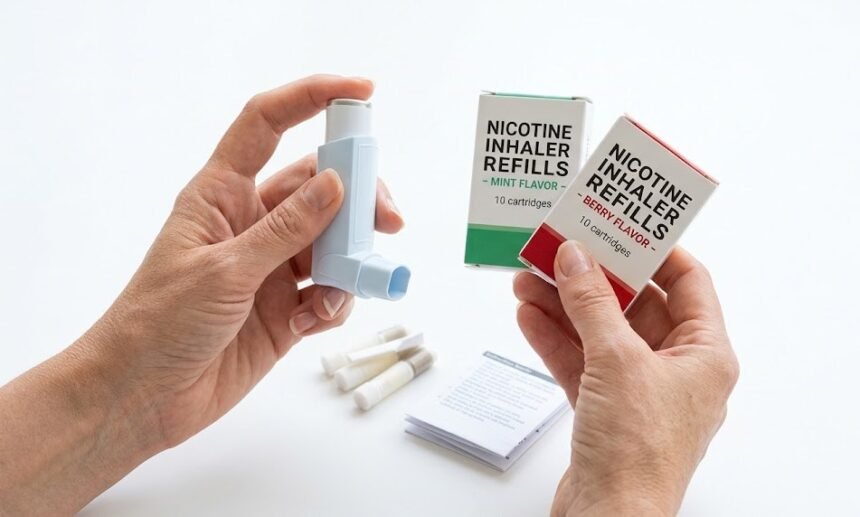
Quitting smoking is one of the most impactful decisions you can make for your long-term health. Nicotine inhaler refills play a surprisingly important role in that journey, yet most people pick them up without much thought. Choosing the right refills, however, can be the difference between a successful quit attempt and falling back into old habits.
This guide is written for patients who are either just starting their quit journey or who have been using nicotine replacement therapy (NRT) for a while and want to get more out of it. We will walk through what nicotine inhaler refills are, how to choose the right ones, and what to look for when sourcing quality products.
Understanding Nicotine Inhaler Refills
What is a nicotine inhaler?
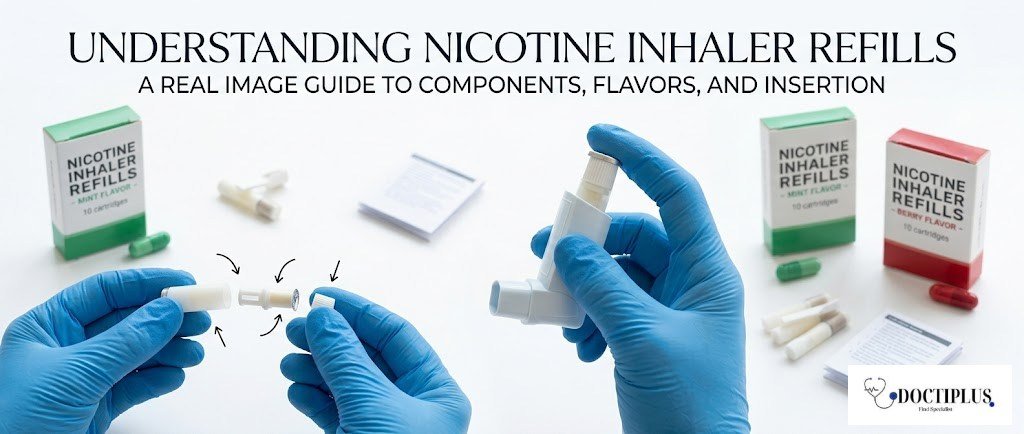
A nicotine inhaler, sometimes called a nicotine inhalator, is a licensed NRT device that mimics the hand-to-mouth action of smoking. Unlike cigarettes, it delivers a low dose of nicotine vapour without harmful tar, carbon monoxide, or the thousands of toxic chemicals found in tobacco smoke.
The device consists of a plastic mouthpiece into which you insert a refill cartridge. When you puff on it, nicotine is absorbed through the lining of your mouth and throat rather than your lungs, which makes it a far safer alternative for managing cravings throughout the day.
Why does refill quality matter for your quit attempt?
Many patients underestimate the role their refill choice plays in NRT success. A poorly formulated or expired cartridge delivers inconsistent nicotine, which leads to breakthrough cravings and increases the temptation to reach for a cigarette. Quality refills, on the other hand, provide steady and predictable relief that keeps cravings manageable.
Beyond nicotine delivery, some refills include mild flavouring agents that reduce the harshness of inhalation, making it easier to use the device as recommended throughout the day.
Choosing Refills That Work for You
Match your nicotine strength to your smoking history.
This is the most clinically important decision you will make. Choosing a strength that is too low means cravings go unmanaged. Too high, and you risk prolonging nicotine dependence beyond what is necessary.
General guidance based on daily cigarette consumption:
- More than 20 cigarettes per day: start with higher-strength refills (typically 15mg or above where available)
- 10 to 20 cigarettes per day: mid-range strength around 10mg is usually appropriate
- Fewer than 10 cigarettes per day or occasional smokers: lower-strength refills between 4mg and 6mg often suffice
Always discuss your nicotine strength with a pharmacist or GP before starting, especially if you have cardiovascular conditions or are pregnant.
Consider flavour for better daily compliance.
Flavour in nicotine inhaler refills is not a gimmick. It genuinely affects how often patients use their NRT throughout the day. Research into smoking cessation consistently shows that patients who find their NRT tolerable and even pleasant are far more likely to use it consistently, which directly improves quit rates.
Common flavour profiles in licensed NRT refills include:
- Menthol, mint, crisp and refreshing, is very popular among former menthol cigarette smokers.
- Tobacco-inspired familiar and grounding, particularly useful for patients who struggle with the psychological break from cigarettes
- Mild fruit or neutral variants appealing to patients who want to move away from tobacco-associated tastes entirely.
You do not have to commit to a single flavour. Many patients rotate between options depending on the time of day or the intensity of their cravings.
Check the cartridge expiry and storage conditions.
Nicotine degrades over time. An expired or improperly stored cartridge delivers less nicotine than intended, which quietly undermines your NRT programme without you realising why cravings feel harder to manage. Always check the expiry date on the packaging before use, and store cartridges in a cool, dry place away from direct sunlight.
Opened cartridges should ideally be used within a few days. Storing them in warm environments, such as a car glove compartment in summer, accelerates nicotine degradation even before the printed expiry date.
Finding Quality Refills: What to Look For
Licensed products only
In the UK, nicotine inhaler refills intended for smoking cessation must be licensed as medicines by the Medicines and Healthcare products Regulatory Agency (MHRA). This licensing ensures consistent nicotine content, safety testing, and quality manufacturing standards that unregulated products cannot guarantee.
Always purchase refills from regulated pharmacies, supermarkets, or reputable health retailers. Unverified online marketplaces carry real risks of counterfeit or substandard products, particularly for something as clinically important as NRT.
Transparent ingredient labelling
Quality refills display clear information about nicotine content, inactive ingredients, and any flavouring agents used. If a product does not clearly state its nicotine strength or full ingredient list on the packaging, that is a red flag worth taking seriously.
Sourcing reliable refills conveniently
Consistency is one of the biggest practical challenges in any NRT programme. Running out of refills or being unable to find them locally is a common reason patients temporarily lapse. Choosing a product that is widely stocked removes that barrier. The tesco ten motives refills range is a licensed NRT option readily available in major UK supermarkets, offering consistent nicotine delivery across a range of strengths. When your refill supply is easy to replenish, staying on track with your quit programme becomes one less thing to manage.
Common Questions Patients Ask About NRT Inhaler Refills
How long does a refill cartridge last?
This depends on the product and how frequently you use it. Most standard cartridges are designed to provide the equivalent of around 6 to 12 cigarettes’ worth of puffing. For a moderate user, a single cartridge may last several hours to a full day. Heavier smokers in the early stages of quitting typically go through more cartridges per day, and that is perfectly normal.
Can I use more than one cartridge per day?
Yes. Most NRT programmes allow patients to use multiple cartridges daily, especially in the first few weeks of quitting when cravings are strongest. The NHS recommends using NRT for at least 8 to 12 weeks for the best results. Follow the product instructions and speak with your pharmacist if you are unsure how many cartridges per day are appropriate for your situation.
Can I combine the inhaler with other NRT products?
Many smoking cessation specialists and the NHS actually recommend combination NRT. Using a nicotine patch for background coverage alongside an inhaler for acute cravings gives you the best of both approaches. The patch provides a steady baseline of nicotine throughout the day. In contrast, the inhaler addresses sudden, intense cravings as they arise. If you are considering combination NRT, discuss it with your GP or a Stop Smoking adviser.
Is the nicotine inhaler safe for everyone?
Nicotine inhaler refills are generally safe for most adult smokers. However, certain groups should seek medical advice before using them, including pregnant women, people with serious cardiovascular conditions, and young people under 18. NRT is not appropriate for people who have never smoked, as it introduces rather than relieves nicotine dependence.
What if the inhaler is not reducing my cravings enough?
If your current refill strength is not adequately managing cravings, do not immediately return to cigarettes. Instead, speak with a pharmacist about stepping up your nicotine strength, adding a background NRT product like a patch, or exploring prescription smoking cessation medications such as varenicline or bupropion, which your GP can discuss with you.
Practical Tips for Getting the Most from Your Nicotine Inhaler
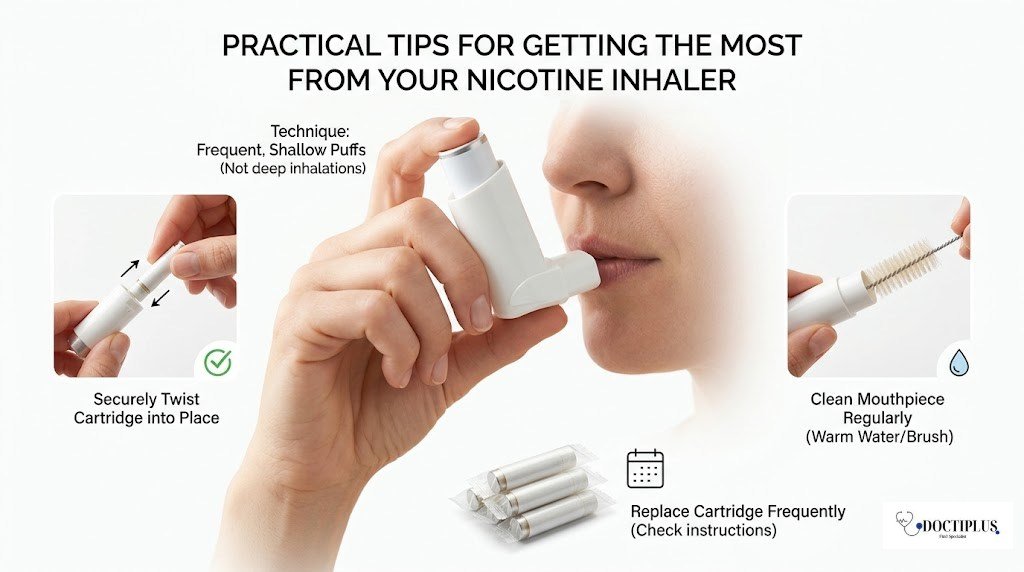
The inhaler is most effective when used consistently and correctly. Here are some evidence-informed tips to help:
- Use the inhaler before a craving peaks, anticipate high-risk moments such as after meals, during work breaks, or in social situations where you previously smoked
- Puff gently, and slowly nicotine absorbs in your mouth and throat, not your lungs, so deep inhalation is unnecessary and can cause throat irritation.
- Keep the cartridge warm. Nicotine vaporises more effectively at room temperature; in cold weather, warm the cartridge in your hands for a minute before use.
- Use it as often as you need it in the early weeks. There is no benefit in rationing your NRT; the goal is to prevent cravings from becoming overwhelming.
- Tracking your daily usage, noting how many cartridges you use per day, helps you and your pharmacist assess whether your current strength and programme are working as intended.
Final Thoughts
Nicotine inhaler refills are a small but genuinely important part of your quit plan. Taking the time to choose the right strength, a flavour you can tolerate daily, and a reliable licensed source makes your NRT programme far more likely to succeed.
Quitting smoking is rarely linear. Most people make several attempts before succeeding long-term, and that is completely normal. What matters is having the right tools in place and using them consistently. Your nicotine inhaler, paired with the right refills and professional support, is one of the most evidence-backed tools available.
If you have questions about which NRT option is right for your situation, speak with your GP, pharmacist, or contact the NHS Stop Smoking Service for personalised guidance.
Medical Disclaimer
This article is intended for informational purposes only and does not constitute medical advice. Always consult a qualified healthcare professional before starting, changing, or stopping any nicotine replacement therapy programme.
References
- Tonnesen P, Nørregaard J, Mikkelsen K, Jorgensen S, Nilsson F. A Double‑blind Trial of a Nicotine Inhaler for Smoking Cessation. JAMA. 1993;269(10):1268–1271. doi:10.1001/jama.1993.03500100066029
- Rennard SI, Daughton DM, Pilcher J, et al. Efficacy of the nicotine inhaler in smoking reduction: a double‑blind, randomized trial. Nicotine Tob Res. 2006;8(4):555‑564. doi:10.1080/14622200600789916
- Schneider NG, Olmstead R, Franzon M, et al. The nicotine inhaler: clinical pharmacokinetics and comparison with other nicotine treatments. Clin Pharmacokinet. 2001;40(9):661‑684. doi:10.2165/00003088-200140090-00003
- Moore D, Aveyard P, Connock M, et al. Effectiveness and safety of NRT-assisted reduction to stop smoking: systematic review and meta-analysis. BMJ. 2009;338:b1024. doi:10.1136/bmj.b1024
- Silagy C, Lancaster T, Stead L, Mant D, Fowler G. Nicotine replacement therapy for smoking cessation. Cochrane Database Syst Rev. 2004; CD000146. doi:10.1002/14651858.CD000146.pub2