

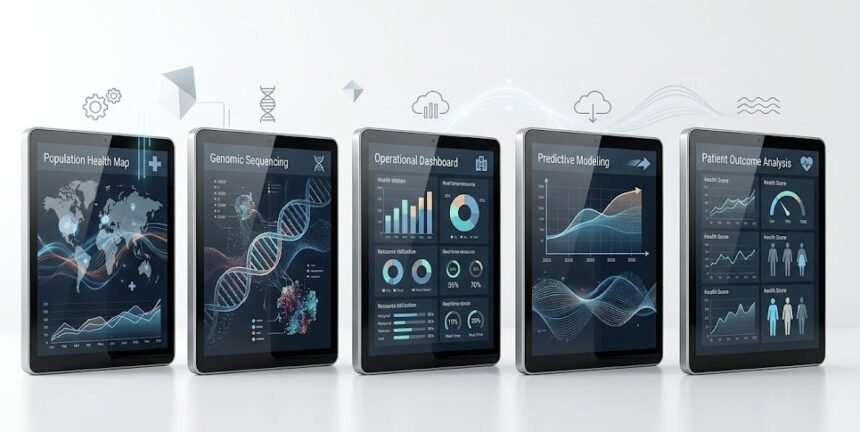
Healthcare organizations are drowning in data. A mid-sized hospital system generates millions of clinical events daily, including lab results, medication administrations, vital signs, imaging orders, and billing codes. The problem has never been a shortage of data. The problem is turning it into something clinicians, analysts, and executives can actually act on.
That is the core promise of modern healthcare analytics platforms: structured intelligence from unstructured complexity. And in 2026, the stakes for getting this right have never been higher. Value-based care contracts demand outcome measurement at the population level. ONC interoperability rules require data to flow across organizational boundaries. CMS quality reporting programs tie reimbursement directly to performance metrics. Healthcare organizations that cannot analyze their data in real time are flying blind in an environment that punishes them for it.
But not all healthcare analytics solutions are built the same. Some are purpose-built for clinical data, with deep support for FHIR, HL7, and payer formats. Others are general-purpose BI tools adapted for healthcare use cases with connectors and templates. The right choice depends on your data architecture, your use cases, your technical team’s capacity, and the degree of integration required between analytics and your interoperability infrastructure.
Quick Comparison: 5 Healthcare Analytics Platforms at a Glance
Use this snapshot to orient your evaluation before diving into the full profiles.
| Platform | Core Strength | Best Fit |
|---|---|---|
| Kodjin | FHIR-native AI analytics, cohort modeling, clinical intelligence | Payers, providers, and researchers needing deep FHIR analytics |
| Qrvey | Embedded, multi-tenant analytics for SaaS products | Healthcare SaaS vendors building analytics into their apps |
| Qlik Sense | Self-service BI with associative data discovery | Operational and quality reporting for non-technical users |
| Health Catalyst | Population health, value-based care, outcome analytics | Large health systems and integrated delivery networks |
| Innovaccer | Unified patient record plus embedded analytics | Care management teams and value-based care programs |
Feature Comparison Across Key Dimensions
| Feature | Kodjin | Health Catalyst | Innovaccer | Qlik | Qrvey |
|---|---|---|---|---|---|
| FHIR-native | Yes (R4 and R5) | Partial | Partial | No | No |
| AI-driven modeling | Yes | Limited | Partial | No | No |
| Cohort analysis | Yes (advanced) | Yes | Yes | No | No |
| Embedded analytics | Yes | Partial | No | No | Yes |
| Claims + clinical fusion | Yes | Yes | Yes | Partial | No |
| Self-service BI | Yes | Yes | Partial | Yes | Yes |
| SaaS / multi-tenant | Yes | No | No | Yes | Yes |
| Custom pricing | Yes | Yes | Yes | Hybrid | Yes |
1 Kodjin: Healthcare Analytics Platform for Clinical Intelligence
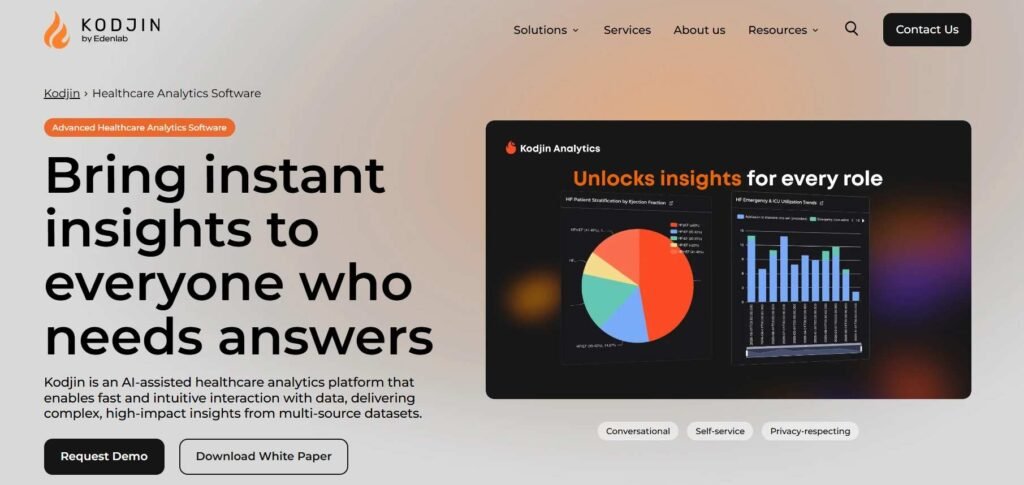
Most healthcare analytics platforms start as general-purpose BI tools and add healthcare connectors. Kodjin takes the opposite approach: it was designed from the ground up for healthcare data, with FHIR as its native language and clinical workflows as its primary design constraint. The result is a platform that does not just visualize health data, it understands it.
What Makes Kodjin Different
Built natively on HL7 FHIR and designed for enterprise healthcare environments, Kodjin Analytics is a purpose-built healthcare analytics software that transforms raw clinical and claims data into structured, queryable intelligence without requiring a separate data warehouse or third-party BI layer.
The core architectural differentiator is Kodjin’s AI-assisted semantic modeling layer. Rather than requiring analysts to manually map EHR exports, claims feeds, and HL7 v2 messages to a common schema, Kodjin’s semantic engine automatically infers relationships across data types and formats. A cardiologist’s episode of care is automatically connected to the patient’s lab trends, medication history, and billing encounters without manual ETL configuration.
This matters because healthcare data is inherently messy. Different EHR systems encode the same clinical concept differently. Payer claims use ICD-10 codes that do not map cleanly to clinical narratives. Lab values carry units and reference ranges that vary by lab and testing methodology. Kodjin’s semantic modeling absorbs this complexity so analysts can focus on questions, not data wrangling.
Clinical Analytics Capabilities
Kodjin’s analytical depth goes well beyond standard dashboarding. The platform offers:
- Cohort logic and temporal modeling: define patient cohorts based on any combination of clinical, claims, and operational criteria, then analyze how outcomes evolve within those cohorts.
- Pathway analysis: map actual patient journeys through the care continuum and compare them against expected pathways to identify deviation points and intervention opportunities.
- Historization: full longitudinal data tracking so queries can return point-in-time snapshots, trend analyses, or delta comparisons across any time window.
- AI-driven insight generation: surface anomalies, outliers, and predictive signals from structured clinical data without requiring data science expertise to configure.
- Customizable reporting layers: clinicians, operational analysts, and C-suite executives each get role-appropriate views built on the same underlying data model.
Interoperability and Data Ingestion
Kodjin integrates tightly with its parent platform’s interoperability stack, making it a natural fit for organizations already running Kodjin FHIR Server or evaluating it alongside an HIE implementation. Supported input formats include:
- HL7 FHIR R4 and R5 resources from any compliant source
- HL7 v2 messages (ADT, ORU, ORM, and other common message types)
- C-CDA documents from legacy EHR exports
- Claims data in EDI 837 and 835 formats
- Custom proprietary formats via configurable transformation pipelines
The built-in ingestion pipelines handle deduplication, patient matching, and normalization, reducing the infrastructure overhead that typically accompanies a healthcare analytics deployment and significantly accelerating time-to-insight.
Who Should Use Kodjin
Kodjin is the strongest fit for payers, providers, and researchers who need genuine clinical intelligence rather than operational reporting. Health systems building population health programs, payers running value-based care analytics, and researchers conducting real-world evidence studies all benefit from the platform’s depth. It is equally effective for organizations building FHIR-native analytics into their own products. Its API-first architecture supports embedded deployment with full white-label flexibility.
Pricing
Kodjin uses custom enterprise pricing, structured as a subscription or per-implementation fee based on data volume, number of users, and deployment model (cloud, on-premise, or hybrid). Pricing is negotiated per engagement, reflecting the platform’s positioning as specialized healthcare analytics software rather than a commoditized BI tool. Organizations should expect a scoping conversation before receiving a formal quote.
Strengths
- FHIR R4 and R5 native, no adapters needed
- AI-driven semantic modeling across formats
- Advanced cohort and pathway analytics
- Full historization and longitudinal views
- API-first, embeddable architecture
Considerations
- Custom pricing requires a scoping call
- Best ROI at mid-to-large scale
- Deeper fit for FHIR-centric environments
2 Qrvey: Embedded Analytics for Healthcare SaaS Products
Qrvey occupies a specific and increasingly important niche: it is built for healthcare SaaS vendors who need to embed analytics capabilities directly into their applications. EHR platforms, patient health management tools, telehealth applications, and care coordination products all need analytics, but building them from scratch is expensive and slow. Qrvey provides a white-label, multi-tenant analytics layer that can be embedded into any web application.
This is a different buyer profile than the one on the other platforms on this list. Qrvey’s customers are not typically health systems or payers. It is a digital health company that wants to offer its own users analytics capabilities without becoming an analytics engineering organization.
Key Capabilities
- Multi-tenant embedded analytics with full white-label customization
- No-code dashboard building for end users within the host application
- Workflow-triggered reports and automated analytics delivery
- RESTful APIs and connectors for healthcare datasets and EHR-adjacent systems
- Usage-based pricing model that scales with tenant and data volume
Pricing: Usage-based, typically tied to the number of tenants, dashboards, or data rows processed, rather than per-user. This makes Qrvey more accessible for early-stage healthcare SaaS companies scaling their analytics offering alongside their product.
Best for: Healthcare SaaS vendors embedding analytics into their products. For direct care delivery organizations, the other platforms on this list are a better fit.
3 Qlik Sense: Self-Service BI for Healthcare Operational Analytics
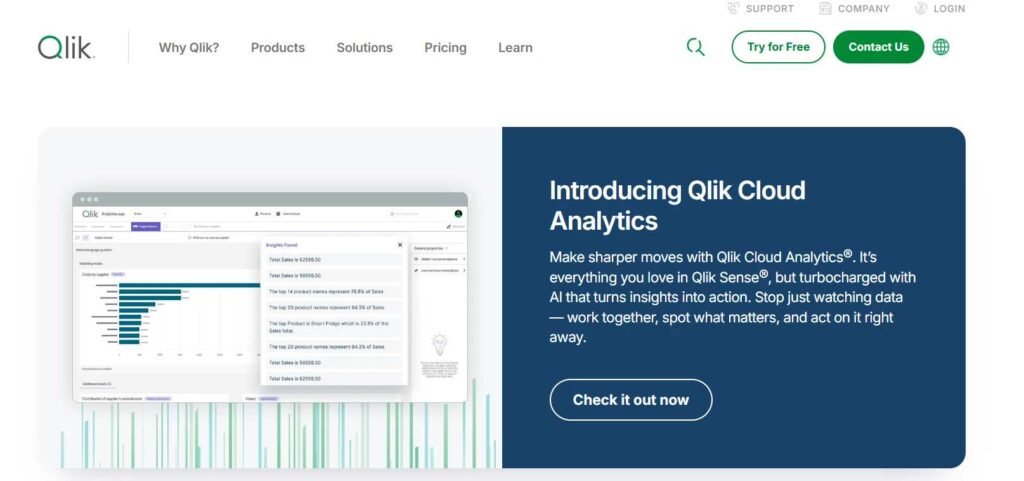
Qlik Sense is not a healthcare-native platform. It is a general-purpose business intelligence tool with a strong adoption base in healthcare operational and quality reporting contexts. Its distinguishing technical feature is an associative data model. Instead of querying in straight lines, Qlik lets users explore relationships across all data in a dataset simultaneously, surfacing connections that directed query tools miss.
In healthcare settings, this makes it effective for operational analytics, such as cross-referencing patient flow data with staffing models, correlating supply chain data with surgical volume, and exploring quality metric trends across facilities. It is less suited for deep clinical analytics that require healthcare-specific data modeling or FHIR-native query patterns.
Key Capabilities
- Associative data model linking EHR, financial, and operational data sources
- Drag-and-drop dashboard creation accessible to non-technical clinical staff
- Extensions and connectors for healthcare-specific data feeds
- Governance and security controls suitable for HIPAA-covered environments
- Embedded analytics via Qlik’s developer APIs for product teams
Pricing: From approximately $30 per user per month for smaller deployments up to custom enterprise contracts.
Best for: Healthcare organizations that need flexible, self-service operational reporting and have analysts comfortable building their own dashboards.
4 Health Catalyst: Population Health and Value-Based Care Analytics
Health Catalyst is one of the more established names in healthcare analytics solutions, built specifically for large health systems, integrated delivery networks, and payers pursuing value-based care programs. Their platform combines a pre-optimized healthcare data warehouse with embedded analytics and a strong professional services arm.
The central product is their Data Operating System (DOS). This cloud-based data platform ingests clinical, financial, and operational data from across an organization and provides a unified foundation for analytics and quality improvement initiatives.
Key Capabilities
- Pre-built healthcare data warehouse with clinical, financial, and operational schemas
- Risk stratification, readmission prediction, and quality metric dashboards
- Embedded analytics and workflow-oriented reporting for clinical and operational teams
- Strong consulting and implementation services to accelerate time-to-value
- Population health management tools with cohort definition and tracking
Health Catalyst’s professional services component is significant. The platform is designed to be deployed with guidance rather than self-service. For large organizations without internal analytics engineering capacity, that is a feature. For teams that want to move fast independently, it can slow down the iteration pace.
Pricing: Custom per organization, typically subscription plus professional services structured by population size and analytics module scope.
Best for: Large health systems and IDNs with dedicated analytics programs.
5 Innovaccer: Unified Patient Record with Embedded Analytics
Innovaccer’s pitch is patient-data unification first, analytics second. The platform ingests and harmonizes clinical data from EHR systems, claims feeds, and social determinants of health sources into a unified patient record, then layers population health analytics and care management tools on top.
For organizations running value-based care programs that depend on understanding the full patient across fragmented data sources, Innovaccer’s unification layer is its primary strength. The analytics are purpose-built for care management teams rather than data scientists.
Key Capabilities
- Unified patient record integrating EHR, claims, SDOH, and referral data
- Real-time risk stratification for care management team prioritization
- Prebuilt models for chronic disease cohorts, readmission risk, and HEDIS plus quality measure reporting
- API-centric architecture supporting third-party integrations
- Care gap identification and outreach workflow tools
Pricing: Enterprise subscription model tied to the number of lives, modules, and data sources.
Best for: ACOs, primary care groups, and payers running population health programs where patient-level longitudinal data unification is the primary bottleneck.
How to Choose the Right Healthcare Analytics Platform
The right healthcare analytics platform is not the one with the most features. It is the one that fits your data architecture, your use cases, and your team’s capacity to operate it.
| Use Case / Need | Recommended Platform | Rationale |
|---|---|---|
| Clinical intelligence on FHIR data, cohort and pathway analytics | Kodjin | Native FHIR support, AI-driven semantic modeling, and strong longitudinal analysis capabilities |
| Population health or value-based care (large health systems) | Health Catalyst | Pre-built healthcare data warehouse and outcome-focused analytics, ideal for large-scale implementations |
| Patient data unification across fragmented sources | Innovaccer | Strong unified patient record foundation before layering analytics |
| Self-service operational reporting (clinical + financial data) | Qlik Sense | Flexible BI with strong accessibility, though requires healthcare-specific configuration |
| Embedded analytics for healthcare SaaS products | Qrvey | Multi-tenant, white-label architecture designed specifically for embedded analytics use cases |
Tip: Match your platform choice to where the bottleneck actually lives. If your data is already clean and unified, but you cannot derive insights from it, you need a stronger analytics layer. If your data is fragmented and you cannot stitch a patient story together, you need a unification layer first. Buying the wrong tool category is the most expensive mistake in healthcare analytics procurement.
Conclusion
Healthcare analytics solutions have matured significantly over the past three years, driven by interoperability mandates, the shift to value-based payment models, and the increasing availability of FHIR-structured data at scale. Organizations that invest in the right platform now will be significantly better positioned to compete on outcomes, reduce costs, and demonstrate quality, the three metrics that define healthcare performance in 2026.
The data is already there. The question is whether your analytics infrastructure can turn it into decisions.