

A mechanical chronograph is worse at measuring time than the phone in your pocket. Not slightly worse. Worse by a factor so large it is difficult to write down without it sounding like an insult.
Your phone syncs to a network of atomic clocks. A well-regulated mechanical watch drifts a few seconds a day and is considered excellent for doing so. Every function the chronograph was invented to perform has since been solved more accurately, more cheaply and more conveniently by something else.
And yet people keep buying them, wearing them, and passing them down. That is the interesting part, and most writing about watches skips straight past it.
What the Chronograph Was Built to Solve
Precision timekeeping did not begin as a luxury. It began as a survival problem.
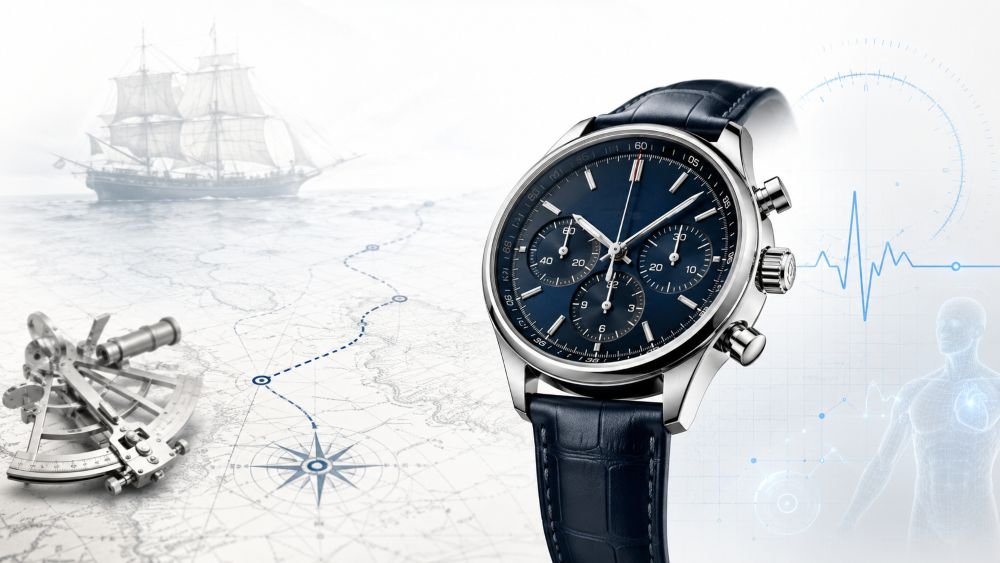
For most of the age of sail, a ship could establish its latitude with reasonable confidence and had no reliable way to establish its longitude at all. Fleets ran aground. Crews starved on voyages that had drifted hundreds of miles off course. The solution turned out to be a clock accurate enough to keep reference time through months of salt, damp and pitching decks, which is what John Harrison spent decades building. The Royal Museums Greenwich account of how Harrison’s timekeepers solved the longitude problem is worth reading in full, because it makes clear that accurate portable timekeeping was once a matter of national security rather than taste.
That lineage runs directly to the wrist. When timing an event precisely mattered, and no other instrument could do it, someone built a chronograph for the job.
Job It Did Best, and Then Lost
The clearest example sits in a museum case in Washington.
When NASA needed a chronograph for crewed spaceflight, it wrote a specification and tested against it: manual winding, waterproof, shockproof, antimagnetic, functional from freezing to two hundred degrees Fahrenheit, and able to survive twelve g. The watch that passed was issued to astronauts as a backup timing instrument, and the Smithsonian now holds the chronograph Neil Armstrong carried on Apollo 11, transferred from NASA in 1973.
That was the chronograph doing serious work: the redundant system you fall back on when the electronics fail. Today the redundancy is digital, and the wrist chronograph has no operational role left to lose. It was made obsolete by success, which is a strange and specific kind of retirement.
A Chronograph Is Not a Chronometer
Two words that sound alike, mean entirely different things, and get used interchangeably in almost every buying guide.
A chronograph is a function. It means the watch can start, stop, and reset an elapsed-time measurement, which is why there are pushers on the case and extra sub-dials on the face.
A chronometer is a rating. It means the movement was submitted to an independent authority and passed. In Switzerland, that authority is COSC, which tests to the ISO 3159 standard over roughly fifteen days, in five positions and at three temperatures, and requires a mean daily rate between minus four and six seconds. Early in 2026, COSC introduced a stricter Excellence tier on top of it.
So a watch can be a chronograph and not a chronometer. It can be a chronometer and not a chronograph. It can be both, and the dial will usually say so. Knowing the difference is the fastest way to read a specification sheet honestly rather than through the marketing.
Accuracy Gap Is the Whole Product
Here is where the numbers get uncomfortable, and then interesting.
Official time is kept by cesium fountain clocks, of which fewer than twenty exist worldwide. The current NIST standard would gain or lose less than a second in a hundred million years. A COSC-certified mechanical movement is permitted to drift six seconds a day.
That gap is not a flaw in the product. It is the product.
Nobody buys a mechanical chronograph to know the time. They already know the time. What they are buying is a physical object that solves the problem badly, on purpose, using a mechanism a person can understand, repair, and eventually hand to someone else. The value moved from function to artefact somewhere in the 1970s, and the category has been honest about it ever since, whatever the advertising says.
What the Health Sensors Are Actually Telling You

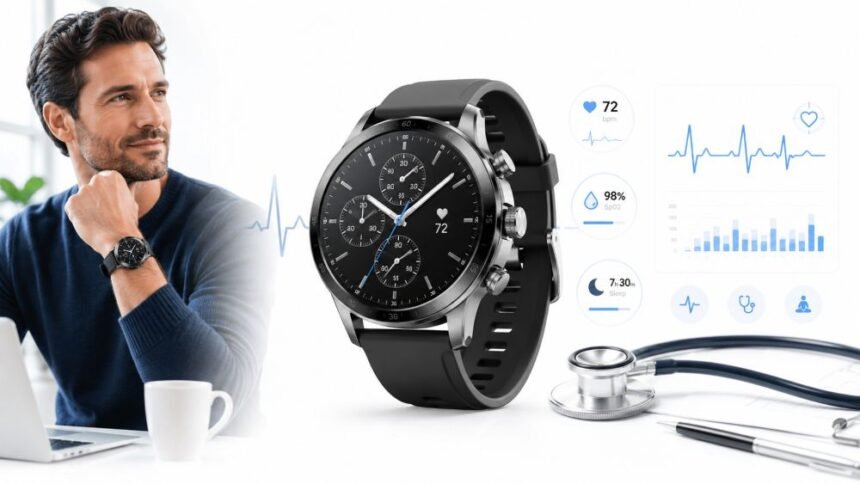
The modern pitch is that a watch can now track your heart rate, your sleep and your recovery. Much of that is real. Some of it is softer than the interface suggests, and this is where a bit of precision helps.
Start with the regulatory position, because it is clearer than most people expect. Consumer wearables largely sit outside medical device regulation by design. The FDA’s general wellness policy for low-risk devices, revised in January 2026, sets out the terms: a product intended solely for general wellness and presenting low risk is not treated as a medical device, provided it avoids diagnostic claims and clinical thresholds. The 2026 revision widened the range of physiological measurements that can sit inside that category. What it did not do is turn those measurements into clinical data.
The validation picture backs that up. An umbrella review of systematic reviews covering hundreds of validation studies found that only around eleven percent of consumer wearables released to date have been validated for even one biometric outcome. Heart rate held up reasonably well, with a mean bias of about three percent. Sleep measurement was shakier, tending to overestimate total sleep time by more than ten percent. Activity intensity was the weakest, with errors running very wide depending on the activity.
None of that makes the numbers useless. A trend line that shows your resting heart rate creeping upward over three weeks is worth noticing regardless of whether the absolute figure is exact. It just means the number on the dial is an estimate produced by an unregulated consumer product, not a reading from an instrument, and it should send you to a doctor rather than replace one.
Case for a Device That Wants Nothing From You
There is a quieter argument for the analogue watch, and it holds up better than the usual wellness language around it.
Researchers at Texas and UC San Diego ran experiments testing what happens to cognitive performance when a smartphone is simply present. The finding, published as the brain drain study, was that the mere presence of your own phone reduces available cognitive capacity even when you successfully ignore it, and that the effect is strongest in people most dependent on their devices. The cost is not the interruption. The cost is the effort of not being interrupted.
A mechanical watch is the only thing you can wear that has no claim on your attention at all. It cannot notify you. It cannot be updated. It has no engagement metrics attached to it, because nobody profits from how often you look at it. In a wardrobe of devices competing for you, that is close to unique, and it is a more defensible reason to own one than anything about craftsmanship.
What the Market Actually Says
Watch writing tends to claim the category is booming. The official numbers are more complicated, and worth knowing before you spend anything.
According to the Federation of the Swiss Watch Industry, Swiss watch exports fell for a second consecutive year in 2025, down 1.7 percent by value to 25.6 billion francs, with volumes down 4.8 percent to 14.6 million units. Exports to China dropped by more than a third across two years. Employment in the sector fell for the first time since the post-pandemic recovery.
Fewer watches, at higher prices, sold to a narrower group of buyers. That is not a boom; it is a concentration. For a buyer, it has two practical consequences: prices at the entry level are under real pressure, and the secondary market is where a great deal of the actual value now sits.
Choosing One Without the Marketing
Design continuity is the reason a forty-year-old chronograph still reads as current. Tachymeter scales, contrasting registers, the layered depth across the dial: the visual grammar has barely moved, which is why these watches age so slowly. If you want to see that continuity laid out across decades rather than described, it helps to browse a single lineage end to end and discover TAG Heuer timepieces from different eras side by side, since the motorsport chronograph is one of the few designs you can trace almost unbroken from the 1960s to now.
Beyond that, three questions settle most purchases.
- Will you still own it in twenty years? Then mechanical. Nothing else is repairable that far out, and no smartwatch on sale today will receive software updates in a decade.
- Do you want the analogue face and the data? A hybrid gives you both, with the caveats above about what the data is.
- Do you need the metrics to be as good as consumer hardware gets? Then buy the full smartwatch and accept the charging cable. Pretending otherwise to preserve an aesthetic is how people end up with a drawer of watches they do not wear.
Living With One
Maintenance is less demanding than the folklore suggests. A service every few years, sensible distance from strong magnets, a wipe down after a hot day, and a mechanical watch will outlast most of the furniture in your house. Compared with a device requiring nightly charging, annual operating system updates, and eventual end-of-support, the older technology is arguably the lower-maintenance option.
The chronograph is a machine that outlived its purpose and found a better one. It stopped being an instrument and became an object: something that keeps working, asks nothing, and does not need replacing. That is a rarer proposition in 2026 than it was in 1965, which may be exactly why it endures.
Disclaimer
This article is for general information only and does not provide medical, financial, or investment advice.
Smartwatch and fitness tracker data should be treated as an estimate, not a medical diagnosis. Speak to a qualified healthcare professional about any concerning readings or symptoms.
Watches are not presented as investments. Prices and resale values can change. Always verify the product, condition, certification, and seller before buying.