


Have you ever woken up after a whole night’s sleep, yet still feel tired? Or caught yourself staring at your screen for long moments, but can’t bring yourself to start working.
Maybe you feel like you’ve been running on fumes these past months, and you can’t really tell where your energy went. Sounds familiar? If yes, then there’s a real chance you’re dealing with Burnout.
You’re not alone in it, too. Burnout has become so common that it affects a staggering 66% of people, according to a report cited in Forbes. So, you see, it’s neither you nor just a bad week; it’s a steady drain that keeps creeping in until virtually everything about your day becomes so heavy.
Because knowing is half the battle, this article is here to open the curtain on Burnout, so you can recognise it and learn how to recover.
Read on.
What is Burnout?
Let’s start by answering the question “What is burnout?” The World Health Organisation (WHO) defines Burnout as an occupational phenomenon resulting from chronic workplace stress that has not been successfully managed.
This definition clears up one mistake many people make: thinking that Burnout is the same thing as stress.
Burnout is more than just stress. Stress is like having too much on your plate. Burnout is what happens when the plate itself feels empty, yet somehow still impossibly heavy. It’s the crater that’s left after stress has been burning for too long.
Burnout is both mental and physical.
In its mental state, it shows up as:
- Emotional exhaustion
- Depersonalization or detachment
- Reduced sense of accomplishment
In its physical state, it shows up as:
- Trouble sleeping
- Forgetfulness
- Constant irritability
- Headaches or muscle tension
- Constant tiredness
The tricky thing with Burnout is that it builds up slowly. You may not even realise it until you’ve hit your breaking point.
What are the Early Warning Signs of Burnout?
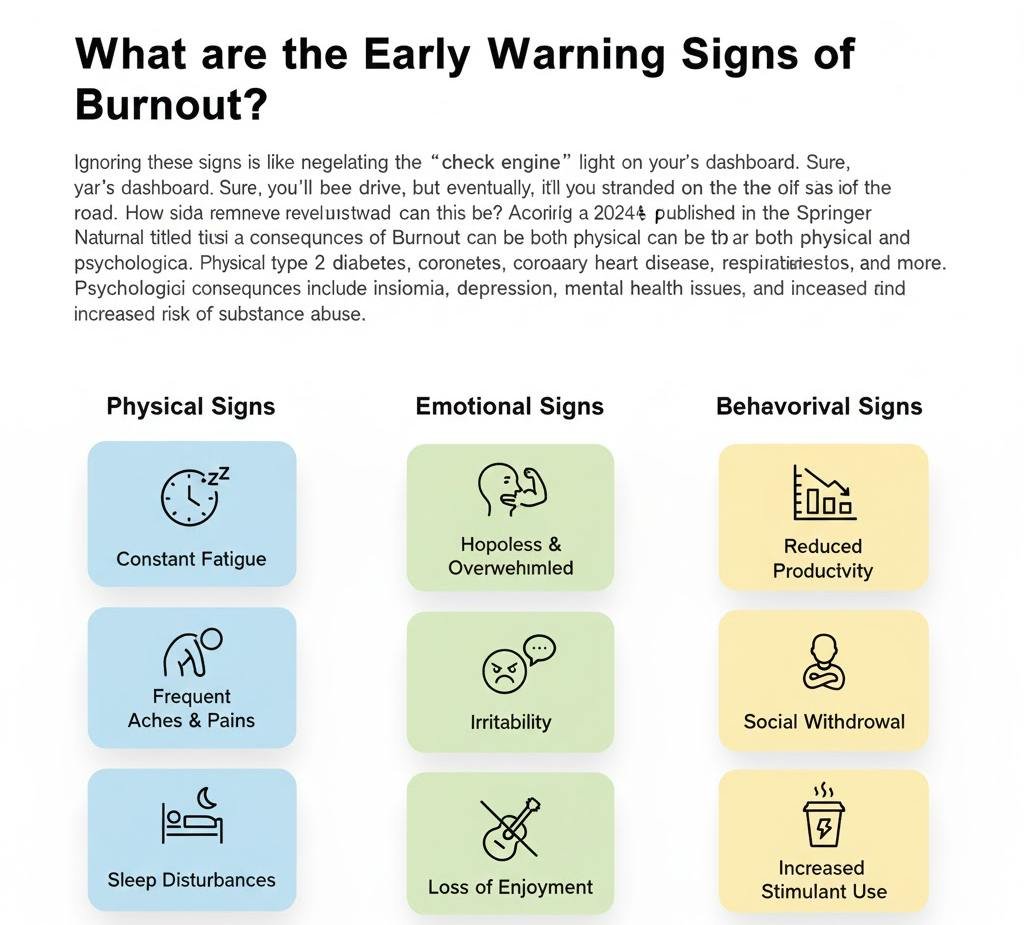
If you own a problematic car, you’ll likely always see a ‘check engine’ light on the dashboard whenever you’re driving. That’s your car telling you that something is wrong and that you should be on the lookout.
While a bulb doesn’t suddenly light up on our foreheads, some signs tell us when something is off. Burnout has its own warning signs, and if you know what to look for, you can take action before things get out of hand.
So, what are these early warning signs?.
Physical Signs
- You’re tired all the time, even after a whole night’s sleep. It’s almost like your body is running on empty.
- Headaches, muscle tension, or unexplained aches show up more often.
- You’re having trouble sleeping. It’s either you can’t fall asleep, or you wake up repeatedly through the night.
Emotional Signs
- You’re suddenly always feeling hopeless and overwhelmed. Nothing you do makes a difference.
- Small things set you off. You snap at people over things that usually wouldn’t bother you.
- The hobbies and activities you once enjoyed now feel like meaningless routines.
Behavioral Signs
- You no longer work as well or as hard as you used to, and it’s affecting your productivity. Tasks now take longer than they used to.
- You suddenly start avoiding responsibilities or withdrawing from people.
- You’re now relying more on quick fixes like caffeine, energy drinks, or other stimulants to push through the day.
Ignoring these signs is like neglecting the ‘check engine’ light on your car’s dashboard. Sure, you’ll be able to drive, but eventually, it’ll get you stranded on the side of the road.
How bad can this be? According to a 2024 review published in the Springer Nature journal titled Burnout: a comprehensive review, the consequences of Burnout can be both physical and psychological.
Physical consequences include type 2 diabetes, coronary heart disease, respiratory infections, headaches, and more.
Psychological consequences include insomnia, depression, mental health disorders, and more.
What Causes Burnout?
If Burnout is a fire, what’s fueling the flames? Many reasons cause burnout. It’s not the same for everybody, but there are patterns.
Work-Related Causes
For many people, this is usually where it all starts.
Remember the WHO’s definition of Burnout? An occupational phenomenon resulting from chronic workplace stress that has not been successfully managed.
The keyword here is workplace stress, and what causes it? Long hours, unrealistic demands, and zero control over your schedule and decisions. According to a Deloitte survey, roughly 50% of employees, both millennials and Gen Z, experience Burnout at work. That’s about half the workforce feeling drained, frustrated, or just completely tapped out.
Personal Lifestyle Causes
Here’s a bitter truth: sometimes, you are actually the cause of your own burnout situation. No. Don’t blame yourself. The point is to help you spot self-defeating patterns.
For example:
- Do you always accept extra tasks and assignments even when you’re maxed out?
- Are you a perfectionist? Someone who spends long, unsustainable hours because the result must be unimpeachable? You’re never truly finished because nothing is ever good enough.
- Are you the kind of person who takes care of everyone else while forgetting yourself, leading to caregiver burnout?
If you answer yes to some or all of these questions, then you need to make some drastic changes fast.
Environmental and Systemic Causes
Sometimes, it’s neither your job nor your habits. It’s just life happening to you.
The cost of living is skyrocketing, and that’s enough to burn anyone out. In fact, according to a 2024 Newsweek article, Americans are feeling financial Burnout more than ever. Research from MarketWatch Guides shows that 47% of adults say 2024 was the most financially stressful year of their lives.
Over time, these pressures can push anyone past their limit, leaving even the strongest coping strategies useless.
How to Recover From Burnout
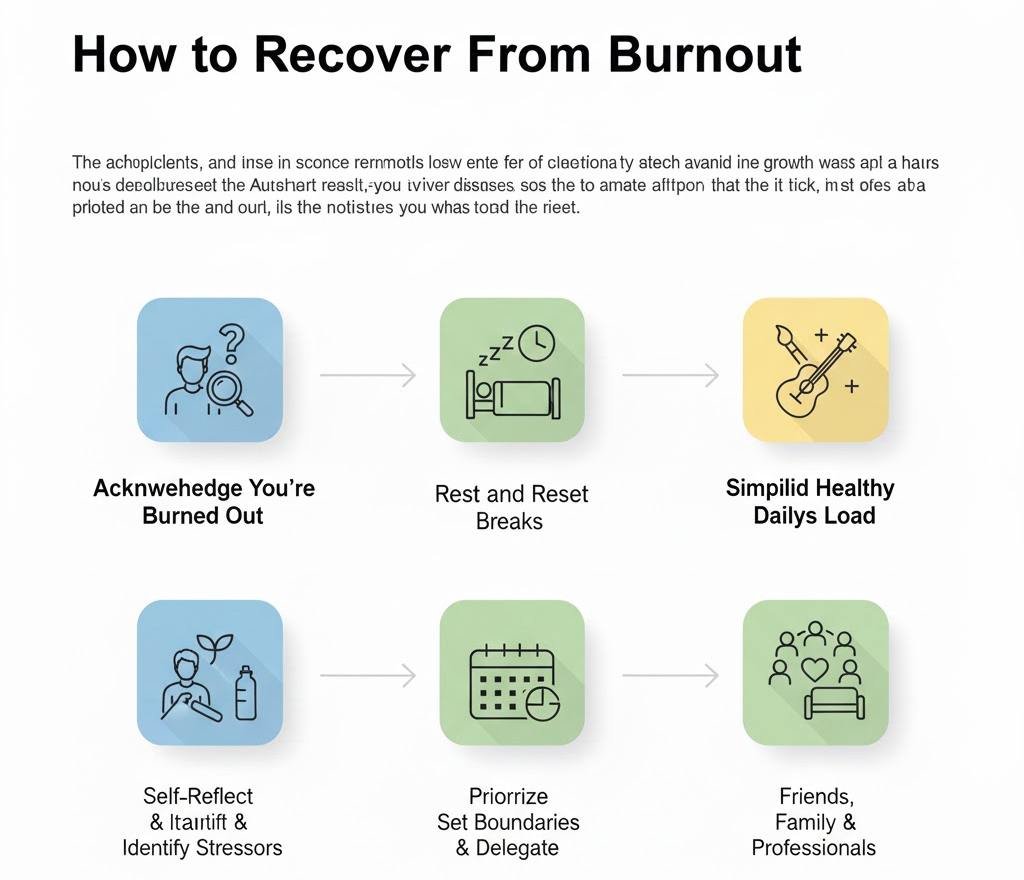
If everything we’ve been talking about so far resonates with you, then you want to pay attention to these remaining sections.
Burnout recovery is very possible. It’s not quick, but it’s achievable with a few practical steps. Here’s what to know.
Acknowledge You’re Burned Out
It starts with acknowledging that you have a problem. Why? Because denial is the single biggest enemy of recovery.
Don’t pretend that everything is okay or that you’re just tired. Acceptance will help you start the healing process.
It’s also vital that you find out exactly what’s causing your stress and Burnout. Is it money, relationship, or work? If it’s work, then you may want to rethink your entire career path. This could mean a subtle career pivot toward meaningful, purpose-driven work that aligns with your values.
This is why you see people move from high-pressure careers like finance and marketing to research roles that offer more breathing room.
Some even do a complete 180, choosing compassion-centred careers like nursing because they want work that feels meaningful. Such a switch is more accessible these days, thanks to accelerated nursing programs for non-nurses.
According to Cleveland State University, successful candidates in courses like these can graduate in just 16 months.
Of course, a career pivot is not a 100% solution to Burnout, but sometimes, this shift might be what you need to help your health.
Rest and Reset
Once you’ve acknowledged the problem, the next step is to take a break to rest and reset. You don’t mean you have to take a vacation (though that can help). The goal here is to do absolutely nothing. Your nervous system has been in fight-or-flight mode for too long. Let it know that it’s safe to relax.
A big part of this rest and reset is sleep restoration. This means actually sleeping for the recommended seven to nine hours per night. Turn off all screens at least an hour before bed. Keep your room cool and dark. And if your brain won’t shut down, see if writing your thoughts down will help.
Simplify Your Daily Load
This is where you start saying NO without feeling guilty. If you were taking on more work than was good for you before, now’s the time to begin declining it. It won’t be easy, but it’s got to be done.
Even better, use technology to manage your workload. Leverage task management apps and calendars to give your routine structure so that you don’t bite more than you can chew again.
For working parents, maybe consider getting someone to help with the children once in a while so that you’re not on your toes all the time. A 2025 study published in the Journal of Pediatric Health Care found that 66% of working parents experience burnout due to parenting. This number shows that many parents are struggling. Getting help, even for a few hours, can be a lifesaver.
Rebuild Healthy Habits Slowly
If you enjoyed activities, get back to them. No one expects you to go from zero to one hundred in a week, but small intentional steps will go a long way.
Loved taking long walks? Start doing so again. Even if you’ve never been a gym person, this is the best time to start. Start small and scale up as you go. The goal is not fitness. It’s to get your body moving and circulation flowing.
More importantly, stay away from those quick fixes like caffeine, energy drinks, or other stimulants you took to push through the day. Eat healthy meals and stay properly hydrated. When the body is well, the mind heals faster.
Reconnect with Support Systems
If there’s one thing that feeds Burnout, it’s isolation. You don’t want to burden anyone, but you’re only getting worse. The solution? Reconnecting with the people who matter to you, especially your friends and family members.
Sometimes, though, the people closest to you, as much as they love you, aren’t equipped to help you untangle the deeper knots. That’s where professional help comes in. An expert can help you get to the root causes of your Burnout and recommend therapies.
One such therapy that’s been really helpful for many people in similar situations is cognitive behavioural therapy (CBT). In one study published in the National Library of Medicine journal, it reduced sick leave associated with fatigue, mental illness, and depression by an impressive 3.65 days. This means people were able to get back on their feet sooner, which clearly shows it works.
Final Thoughts
If you take just one thing from this article, it’s that Burnout is neither in your head nor is it your fault. It’s simply an essential message from your body and mind telling you that something’s wrong somewhere.
And just like with the ‘check engine’ light on the dashboard of your car, you need to deal with it before it’s too late. Hopefully, this article helps.
References
World Health Organization – Definition of Burnout
- Author: World Health Organization (WHO)
- Publishing Date: May 28, 2019
- Site: who.int
- Topic: Official definition of burnout in ICD-11; burnout as an occupational phenomenon.
- Reference:
- World Health Organization. Burn-out an “occupational phenomenon”: International Classification of Diseases. 2019.
Forbes – 66% of People Experience Burnout
- Author: Forbes Staff / Contributor (varies per article; your cited statistic is from Forbes burnout coverage)
- Publishing Date: 2023–2024 range (depending on exact piece cited)
- Site: forbes.com
- Topic: Workforce burnout statistics; 66% burnout prevalence.
Springer Nature – “Burnout: A Comprehensive Review” (2024)
- Authors: Varies (Springer review article)
- Publishing Date: 2024
- Site: link.springer.com (Springer Nature)
- Topic: Comprehensive review of burnout; physical & psychological consequences.
- Reference:
- Burnout: A Comprehensive Review. Springer Nature, 2024.
Deloitte – Millennial & Gen Z Burnout Survey
- Author: Deloitte Insights Team
- Publishing Date: 2023 or 2024 (Millennial & Gen Z Survey)
- Site: deloitte.com
- Topic: Approximately 50% of Millennials and Gen Z report workplace burnout.
Newsweek / MarketWatch Guides – Financial Burnout (2024)
- Author: Newsweek Reporting Team citing MarketWatch Guides
- Publishing Date: 2024
- Site: newsweek.com
- Topic: 47% of U.S. adults say 2024 was their most financially stressful year; rising financial burnout.
Cleveland State University – Accelerated Nursing Programs
- Author: Cleveland State University Faculty/Program Team
- Publishing Date: Noted on program page (Ongoing)
- Site: csuohio.edu
- Topic: Accelerated nursing programs (for non-nurses) enabling graduation in ~16 months.
PLOS ONE – Physical & Psychological Consequences of Burnout (2017)
- Authors: Salvagioni, D.A.J.; Melanda, F.N.; Mesas, A.E.; González, A.D.; Gabani, F.L.; Andrade, S.M.
- Publishing Date: October 4, 2017
- Site: journals.plos.org / pmc
- Topic: Long-term consequences of burnout, including diabetes, coronary disease, insomnia, depression, etc.
- Reference:
- Salvagioni DAJ et al. Physical, psychological and occupational consequences of job burnout: A systematic review of prospective studies. PLOS ONE, 2017.
National Library of Medicine – CBT Study Reducing Sick Leave
- Author: Varies (CBT burnout/fatigue meta-analysis)
- Publishing Date: Year shown on study page
- Site: pubmed.ncbi.nlm.nih.gov
- Topic: CBT reduces sick leave by ~3.65 days for mental health, fatigue, depression.
Journal of Pediatric Health Care – Working Parents Burnout (2025)
- Author: Journal of Pediatric Health Care (study authors vary)
- Publishing Date: 2025
- Site: jpedhc.org / Elsevier
- Topic: 66% of working parents experience parenting-related burnout.