

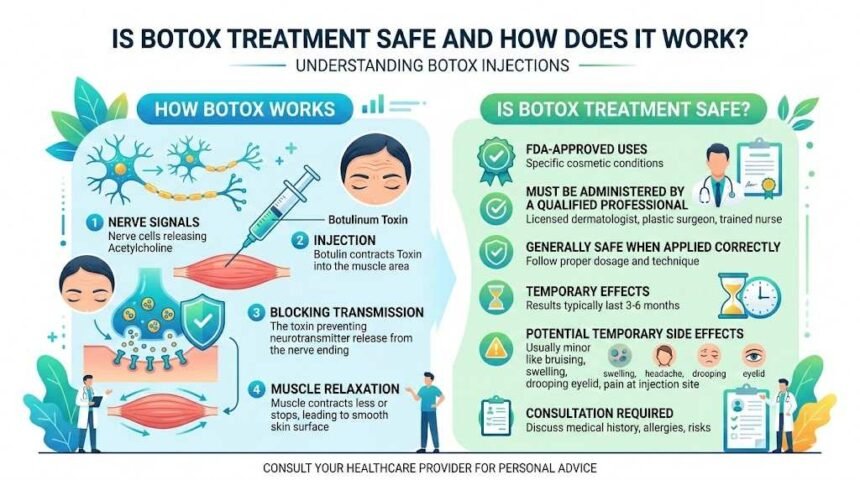
If you’ve been considering cosmetic injectables, you’ve probably searched for Botox treatment near me and wondered about both safety and effectiveness. Botox has been widely used for decades, yet many people still have questions about how it works and whether it’s truly safe.
Understanding the science behind Botox, its safety record, and how to choose a qualified provider can help you make an informed and confident decision.
How Does Botox Work?
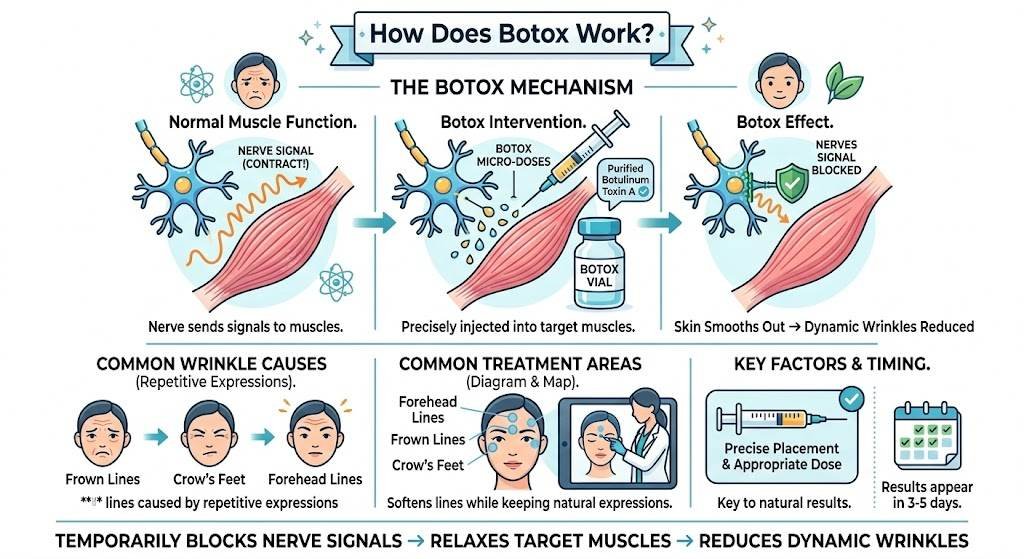
Botox is a purified form of botulinum toxin type A. While the word “toxin” may sound intimidating, the doses used in cosmetic treatments are extremely small and carefully controlled.
When injected into specific muscles, Botox temporarily blocks nerve signals that tell those muscles to contract. Without repeated muscle movement, the overlying skin smooths out, reducing the appearance of dynamic wrinkles. These are the lines caused by repetitive facial expressions such as frowning, squinting, or raising your eyebrows.
Common treatment areas include:
- Forehead lines
- Frown lines between the brows
- Crow’s feet around the eyes
When people search for Botox treatment near me, they’re often looking to soften these areas while maintaining natural facial expressions. The key is precise placement and appropriate dosing.
Results typically begin to appear within three to five days, with full effects visible around two weeks after treatment. The results are temporary, lasting 3 to 4 months.
Is Botox FDA-Approved?
Yes. Botox Cosmetic was approved by the U.S. Food and Drug Administration (FDA) in 2002 for the temporary improvement of moderate-to-severe frown lines. Since then, it has received additional approvals for other cosmetic and medical uses.
The product commonly used in aesthetic clinics is manufactured by Allergan, a well-known pharmaceutical company. FDA approval means the product has undergone extensive clinical testing to evaluate both safety and effectiveness when administered correctly.
When researching Botox treatment near me, it’s important to ensure that the clinic uses authentic, FDA-approved products rather than counterfeit or diluted alternatives.
Is Botox Treatment Safe?
For most healthy adults, Botox is considered very safe when administered by a trained and licensed medical professional. Millions of treatments are performed each year with a strong safety record.
However, safety depends heavily on the injector’s skill and experience. That’s why searching for Botox treatment near me should go beyond convenience; you should verify credentials and training.
Potential Side Effects
Most side effects are mild and temporary. They may include:
- Slight redness or swelling at injection sites
- Minor bruising
- Temporary headache
More serious complications are rare but can occur if Botox spreads beyond the intended area. This is why choosing an experienced provider is essential when evaluating Botox treatment options near me.
During your consultation, a qualified injector will review your medical history to ensure you’re a suitable candidate. Individuals who are pregnant, breastfeeding, or have certain neurological conditions may be advised to avoid treatment.
Importance of an Experienced Injector
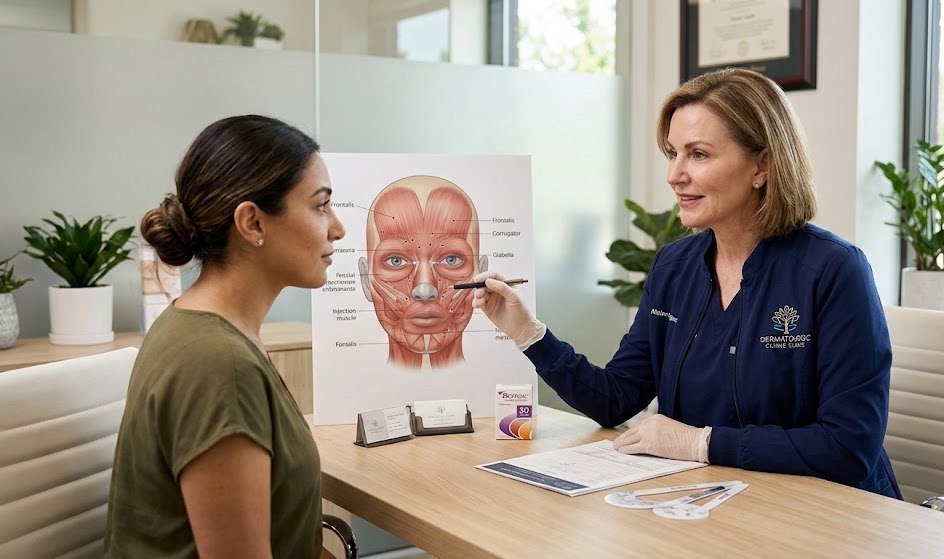
Botox is both a medical procedure and an aesthetic art. Proper knowledge of facial anatomy is critical for achieving balanced, natural-looking results.
When looking for Botox treatment near me, prioritize providers who:
- Are board-certified medical professionals
- Specializes in cosmetic injectables
- Perform treatments regularly
- Offer consultations before injecting
An experienced injector understands how to soften wrinkles without creating a frozen appearance. Over-treatment is usually the result of excessive dosing or improper placement, not the product itself.
Common Myths About Botox
Despite its popularity, Botox is surrounded by misconceptions. Let’s address some common myths.
| Myth | Reality / Explanation | Notes / Tips |
|---|---|---|
| Myth 1: Botox Will Freeze Your Face | Botox relaxes targeted muscles without eliminating all facial movement. Natural expressions are maintained. | If a face looks expressionless, it’s usually due to improper technique, not the treatment. |
| Myth 2: Botox Is Toxic and Dangerous | Although derived from a toxin, cosmetic Botox uses tiny, highly purified doses that are clinically proven safe. | Research providers with “Botox treatment near me” to ask about product sourcing and dosing. |
| Myth 3: Botox Is Only for Older Adults | Patients in their late 20s and 30s often use Botox preventatively to reduce repetitive muscle movement and delay deeper wrinkles. | Early intervention can support long-term wrinkle management. |
| Myth 4: Botox Results Are Immediate | Botox results are not instant; muscle relaxation typically appears over several days. | Clinics promising immediate effects should be approached with caution. |
How to Ensure a Safe Experience
If you’re considering Botox treatment near me, take these steps to enhance safety:
- Schedule a thorough consultation
- Ask about the provider’s experience
- Confirm that authentic Botox is used
- Follow all pre- and post-treatment instructions
Avoid extremely discounted offers or non-medical settings. Botox injections should always be performed in a clean, professional medical environment.
Final Thoughts
So, is Botox treatment near me safe? For most people, yes, when administered by a qualified professional using FDA-approved products. Understanding how Botox works, recognizing common myths, and prioritizing experienced injectors can significantly reduce risks and improve your results.
By taking the time to research and choose a reputable provider, you can enjoy smoother, more youthful-looking skin with confidence and peace of mind.
Medical Disclaimer
DISCLAIMER: The information provided in this article is intended for general informational and educational purposes only. It does not constitute medical advice, diagnosis, or treatment. This content should not be used as a substitute for professional medical advice from a licensed physician, dermatologist, or other qualified healthcare provider.
Always consult a qualified medical professional before undergoing any cosmetic or medical procedure, including Botox injections. Individual results may vary, and the safety and suitability of Botox treatment depend on your personal health history, medical conditions, medications, and other individual factors.
The mention of specific products, brand names (such as Botox® or Allergan), or regulatory approvals (such as FDA clearance) does not constitute an endorsement. Regulatory guidance and clinical recommendations may change over time; readers are encouraged to verify current information with official sources.
The authors and publishers of this article are not liable for any adverse effects, complications, or outcomes that may result from the use of information contained herein. Always seek the advice of your physician or another qualified health provider with any questions you may have regarding a medical condition or cosmetic procedure.
References
The following sources were consulted in the preparation of this article:
- U.S. Food and Drug Administration (FDA). (2002). FDA approves Botox Cosmetic (onabotulinumtoxinA) for temporary improvement in the appearance of moderate to severe glabellar lines. FDA.gov. https://www.fda.gov
- Allergan Aesthetics. (2023). Botox Cosmetic (onabotulinumtoxinA) prescribing information. AbbVie Inc.
- Carruthers, J. D. A., & Carruthers, J. A. (1992). Treatment of glabellar frown lines with C. botulinum-A exotoxin. Journal of Dermatologic Surgery and Oncology, 18(1), 17–21. https://doi.org/10.1111/j.1524-4725.1992.tb03295.x
- American Society of Plastic Surgeons (ASPS). (2023). 2022 Plastic Surgery Statistics Report. ASPS National Clearinghouse of Plastic Surgery Procedural Statistics. https://www.plasticsurgery.org
- Naumann, M., & Jankovic, J. (2004). Safety of botulinum toxin type A: A systematic review and meta-analysis. Current Medical Research and Opinion, 20(7), 981–990. https://doi.org/10.1185/030079904125003962
- Klein, A. W. (2001). Complications and adverse reactions with the use of botulinum toxin. Disease-a-Month, 48(5), 336–356. https://doi.org/10.1067/mda.2002.122586
- Dressler, D., Saberi, F. A., & Barbosa, E. R. (2005). Botulinum toxin: Mechanisms of action. Arquivos de Neuro-Psiquiatria, 63(1), 180–185. https://doi.org/10.1590/S0004-282X2005000100035
- American Board of Cosmetic Surgery (ABCS). (2023). Botox Cosmetic Guide. https://www.americanboardcosmeticsurgery.org
- Hexsel, D., Brum, C., do Prado, D. Z., et al. (2013). Field effect of two commercial preparations of botulinum toxin type A: A double-blind, randomized trial. Journal of the American Academy of Dermatology, 69(3), 373–379. https://doi.org/10.1016/j.jaad.2013.03.028
- Rzany, B., Dill-Müller, D., Grablowitz, D., Heckmann, M., & Caird, D. (2007). Repeated botulinum toxin A injections for the treatment of lines in the upper face: A retrospective study of 4,103 treatments in 945 patients. Dermatologic Surgery, 33(S1), S18–S25. https://doi.org/10.1111/j.1524-4725.2006.32354.x