


Every year, more patients choose to travel abroad for surgery, whether to access shorter wait times, lower costs, or specialized expertise unavailable in their home country. Countries like Turkey, Mexico, and Thailand have become familiar names in this space, each building hospital networks specifically geared toward international patients. What often gets less attention than the procedure itself, regardless of the destination, is everything that happens before the flight and after the return home. This is precisely where telehealth has quietly become one of the most important safety tools in international care.
A video consultation cannot replace an operating room, but it can replace a lot of the guesswork that makes medical travel risky. Used correctly, telehealth turns a one-time transaction into a continuous care pathway, with a clinician reviewing the case before departure and staying reachable long after the patient is back home.
Problem Telehealth Actually Solves
The surgery itself does not cause most complications linked to medical travel. They come from gaps around it: an undiagnosed contraindication missed because no one reviewed the full medical history, a patient who arrives at a clinic without realizing they were never a good candidate for the procedure, or a recovery that goes unmonitored once the patient lands back home.
A remote consultation closes these gaps at both ends of the trip. Before departure, it allows a qualified clinician to review imaging, lab results, and medical history, confirm whether the planned procedure is appropriate, and flag any contraindication early enough to change plans without financial or medical consequences. After the trip, it allows the same kind of oversight during the recovery period, when complications are most likely to appear and when the patient is furthest from the team that operated on them.
Before You Travel: What A Pre-Departure Consultation Should Cover
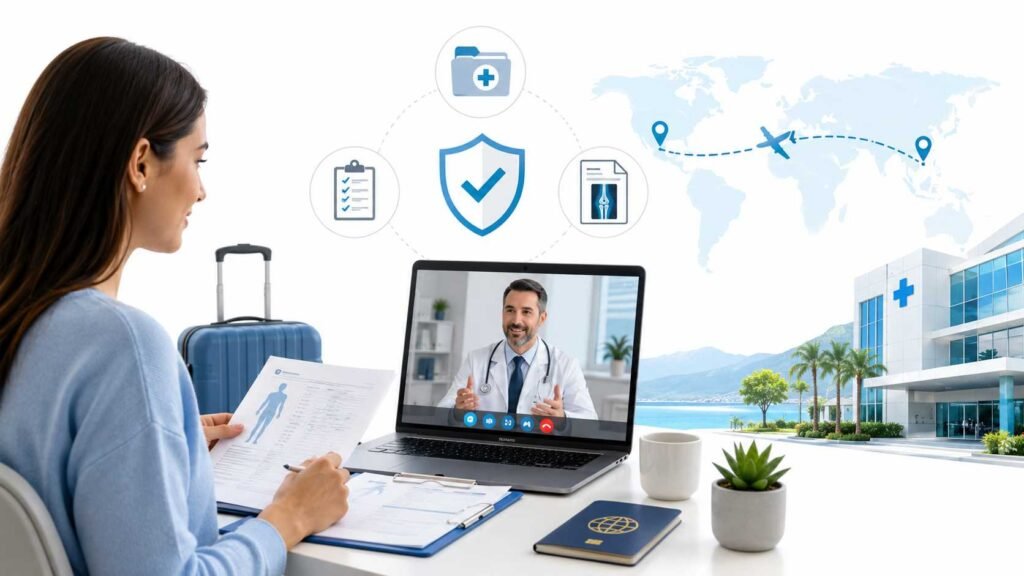
A serious pre-departure teleconsultation is not a sales call. It should function like any other specialist appointment, just conducted remotely: a review of the patient’s full medical file, a discussion of realistic outcomes and risks specific to their case, and a clear explanation of what happens if something doesn’t go as planned once they are already abroad.
International platforms that organize care abroad increasingly build this step into their process rather than treating it as optional. Turquie Santé, for instance, structures its patient pathway around a free remote evaluation with a specialist before any commitment is made, so the decision to travel rests on a documented medical opinion rather than marketing material.
During The Stay: Telehealth As a Second Layer of Oversight
Once a patient arrives at the treating facility, telehealth’s role shifts but doesn’t disappear. For patients traveling with a companion, or for those who want a second set of eyes on a treatment plan once they’re on-site, a remote consultation with an independent physician back home can serve as a sanity check, particularly before agreeing to a significant change in scope, such as an added procedure suggested only after arrival.
This is also the point where having a documented baseline from the pre-departure consultation pays off. If a treatment plan changes once the patient is abroad, the original remote assessment gives the patient and their home physician a clear reference point to evaluate whether the new recommendation is consistent with what was initially discussed.
Why High-Risk Specialties Demand A Higher Standard of Review
Not every procedure carries the same stakes. A standard cosmetic treatment has a very different risk profile than brain or spine surgery, where the margin for error is smaller, and recovery is harder to manage informally. For these higher-risk specialties, remote case review has effectively become standard practice rather than an extra step: neurosurgery in Turkey is a useful example, since patients are typically asked to send MRI or CT scans ahead of time so a specialist can assess feasibility and risk before any travel is booked, rather than discovering on-site whether the procedure is even advisable.
After The Trip: Why Recovery Monitoring Cannot Stop At The Airport
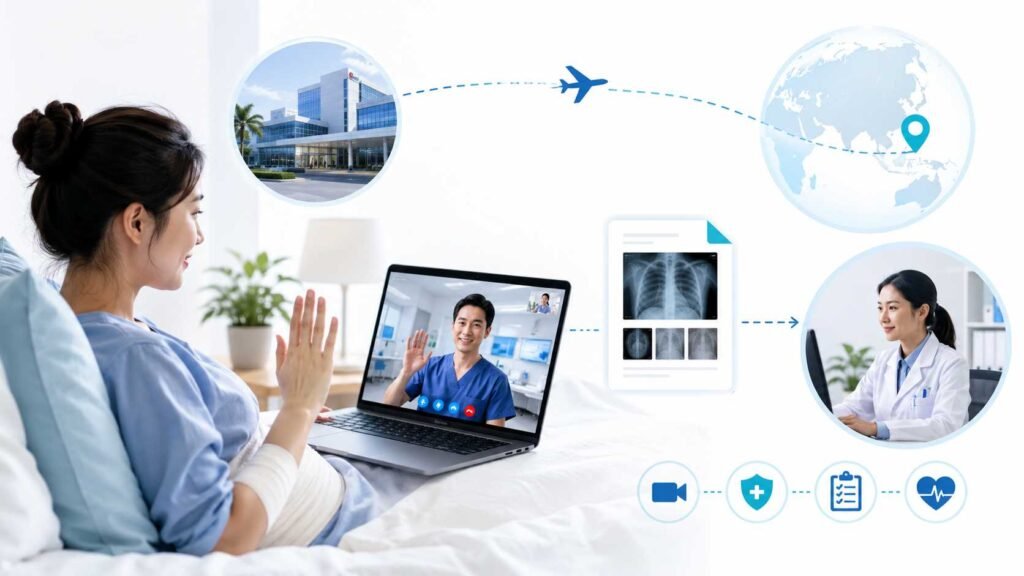
The recovery period is statistically when most preventable complications surface, and it’s also when patients are most likely to be on their own. Once they’re back home, the surgical team that performed the procedure is thousands of miles away, and the patient’s local doctor may have no record of what was actually done.
Telehealth addresses both problems. A short follow-up video call with the treating clinic allows the surgical team to assess healing, answer questions, and catch early warning signs without requiring another flight. At the same time, sharing the full surgical report and imaging with a local physician through telehealth allows continuity of care without forcing the patient to explain a complex procedure from memory.
Patients should ask about this explicitly before booking treatment, not after. Reasonable questions include: How many follow-up consultations are included after discharge? How is an urgent complication handled if it occurs after the patient has already left the country? Will the clinic provide a full medical report that a local doctor can act on?
A Simple Checklist Before Booking Surgery Abroad
Before committing to any procedure abroad, it’s worth confirming a few things directly with the provider or the platform coordinating the trip: a documented remote evaluation prior to departure, a clear point of contact for the recovery period, a written report shareable with a local doctor, and an explicit plan for what happens if a complication occurs after the patient has returned home. None of these requires an in-person visit to verify, which is exactly the point.
Telehealth is a Safety Net, Not A Substitute
None of this replaces in-person surgical care, and no remote consultation can fully assess a patient the way a hands-on physical exam can. What telehealth does is remove the blind spots that used to make medical travel riskier than it needed to be: the unverified candidacy, the undocumented case history, and the silence that used to follow a patient home after discharge.
As more clinics and platforms build structured remote evaluation into their process by default rather than as an afterthought, patient safety in medical travel stops depending on luck and starts depending on process. That shift, more than any single new device or technology, is what makes telehealth one of the more meaningful improvements in how international care is delivered today.
Final Conclusion
Telehealth cannot remove every risk from surgery abroad, but it can make the patient journey much safer, more organized, and less dependent on assumptions. Its value is not only in the video call itself. Its real value is in the process around that call: reviewing medical history before travel, checking whether the patient is a suitable candidate, documenting the treatment plan, keeping records shareable, and making follow-up care possible after the patient returns home.
For patients considering surgery in another country, the safest question is not only “Which clinic should I choose?” It is also “Who will review my case before I travel, who will monitor me after I return, and what happens if something goes wrong?” A provider that can answer those questions clearly is offering more than convenience. It is offering a safer care pathway.
The future of medical travel should not be based on fast bookings, social media promises, or price alone. It should be based on proper medical review, informed consent, documented communication, and planned follow-up. When telehealth is used this way, it becomes one of the most practical safety tools for patients seeking treatment across borders.
Medical Disclaimer
This article is for general educational information only. It is not medical advice, diagnosis, or a substitute for care from a licensed doctor, surgeon, or other qualified healthcare professional.
Surgery abroad carries medical, legal, travel, and recovery risks. A remote consultation can help with screening, planning, and follow-up, but it cannot replace an in-person physical examination, emergency care, or direct surgical assessment. Anyone considering surgery in another country should speak with a qualified healthcare professional in their home country and confirm the credentials, accreditation, safety standards, complication policy, and follow-up process of the overseas provider before booking.
Seek urgent medical care if you develop severe pain, fever, heavy bleeding, breathing difficulty, chest pain, sudden swelling, worsening wound symptoms, confusion, fainting, or any other serious symptom after surgery or travel.
References
- Centers for Disease Control and Prevention. “Medical Tourism.” In CDC Yellow Book: Health Information for International Travel, 2026 edition. Chapter authors: Rhett J. Stoney and Laura Leidel. Atlanta: Centers for Disease Control and Prevention; updated April 23, 2025.
- Centers for Disease Control and Prevention. “Medical Tourism: Travel to Another Country for Medical Care.” CDC Travelers’ Health. Atlanta: Centers for Disease Control and Prevention; updated guidance for international travelers seeking care abroad.
- World Health Organization. Recommendations on Digital Interventions for Health System Strengthening. Geneva: World Health Organization; 2019. WHO guideline. ISBN: 978-92-4-155050-5.
- World Health Organization. Global Strategy on Digital Health 2020–2027. Geneva: World Health Organization; 2025. ISBN: 978-92-4-011687-0.
- Asiri A, AlBishi S, AlMadani W, ElMetwally A, Househ M. “The Use of Telemedicine in Surgical Care: A Systematic Review.” Acta Informatica Medica. 2018;26(3):201–206. doi: 10.5455/aim.2018.26.201-206.
- Xiao K, Yeung JC, Bolger JC. “The Safety and Acceptability of Using Telehealth for Follow-up of Patients Following Cancer Surgery: A Systematic Review.” European Journal of Surgical Oncology. 2023;49(1):9–15. doi: 10.1016/j.ejso.2022.08.037.
- Crooks VA, Turner L, Cohen IG, Bristeir J, Snyder J, Casey V, Whitmore R. “Ethical and Legal Implications of the Risks of Medical Tourism for Patients: A Qualitative Study of Canadian Health and Safety Representatives’ Perspectives.” BMJ Open. 2013;3(2). doi: 10.1136/bmjopen-2012-002302.
- England C, Bromham N, Needham-Taylor A, Hounsome J, Gillen E, Ingram BJ, Davies J, Edwards A, Lewis R. “Complications and Costs to the UK National Health Service Due to Outward Medical Tourism for Elective Surgery: A Rapid Review.” BMJ Open. 2026;16(1). doi: 10.1136/bmjopen-2025-109050.