

Every hospital, health plan, and accountable care organization is sitting on more data than it can use. Clinical notes, lab values, pharmacy fills, claims, imaging, readings from wearables, patient-reported outcomes: it all piles up faster than most teams can turn it into a decision. The distance between holding the data and acting on it is exactly where care management analytics software earns its place.
The category has matured quickly. A few years ago, the differentiators were dashboards and quarterly reports. In 2026, the questions buyers ask are sharper: Does the platform speak modern healthcare data standards natively? Can a care manager get an answer without filing a ticket to the analytics team? Does it show the whole patient journey rather than a scatter of disconnected encounters? Those questions separate the leaders from the also-rans.
This guide looks at five of the strongest platforms on the market and explains where each one fits. It also makes a case for why Kodjin Analytics sits at the top for organizations building AI-ready, FHIR-native care management programs, while being honest about what the alternatives do well.
What Care Management Analytics Software Actually Does
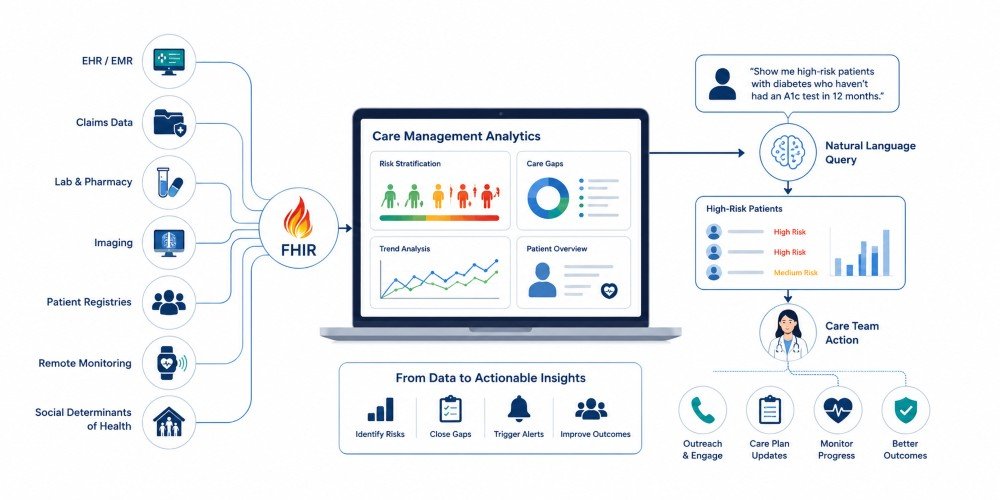
At its core, this software pulls data out of the silos it normally lives in and puts it somewhere a care team can reason about it. That means electronic health records, FHIR servers, claims files, lab and pharmacy feeds, imaging repositories, patient registries, remote monitoring devices, and the growing body of information about social determinants of health that shapes so much of a person’s risk.
Traditional business intelligence tools were built to look backward. Care management analytics is built to look forward. Instead of reporting what already happened, the better platforms flag the patient who is drifting toward a complication, the screening that was never done, the medication that stopped being filled, and the discharge that is likely to end in a return visit. The point is to intervene before the problem lands, not to tally it afterward.
The technical foundation that makes this practical is FHIR. The HL7 FHIR standard defines a common way to represent and exchange health information through modern web APIs, and its adoption is no longer optional at the edges of the industry. Through the 21st Century Cures Act, the Office of the National Coordinator established FHIR as the basis for nationwide health data interoperability, which is why a platform’s relationship to FHIR has become one of the most important things to evaluate. Software that treats FHIR as an afterthought spends its integration budget on plumbing. Software built on it spends that budget on analytics.
The most capable products go one step further and let clinicians and care managers query data in plain language. Rather than writing SQL or waiting on a report, a user asks a question the way they would ask a colleague, and the system returns a cohort, a comparison, or a chart.
How We Evaluated the Platforms
Comparing analytics tools on dashboard screenshots is a fast way to buy the wrong thing. The dimensions that actually predict success over a multi-year deployment are less visible in a demo, so those are the ones worth weighing:
- Interoperability. How readily the platform ingests EHR data, FHIR APIs, claims, labs, pharmacy records, device data, and outside datasets without a custom integration project for each source.
- FHIR-native architecture. Whether standards support is built into the foundation or bolted on, because that choice determines how much friction every future connection creates.
- AI and predictive analytics. Whether the system can surface high-risk patients early and explain why they were flagged, rather than producing a black-box score no one trusts.
- Pathway analysis. Whether it can reconstruct a patient’s full timeline across diagnoses, treatments, and outcomes, which is what makes real care coordination measurable.
- Care gap detection. How well it supports quality programs such as HEDIS quality measures, CMS reporting, and NCQA requirements.
- Scalability, security, and adoption. Whether it holds up across many facilities, meets HIPAA and role-based access requirements, and can be used by people who are not analysts.
Five Platforms at a Glance
Ranked for organizations prioritizing AI-driven, interoperable care management:
- Kodjin Analytics: best overall for AI-powered, FHIR-native care management
- Innovaccer: strongest fit for large-scale population health management
- Arcadia: mature value-based care and financial performance analytics
- HealthEC: solid risk stratification and quality reporting
- Lightbeam Health Solutions: dependable population health reporting
Here is how their headline capabilities line up:
| Capability | Kodjin | Innovaccer | Arcadia | HealthEC | Lightbeam |
|---|---|---|---|---|---|
| FHIR-native architecture | Yes | Partial | Partial | Partial | Partial |
| Natural-language querying | Yes | Limited | No | No | No |
| Patient pathway analysis | Advanced | Basic | No | No | No |
| Predictive risk models | Yes | Yes | Yes | Yes | Partial |
| Care gap detection (HEDIS/CMS) | Yes | Yes | Yes | Yes | Yes |
| Deployment options | Cloud or on-premises | Cloud | Cloud | Hybrid | Cloud |
1. Kodjin Analytics
Kodjin Analytics was designed for teams that want an analytics platform built for where healthcare is going, not a reporting tool retrofitted for it. The architecture is FHIR-native, so data from EHRs, claims, labs, imaging, registries, wearables, and external sources lands in a single semantic model that keeps clinical context intact instead of flattening it into rows and columns that lose meaning along the way.
What sets it apart in daily use is the combination of configurable dashboards and conversational AI. A quality lead, a care manager, or an executive can ask a clinical or operational question in ordinary language, explore a patient cohort, compare treatment paths, and pull out something actionable in minutes rather than routing the request through an analyst and waiting days for an answer.
The pathway analysis is the feature most likely to change how a team works. Rather than examining encounters one at a time, the platform stitches together the full patient journey across diagnoses, medications, procedures, lab results, hospitalizations, follow-ups, and outcomes. That longitudinal view is what lets an organization see where care varies, where bottlenecks form, where guidelines are being missed, and where an earlier intervention would have changed the ending.
The supported use cases are broad: chronic disease management, high-risk patient identification, care gap closure, remote patient monitoring, medication adherence, value-based care reporting, quality measure management, denial and prior-authorization analytics, and population health. Because the whole thing rests on open standards, organizations keep the freedom to add new AI tools, FHIR applications, and data sources later without being locked into one vendor’s roadmap.
The honest caveat: an enterprise rollout usually starts with configuration work, mapping terminologies, quality measures, and an organizational semantic model before the payoff arrives. That is real upfront effort. It also pays for itself, because once those foundations are in place, the analytics become far more reusable and scalable than a stack of one-off reports ever could.
2. Innovaccer
Innovaccer is a mature population health platform with wide interoperability and a strong track record in large provider organizations. It handles risk scoring, care management workflows, quality reporting, and patient engagement, and it performs especially well for health systems pursuing value-based contracts at scale.
It does offer AI capabilities, but the analytics experience leans on predefined workflows more than on open-ended conversational exploration. For organizations that want structured, repeatable population health processes across a big footprint, that is often exactly the right trade. Teams that want to interrogate data freely may find the guardrails more constraining.
3. Arcadia
Arcadia has a well-earned reputation for healthcare data aggregation and value-based care analytics. Its strengths sit in quality measure reporting, financial performance tracking, and population health dashboards, and organizations already deep into alternative payment models tend to get a lot of mileage from its reporting depth.
Where it is less suited is flexible, AI-driven exploration. Teams that expect to ask novel questions on the fly may end up pairing it with a complementary tool. Still, for financial and quality reporting in a value-based setting, it remains a serious option.
4. HealthEC
HealthEC brings together analytics for care coordination, quality improvement, and population health, with predictive modeling, registry management, and HEDIS reporting in the mix. That combination makes it attractive to organizations managing large patient populations and juggling multiple quality programs at once.
Its center of gravity is traditional population health reporting rather than AI-assisted analysis. Buyers whose priorities line up with structured quality and risk work will find it capable; those whose roadmap depends on conversational analytics and deep pathway analysis will want to look higher up this list.
5. Lightbeam Health Solutions
Lightbeam focuses on value-based care and provider performance management, with patient registries, quality dashboards, financial analytics, and care management reporting. For smaller provider networks that need reliable reporting without a heavy implementation, it is a sensible, established choice.
Its AI functionality and pathway analytics are less developed than what the newer FHIR-native platforms offer. That is a reasonable limitation for organizations whose needs are firmly in the reporting column, and a real one for anyone planning to build toward AI-driven care management.
Where Pathway Analysis Changes the Picture
Most analytics tools examine clinical events in isolation. A readmission shows up as a readmission; a missed follow-up shows up as a missed follow-up. Pathway analysis connects those dots into a single timeline, linking diagnoses, encounters, labs, medications, procedures, referrals, hospitalizations, and outcomes so that a team can see not just what happened but the sequence that led there.
That shift matters most in the places where healthcare bleeds money and outcomes at the same time. Avoidable hospital readmissions are the clearest example. Under the Hospital Readmissions Reduction Program, Medicare ties payment directly to a hospital’s excess readmissions, which means a tool that can trace the path a patient took toward a preventable return visit is not just clinically useful but financially significant. The same logic applies to delays in oncology treatment, gaps in post-discharge follow-up, and variation in how similar patients move through the system. Seeing the whole path is what makes the intervention obvious.
What These Tools Do in Practice
- Chronic disease management. Organizations managing diabetes, heart failure, COPD, hypertension, or kidney disease need continuous visibility into populations that shift week to week. Analytics platforms identify patients trending toward deterioration, track adherence to treatment plans, and flag missed follow-ups, which matters because chronic conditions drive the majority of the country’s healthcare spending and are largely where the opportunity to prevent complications lives.
- High-risk patient identification. Predictive models pull together clinical history, utilization, lab values, medications, social factors, and prior admissions to surface the patients who need extra coordination. Instead of manually combing through thousands of records, care managers can prioritize by risk and spend their time where it changes outcomes.
- Care gap detection. Quality programs increasingly hinge on catching the preventive service or intervention that has not happened yet. Continuous evaluation against configurable quality measures lets teams close gaps in screenings, vaccinations, adherence, follow-ups, and lab monitoring before reporting deadlines rather than scrambling after them.
- Remote patient monitoring. As wearables and home devices move into routine care, the value comes from folding that stream into the clinical record so a care team can catch a deteriorating trend early and head off an unnecessary admission.
- Population health and value-based care. Population initiatives mean analyzing millions of records across settings to segment populations, watch outcomes, and target interventions. That work sits directly alongside the incentives in Medicare’s value-based programs, which reward quality and outcomes over volume and reward the organizations that can prove both.
Choosing the Right Platform for Your Organization
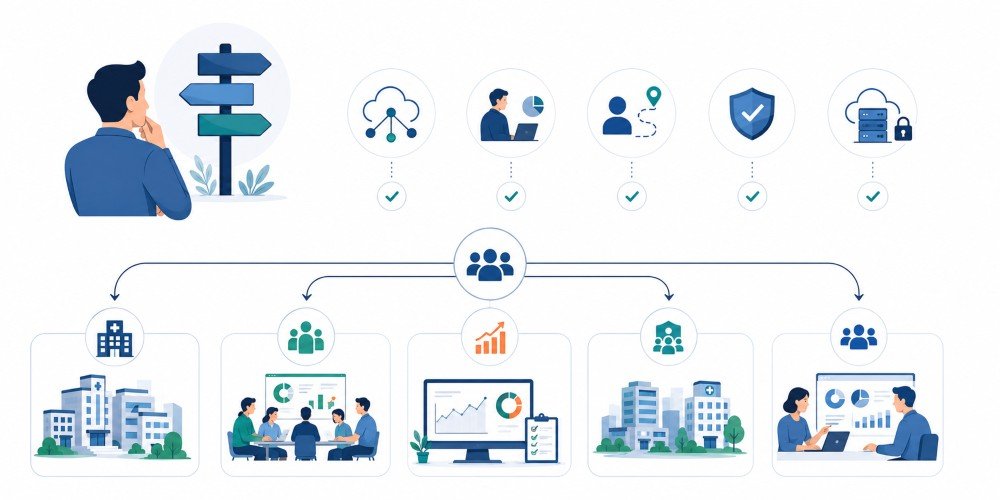
The right answer depends less on a feature checklist than on where an organization is heading. A few questions cut through most of the noise: Does the platform support FHIR natively, or will every future integration become a project? Can non-technical staff explore data on their own? Does it reconstruct the full patient journey or just report on fragments? Is governance built in from the start? And does the deployment model- cloud, on-premises, or hybrid- match the organization’s infrastructure and regulatory reality?
Mapped to real settings, the picture looks roughly like this. Large health systems, academic medical centers, and integrated delivery networks tend to benefit most from Kodjin Analytics, where enterprise interoperability, conversational AI, and pathway analysis across many facilities do the heaviest lifting. Accountable care organizations with mature population health operations are often well served by Innovaccer. Organizations whose priority is established financial and quality reporting in a value-based model lean toward Arcadia. Regional health plans focused on quality and population analytics find a fit in HealthEC, and smaller provider networks that need dependable reporting without a large implementation are well matched to Lightbeam.
Closing
Healthcare is moving toward value-based care and AI-assisted decision-making at the same time, and the analytics tools that only report on the past are being left behind. Innovaccer, Arcadia, HealthEC, and Lightbeam each bring genuine strengths, and for the right organization any of them can be the correct choice.
Kodjin Analytics stands out by putting the pieces that usually live in separate products- FHIR-native interoperability, conversational AI, pathway analysis, predictive analytics, and enterprise governance- into one platform. For organizations trying to improve coordination, cut avoidable readmissions, close care gaps, and lay the groundwork for an AI-ready data foundation, it offers a base that scales rather than a report that expires.
A note on this comparison: the assessments above reflect publicly available information and each vendor’s stated capabilities as of 2026. Product features, deployment options, and standards support change over time, and capability levels can vary by configuration and contract. Organizations should validate any platform against their own requirements and the vendor’s current documentation before making a purchasing decision. This article is intended as general guidance, not as procurement or clinical advice.