


Personal injury cases in the United States have been growing steadily in volume and complexity. In 2024 alone, federal personal injury filings increased by 78 percent, with 46,809 new cases filed in the federal judicial system. The majority of this growth was driven by mass tort litigation and product liability cases. Behind every one of those filings is an individual who has been physically harmed, financially disrupted, and is trying to navigate a legal system they have probably never encountered before.
Knowing how to choose the right personal injury lawyer is not a minor administrative detail. It is one of the most consequential decisions an injury victim can make. The attorney you select will determine how your case is investigated, how your damages are calculated, how negotiations with insurance companies unfold, and whether you ultimately receive fair compensation for your injuries. A skilled, experienced attorney maximises your recovery. An inexperienced or poorly matched one can leave significant money on the table or worse, jeopardise your entire claim.
Key fact: According to the Insurance Research Council, injury victims who a personal injury attorney represents receive settlements that are on average three and a half times higher than those who negotiate directly with insurance companies on their own.
Essential Personal Injury Legal Concepts Every Victim Should Understand
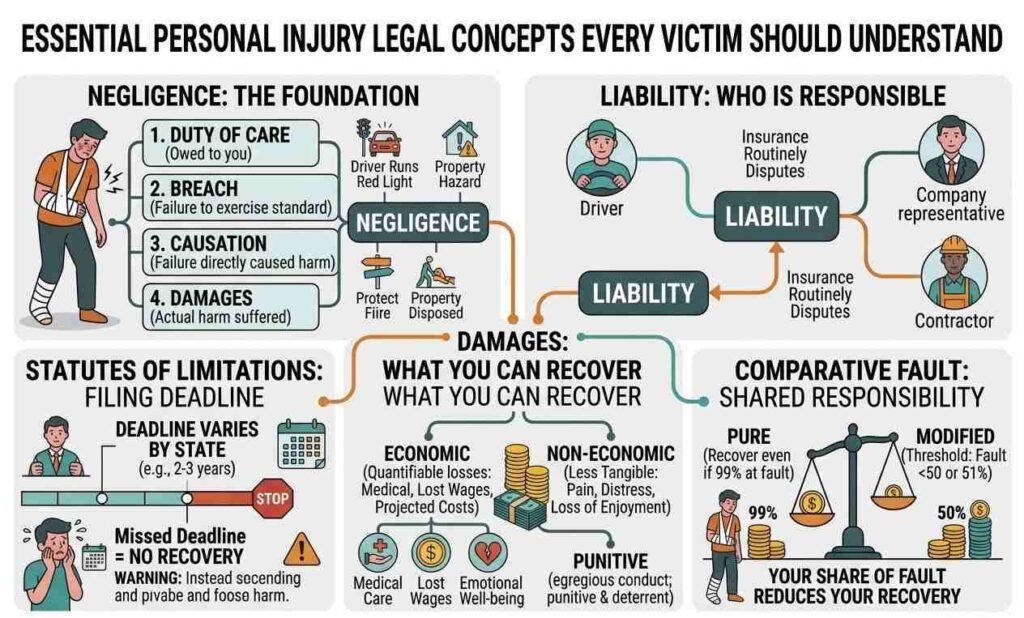
You do not need to become a lawyer to pursue a personal injury claim. But understanding the basic legal framework gives you a meaningful advantage when evaluating your case, communicating with your attorney, and making informed decisions at each stage of the process.
Negligence: The Foundation of Most Personal Injury Claims
Most personal injury cases rest on the legal concept of negligence. Negligence exists when one person or entity fails to exercise the standard of care that a reasonable person would have exercised under the same circumstances. That failure causes harm to another person. Establishing negligence requires proving four elements: that the defendant owed you a duty of care, that they breached that duty, that the breach directly caused your injury, and that you suffered actual damages as a result.
In practical terms, negligence covers a wide range of situations: a driver who runs a red light and causes a collision, a property owner who fails to fix a hazardous floor surface, a manufacturer who releases a product with a known defect, or a medical professional who departs from the accepted standard of care. The specific circumstances of your injury will determine how negligence is established and proven in your case.
Liability: Who Is Legally Responsible
Liability is the legal determination of who is responsible for your injuries and their associated costs. In some personal injury cases, liability is clear and largely undisputed. In others, it is fiercely contested. Insurance companies routinely dispute or minimise liability as a strategy for reducing settlement amounts, which is one of the most important reasons to have experienced legal representation from the earliest stage of your claim.
Liability can involve multiple parties simultaneously. In a commercial vehicle accident, for example, liability might be shared between the driver, the trucking company, the vehicle’s maintenance contractor, and a parts manufacturer. An experienced attorney investigates all potential sources of liability to ensure that every avenue of recovery is pursued.
Damages: What You Can Recover
Damages are the monetary compensation you are entitled to seek as a result of your injuries. They fall into two broad categories. Economic damages are the quantifiable financial losses directly caused by the injury, including medical expenses already incurred, projected future medical costs, lost wages during recovery, and diminished future earning capacity. Non-economic damages cover the less tangible but equally real harms, including physical pain and suffering, emotional distress, loss of enjoyment of life, and loss of consortium in cases where the injury has affected family relationships.
In cases involving particularly egregious conduct, such as drunk driving or deliberate misconduct, punitive damages may also be available. Punitive damages are designed to punish the defendant and deter similar behaviour rather than simply compensate the victim, and they can significantly increase the total value of a claim.
Statutes of Limitations: Do Not Miss the Deadline
Every state sets a legal deadline, called the statute of limitations, by which a personal injury lawsuit must be filed. If you miss this deadline, you permanently lose the right to sue, regardless of how strong your case is. The specific deadline varies by state and by the type of injury involved. Most states set the general personal injury statute of limitations at two to three years from the date of the injury or the date of discovery of the injury.
Some exceptions can extend or shorten this window, including cases involving government defendants, injuries to minors, and situations where the defendant fraudulently concealed relevant information. This is one of the most compelling reasons to consult an attorney as early as possible after an injury. Missing a deadline is an irreversible mistake that no amount of legal skill can fix after the fact.
Comparative Fault: How Shared Responsibility Affects Your Recovery
In many personal injury cases, the injured party bears some degree of responsibility for the circumstances that led to the injury. Most states use a system of comparative fault to handle these situations, adjusting the compensation the plaintiff receives based on their percentage of responsibility for the accident.
Under pure comparative fault, which applies in states including California and New York, a plaintiff can recover damages even if they are 99 percent at fault. However, their recovery is reduced by their percentage of fault. Under modified comparative fault, which is used in the majority of states, a plaintiff can only recover if their fault is below a threshold, typically 50 or 51 percent. Understanding which system applies in your state, and how the facts of your case are likely to be characterised, is an important part of assessing your claim’s realistic value.
Key terms at a glance: Negligence is the failure to exercise reasonable care. Liability is legal responsibility for the resulting harm. Damages are the financial compensation available. The statute of limitations is the filing deadline. Comparative fault determines how shared responsibility affects your recovery.
Key Factors for Choosing a Personal Injury Lawyer
With a foundational understanding of the legal framework in place, you can evaluate potential attorneys more effectively. The following factors are the most important considerations in the selection process.
Specialty and Case-Type Experience
Personal injury law encompasses an enormous range of case types, from car accidents and slip-and-fall claims to medical malpractice, product liability, and workplace injuries. An attorney who handles car accident cases primarily may not be the best choice for a complex medical malpractice claim, and vice versa. The first question to ask any prospective attorney is how much of their practice is dedicated to personal injury cases and, within that, what percentage of their caseload involves cases similar to yours.
This specificity matters because different case types involve different investigative requirements, expert witness networks, and litigation strategies. An attorney who regularly handles the type of case you have will have established relationships with the medical experts, accident reconstructionists, economists, and other specialists whose testimony may be essential to maximising your recovery.
Track Record of Results
Experience is valuable, but the outcomes that experience has produced are what actually matter. Ask prospective attorneys directly about their settlement and verdict history in cases similar to yours. Reputable attorneys will be able to share general ranges and notable outcomes without violating client confidentiality. An attorney who is unwilling or unable to discuss their track record is one to approach with caution.
Pay particular attention to whether the attorney has trial experience and a record of taking cases to verdict when warranted. Insurance companies are aware of which attorneys are genuinely prepared to litigate and which ones always settle. An attorney with a credible trial record has more leverage in settlement negotiations than one who is known to avoid the courtroom.
Local Knowledge and Jurisdiction Familiarity
Personal injury law is state-specific, and local practice norms can vary significantly even within a state. An attorney who practices regularly in the courts where your case would be filed knows the judges, understands the jury pool demographics, and is familiar with the local litigation culture. This knowledge can meaningfully affect case strategy, settlement positioning, and outcomes.
For cases involving drunk driving accidents, for example, local experience is particularly valuable because DUI-related personal injury claims involve specific evidentiary issues, insurance policy dynamics, and potentially both civil and criminal proceedings running simultaneously. According to Baton Rouge drunk driving accident lawyer Peyton Murphy, attorneys who focus on these cases can provide personalised guidance and support to help maximise damages and navigate the intersection of criminal and civil proceedings that DUI injury cases often involve.
Communication Style and Responsiveness
The attorney-client relationship in a personal injury case can span months or years. During that time, you need to feel confident that your attorney is genuinely engaged with your case, keeps you informed about developments, and responds to your questions promptly. Poor communication is one of the most common sources of client dissatisfaction with legal representation, and it is often a predictor of inadequate case management.
Use the initial consultation as an evaluation opportunity. Does the attorney listen actively and ask clarifying questions, or do they seem distracted or dismissive? Do they explain legal concepts in language you can understand without condescension? Do they give you a realistic assessment of your case rather than simply telling you what you want to hear? These qualities in the consultation are likely reliable indicators of how the attorney will communicate throughout the case.
Transparency About Fees and Costs
Fee structures in personal injury law are relatively standardised, but the specific percentages and cost arrangements vary between firms and can significantly affect your net recovery. Ensure that you fully understand the fee structure before signing a representation agreement, and that the terms are clearly set out in writing.\
Understanding Personal Injury Lawyer Fee Structures
| Fee Type | What It Means |
| Contingency fee | The lawyer is paid only if you win. Typically 25% to 40% of the total recovery |
| Pre-litigation rate | Lower percentage (often 25-33%) if case settles before a lawsuit is filed |
| Litigation rate | Higher percentage (often 33-40%) if a lawsuit must be filed and litigated |
| Trial rate | Some agreements increase the percentage further if the case goes to a jury trial |
| Case expenses | Filing fees, expert witness costs, medical record fees deducted from your recovery |
| Expense repayment | Clarify whether expenses are deducted before or after the attorney’s percentage is calculated |
Critical question to ask: If you recover $100,000, what is the exact net amount you will receive after the attorney’s fee and all case expenses are deducted? Ask this question directly and get a written answer before signing any representation agreement.
Values Alignment and Personal Rapport
This factor is often underweighted in legal selection guidance, but it matters practically. You will be sharing sensitive personal and medical information with your attorney over an extended period. You will be relying on their judgment at critical decision points. If your fundamental values or communication styles are misaligned, the working relationship will be difficult regardless of the attorney’s technical competence.
Trust your instincts during the consultation. A lawyer who appears dismissive of your concerns, pressures you to accept a settlement strategy you are uncomfortable with, or seems primarily interested in closing the case quickly rather than maximising your recovery may not be the right match, regardless of their credentials.
How to Evaluate a Personal Injury Lawyer’s Experience
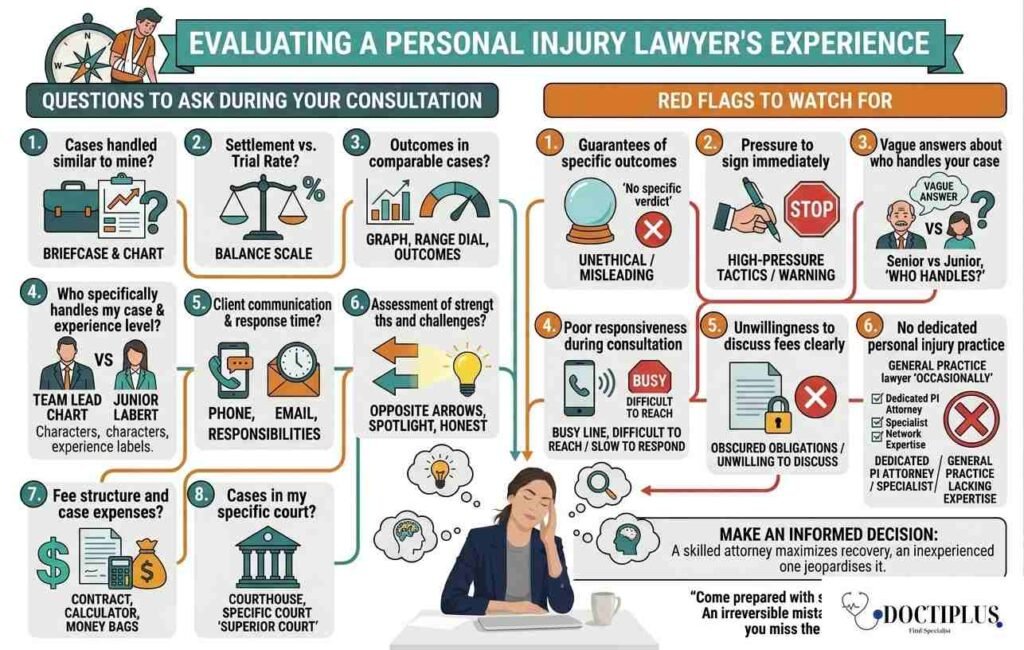
Questions to Ask During Your Consultation
The initial consultation is your primary opportunity to assess whether an attorney is right for your case. Come prepared with specific questions rather than relying on general impressions.
- How many personal injury cases have you handled, and what proportion were similar to mine?
- What is your settlement rate versus trial rate for cases like mine?
- Can you describe the range of outcomes you have achieved in comparable cases?
- Who specifically in your firm will be handling my case, and what is their experience level?
- How do you communicate with clients during the case, and how quickly can I expect responses to questions?
- What is your honest assessment of the strengths and challenges of my specific situation?
- What is your fee structure, and how are case expenses handled?
- Have you handled cases in the specific court where mine would be filed?
Red Flags to Watch For
Just as important as identifying strong qualities is recognising warning signs that may indicate a poor choice of representation.
- Guarantees of specific outcomes: No ethical attorney can guarantee a specific settlement amount or verdict. An attorney who makes such promises is either uninformed or misleading you
- Pressure to sign immediately: Reputable attorneys will give you time to consider representation agreements. High-pressure tactics at the initial consultation are a warning sign
- Vague answers about who handles your case: Some firms use high-profile partners to sign cases and then hand them to junior associates. Clarify exactly who will manage your matter day to day
- Poor responsiveness during the consultation process: If an attorney is difficult to reach or slow to respond before they have your case, the problem is unlikely to improve once they do
- Unwillingness to discuss fees clearly: Any legitimate attorney should be able to explain their fee structure clearly and provide it in writing without hesitation
- No dedicated personal injury practice: General practice attorneys who handle personal injury cases occasionally alongside other legal work typically lack the specialist expertise and network that a dedicated personal injury attorney brings
Evaluating a Lawyer’s Communication Skills
What to Assess During the Initial Consultation
The initial consultation serves multiple purposes simultaneously. It allows the attorney to assess whether they can help you, and it allows you to assess whether they are the right representation for your needs. From a communication perspective, the specific dimensions to evaluate include how well they listen, how clearly they explain legal concepts, how honestly they characterise the challenges in your case, and how comfortable you feel asking questions.
Active listening is a specific and observable skill. An attorney who interrupts frequently, seems distracted, or moves to conclusions before you have finished explaining your situation is demonstrating a communication pattern that will cause problems throughout the representation. An attorney who asks clarifying questions, reflects what they have heard, and takes notes is showing the kind of attentiveness that good case management requires.
Ongoing Communication Expectations
Before hiring any attorney, establish explicit expectations about communication. Ask how frequently you will receive updates on your case, through what channel, and who your primary point of contact will be. Ask what the typical response time is for client calls and emails. Ask what the protocol is for urgent developments in the case.
The standard of reasonable communication in legal representation is that clients are kept informed of all significant case developments promptly and have their questions answered within a reasonable timeframe, typically one to two business days for non-urgent matters. An attorney who cannot commit to this standard during the consultation is unlikely to meet it during the representation.
How to Find and Interpret Lawyer Reviews
Where to Look
Online reviews are a useful input into the attorney selection process, but they need to be interpreted carefully. The most reliable sources for attorney reviews include several dedicated legal platforms as well as general review sites.
- Avvo: A legal-specific review platform that also displays bar membership status, disciplinary history, and peer endorsements. Avvo ratings provide a useful baseline assessment of an attorney’s standing in the legal community.
- Google Reviews: The most widely used review platform. The volume and recency of reviews on Google provide useful signals about a firm’s activity level and client experience.
- Martindale-Hubbell: One of the oldest lawyer rating systems, Martindale-Hubbell peer ratings reflect the assessments of other attorneys in the legal community and are a particularly reliable indicator of professional standing
- State Bar Association websites: Every state bar maintains publicly searchable records that confirm an attorney’s license status and disclose any disciplinary history. This is a verification step, not a review source, but it is essential.
- Better Business Bureau: Useful for identifying patterns of unresolved complaints against a law firm
How to Interpret What You Read
A high volume of positive reviews over an extended period is a stronger signal than a perfect rating based on a small number of recent reviews. Read the specific content of reviews rather than focusing solely on star ratings. Reviews that describe specific behaviours, such as the attorney’s responsiveness, how they explained the case, how they handled a difficult negotiation, or how they supported the client during a stressful process, provide more useful information than generic endorsements.
Apply appropriate scepticism to both highly positive and highly negative outliers. Extremely positive reviews that use similar language may reflect review generation efforts rather than genuine client experiences. Single-star reviews from clients who express unrealistic expectations about outcomes or timelines may reflect dissatisfaction with the legal process rather than the attorney’s performance. The overall pattern across a substantial number of reviews is the most reliable signal.
Step-by-Step Guide to Selecting Your Personal Injury Lawyer
Bringing all of the above together into a practical action plan makes the selection process manageable even when you are dealing with the stress and disruption of a recent injury.
- Document your injury immediately: Preserve all evidence relevant to your injury from the moment it occurs. Photographs, medical records, police reports, witness contact information, and a personal log of symptoms and limitations are the foundation of your claim.
- Research attorneys with the relevant specialty: Use online resources, state bar referral services, and personal recommendations to build an initial list of attorneys who handle cases similar to yours in your jurisdiction
- Verify bar membership and check for disciplinary history: Confirm that every attorney on your shortlist is currently licensed and in good standing with their state bar before booking a consultation.
- Book initial consultations with at least three attorneys: Most personal injury attorneys offer free initial consultations. Speaking with multiple attorneys before making a decision gives you an important comparative perspective.
- Prepare specific questions and bring your documentation: Come to each consultation with your evidence, a written summary of the incident and your injuries, and your list of prepared questions.
- Evaluate each consultation against the criteria in this guide: Assess experience, communication, fee transparency, values alignment, and your overall confidence in the attorney’s judgment
- Review the representation agreement carefully before signing: Ensure the fee structure, cost arrangements, and scope of representation are clearly defined in writing.
- Establish communication expectations at the outset: Confirm how updates will be provided, who your primary contact will be, and what response time you can expect for questions.
Conclusion
A personal injury claim is not just a legal process. It is a process that runs alongside your physical recovery, your financial uncertainty, and the emotional stress of dealing with an injury that was not your fault. The right attorney provides more than legal skill. They provide guidance, advocacy, and the assurance that someone with genuine expertise is protecting your interests at every stage.
The decision-making framework in this guide gives you the tools to evaluate potential attorneys with the same care and diligence that a good attorney will bring to your case. Take the time to consult with multiple attorneys, ask the hard questions, read the reviews, verify the credentials, and trust your assessment of how each attorney makes you feel during the consultation.
The right lawyer will not just work to maximise your compensation. They will make a genuinely difficult period in your life more manageable by ensuring that you are never left in the dark, never pressured into decisions you are not comfortable with, and always treated as a person rather than a case number.
Disclaimer
This article is provided for general informational and educational purposes only. It does not constitute legal advice and should not be relied upon as a substitute for consultation with a licensed personal injury attorney in your jurisdiction. Personal injury law, including statutes of limitations, comparative fault rules, damage caps, and procedural requirements, varies significantly by state and is subject to change. The statistics and case study information referenced in this article are based on publicly available data at the time of writing and may not reflect current figures. The mention of specific attorneys or law firms is for illustrative purposes only and does not constitute an endorsement or guarantee of outcomes. Always verify an attorney’s license status and disciplinary history with your state bar association before retaining representation.
References and Resources
- United States Courts. (2024). Federal Judicial Caseload Statistics 2024. Administrative Office of the U.S. Courts.
- Bureau of Justice Statistics. (2023). Civil Justice Survey of State Courts. U.S. Department of Justice.
- National Center for State Courts. (2023). Court Statistics Project: Civil Caseloads.
- Insurance Research Council. (2022). Auto Injury Insurance Claims: Countrywide Patterns in Treatment, Costs, and Compensation. IRC Research Report.
- National Association of Insurance Commissioners (NAIC). (2023). Auto Insurance Database Report.
- American Bar Association. (2023). Model Rules of Professional Conduct. ABA Center for Professional Responsibility.
- American Bar Association. (2023). Finding Legal Help. ABA Legal Help Resource Center.
- Nolo. (2024). Personal Injury Law: Overview of Claims, Damages, and Settlements.
- Justia. (2024). Personal Injury Overview: Negligence, Liability, and Damages.
- Avvo. Attorney Rating and Review Platform.
- Martindale-Hubbell. Lawyer Ratings and Peer Review Directory.
- Better Business Bureau. Law Firm Complaint History and Accreditation.
- State Bar Associations. License Verification and Disciplinary Records. Available through each state bar website
- Dobbs, D. B., Hayden, P. T., & Bublick, E. M. (2016). The Law of Torts (2nd ed.). West Academic Publishing.
- Prosser, W. L., & Keeton, W. P. (1984). Prosser and Keeton on the Law of Torts (5th ed.). West Publishing.