

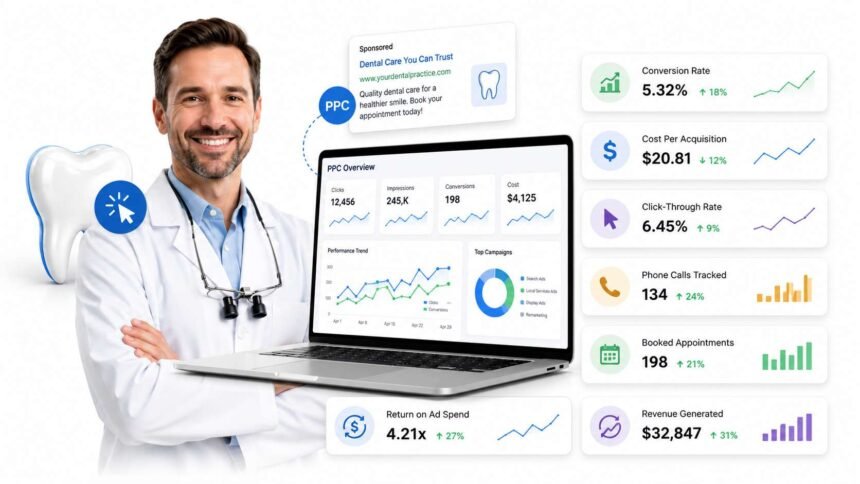
Spend enough time managing paid advertising for dental practices and a clear pattern emerges. Some campaigns generate impressive click numbers and steady traffic but barely bring in new patient appointments. Others run on smaller budgets with fewer clicks and still produce consistently booked schedules.
The difference usually comes down to the KPIs being tracked. Many dental practices focus on surface-level metrics like clicks, impressions, and cost per click because those numbers are easy to find inside Google Ads dashboards. But clicks alone do not grow a practice. Booked appointments and treatment revenue do.
The most successful dental PPC campaigns focus on measurable patient acquisition outcomes rather than ad platform activity. Understanding which metrics truly matter helps practices spend more efficiently and generate stronger returns from their advertising budgets.
Key Takeaways on Dental PPC KPIs
- Conversion rate and cost per acquisition (CPA) are among the most important dental PPC metrics.
- Phone call tracking is essential because many dental leads convert by phone.
- Low CPC does not automatically mean campaign success.
- Quality Score affects ad costs and visibility significantly.
- Booked appointment rate is more valuable than raw lead volume.
- Accurate attribution is critical for reliable reporting and optimization.
What Are PPC KPIs and Why Do They Matter?
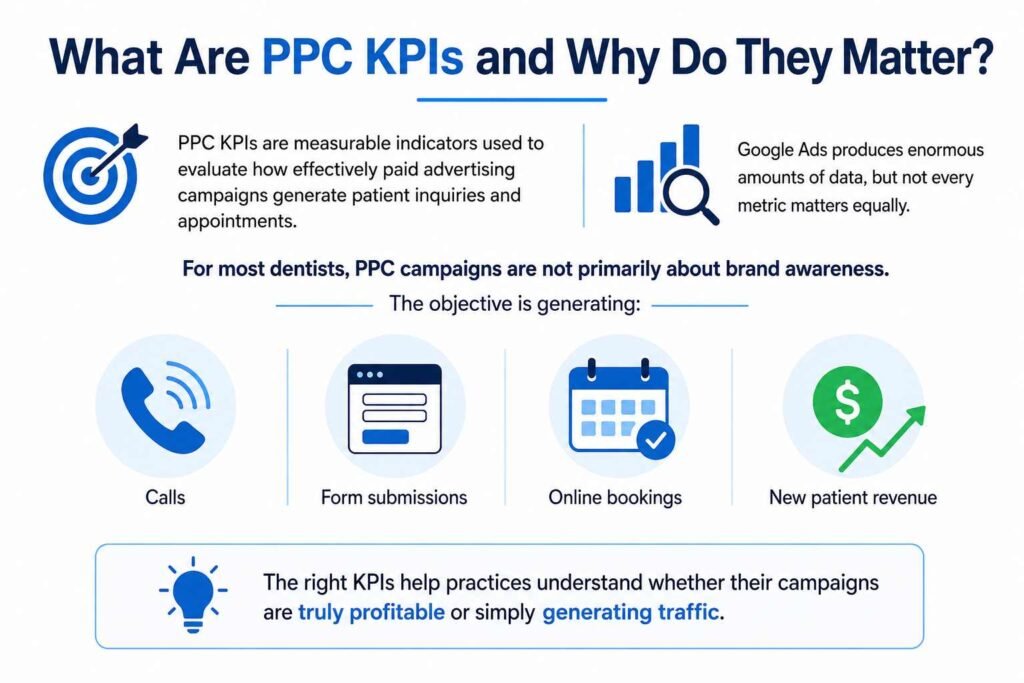
PPC KPIs are measurable indicators used to evaluate how effectively paid advertising campaigns generate patient inquiries and appointments.
Google Ads produces enormous amounts of data, but not every metric matters equally. Dental practices should focus on metrics that connect ad spend directly to patient acquisition.
For most dentists, PPC campaigns are not primarily about brand awareness. The objective is generating:
- Calls
- Form submissions
- Online bookings
- New patient revenue
The right KPIs help practices understand whether their campaigns are truly profitable or simply generating traffic.
Two Types of Dental PPC Metrics
Dental PPC metrics generally fall into two categories.
Activity Metrics
These measure platform-level engagement:
- Impressions
- Clicks
- Click-through rate (CTR)
- Cost per click (CPC)
- Quality Score
These metrics help evaluate campaign efficiency but do not guarantee patient acquisition.
Outcome Metrics
These measure actual business results:
- Leads
- Phone calls
- Scheduled appointments
- Revenue
- Return on ad spend (ROAS)
Many struggling campaigns show healthy activity metrics but weak outcome metrics. The ads attract attention, but the traffic does not convert into patients.
Most Important Dental PPC KPIs
These are the most crucial dental KPIs which matter.
Conversion Rate
The percentage of users who complete a desired action after clicking an ad.
Conversions may include:
- Phone calls
- Contact forms
- Online appointment requests
Conversion rate is one of the clearest indicators of campaign performance. If users click but fail to take action, the problem may involve:
- Landing page quality
- Offer clarity
- Audience targeting
- Call-to-action effectiveness
Dental landing pages often convert between 3% and 6%, while highly optimized campaigns can exceed 8%.
A conversion rate below 2% typically signals a problem worth investigating.
Cost Per Lead (CPL)
The amount spent to generate a lead.
CPL helps practices evaluate lead generation efficiency, but lead quality matters just as much as lead volume.
For example:
- A low-cost lead from an irrelevant search has little value.
- A higher-cost lead searching for treatment-specific services may convert into significant revenue.
CPL should always be reviewed alongside lead quality and appointment rates.
Cost Per Acquisition (CPA)
The amount spent to acquire one new booked patient.
CPA directly connects advertising spend to patient acquisition, making it one of the most valuable PPC metrics for dentists.
If a practice spends:
- $3,000 monthly on ads
- Generates 15 new patients
The CPA equals $200.
Whether that is profitable depends on patient lifetime value and treatment types.
A cosmetic or implant-focused practice may support a much higher CPA than a hygiene-focused office.
Phone Call Conversions
The number of calls generated from PPC campaigns.
Phone calls remain one of the most important conversion channels in dentistry. Many patients still prefer calling rather than completing online forms.
Without proper call tracking, practices lose visibility into a large portion of PPC performance.
Tracking should measure:
- Call volume
- Call duration
- Appointment outcomes
- Missed calls
Many practices discover that unanswered or mishandled calls are costing them significant revenue.
Click-Through Rate (CTR)
The percentage of users who click after seeing an ad.
CTR helps evaluate:
- Ad relevance
- Headline quality
- Messaging effectiveness
Well-optimized dental campaigns often achieve CTRs between 4% and 7%.
CTR matters because it influences Quality Score, which impacts ad costs and placement. However, high CTR alone does not guarantee quality traffic.
A broad keyword strategy may generate many clicks but few actual patients.
Quality Score
Google’s rating of ad relevance and user experience.
Quality Score is based on:
- Expected CTR
- Ad relevance
- Landing page experience
Higher Quality Scores usually lower CPCs and improve ad placement.
Practices working with a specialized Google Ads agency for dentists often improve campaign efficiency quickly by tightening keyword targeting and improving landing page relevance.
Many dental practices overlook Quality Score entirely, even though it directly affects advertising costs.
Impression Share
The percentage of available impressions your ads capture.
If your impression share is low, your ads are missing opportunities in the market.
Lost impression share usually results from:
- Limited budgets
- Low ad rank
- Weak Quality Scores
- Poor bidding strategies
Understanding impression share helps practices identify whether they are underexposed in important search markets.
Landing Page Conversion Rate
The percentage of landing page visitors who convert.
The landing page is where ad traffic either turns into leads or disappears.
Dedicated dental PPC landing pages usually outperform generic homepages because they:
- Match user intent
- Focus on one treatment or offer
- Reduce distractions
- Create clearer calls to action
Even small improvements in landing page conversion rates can dramatically improve overall campaign profitability.
Booked Appointment Rate
The percentage of leads that become scheduled appointments.
This KPI connects marketing performance with front-office operations.
Strong campaigns can still underperform if:
- Calls go unanswered
- Response times are slow
- Staff fail to convert inquiries
- Scheduling processes create friction
Booked appointment rate often reveals operational weaknesses rather than advertising problems.
Practices focused on optimizing this metric usually see major improvements in ROI without increasing ad spend.
Return on Ad Spend (ROAS)
Revenue generated for every dollar spent on advertising.
If:
- A campaign generates $10,000 in treatment revenue
- The ad spend is $2,000
The ROAS equals 5:1.
ROAS is one of the strongest indicators of financial performance, but accurate tracking requires advanced attribution systems.
Practices investing in proper dental marketing analytics gain much clearer visibility into which campaigns, services, and keywords actually produce profitable patients.
PPC Metrics That Can Be Misleading
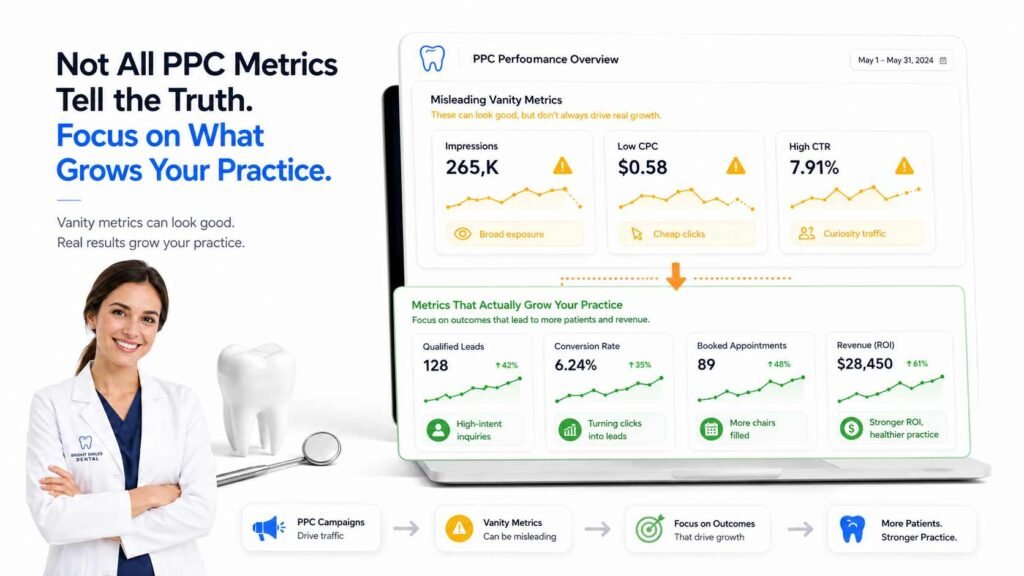
Not every popular PPC metric deserves equal attention.
Impressions Alone Mean Very Little
High impression counts may simply indicate broad exposure, not patient intent. Ads shown to irrelevant audiences do not generate value.
Low CPC Is Not Always Positive
Cheap clicks often come from:
- Broad keywords
- Weak intent searches
- Poor audience targeting
A higher CPC for a high-intent keyword often produces much stronger ROI than inexpensive but low-quality traffic.
High CTR Can Be Misleading
A high CTR does not automatically mean strong campaign performance. If ads attract curiosity clicks from poorly matched searches, CTR may rise while conversion rates fall.
The true goal is qualified traffic, not simply more clicks.
KPI Comparison Table: Dental PPC Campaign Metrics
| KPI | What It Measures | Priority Level | Healthy Benchmark |
|---|---|---|---|
| Conversion Rate | % of clicks that convert to leads | Very High | 3–8%+ |
| Cost Per Lead (CPL) | Ad spend per lead generated | High | Varies by market |
| Cost Per Acquisition (CPA) | Ad spend per new booked patient | Very High | Depends on service LTV |
| Phone Call Conversions | Calls generated from ads | Very High | Track + qualify all |
| Click-Through Rate (CTR) | % of impressions that generate clicks | Medium | 4–7% |
| Quality Score | Google’s ad relevance rating | High | 7–10 target |
| Impression Share | % of eligible impressions captured | Medium | 60–80%+ in target area |
| Landing Page CVR | % of page visitors who convert | Very High | 4–10%+ |
| Booked Appointment Rate | % of leads that book appointments | Very High | 30–60%+ |
| ROAS | Revenue per dollar of ad spend | High | 3:1 minimum; 5:1+ ideal |
Building an Effective PPC Tracking System
Knowing which KPIs matter only helps if tracking is properly configured.
An effective dental PPC tracking system should connect:
- Google Ads data
- Website analytics
- Form submissions
- Phone calls
- Appointment data
- Revenue attribution
Essential Tracking Best Practices
Set Up Conversion Tracking Before Launching Campaigns
Launching campaigns without tracking creates major blind spots and prevents meaningful optimization.
Use Dedicated Call Tracking Numbers
Dynamic call tracking allows practices to identify:
- Which ads generated calls
- Which keywords drove leads
- Which campaigns produced appointments
Without proper attribution, valuable data gets lost.
Define Real Business Conversions
Not every interaction should count as a conversion.
Strong conversion definitions include:
- Qualified phone calls
- Genuine appointment requests
- New patient inquiries
Simple page visits or button clicks often provide misleading data.
Review KPIs Consistently
Different reporting timelines serve different purposes:
- Weekly reviews identify pacing issues
- Monthly reviews evaluate optimization opportunities
- Quarterly reviews assess broader strategy and budget allocation
Consistent reviews help campaigns improve steadily over time.
Connect Marketing Data to Revenue
The most advanced dental PPC systems track users from:
- Click
- Lead
- Appointment
- Treatment acceptance
- Revenue
This allows practices to optimize campaigns based on profitability rather than superficial engagement metrics.
Why Many Dental PPC Campaigns Underperform
Many dental practices launch campaigns, monitor clicks and impressions, and assume performance is healthy simply because traffic increases.
Months later, they realize patient growth does not match advertising spend. The issue is usually not a lack of clicks. It is an incomplete measurement.
Without strong attribution systems, practices cannot identify:
- Weak keywords
- Poor landing pages
- Missed calls
- Low-quality leads
- Scheduling bottlenecks
Practices that consistently achieve strong PPC results define success before campaigns launch and track performance against real patient acquisition goals.
Wrapping Up
The best dental PPC campaigns are not necessarily the ones generating the most traffic or cheapest clicks. They are the campaigns that consistently convert ad spend into profitable patient outcomes.
Successful PPC management depends on:
- Tracking the right KPIs
- Building accurate attribution systems
- Monitoring booked appointments
- Connecting marketing to revenue
Practices that focus on meaningful metrics rather than vanity numbers consistently achieve stronger returns, better patient acquisition, and more efficient advertising performance.
Disclaimer
This article is for general informational and marketing education purposes only. It should not be taken as legal, financial, dental, or professional advertising advice. PPC performance can vary depending on location, competition, budget, landing page quality, practice reputation, treatment type, and how accurately calls, forms, appointments, and revenue are tracked.
Dental practices should review advertising claims, patient privacy rules, data tracking methods, and local dental board regulations before launching or optimizing paid advertising campaigns. For financial decisions, compliance questions, or legal concerns, consult a qualified professional.
References
- Google Ads Help. About Quality Score for Search Campaigns. Google explains that Quality Score is a diagnostic tool based on expected click-through rate, ad relevance, and landing page experience. Accessed May 18, 2026.
- Google Ads Help. About Phone Call Conversion Tracking. Google explains how advertisers can track calls from ads, calls from websites, mobile call clicks, and imported call conversions to evaluate advertising performance and ROI. Accessed May 18, 2026.
- McLeod, N. S. (2012). Enhancing the online presence of a dental practice. The Journal of Prosthetic Dentistry, 107(4), 271–275. DOI: 10.1016/S0022-3913(12)60073-0. This publication discusses dental websites, online visibility, patient reviews, keywords, and pay-per-click advertising options for dental practices.
- Piedra Andrade, M. N., Astudillo, P. A., Bravo, M. E., Cordero Coronel, M. I., & Bravo Calderón, M. E. (2024). Marketing and patient acquisition strategies in dental clinics: Development and implementation of digital marketing campaigns to attract new patients and the effectiveness of social networks as a marketing tool for dental clinics. Research, Society and Development, 13(10). DOI: 10.33448/rsd-v13i10.47175.
- Freire, Y., Gómez Sánchez, M., Suárez, A., Joves, G., Nowak, M., & Díaz-Flores García, V. (2023). Influence of the use of social media on patients changing dental practice: A web-based questionnaire study. BMC Oral Health, 23, Article 365. DOI: 10.1186/s12903-023-03078-9.
- Pollet, A., & Diakonoff, H. (2024). Assessment of the online presence and regulatory compliance of dental practice websites in France. Digital Health, 10. DOI: 10.1177/20552076241258143. This study is useful for supporting points about online dental marketing, website visibility, and the importance of compliance in healthcare advertising.