

Private label supplements give brands a faster way to enter the health and wellness market without building their own factory. Instead of managing production from the ground up, a brand can work with an experienced manufacturer that already has the equipment, quality systems, formulation support, packaging options, and export knowledge needed to bring products to market.
This matters because the supplement market continues to grow, but competition is also stronger than before. A product with a nice label is not enough. Brands need a clear audience, the right dosage form, compliant labeling, reliable manufacturing standards, and a product strategy built for repeat purchases.
Choosing the right private label supplement manufacturer is one of the most important decisions a brand will make. The right partner can help with product development, ingredient sourcing, testing, packaging, documentation, certifications, and shipping. The wrong partner can create delays, compliance problems, poor product quality, weak customer trust, and wasted startup capital.
For pharmacies, retail chains, e-commerce sellers, Amazon brands, TikTok brands, influencers, distributors, and health-focused businesses, private label manufacturing can be a practical growth path. The key is not simply finding the cheapest factory. The real goal is to choose a manufacturer that matches your target market, product category, quality expectations, certification needs, and long-term brand plans.
How To Choose A Private Label Supplement Manufacturer For A Brand
For private-label supplement brands, the difference between those that truly succeed and those that fizzle out after the initial order lies in getting six fundamentals right:
- Define your target audience before selecting products.
- Enter categories with strong, essential demand while bringing a unique perspective.
- Choose the right production model (Private Label, ODM, or OEM).
- Manufacturer certifications determine which markets you can enter.
- Packaging is the moment the sale is won, not merely an afterthought.
- Design for repeat purchases from day one, rather than focusing solely on initial sales volume.
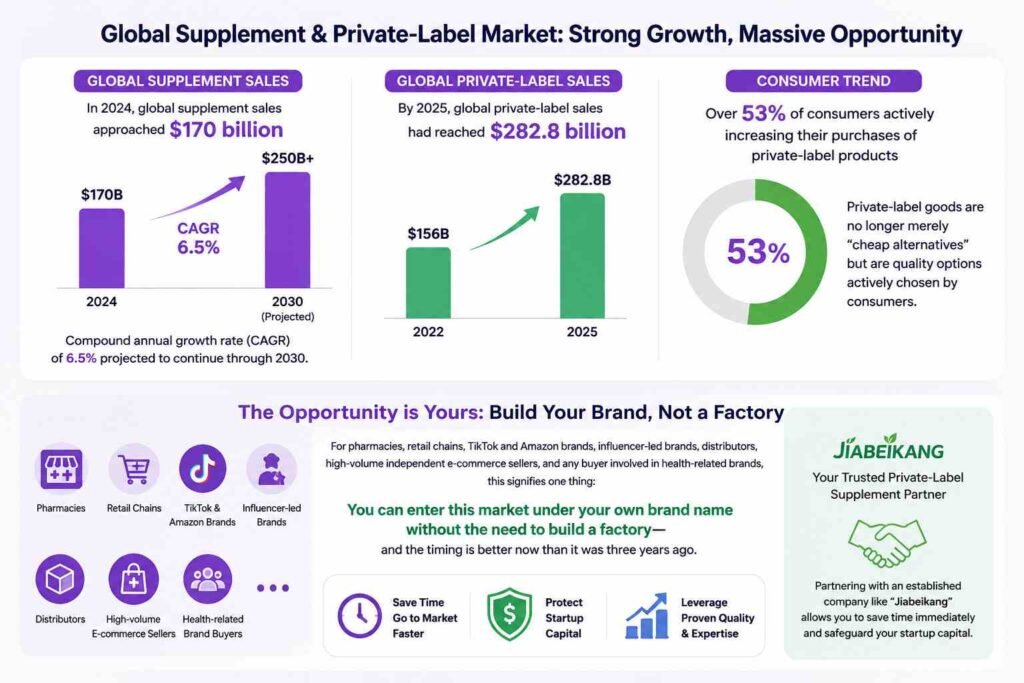
In 2024, global supplement sales approached $170 billion, with a compound annual growth rate (CAGR) of 6.5% projected to continue through 2030. By 2025, global private-label sales had reached $282.8 billion, with over 53% of consumers actively increasing their purchases of private-label products; private-label goods are no longer merely “cheap alternatives” but are quality options actively chosen by consumers.
For pharmacies, retail chains, TikTok and Amazon brands, influencer-led brands, distributors, high-volume independent e-commerce sellers, and any buyer involved in health-related brands, this signifies one thing: you can enter this market under your own brand name without the need to build a factory, and the timing is better now than it was three years ago. Partnering with an established company like “Jiabeikang” allows you to save time immediately and safeguard your startup capital.
Define Your Audience First, Then Select Your Product
Most people follow this sequence: find a “best-selling” product → figure out how to market it. Brands that successfully build a loyal customer base do the exact opposite: first, clearly define whom you are serving → then, find the product that person truly needs. The more specifically you can describe your target audience, the smoother all subsequent decisions will be. You can define your primary customer base using the following approaches:
- Life-stage positioning
- Lifestyle positioning
- Problem-first positioning
Enter categories with essential demand, but bring your own unique perspective.
Finding popular categories isn’t difficult; the real value lies in the specific angle you bring to that category. The question of product selection is never simply “what is selling,” but rather “what is selling *to my specific target audience*.” Adopt a unique entry point and focus on categories with structural, long-term demand, such as products for women’s health or gut health.
OEM vs. ODM Services Explained
When outsourcing production, brands choose between two main pathways based on their technical setup:
- OEM (Original Equipment Manufacturing): You provide the exact recipe. The factory handles bulk raw material sourcing, mixing, and machine line assembly using your blueprint.
- · ODM (Original Design Manufacturing): You bring a rough concept. The factory lab handles formulation R&D, flavor testing, stability checks, and final retail packaging design.
- Private Labeling: You pick a pre-tested stock formula that the manufacturer already owns. You print your logo on the bottle and start selling immediately for fast market entry.
Contract Manufacturer Certifications: Determine Which Markets You Can Enter
Certifications are more than just compliance requirements; they serve as the gateway to specific markets and sales channels.
- FDA Registration: Your ticket to the U.S. market.
- cGMP Certification: Essential for U.S. retail chains, Amazon compliance, and pharmacy channels.
- HALAL Certification: Access to the Middle East, Southeast Asia, and global Muslim consumer markets.
- Non-GMO: Appeals to U.S. “clean label” buyers and natural food channels.
- NSF / Informed Sport: Required for sports nutrition retailers and nutritionists’ clinics.
When selecting a supplier, directly cross-reference their list of certifications with the specific channels you plan to enter.
Packaging Represents The First Moment Of The Sale
Effective packaging must achieve three things simultaneously: ensure compliance, build trust, and create differentiation. Compliance does not necessitate unattractive design; the strongest brands design *within* the framework of compliance rather than cobbling something together to skirt around it.
- The form of the container itself serves as a brand signal.
- The label copy conveys the brand story.
- When pursuing an ODM strategy, exclusivity regarding the formula must be locked in through a formal, written agreement.
Designed For Repeat Purchases From Day One
Repeat purchases drive the supplement business. Customers who buy only once offer virtually no long-term value to your brand.
- Key factors that truly drive repeat purchases:
- Select product categories that deliver visible results.
- A subscription model is a standard requirement, not an optional add-on.
- A focused, curated SKU strategy outperforms a broad, all-encompassing one.
Choosing Your Dosage Forms
Modern consumers want diverse options. Match your target audience with the right product type using this framework:
| Product Format | Main Consumer Focus | Why It Sells | Production Demands |
|---|---|---|---|
| Gummies | Younger Buyers & Families | Fun to take; hides bitter vitamin tastes easily. | Highly sensitive to heat and climate settings. |
| Softgels | Classic Wellness Users | Perfect for health oils; the body absorbs them fast. | Needs dedicated liquid-filling machinery. |
| Liquids / Drops | Seniors & Active Athletes | Zero throat struggle; enters the system quickly. | Must be bottled in zero-bacteria cleanrooms. |
| Powders | Fitness Fans & Bulk Users | Delivers huge nutrient amounts in one scoop. | Ruins easily if damp air enters the container. |
Why Choose Jiabeikang?
Working with Jiabeikang gives you expert manufacturing backup with very low financial risk.
- Global Safety Approvals: Their facility operates under strict global food standards. It is fully registered with the FDA and follows international cGMP quality standards. Additionally, the plant maintains clear clearance systems like ISO 22000, ISO 9001, and HACCP setups alongside certified HALAL lines to guarantee smooth customs processing worldwide.
- Flexible MOQs: You do not need to buy massive volumes upfront. They offer flexible minimum order terms perfect for startup e-commerce brands.
- Complete Setup: Their team handles every step from scratch, managing custom lab recipes, strict label legal checks, graphic package styling, and actual freight delivery to buyers across 150+ countries.
Operational benchmarks: Jiabeikang vs. Generic Plants
| Metric | Generic Factories | Jiabeikang Solutions |
|---|---|---|
| Certifications | Local registration only | Full GMP, ISO 22000, HACCP, FDA, HALAL, BRC, GS, TUV, etc. |
| Form Variety | Only basic tablets and powders | Gummies, Softgels, Liquids, Capsules |
| Sample Phase | Paid testing with hidden costs | Free laboratory product testing samples |
| MOQ Terms | Huge volume demands (high risk) | Flexible small MOQs for scaling brands |
Private Label Dietary Supplements Processes
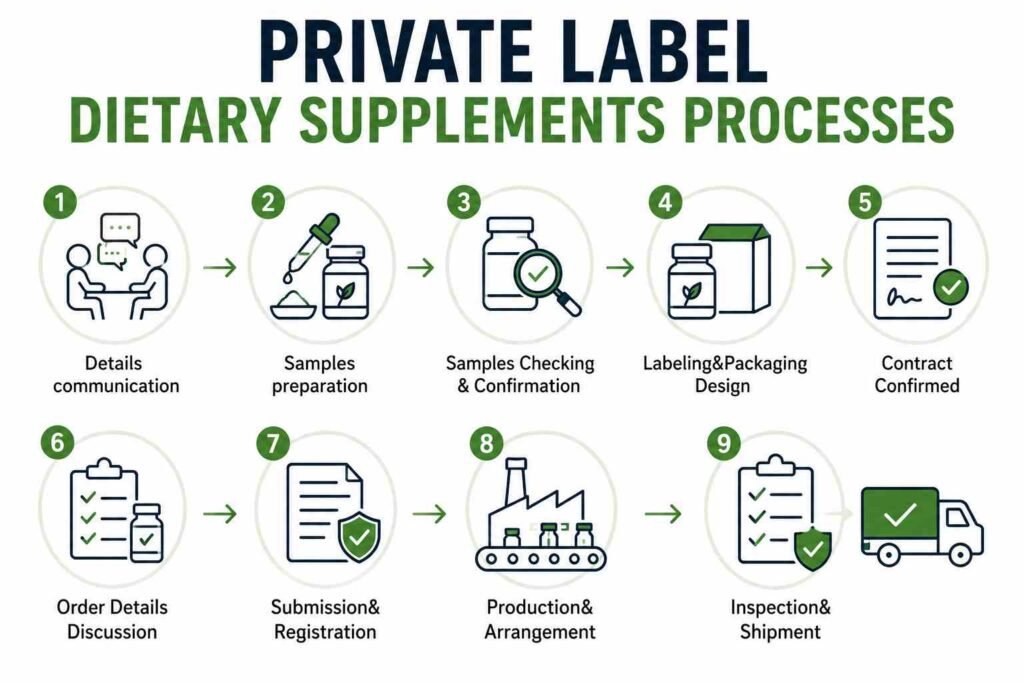
- Details communication
- Samples preparation
- Samples Checking & Confirmation
- Labeling&Packaging Design
- Contract Confirmed
- Order Details Discussion
- Submission&Registration
- Production&Arrangement
- Inspection&Shipment
Closing line
Stop burning capital on expensive factory setups. Partnering with a vetted manufacturer like Jiabeikang hands your business top-tier cleanrooms and ready-to-use global logistics right away. This operational shortcut leaves your team completely free to manage marketing, drive daily traffic, and build your brand equity.
Disclaimer
This article is for general business and educational information only. It does not provide medical, legal, regulatory, or financial advice. Dietary supplement rules, labeling requirements, certification needs, import rules, and advertising standards may vary by country, platform, and sales channel. Brand owners should consult qualified regulatory, legal, and product safety professionals before launching, importing, labeling, advertising, or selling any supplement product.
Dietary supplements are not intended to diagnose, treat, cure, or prevent disease. Any health-related claims should be reviewed carefully for compliance with the rules of the target market.
References
- U.S. Food and Drug Administration. Dietary Supplements. FDA, updated 2026. This source explains FDA oversight of dietary supplements, including the responsibility of manufacturers and distributors to ensure products are not adulterated or misbranded before marketing.
- U.S. Food and Drug Administration. Structure and Function Claims. FDA, updated 2026. This source explains structure and function claims for dietary supplements and the required disclaimer that products are not intended to diagnose, treat, cure, or prevent disease.
- Electronic Code of Federal Regulations. Title 21, Part 111: Current Good Manufacturing Practice in Manufacturing, Packaging, Labeling, or Holding Operations for Dietary Supplements. U.S. Government Publishing Office, current edition. This regulation outlines cGMP requirements for dietary supplement manufacturing, packaging, labeling, and holding.
- Grand View Research. Dietary Supplements Market Size, Share and Trends Analysis Report, 2026 to 2033. Grand View Research, 2026. This market report estimates the global dietary supplements market size at USD 209.52 billion in 2025, and projects continued growth through 2033.
- Food Processing. Private Label Sales Hit Record $282.8 Billion in 2025. Published January 22, 2026. This report summarizes PLMA and Circana data showing that U.S. private-label sales reached USD 282.8 billion in 2025.
- NSF. Certified for Sport Program. NSF International, accessed 2026. This source explains how NSF Certified for Sport verifies supplement products for banned substances and supports safer supplement choices for athletes and sports nutrition buyers.
- National Institutes of Health, Office of Dietary Supplements. Dietary Supplement Fact Sheets. NIH Office of Dietary Supplements, accessed 2026. This source provides science-based information on supplement ingredients, safety considerations, recommended intake levels, and possible interactions.
- Federal Trade Commission. Health Products Compliance Guidance. FTC, 2022. This guidance explains advertising standards for health-related products, including the need for truthful, non-misleading claims supported by competent and reliable scientific evidence.