


A clinical trial can look orderly from the outside. There is a protocol, a list of sites, a study schedule, a database and a final report. Inside the project, however, hundreds of connected decisions must work together.
A small change to an eligibility criterion may alter recruitment across several countries. A laboratory delay may affect visit schedules, data cleaning and safety review. A poorly chosen site may consume months of monitoring effort without recruiting a single participant.
This is why successful clinical development depends on more than completing a list of assigned tasks. It requires a close connection between early strategic thinking and practical study management. The strongest trial plans are not only scientifically credible. They can also be carried out by real investigators, coordinators and participants working under real-world conditions.
A Protocol Is More Than a Scientific Document
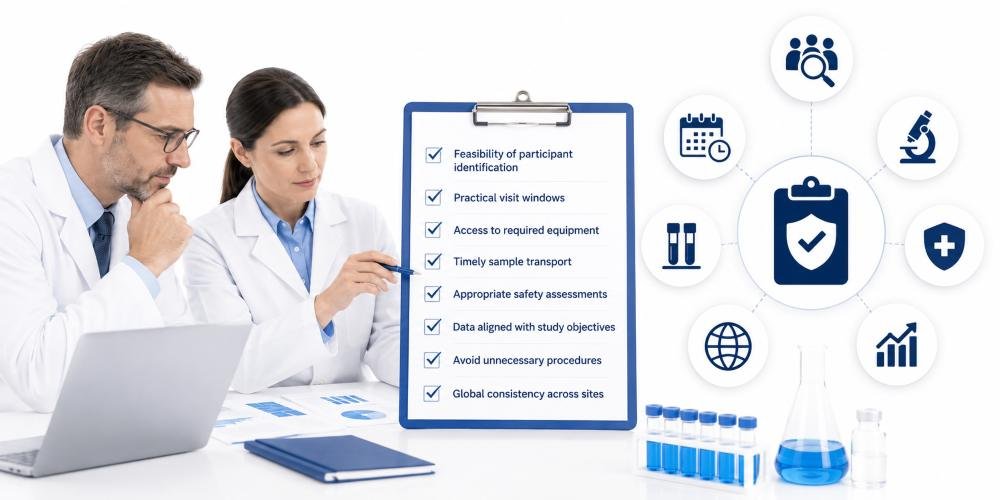
A protocol describes what the study intends to test, but it also creates the operating conditions for everyone involved.
Every visit, assessment, laboratory sample, questionnaire and reporting deadline becomes part of a participant’s experience and a site’s workload. A protocol may appear reasonable during an internal review yet become difficult to manage once it reaches a busy hospital or specialist clinic.
For that reason, protocol development should include questions that go beyond scientific validity:
- Can suitable participants realistically be identified?
- Are the visit windows practical for patients and sites?
- Do investigators have access to the required equipment?
- Can samples reach the central laboratory within the required period?
- Are the safety assessments appropriate for the expected risks?
- Will the data collected answer the study’s central questions?
- Are any procedures being included simply because they are customary?
- Can the study be managed consistently across different countries?
The ICH E6(R3) Good Clinical Practice guideline places strong emphasis on building quality into trial design rather than trying to correct every weakness after a study has started. This means identifying the factors that matter most to participant protection and reliable results at the planning stage.
Two Forms of Support With One Shared Purpose
Sponsors may require help with strategic decisions, practical execution or both. Clinical trial services generally provide the people, systems and processes needed to run the study. Clinical trial consulting focuses on the decisions that shape how the development programme and individual study should be designed.
The distinction is useful, but the two functions should not operate in isolation.
| Strategic Question | Operational Consequence |
|---|---|
| Which countries should participate? | Regulatory pathways, site contracts, language requirements and start-up timelines |
| Is the protocol practical? | Recruitment performance, deviations, monitoring workload and participant retention |
| Which data are critical? | Database design, source-data review, query management and quality controls |
| What are the main study risks? | Monitoring plans, escalation routes, training and oversight |
| Which vendors are needed? | Contracting, system integration, timelines and accountability |
| How should success be measured? | Milestones, performance indicators and governance reports |
Strategic advisers may recommend the most appropriate study structure, but operational teams must determine whether that structure can function across every participating site. In the same way, operational teams may identify recurring problems that require a strategic decision rather than another temporary correction.
Good support creates a working loop between the two.
Feasibility Should Challenge Assumptions
Feasibility is often treated as a questionnaire sent to investigators. Sites are asked how many suitable patients they see, how quickly they can recruit and whether they have the necessary staff.
Those answers are useful, but they are not enough.
An investigator may see hundreds of patients with the target condition while only a small percentage meet the complete eligibility criteria. Competing trials may be recruiting from the same population. Patients may live too far from the site to attend frequent visits. A required diagnostic test may not be routinely available. Local treatment practices may also reduce the number of eligible candidates.
A stronger feasibility assessment examines the assumptions behind each estimate.
Questions Worth Testing Before Site Selection
- How were the recruitment figures calculated?
- Were complete eligibility criteria considered?
- How many competing studies are active at the site?
- Who will review medical records for potential participants?
- Does the site have enough research coordinators?
- Are pharmacy, imaging and laboratory departments available?
- How long do local approvals and contracts usually take?
- Has the investigator recruited successfully in similar studies?
- Is the proposed participant population willing to accept the study burden?
The goal is not to produce the largest possible list of interested sites. It is to identify sites that can recruit appropriately, protect participants, follow the protocol and maintain dependable documentation.
Ten carefully selected sites may be more productive than twenty sites chosen mainly through optimistic enrollment estimates.
Country Selection Is an Operational Decision Too
A country may appear attractive because it has a large patient population or experienced investigators. Yet the complete picture may include lengthy contract negotiations, import requirements, translation needs, limited laboratory capacity or complex submission procedures.
Country selection should therefore consider several connected factors:
| Factor | Why It Matters |
|---|---|
| Target population | Determines whether enough potentially eligible participants are available |
| Standard of care | May affect eligibility, treatment expectations and comparator selection |
| Regulatory pathway | Influences submission requirements and approval timelines |
| Ethics review | May operate nationally, regionally, locally or through combined processes |
| Site infrastructure | Affects whether procedures can be performed correctly |
| Competing studies | May reduce recruitment and investigator attention |
| Contracting environment | Can delay site activation even after approval |
| Participant travel | Influences retention and missed visits |
| Data privacy requirements | Affects systems, transfers, contracts and consent language |
For trials conducted in the European Union and European Economic Area, the European Medicines Agency’s overview of the Clinical Trials Information System explains how sponsors and regulators use CTIS for applications, regulatory communication and trial information.
Choosing countries only because they appear to recruit quickly can create problems later. A more balanced decision considers start-up time, enrollment potential, study quality, cost, regulatory complexity and the ability to maintain oversight.
Site Start-Up Is Where Planning Meets Reality
Study start-up is often described through milestones such as regulatory submission, ethics approval, contract execution, site initiation and activation. These milestones are important, but they do not always show whether a site is genuinely ready.
A site may be officially activated while still lacking:
- completed system access;
- trained backup staff;
- confirmed laboratory supplies;
- translated participant materials;
- pharmacy readiness;
- tested data-entry procedures;
- clear safety-reporting routes;
- working delegation and responsibility records.
Activation should mean that the site can screen and enroll participants correctly, not simply that a checklist has been signed.
A useful readiness review asks the coordinator to explain what would happen if a potential participant arrived tomorrow. Where would screening begin? Who would confirm eligibility? How would consent be documented? Where would samples go? Who would enter the data? Who would report a safety event outside normal working hours?
Unclear answers reveal practical gaps that may not appear in a status report.
Participant Protection Must Remain Visible
Participant safety is not a separate workstream owned only by the medical or pharmacovigilance team. It should influence protocol design, consent materials, investigator training, data review and study governance.
Informed consent is one example. A signed form is evidence that a process occurred, but it does not prove that the information was understandable or that the participant had a meaningful opportunity to ask questions.
The US Office for Human Research Protections provides extensive guidance on informed consent in human research. Its materials treat consent as a continuing process rather than a one-time administrative event.
Operational planning should consider:
- whether participant information uses understandable language;
- how updated safety information will be communicated;
- whether translated materials are accurate and culturally suitable;
- how consent will be handled during remote visits;
- who will answer participant questions;
- how re-consent will be tracked;
- how withdrawal decisions will be documented and respected.
A study becomes safer when participant protection is built into ordinary site activities rather than handled only during audits or urgent safety events.
Quality Management Should Focus on What Matters Most

Trying to review every activity with equal intensity may feel thorough, but it can direct attention away from the issues that have the greatest effect on safety and study reliability.
Risk-based quality management starts by identifying critical-to-quality factors. These are the study elements that must function correctly for the trial to protect participants and answer its central scientific question.
They may include:
- confirmation of key eligibility criteria;
- correct treatment allocation;
- accurate primary endpoint assessment;
- timely reporting of serious safety events;
- appropriate investigational product handling;
- reliable informed consent;
- complete follow-up for important outcomes;
- correct collection of essential laboratory samples.
The US Food and Drug Administration’s questions and answers on risk-based monitoring explain how monitoring can be adjusted according to the risks and characteristics of a clinical investigation. The aim is not to reduce oversight. It is to make oversight more purposeful.
Risk Indicators That May Require Attention
| Indicator | Possible Meaning |
|---|---|
| Unusually fast recruitment | Eligibility checks may require review |
| Repeated missing assessments | Visit design or site processes may be impractical |
| High numbers of data corrections | Training or source-documentation problems may exist |
| Delayed safety reports | Escalation routes may be unclear |
| Frequent staff changes | Site continuity and training may be at risk |
| Very low query rates | Data review may be insufficient rather than perfect |
| Repeated protocol deviations | The protocol may be unclear or difficult to follow |
| Long gaps in data entry | Emerging issues may remain hidden |
Metrics should begin conversations, not replace professional judgment. A number can show that something has changed, but people must determine why it changed and what response is appropriate.
Data Integrity Begins Before the First Entry
Data quality is often discussed during cleaning and database lock. In reality, many data problems begin much earlier.
They may start when the protocol requests information that sites do not routinely record. They may result from unclear source requirements, complicated case report forms, poorly integrated technology or inconsistent instructions across different documents.
The FDA’s guidance on electronic source data in clinical investigations discusses the capture, review and retention of electronic source information, including the need for reliability, traceability and appropriate controls.
Before study launch, teams should agree on:
- where each important data point originates;
- who is authorised to enter or change information;
- how corrections will be recorded;
- which systems exchange data;
- how discrepancies between systems will be resolved;
- how access rights will be controlled;
- what happens when a system is unavailable;
- how records will be retained and inspected.
Technology does not automatically improve data quality. A complicated digital process can reproduce the same weaknesses as a paper process while making them harder to see.
Systems should make correct work easier, not simply move existing work onto a screen.
Safety Oversight Requires Clear Ownership
Safety information may come from sites, laboratories, electronic diaries, medical monitors, external committees and other vendors. Without clear ownership, an important signal can sit between systems while each team assumes another group is reviewing it.
The NIH data and safety monitoring resources describe oversight approaches intended to protect participants and support the validity of trial data. The appropriate structure may vary according to the intervention, trial phase, study population and level of risk.
A workable safety plan should define:
- who receives initial reports;
- who determines seriousness and expectedness;
- who evaluates possible relationships to the study intervention;
- when medical review must occur;
- which events require rapid escalation;
- how follow-up information will be obtained;
- who communicates with investigators and regulators;
- how safety information is reconciled across databases.
The plan should also be tested. Teams can walk through a hypothetical report and check whether each person understands what happens next. A process that works only when the usual contact is available is not reliable.
Trial Master File Should Tell the Study’s Story
A Trial Master File is sometimes treated as a storage location for documents. Its real purpose is broader. It should allow an authorised reviewer to understand how the study was planned, approved, conducted, supervised and closed.
A well-maintained file should show not only final documents but also the decisions behind important actions. When a risk was identified, what was done? When a vendor missed a milestone, how was the issue assessed? When the protocol changed, how were sites and participants affected?
Inspection readiness improves when filing occurs as part of normal work. Attempting to rebuild the study history shortly before an inspection can reveal missing approvals, incomplete correspondence, outdated documents and decisions that were never formally recorded.
Useful file-management practices include:
- assigning clear document ownership;
- defining expected filing timelines;
- reviewing completeness throughout the study;
- controlling document versions;
- recording significant decisions;
- reconciling sponsor and investigator files;
- checking vendor-held documents;
- resolving filing gaps before staff leave the project.
The strongest file is not necessarily the largest. It is the one that presents a complete, accurate and understandable record of the trial.
Transparency Is Part of Responsible Research
Trial registration helps make clinical research visible to patients, healthcare professionals, researchers and the public. It also reduces the risk that studies or outcomes become difficult to locate.
The World Health Organization’s International Clinical Trials Registry Platform provides access to trial records supplied by registries that meet WHO criteria. WHO also explains that studies should be registered through an appropriate primary or recognised registry rather than directly with the ICTRP.
For studies registered in the United States database, the ClinicalTrials.gov guide to registering a study explains responsibility, account selection and protocol information submission through the Protocol Registration and Results System.
Registration should not be left until the final days before enrollment. The protocol, registry record, consent materials and regulatory submissions should be checked for consistency. Differences in study titles, outcomes, enrollment targets or timelines can create unnecessary corrections and questions later.
Vendor Oversight Cannot Be Fully Outsourced.
Central laboratories, imaging providers, technology companies, couriers, data-management teams and other specialist vendors may perform major parts of a study. Delegating an activity, however, does not remove the sponsor’s need for oversight.
Vendor management should begin with clear expectations:
- What exactly is the vendor responsible for?
- Which activities remain with the sponsor?
- How will performance be measured?
- What data will be exchanged?
- Who investigates errors?
- When must problems be escalated?
- How will changes be controlled?
- What records must be transferred at study close?
Meetings should focus on decisions and risks, not only status updates. A report showing that 95 percent of laboratory results were issued on time may appear positive, but the remaining 5 percent could include the results needed for important treatment or safety decisions.
Percentages need context.
Project Governance Should Help People Decide
Clinical studies produce large volumes of reports, trackers, dashboards and meeting notes. More reporting does not automatically create better control.
Useful governance gives the right people enough information to make timely decisions. It should show:
- what has changed;
- why the change matters;
- who owns the response;
- when action is required;
- whether the issue affects participants, data or timelines;
- whether senior escalation is needed.
A governance meeting should not spend most of its time reading information that participants could review beforehand. Its value comes from resolving uncertainty, assigning responsibility and documenting decisions.
Clear governance is especially important in multinational studies, where local teams may face different regulatory systems, healthcare practices and administrative expectations. Global consistency should define the required outcome, while local knowledge should shape how that outcome is achieved.
Questions Sponsors Should Ask Potential Support Partners
Selecting an external partner should involve more than comparing service lists and hourly rates. Sponsors need to understand how the partner thinks, communicates and responds when a study does not follow the original plan.
Useful questions include:
- How do you test whether a protocol is operationally realistic?
- How do strategic and operational teams share information?
- What information is used to challenge recruitment estimates?
- How are critical-to-quality factors identified?
- How are vendors supervised?
- What happens when a site repeatedly misses expectations?
- How are risks escalated to sponsor leadership?
- How do you maintain continuity when project staff change?
- What systems are used, and how are they validated?
- How is inspection readiness assessed during the study?
- How do you distinguish a temporary issue from a structural problem?
- What evidence will show that corrective actions have worked?
The most valuable partner is not always the one promising the fastest start-up or the largest site network. A stronger choice may be the team willing to question weak assumptions before those assumptions become expensive operational problems.
What Strong Clinical Development Support Looks Like
Good clinical development support is often visible in what does not happen.
Sites do not receive conflicting instructions. Important safety information does not remain unreviewed. Monitoring teams do not spend months correcting problems that could have been prevented during protocol design. Project leaders do not learn about major delays only after a milestone has already been missed.
This does not mean that every trial proceeds without difficulty. Clinical research includes uncertainty by its nature. Recruitment patterns change, sites lose staff, vendors experience problems, and new safety information may appear.
The difference is how prepared the study is to recognise and manage those events.
Strong support connects scientific intent with daily study activity. It turns the protocol into workable site processes, converts risks into clear controls and ensures that decisions are supported by reliable information. It also keeps participant protection visible when commercial pressure, timelines and operational complexity compete for attention.
Strategy without execution remains a plan. Execution without strategy becomes a series of disconnected tasks. Clinical development works best when both are treated as parts of one system, with shared responsibility for study quality, participant safety and dependable evidence.