

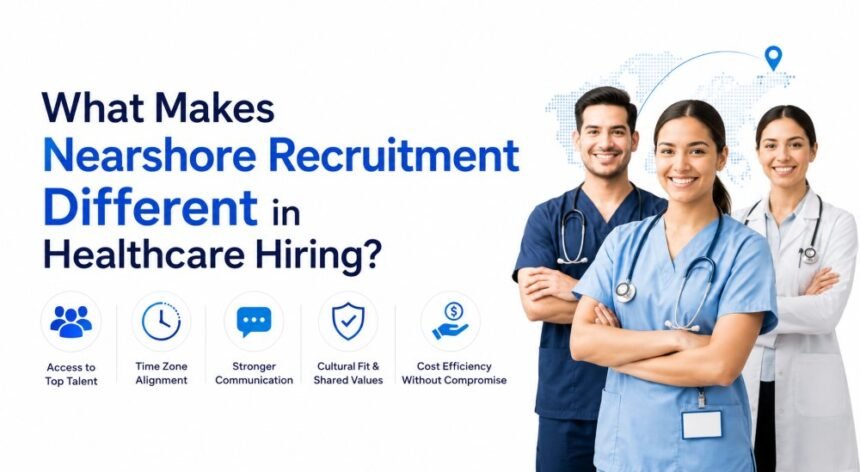
Healthcare hiring carries a different kind of pressure. An unfilled position not only delays a project or increases someone’s workload. It can leave patients waiting longer, create appointment backlogs, slow insurance verification, and place additional pressure on clinical staff.
A medical practice may need another billing specialist. A telehealth company may be looking for patient coordinators who can work during US hours. A dental group may need appointment support across several locations. A health technology company may struggle to find developers who understand secure healthcare systems.
Traditional hiring can fill these roles, but it may become slow or expensive when suitable candidates are difficult to find nearby. Nearshore recruitment widens the search to professionals in nearby countries while preserving meaningful working-hour overlap with the US team.
The model can be useful, but healthcare organizations must apply stricter standards than businesses hiring for ordinary remote roles. Patient privacy, professional licensing, communication accuracy, system security, and service continuity all need careful attention.
Why Healthcare Organizations Are Looking Beyond Local Hiring
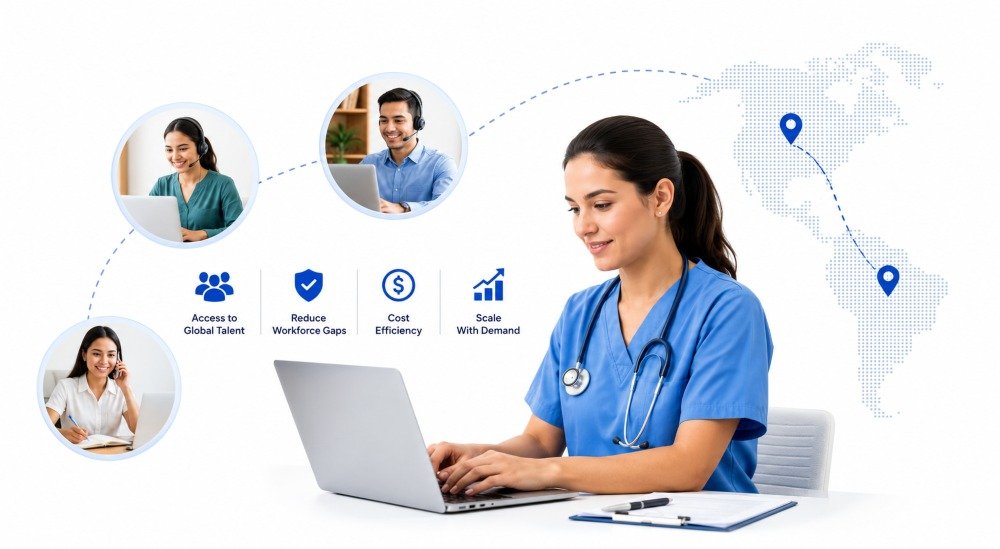
Healthcare employment continues to expand. The US Bureau of Labor Statistics expects employment across healthcare occupations to grow much faster than the average for all occupations between 2024 and 2034. The category includes both clinical professionals and support workers who keep healthcare organizations operating.
Demand does not appear evenly across every profession or location. A hospital may have plenty of applicants for one role but struggle for months to fill another. Smaller practices can also find it difficult to compete with large health systems on salary, benefits, and career development.
HRSA’s health workforce projections assess the expected supply and demand for different health professions. These projections show why healthcare organizations need to plan their workforce rather than waiting until shortages interrupt patient services.
When Local talent pools are limited, practices may start considering candidates outside their immediate region. Nearshore hiring provides one possible route, particularly for remote-ready administrative, technical, and patient-support positions.
What Nearshore Healthcare Recruitment Means
Nearshore healthcare recruitment involves hiring professionals from countries that are relatively close to the organization’s main market.
For US healthcare businesses, this often means recruiting from Latin America. Depending on the country and time of year, candidates may work within the same time zone as a US office or only a few hours apart.
Nearshore recruitment can be used for roles such as:
- Medical billing and coding support
- Appointment scheduling
- Patient intake coordination
- Insurance eligibility verification
- Prior authorization support
- Medical records administration
- Telehealth technical support
- Healthcare customer service
- Revenue cycle support
- Digital health content review
- Software development
- Quality assurance testing
- Data reporting
- General administrative support
Some clinical roles may also be performed remotely, but clinical recruitment involves much stricter licensing, credentialing, professional liability, and jurisdiction requirements.
The US Department of Health and Human Services explains that healthcare professionals generally need to satisfy the applicable licensing requirements for the location where the patient receives care. Hiring a licensed professional in another country or state does not automatically permit that person to treat US patients.
For that reason, healthcare organizations often begin nearshore hiring with non-clinical roles that can be clearly supervised and performed remotely.
How Traditional Healthcare Hiring Usually Works
Traditional recruitment normally focuses on candidates who already live within the organization’s city, state, or country.
The process may involve:
- Writing the job description
- Publishing the vacancy
- Collecting applications
- Screening résumés
- Conducting interviews
- Checking qualifications and references
- Completing background checks
- Making an offer
- Arranging onboarding and training
For licensed healthcare positions, the organization may also need to verify professional education, active licenses, sanctions, malpractice history, board certification, and hospital privileges.
Traditional hiring remains the most practical choice for roles requiring physical patient care, access to medical equipment, local professional registration, or regular attendance at a clinic.
The limitation is reach. A healthcare practice may be searching within the same small candidate market as every nearby hospital, clinic, dental office, and insurance company.
Nearshore and Traditional Healthcare Hiring Compared
| Point to Compare | Nearshore Healthcare Hiring | Traditional Healthcare Hiring |
|---|---|---|
| Candidate reach | Access to nearby international markets | Mainly local or national |
| Working hours | Often strong US-hour overlap | Usually complete overlap |
| On-site availability | Normally unavailable | Possible for local employees |
| Clinical licensing | Complex and role-dependent | Usually easier to verify locally |
| Patient-data access | Requires strict controls | Still requires controls, but may be easier to manage internally |
| Salary expectations | Based partly on the candidate’s local market | Based on the domestic market |
| Hiring administration | May require international employment support | Usually handled through existing systems |
| Communication | Must be assessed carefully | Often easier to evaluate in person |
| Suitable roles | Remote support, billing, technology and administration | Clinical, administrative and on-site roles |
| Scaling | Can open a larger hiring pipeline | Depends on domestic availability |
The models can work together. A clinic might hire physicians, nurses, and medical assistants locally while building a nearshore team for billing, scheduling, patient reminders, and after-hours administrative tasks.
Healthcare Hiring Is Not the Same as General Outsourcing
A healthcare worker may handle information that is sensitive, time-critical, or closely connected to patient care.
A delayed customer-service reply in another industry may be inconvenient. A delayed message about an urgent appointment, prescription question, or abnormal test follow-up could have more serious consequences.
Nearshore staff therefore need clear boundaries. They must understand which decisions they can make, which issues require escalation, and which messages must go directly to a licensed healthcare professional.
A patient coordinator, for example, may be allowed to schedule an appointment or explain how to access the patient portal. That person should not interpret symptoms, recommend treatment, or provide a medical opinion unless properly licensed and authorized to do so.
Good role design protects both the patient and the employee.
Onboarding Should Be Built Around Real Healthcare Workflows
A new team member should not learn healthcare operations by watching a few recorded meetings and guessing the rest.
Healthcare onboarding should explain:
- The organization’s services
- The patient groups it serves
- The limits of the employee’s role
- Approved scripts and templates
- Scheduling rules
- Escalation procedures
- Privacy expectations
- Security requirements
- Documentation standards
- Performance measures
- Emergency contacts
New employees should practise using fictional records before receiving access to live patient information.
Managers can also create a role-specific guide showing what the employee should do when:
- A patient reports urgent symptoms
- An appointment request is unclear
- Insurance information does not match
- A caller asks for medical advice
- A family member requests records
- A system stops working
- A privacy mistake may have occurred
The goal is to remove uncertainty before the employee faces a real patient situation.
Which Healthcare Roles Work Well Nearshore?
Nearshore hiring is most practical when the work can be completed through secure digital systems and does not require hands-on patient care.
Patient Scheduling
Nearshore scheduling staff can answer calls, manage calendars, confirm appointments, send reminders, and help patients understand basic preparation instructions approved by the clinic.
They should receive scripts for common questions and clear rules for escalating urgent situations.
Medical Billing Support
Billing teams may help enter charges, review claim status, check missing information, follow up on denials, and organize payment records.
Because billing work can involve protected health information, access should be limited to the information required for the task.
Insurance Verification
Remote team members can confirm coverage, check eligibility, collect authorization details, and document benefit information before an appointment.
The organization should still make it clear that insurance verification is not a guarantee of payment.
Medical Records Administration
Staff may organize files, process record requests, review documentation for completeness, or support data entry.
Record-access permissions should be based on job responsibilities rather than giving every worker broad access to the complete patient database.
Telehealth Support
Telehealth platforms may need staff who can help patients log in, test audio or video, reset passwords, and prepare for virtual appointments.
CMS maintains information about telehealth services and provider requirements. The rules surrounding eligible services, billing, and providers can change, so operational teams need current instructions rather than relying on old training materials.
Health Technology Roles
Developers, designers, testers, product managers, and technical support professionals can often work successfully in nearshore arrangements.
Technical skill remains important, but healthcare technology staff also need to understand privacy, access control, audit trails, secure communication, and the consequences of system downtime.
Roles That Usually Need Local or Specialized Hiring
Nearshore recruitment is not a sensible replacement for every healthcare position.
Local or specially licensed hiring is generally more suitable when the role involves:
- Physical examinations
- Direct bedside care
- Giving medication
- Drawing blood
- Operating medical equipment
- Performing dental procedures
- Emergency response
- In-person therapy
- Local prescribing authority
- State-specific clinical responsibility
- Access to controlled clinical facilities
Even telehealth clinicians may need licenses or legal permission in the location where the patient is physically present.
The World Health Organization describes the health workforce as including clinical professionals as well as management and support personnel. A strong health system needs both groups, but their responsibilities and qualification requirements are not interchangeable.
Patient Privacy Must Shape the Hiring Process
Healthcare organizations cannot treat patient-data access as a routine remote-work matter.
The HIPAA Rules apply to covered entities and certain organizations or individuals that perform services involving protected health information. HHS explains when vendors and service providers may be considered business associates.
Whether a particular staffing company or worker qualifies as a business associate depends on the relationship and the work performed. Healthcare organizations should obtain qualified compliance advice rather than assuming that a confidentiality clause alone is sufficient.
Before a nearshore employee receives access, the organization should decide:
- Which patient information the person genuinely needs
- Which systems the person can use
- Whether downloading information is allowed
- Whether printing is prohibited
- Which device the worker will use
- How activity will be logged
- How access will be removed
- What happens if a device is lost
- How a possible privacy incident must be reported
The safest approach is to give the minimum level of access needed to complete the job.
Remote Security Requires More Than a Password
A remote employee may work from a private home office, a shared building, or another approved location. Each arrangement creates possible security concerns.
The National Institute of Standards and Technology guides enterprise telework and remote-access security. Its recommendations cover remote connections, organization-issued devices, personal devices, and security policies.
Healthcare organizations should consider controls such as:
- Company-managed computers
- Multi-factor authentication
- Virtual private network access
- Encrypted data
- Automatic screen locking
- Restricted downloads
- Role-based permissions
- Approved communication platforms
- Endpoint monitoring
- Regular security training
- Documented incident reporting
- Immediate account closure after termination
Sensitive information should not be shared through personal email accounts, unapproved messaging apps, or open spreadsheets.
Managers should also make sure remote workers cannot be overheard discussing patient details in shared spaces.
Communication Skills Affect Patient Experience
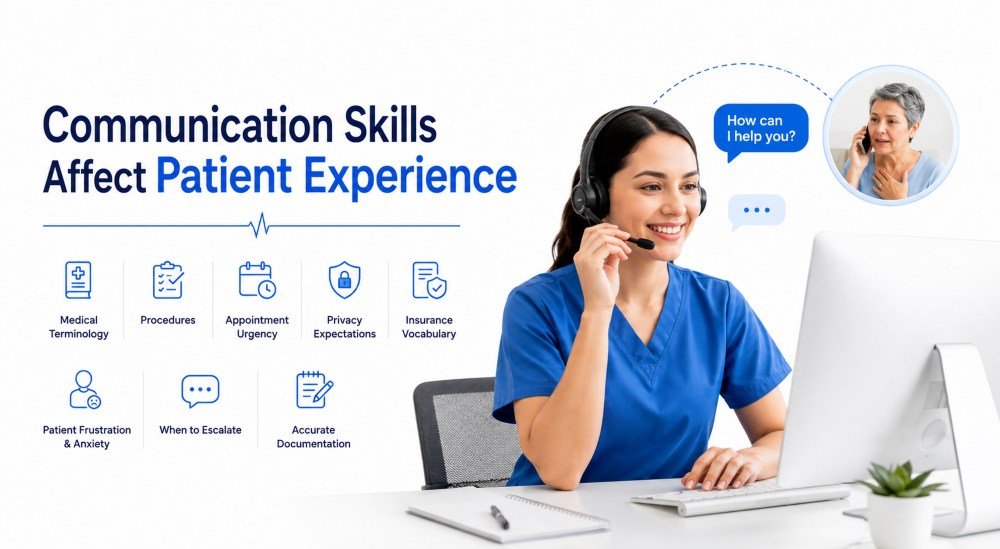
A patient may not know whether the person answering a call is in the clinic, another state, or another country. They judge the practice by how clearly and respectfully that person communicates.
Healthcare communication requires more than conversational English.
Candidates may need to understand:
- Medical terminology
- Names of common procedures
- Appointment urgency categories
- Privacy expectations
- Insurance vocabulary
- Patient frustration and anxiety
- When to stop and escalate a question
- How to document a conversation accurately
A fluent speaker may still struggle if training is rushed or the role is poorly defined.
During interviews, healthcare employers can use realistic but fictional scenarios. A scheduling candidate might be asked how they would respond to a caller reporting severe symptoms. The correct response should follow the organization’s escalation policy, not attempt to diagnose the patient.
Hiring tests must remain job-related and fair. The Equal Employment Opportunity Commission states that recruitment and hiring practices should not discriminate, and employment tests should be connected to legitimate job requirements.
Credential Checks Depend on the Role
A billing specialist, software developer, nurse, dentist, and patient coordinator require different checks.
A general nearshore screening process may include:
- Identity verification
- Employment history
- Professional references
- Education checks
- Language assessment
- Role-specific testing
- Criminal background checks where lawful
- Data-security awareness
- Availability confirmation
Clinical positions require additional verification. Depending on the role and jurisdiction, this may include:
- Active professional licenses
- Registration with the relevant board
- Education and training records
- Disciplinary history
- Specialty certification
- Professional liability coverage
- Prescribing authority
- Scope-of-practice confirmation
A recruiter should never present a candidate as “clinically approved” without explaining exactly what has been verified and by whom.
Final responsibility remains with the healthcare organization.
Cost Savings Should Not Be the Only Goal
Nearshore recruitment is frequently promoted as a way to lower staffing costs. Savings may be possible, but a simple salary comparison does not show the full cost.
The organization may also need to pay for:
- Recruitment fees
- International payroll support
- Employer-of-record services
- Legal and compliance advice
- Equipment
- Secure software
- Training
- Management time
- Benefits
- Paid leave
- Currency conversion
- Replacement hiring
A lower-cost employee is not good value when errors create claim denials, appointment confusion, security incidents, or dissatisfied patients.
The more useful calculation is the cost of hiring and retaining someone who can do the work accurately, securely, and consistently.
Nearshore Staff Should Be Treated as Part of the Care Team
Non-clinical staff may not provide treatment, but they still affect the patient’s experience.
A scheduler influences how quickly someone receives care. A billing specialist affects whether a claim is processed correctly. A portal-support worker may determine whether a patient can join a telehealth appointment.
Nearshore employees should therefore receive:
- A named manager
- Regular feedback
- Access to relevant team updates
- Written priorities
- Refresher training
- Opportunities to raise problems
- Recognition for good work
- Clear performance reviews
Separating the remote team from the rest of the organization can create information gaps. When policies change, everyone handling patients or records should receive the update at the same time.
Starting With a Small Healthcare Function
A healthcare organization does not need to move an entire department nearshore at once.
A smaller pilot may be safer. The practice could begin with:
- Appointment reminders
- Basic scheduling
- Inactive-patient follow-up
- Insurance eligibility checks
- Claim-status follow-up
- Telehealth login assistance
- Administrative data cleanup
The pilot should have clear measures, such as:
- Response time
- Scheduling accuracy
- Claim follow-up completion
- Patient complaints
- Documentation quality
- Attendance
- Security incidents
- Manager satisfaction
After the workflow is stable, the organization can decide whether to expand the team.
Choosing a Nearshore Healthcare Recruitment Partner
When assessing providers of nearshore recruitment services, healthcare organizations should look beyond a polished candidate database.
Ask the provider:
- Which healthcare roles have you filled before?
- How do you test medical terminology?
- How do you assess patient communication?
- What background checks are available?
- How is candidate identity verified?
- Can you support secure equipment?
- How are privacy expectations communicated?
- Who manages payroll and local employment requirements?
- What happens when an employee leaves?
- What replacement terms are included?
- Can you provide references from healthcare clients?
A credible partner should also be honest about limitations. It should not promise that every healthcare function can be moved abroad or that international recruitment removes compliance responsibilities.
Avoid providers that give vague answers about patient data, employment status, security, credential verification, or staff supervision.
Traditional Hiring Still Has an Important Place
Traditional recruitment is often the better route when a healthcare role requires physical presence, local licensing, close clinical supervision, or direct patient treatment.
It may also work best when:
- The practice has a healthy local candidate pipeline
- The position requires local community knowledge
- The employee must work with physical records or equipment
- The role includes home visits
- Patients strongly prefer in-person support
- International administration would cost more than it saves
Nearshore hiring should solve a real workforce problem. It should not be added simply because it is fashionable.
Choosing the Right Hiring Model for a Healthcare Team
The strongest healthcare staffing plans rarely depend on only one hiring model.
A medical group may hire clinicians and medical assistants locally while using nearshore support for appointment coordination, billing follow-up, and digital operations. A telehealth platform may use international developers but require clinicians to hold licenses in every jurisdiction where they treat patients.
The right decision depends on:
- Whether the role involves patient care
- Whether professional licensing is required
- Whether protected health information is involved
- How quickly the position must be filled
- Whether the work can be documented
- How much supervision is available
- Which working hours are needed
- Whether secure access can be provided
- The complete cost of the arrangement
Nearshore recruitment can help healthcare organizations reach skilled people beyond their usual hiring area. Its real value is not simply finding cheaper workers. It is creating another reliable staffing route without losing communication, security, accountability, or patient trust.
Frequently Asked Questions
Which Healthcare Jobs Can Be Hired Nearshore?
Administrative and technology roles are usually the easiest to hire nearshore. Examples include scheduling, medical billing support, insurance verification, telehealth technical support, healthcare customer service, software development, and data reporting.
Clinical roles require additional licensing, credentialing, insurance, and jurisdiction reviews.
Can Nearshore Staff Access Patient Records?
They may be able to access limited patient information when the work requires it, and the arrangement complies with applicable privacy and security requirements.
Access should be role-based, monitored, and limited to the minimum information required.
Is Nearshore Healthcare Recruitment Always Less Expensive?
No. Salaries may be lower in some markets, but the complete cost can include recruitment, payroll support, equipment, compliance advice, security systems, training, and management.
Quality and patient safety should not be reduced to achieve a lower price.
Can an Overseas Doctor Treat US Patients Through Telehealth?
Not automatically. Healthcare professionals generally need to meet licensing and legal requirements connected to the patient’s location, along with applicable credentialing, prescribing, insurance, and reimbursement rules.
How Can a Practice Test Nearshore Hiring Safely?
Begin with one clearly documented, non-clinical function. Limit system access, use fictional data during training, define escalation procedures, and review performance before expanding the arrangement.
Disclaimer: This article provides general business information and does not constitute medical, employment, privacy, cybersecurity, tax, or legal advice. Healthcare staffing, professional licensing, worker classification, data protection, and telehealth requirements vary by role and jurisdiction. Organizations should obtain advice from qualified professionals before hiring workers who will access patient information or provide healthcare services.