


Ask anyone who has worked a night shift in a transfusion service, and they will tell you the same thing: a blood bank does not fail loudly. It fails in the small gaps. A donor record typed twice. A unit that sits a shift too long because nobody could see it was there. A report that takes three people and half a day to assemble before an audit. None of these feel like emergencies on their own. Together, they decide whether the right unit reaches the right patient at the right time.
That is the real problem blood banks are trying to solve, and it is why so many are consolidating their operations onto Panacea blood bank software by Zaavia. The pitch is not “more technology.” It is fewer gaps. Panacea replaces the patchwork of spreadsheets, handwritten logs, and disconnected modules with one connected environment built specifically for transfusion services, where donor registration, collection, testing, component preparation, inventory, issuance, and reporting all speak to each other.
Today, organizations including Saudi German Hospital KSA, Fatimid Foundation, Indus Hospital and Health Network, Chughtai Lab, Ziauddin Hospital, Al-Hammadi Hospital KSA, and several regional blood centers run their daily operations on Panacea. To understand what actually changes after adoption, Zaavia surveyed 23 of these healthcare organizations. The results are worth reading closely, because they line up neatly with what the wider clinical literature has been saying for years.
The Problems Blood Banks Actually Wanted Solved
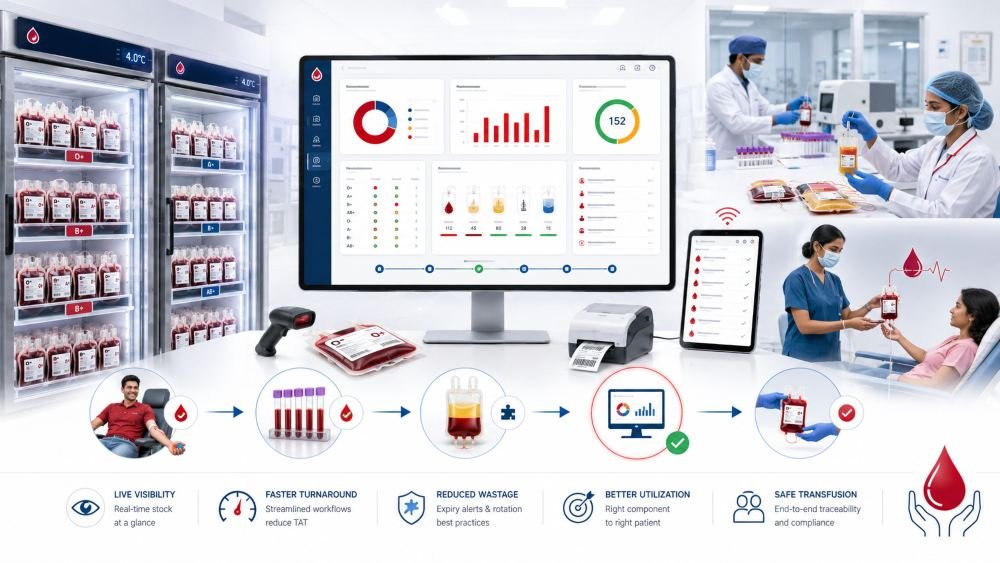
Before Panacea, most respondents described the same friction points:
- 20 organizations struggled with manual documentation, data entry, and reporting.
- 16 had limited traceability of donors, patients, and blood units.
- 15 dealt with frequent data entry errors.
- 14 found compliance, audit preparation, and workflow standardization difficult.
- 10 reported delays in inventory visibility and blood issue workflows.
Only 3 considered their workflows efficient beforehand. Everyone else rated their operations as “acceptable” or “inefficient.”
This is not a local quirk. The World Health Organization describes transfusion as a multi-step chain where an error can be introduced at every stage, from donor selection through collection, testing, and issue, which is exactly why structured quality systems are treated as the foundation of blood safety rather than an optional extra. Manual, disconnected workflows are the environment in which those errors thrive. Panacea’s core value is closing that environment down.
Complete Traceability From Vein to Vein
Of everything Panacea does, traceability was the capability clients valued most, and that is telling.
In transfusion medicine, traceability answers a deceptively simple question: at any moment, can you say who donated, and who received, which specific unit? The International Society of Blood Transfusion frames this “vein-to-vein” chain of custody as a cornerstone of patient safety and the basis for any haemovigilance and look-back investigation. If a donor is later found to carry an infection, or a recipient has an adverse reaction, the whole system depends on being able to trace every component back and forth quickly and completely.
Panacea builds that chain digitally, from registration through testing, grouping, component preparation, storage, issuance, and transfusion. Among the surveyed organizations:
- 20 of 23 reported more than a 50% improvement in blood unit traceability and tracking.
- Traceability was the single most cited “most valuable feature” in open responses.
- Clients specifically pointed to cleaner documentation and faster record retrieval during audits and investigations.
For any facility working under regulatory scrutiny, that shift from “we think we can find it” to “we can find it in seconds” is not a convenience. It is the difference between confidence and exposure.
Less Manual Work, Fewer Human Errors
Manual documentation is where duplicate entries, mislabeling, and reporting inconsistencies creep in, and the consequences are not trivial. Wrong-patient identification during sampling and issue is one of the most common serious hazards in transfusion, which is why the field has moved so decisively toward barcode-driven verification.
The evidence here is strong. A tertiary hospital that implemented a barcode-based transfusion management system saw its error rate fall from 0.03% to roughly 0.001% over several years, with no incorrect transfusions recorded across more than 67,000 orders in the final year studied. A separate pre-and-post study found that electronic patient identification for sample labeling measurably cut “wrong blood in tube” errors, one of the most dangerous mistakes a laboratory can make.
Panacea applies the same logic through rule-based validations, digital records, barcode-driven steps, and system-level cross-checking. The survey reflected it clearly:
- 23 of 23 respondents reported a positive impact on staff workflow and confidence.
- 21 described the system as “extremely helpful” or “very helpful” in reducing human error.
- Teams reported noticeably less time lost to administrative tasks and manual entry.
The point is not that staff were careless before. It is that a well-designed system catches the mistakes that tired, busy humans inevitably make.
Live Inventory and Faster Blood Issue
Inventory is where blood banking gets genuinely hard, because the product is perishable and demand is unpredictable. Hold too little, and you risk a shortage in an emergency. Hold too much and units expire on the shelf. Managing that tension well is a recognized discipline in its own right, and the research on blood inventory best practice keeps returning to the same drivers: transparency of stock, disciplined stock rotation, and daily review.
Every one of those depends on visibility, and visibility is precisely what fragmented systems destroy. Purpose-built inventory software has been shown to help facilities meet demand while cutting wastage by linking demand for components directly to available stock.
Panacea connects inventory movement to testing, component preparation, and issue workflows, so operational teams see a live picture of stock and component status at all times. Survey participants reported gains in:
- Blood inventory monitoring and stock visibility
- Blood issue workflows
- Turnaround times from donor to availability
Several organizations also reported measurable reductions in component wastage and expiry after implementation, which is exactly the outcome disciplined, visible inventory management is supposed to produce.
Compliance and Audit Readiness That Holds Up
Blood banks live under constant documentation pressure, and preparing for an audit by hand is slow, stressful, and error-prone. Every missing field is a finding waiting to happen.
Panacea shifts that work from reactive to continuous, with structured documentation, centralized records, automated reporting, and management dashboards. The Patient Safety literature on blood product scanning makes the same underlying case: when verification and record-keeping are built into the workflow rather than bolted on afterward, both safety and reporting improve together.
In the survey:
- 20 organizations rated Panacea’s contribution to compliance and audit readiness as “strong.”
- Clients singled out reporting accuracy and administrative visibility as major improvements.
- Several mentioned easier report generation and tighter documentation control.
For high-volume hospitals and blood centers, automated reporting alone can reclaim significant administrative time every month.
Consistent Results Across Very Different Institutions
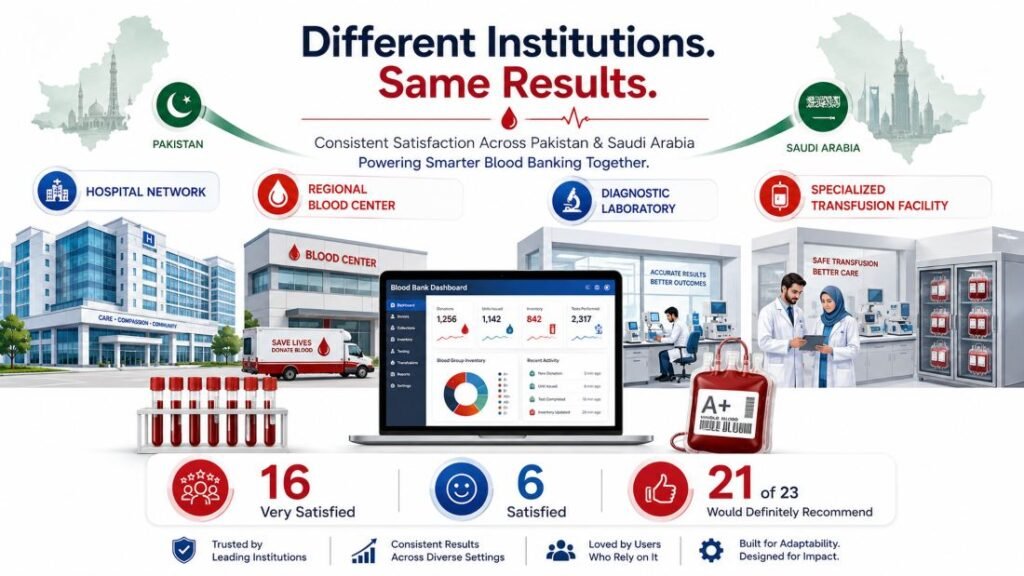
What gives the survey weight is the range of organizations behind it. Respondents spanned Pakistan and Saudi Arabia and included large hospital networks, regional blood centers, diagnostic laboratories, and specialized transfusion facilities. Their satisfaction was consistent:
- 16 respondents were “very satisfied,” 6 were “satisfied.”
- 21 of 23 said they would definitely recommend Panacea to other institutions.
Operational complexity varies enormously between a national hospital network and a standalone regional center. The fact that feedback stayed positive across such different environments suggests the system adapts to varied workflows rather than forcing one rigid model. For facilities with unusual requirements, Zaavia also offers custom healthcare software development to shape the platform around specific needs.
Built as a Complete Platform, Not a Patch
Panacea is not a single-workflow add-on. It functions as a full operational platform covering:
- Donor management and blood collection
- Component preparation, grouping, and testing
- Inventory management and blood issuance
- Transfusion workflows and barcode traceability
- Compliance documentation, reporting, and KPI monitoring
- Audit preparation and multi-user operational control
Standardized coding and labeling matter here too. Global traceability frameworks such as ISBT 128 exist precisely because units routinely move between facilities, and inconsistent identification breaks the chain. A single connected environment is what keeps that chain intact from the first donor record to the final transfusion note.
Final Thoughts
The most honest validation of any healthcare system is what the people running it every day report after the novelty wears off. Across 23 organizations, the Panacea survey points in one direction: better traceability, lighter manual workload, stronger compliance, clearer inventory, fewer errors, and faster workflows. Those gains match what decades of transfusion research have found about what actually makes blood banks safer and more efficient.
For a service where a single gap can affect a patient’s life, that alignment between real-world results and clinical evidence is the strongest argument Panacea can make.
Disclaimer: This article is intended for general informational purposes only and does not constitute medical, clinical, legal, or regulatory advice. Survey figures reflect self-reported responses from 23 organizations and describe those participants’ experiences rather than guaranteed outcomes for any specific facility. Blood banks and transfusion services should follow the requirements of their national regulators and relevant clinical guidelines. They should evaluate any software against their own operational and compliance needs before implementation.
References
- World Health Organization. Blood safety and availability. Geneva: WHO; 2024. Available from: https://www.who.int/news-room/fact-sheets/detail/blood-safety-and-availability
- Ashford P, Ekermo B, Ho SK, et al. International Society of Blood Transfusion Guidelines for Traceability of Medical Products of Human Origin. Vox Sang. 2023. doi:10.1111/vox.13473
- Chou SS, Chen YJ, Shen YT, Yen HF, Kuo SC. Implementation and Effectiveness of a Bar Code-Based Transfusion Management System for Transfusion Safety in a Tertiary Hospital: Retrospective Quality Improvement Study. JMIR Med Inform. 2019;7(3):e14192. doi:10.2196/14192
- Kaufman RM, Dinh A, Cohn CS, et al. Electronic patient identification for sample labeling reduces wrong blood in tube errors. Transfusion. 2019;59(3):972-980. doi:10.1111/trf.15102
- Stanger SHW, Yates N, Wilding R, Cotton S. Blood inventory management: hospital best practice. Transfus Med Rev. 2012;26(2):153-163. doi:10.1016/j.tmrv.2011.09.001
- do Carmo BBT, de Souza DFL, Queiroz PGG, de Souza AA, de Lira ILB. Blood Inventory Management System: Reducing Wastage and Shortage. In: Proceedings on 25th International Joint Conference on Industrial Engineering and Operations Management (IJCIEOM 2019). Cham: Springer; 2020. doi:10.1007/978-3-030-43616-2_3
- O’Neill K, et al. So Many Barcodes, So Little Time: A Quality Improvement Project to Improve Scanning of Blood Product Bags. Patient Saf. 2024;6(1). doi:10.33940/001c.122085