

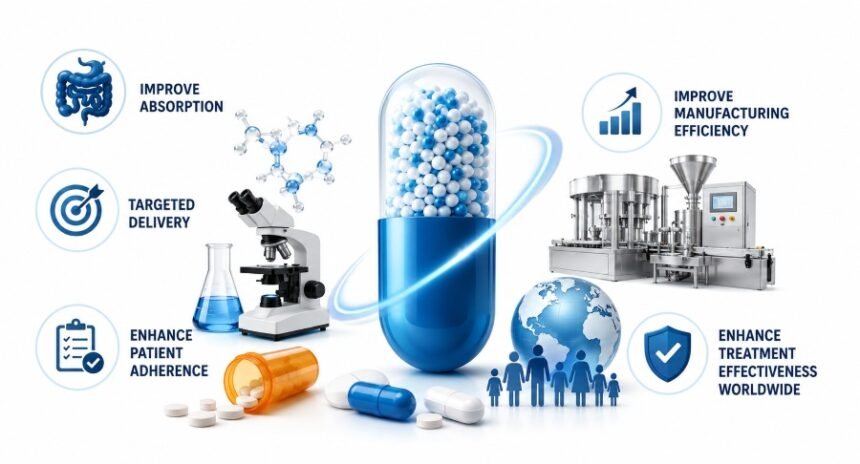
A drug can be brilliant on paper and useless in practice. If the body cannot absorb it, if it breaks down before it reaches the right tissue, or if a patient cannot manage the dose, the underlying chemistry hardly matters. This is the problem drug formulation exists to solve. It covers everything that turns an active ingredient into something a person can actually take: the tablet, the injection, the patch, the inhaler, and all the design choices that decide how and when the medicine does its job.
For years, this work sat in the background while attention went to new molecules and headline approvals. That is starting to change. Formulation has become one of the more active areas of pharmaceutical research, partly because so many promising compounds now fail for reasons that have nothing to do with whether they work, and everything to do with how they behave once they leave the lab. What follows is a look at where the field is moving and why it matters for anyone involved in developing, making, or supplying medicines.
Making Poorly Soluble Drugs Actually Work
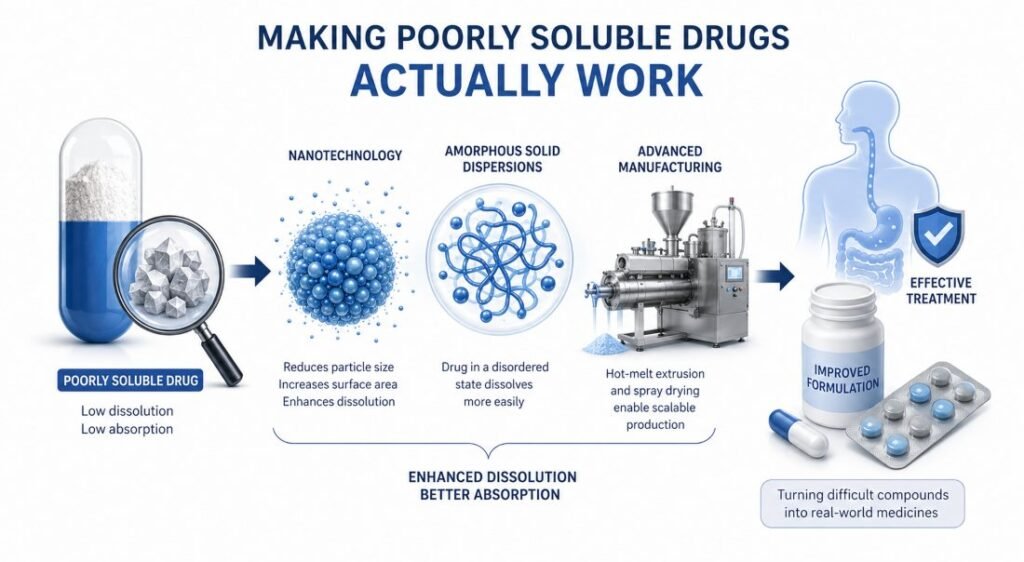
A large share of new drug candidates share the same awkward trait: they barely dissolve in water. That sounds like a minor technical detail, but poor solubility limits how much of a drug the body can absorb, which can sink an otherwise effective compound before it ever reaches patients.
Several techniques have grown up around this problem. Nanotechnology shrinks drug particles to a scale where they dissolve far more readily, increasing the surface area available for absorption. Amorphous solid dispersions take a different route, holding the drug in a disordered, non-crystalline state that dissolves more easily than its stable crystalline form. Methods such as hot-melt extrusion and spray drying have made these approaches practical at commercial scale.
None of this is theoretical tinkering. These techniques have opened the door to treatments that were previously written off as impractical purely because of absorption challenges, giving difficult compounds a genuine route to market.
Controlled and Sustained Release
Getting a drug into the body is only half the task. Releasing it at the right time and rate matters just as much, and controlled release technologies are built around exactly that.
Extended-release tablets and capsules let the active ingredient trickle out gradually rather than arriving in a single spike. That keeps blood levels steadier, reduces how often someone has to take a dose, and softens the sharp peaks that often cause side effects. For longer horizons, depot injections and implants can deliver medicine steadily over weeks or months, which suits chronic conditions where consistency is everything. Long-acting contraceptive implants and monthly injectables for conditions like schizophrenia are familiar examples.
The real payoff here is human rather than purely technical. Fewer doses and simpler routines make it easier for people to stay on their treatment, and adherence is one of the strongest predictors of whether a therapy actually helps.
Sending Medicine Straight to Where It’s Needed
Some of the most interesting formulation research is about precision: getting a drug to the tissue that needs it while sparing everywhere else.
Liposomes and other lipid-based carriers can wrap a drug in a protective shell and steer it towards specific tissues, limiting exposure to healthy cells along the way. This is heavily studied in oncology, where the difference between hitting a tumour and flooding the whole body can be the difference between a tolerable treatment and a brutal one. Pegylated liposomal doxorubicin, one of the first products of this kind, showed the idea could work in the clinic decades ago.
Antibody- and ligand-directed delivery pushes precision further by attaching drugs to molecules that recognise specific cell markers. The upside is lower doses and fewer unwanted effects elsewhere in the body. Taken together, targeted delivery marks a shift away from broad, one-size treatment towards something much closer to personalised therapy.
Working With Biologics and Other Fragile Molecules
Biologic drugs, including proteins and peptides, are powerful but delicate. They are sensitive to heat, light, and handling, and even small changes to their structure can strip away their effect. That makes them a genuine formulation challenge.
Much of the work goes into keeping them stable. New excipients and buffering systems protect these molecules through manufacturing, storage, and administration, and careful formulation is often what allows a biologic to survive the journey from factory to patient at all.
The other frontier is how they are given. Injections remain the norm, but researchers are testing alternatives such as inhalable and oral versions, since swallowing or breathing in a protein is far more convenient than injecting it. Inhalable insulin is one example that has already reached patients. These routes are technically demanding, but if they can be made reliable, they would put complex treatments within much easier reach.
Dosage Forms Built Around Real Patients
Formulation increasingly starts from a simple question: will people actually be able to use this? A medicine that works in the body but is a struggle to take is only half a success.
Orally disintegrating and chewable forms answer part of that. They dissolve quickly, often need no water, and are a relief for children, older adults, and anyone who finds swallowing tablets difficult. Combination products tackle a different friction point by folding several active ingredients into a single dose. Single-tablet regimens for HIV and combined cardiovascular pills have shown how much simpler treatment becomes when a handful of daily tablets collapse into one.
The thread running through all of it is usability. These are the innovations that connect laboratory progress to the messy reality of everyday life, which is where medicines either get taken or quietly abandoned.
Manufacturing Behind the Breakthroughs
New formulations are only as good as the processes that produce them, and manufacturing quality feeds directly into consistency, safety, and supply.
Continuous manufacturing is a notable shift. Instead of the traditional stop-start batch approach, materials flow steadily through the process from start to finish, which tightens quality control and can speed up scale-up. Regulators have taken it seriously enough to build guidance around it; the FDA now actively supports advanced manufacturing technologies as a way to improve quality and ease the drug shortages that so often dog batch production.
3D printing of medicines is younger but points somewhere striking: customised doses and complex internal structures that ordinary tablets cannot match. It stopped being hypothetical in 2015, when the FDA approved Spritam, a 3D-printed epilepsy tablet designed to dissolve almost instantly even at high doses.
These production methods are what let a laboratory result become a reliable, large-scale supply. It is also why events like the Pharmtech & Ingredients Exhibition matter to the industry, giving manufacturers, ingredient suppliers, and equipment makers a single place to see where production technology is heading and to build the partnerships that carry these advances forward.
Where Drug Formulation Is Heading Next
Formulation rarely gets the spotlight, but it sits close to the centre of whether a treatment works in the real world. From solubility fixes and controlled release to targeted delivery and patient-friendly forms, the common thread is not novelty for its own sake. It is better outcomes: more of the drug absorbed, fewer doses to manage, greater precision, and medicines that people can genuinely stick with.
As the underlying science and manufacturing keep advancing, formulation will stay one of the more consequential corners of modern medicine. For researchers, healthcare providers, manufacturers, and suppliers, keeping an eye on it is one of the clearest ways to understand where treatment is going, and how medicines can be designed to work more reliably in practice.
Frequently Asked Questions
What is drug formulation, and why does it matter?
- Drug formulation is the process of designing how a medicine is delivered, whether as a tablet, injection, patch, or inhaler. It matters because those choices shape how well the drug is absorbed, how stable it stays, how safe it is, and how easily patients can take it correctly. A strong active ingredient can still fail if it is poorly formulated.
How do solubility enhancement techniques improve medicines?
- Many drugs dissolve poorly, which limits how much the body can absorb. Approaches like nanotechnology and amorphous solid dispersions increase that absorbable fraction, which can lift a treatment’s performance and make otherwise difficult compounds practical to develop.
Why is targeted drug delivery seen as such an advance?
- Targeted delivery sends medicine to the affected cells or tissue rather than exposing the whole body to it. That improves precision, can reduce the dose needed, and helps limit side effects. The benefit is clearest in areas like cancer treatment, where sparing healthy tissue is a major concern.
Disclaimer
This article is for general educational and informational purposes only. It is not medical advice, pharmaceutical advice, regulatory guidance, or a substitute for professional consultation. Drug formulation, medicine design, manufacturing methods, and delivery technologies should always be assessed by qualified pharmaceutical scientists, clinicians, regulatory experts, and healthcare professionals. Patients should not change, stop, or start any medicine without speaking to a doctor, pharmacist, or licensed healthcare provider. Product examples mentioned in this article are used only to explain formulation concepts and should not be treated as endorsements.
References
- Gigliobianco, M. R., Casadidio, C., Censi, R., & Di Martino, P. (2018). Nanocrystals of poorly soluble drugs: Drug bioavailability and physicochemical stability. Pharmaceutics, 10(3), 134. doi: 10.3390/pharmaceutics10030134.
- Junyaprasert, V. B., & Morakul, B. (2015). Nanocrystals for enhancement of oral bioavailability of poorly water-soluble drugs. Asian Journal of Pharmaceutical Sciences, 10(1), 13-23. doi: 10.1016/j.ajps.2014.08.005.
- Schittny, A., Huwyler, J., & Puchkov, M. (2020). Mechanisms of increased bioavailability through amorphous solid dispersions: A review. Drug Delivery, 27(1), 110-127. doi: 10.1080/10717544.2019.1704940.
- Adepu, S., & Ramakrishna, S. (2021). Controlled drug delivery systems: Current status and future directions. Molecules, 26(19), 5905. doi: 10.3390/molecules26195905.
- Gabizon, A., Shmeeda, H., & Barenholz, Y. (2003). Pharmacokinetics of pegylated liposomal doxorubicin: Review of animal and human studies. Clinical Pharmacokinetics, 42(5), 419-436. doi: 10.2165/00003088-200342050-00002.
- Stegemann, S., Ternik, R. L., Onder, G., Khan, M. A., & van Riet-Nales, D. A. (2016). Defining patient-centric pharmaceutical drug product design. The AAPS Journal, 18(5), 1047-1055. doi: 10.1208/s12248-016-9938-6.
- Menditto, E., Orlando, V., De Rosa, G., Minghetti, P., Musazzi, U. M., Cahir, C., Kurczewska-Michalak, M., Kardas, P., Costa, E., Lobo, J. M. S., & Sousa Lobo, J. M. (2020). Patient-centric pharmaceutical drug product design: The impact on medication adherence. Pharmaceutics, 12(1), 44. doi: 10.3390/pharmaceutics12010044.
- Drumond, N. (2020). Future perspectives for patient-centric pharmaceutical drug product design with regard to solid oral dosage forms. Journal of Pharmaceutical Innovation, 15, 318-324. doi: 10.1007/s12247-019-09407-2.
- Adepu, S., & Ramakrishna, S. (2021). Controlled drug delivery systems: Current status and future directions. Molecules, 26(19), 5905. doi: 10.3390/molecules26195905.
- Saleh-Bey-Kinj, Z., and colleagues. (2025). 3D printing in oral drug delivery: Technologies, clinical applications, and future perspectives. This review discusses oral drug delivery, 3D-printed medicines, and Spritam as the first FDA-approved 3D-printed drug product.