

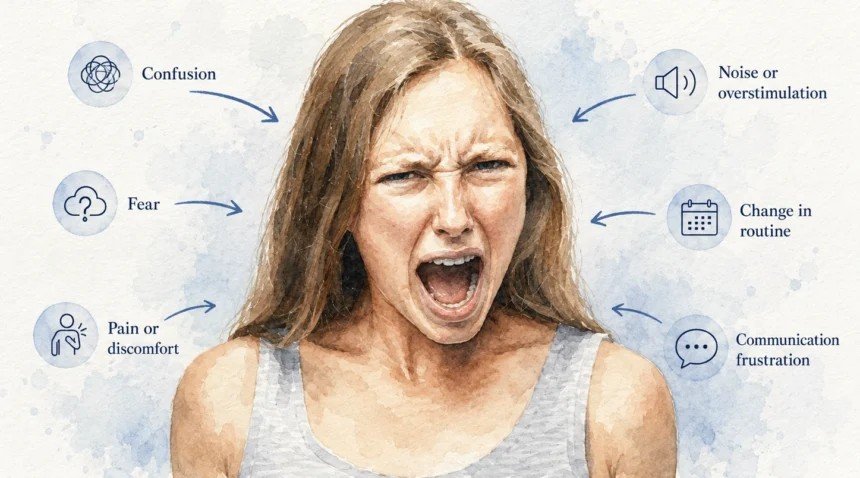
There is a particular kind of heartbreak in being shouted at, accused of stealing, or even struck by someone you love and have cared for faithfully for years. If you have lived through that moment with a parent or spouse who has dementia, you already know it lands somewhere words struggle to reach. You are not imagining how hard it is, and you are far from alone in facing it.
Anger and aggression are among the most common behavioral symptoms in dementia. Estimates vary, but research consistently finds that a large share of people with Alzheimer’s disease experience agitation at some point, with some reviews reporting figures reaching into the majority of patients over the course of the illness. It is common enough that if you are caring for someone with dementia, you should expect to encounter it rather than be surprised by it.
The reassuring part is that anger in dementia is rarely random. It almost always has a cause, and once you learn where to look, most episodes become far more predictable and far more preventable.
Why the Brain Produces Anger in the First Place

To respond well to the outbursts, it helps to understand what is happening underneath them.
Dementia progressively damages the frontal and temporal lobes, the parts of the brain that handle impulse control, emotional regulation, judgment, and empathy. As that damage spreads, the person gradually loses the ability to hold a reaction in check before it escapes. A flash of irritation that a healthy brain would quietly manage instead comes straight out. The filter is simply no longer there.
At the same time, the person is living inside an experience you cannot see from the outside: confusion, fear, and the slow, frightening sense of losing control over their own mind. The Alzheimer’s Association describes this bluntly, noting that the person is biologically experiencing a profound loss of their ability to process new information and stimulation. Seen that way, the anger reads differently. It is usually not malice. It is distress that has no other way out.
That reframing matters more than any single technique in this article. The anger is the disease speaking, not the person you love.
Most Common Triggers, and What Actually Helps
1. Unmet Physical Needs
This is the most overlooked trigger and often the easiest to fix. Someone with dementia frequently cannot say that they are in pain, hungry, thirsty, too cold, or need the bathroom. The discomfort still exists; it just comes out sideways as agitation or aggression.
Urinary tract infections deserve a paragraph of their own. In older adults, a UTI often skips the usual burning and frequency and instead shows up as sudden confusion, agitation, or a sharp change in behavior, a state doctors call delirium. The key signal is speed: dementia declines slowly, so an abrupt behavioral change points toward something acute like an infection rather than the disease itself.
What helps: Before reacting to an outburst, run a quick mental checklist. Pain? Hunger? Thirst? Too hot or cold? Bathroom? Meeting the underlying need often settles the behavior faster than anything else. And any sudden escalation warrants a prompt medical check for infection.
2. Being Corrected or Contradicted
When a loved one insists on something untrue, that their long-dead spouse is coming for dinner, that today is a day it isn’t, the natural instinct is to gently set them straight. It almost always backfires.
Correction forces the person to confront a reality their brain can no longer hold onto, and the result is usually more distress, not acceptance. This is why dementia specialists and the National Institute on Aging both emphasize the same thing: listen calmly and avoid arguing.
What helps: Meet the emotion instead of the fact. “You’re missing Dad, tell me about him” reaches the person far better than a correction they will only forget and grieve again.
3. Overstimulation and Sensory Overload
A crowded room, a blaring television, several conversations at once, harsh lighting: a healthy brain filters this automatically. A brain with dementia cannot, and the flood of input tips quickly into anxiety, then anger. This is part of why noisy family gatherings can go sideways so fast.
What helps: Lower the stimulation. Cut background noise, keep the number of people in the room small, and soften the lighting as evening approaches. That last point matters especially for sundowning, which the next sections touch on.
4. Loss of Control and Dignity
Bathing, dressing, grooming, and toileting are among the most reliable flashpoints. Put yourself in their position: being undressed and cleaned by another person, sometimes without understanding why or who they are, can feel like a genuine violation.
This one has a distinct pattern across the disease. It tends to peak in the middle stage, when the person has declined enough to need hands-on help but is still aware enough to feel frightened and humiliated by it. If you want to see how these behaviors map onto the broader arc of the illness, the 7 stages of Alzheimer’s disease offer a useful framework for anticipating what is coming rather than being blindsided by it.
What helps: Narrate each step before you do it, and hand back as much control as you can. Which shirt? Which arm first? Small choices restore dignity, and dignity lowers resistance.
5. Fear and Misrecognition
As dementia erodes the ability to recognize faces and places, the person may look at their own child and see a stranger, or wake in the dark with no idea where they are. The brain’s threat system fires, and fear frequently arrives dressed as anger.
What helps: Approach slowly and from the front, never from behind. Reintroduce yourself by name and relationship every time, without irritation. If they wake frightened, anchor them gently with something familiar, a known song, a favorite object, a phrase they have heard a thousand times.
6. Your Own Emotional State
This trigger gets little attention and deserves much more. People with dementia stay remarkably attuned to the emotions of those around them, long after their cognitive abilities have faded. A caregiver who is tense, rushed, or frustrated broadcasts that state without a word, and the person absorbs and mirrors it. Guidance for families repeatedly stresses that a caregiver’s own calm, patient manner is one of the most effective tools available, which is why the advice to try not to show frustration and speak calmly appears in nearly every clinical resource.
What helps: Before you walk into the room or start a care task, take a moment to settle yourself. Slow your breathing, soften your face. This is not about faking feelings you don’t have. It is about recognizing that your steadiness is contagious in the best way.
7. Changes in Routine and Environment
A predictable routine is scaffolding for a brain that can no longer improvise. A new caregiver, a rearranged room, an unfamiliar holiday crowd, even a shifted mealtime can destabilize someone with dementia enough to provoke anger. The Alzheimer’s Association lists exactly these kinds of disruptions, changes in environment, caregiver arrangements, and travel, among the common causes of agitation.
What helps: Guard the routine wherever you can. When change is unavoidable, introduce it gradually and with gentle preparation, and bring familiar objects along when the setting itself has to change, such as a hospital stay.
8. Medication Side Effects
Several commonly prescribed drugs can increase agitation in older adults, including certain sleep aids, some antidepressants, anticholinergic medications, and even a few blood pressure drugs. Because of how the aging body processes medication, effects can be unpredictable.
What helps: If anger climbs for no clear reason, put a medication review on the calendar with the prescribing physician before assuming the disease has simply progressed.
9. Fatigue and Sundowning
Tiredness lowers everyone’s emotional threshold, and dementia amplifies the effect. This ties directly into sundowning, the well-documented pattern of rising confusion and agitation in the late afternoon and evening. The Mayo Clinic notes that sundowning can be worsened by being tired, hungry or thirsty, or having an infection like a UTI, which is why a busy, overstimulating day so often ends in an early-evening storm.
What helps: Build genuine rest into the day, and front-load the demanding activities, bathing, appointments, visits, into the morning when cognitive reserves are highest. Keeping the home well lit as daylight fades and holding to a steady schedule also help blunt the late-day spike.
10. Feeling Rushed or Pressured
Dementia slows the brain’s processing speed dramatically. When someone is hurried to dress, eat, answer, or move, the pressure itself registers as a threat, and anger is a common answer to a threat. Notably, guidance from the National Institute on Aging identifies being pushed to do something that dementia has made very hard as a direct trigger for aggression.
What helps: Budget far more time than seems necessary for every task, and slow your own pace to meet theirs. Silence is not awkward in dementia care. Often it is exactly the room the brain needs to catch up.
How Anger Shifts Across the Stages
Anger does not stay constant as dementia progresses, and knowing its trajectory helps you prepare.
In the early stages, it is less frequent, and when it appears it often stems from the person’s own awareness of their decline, frustration at forgetting, dread of what lies ahead. In the middle stages, anger and aggression peak. That is no accident: significant cognitive loss, still-intact emotional awareness, shrinking independence, and an inability to communicate needs combine into a perfect storm. In the later stages, overt anger tends to ease as the person becomes less mobile and less responsive, though agitation can still surface in response to pain or care.
It is worth naming that the middle stage, when the behaviors are hardest, is also when caregiver burnout most often peaks. That overlap is not a coincidence, and it is not a personal failing on your part. Managing frequent anger while continuing to give tender care is genuinely one of the most demanding things a family member is ever asked to do. Bringing in support at this stage, whether through a senior care agency with caregivers trained in these situations or through respite and family help, is a strategic choice, not an admission of defeat.
When to Involve a Professional
If anger escalates into physical aggression that puts the person or anyone caring for them at risk of harm, it is time for professional input. Start with the prescribing physician, who can review medications, rule out an acute cause like infection, and discuss whether behavioral strategies or carefully monitored medication is warranted. Clinical guidance is consistent that non-drug approaches should generally come first, with medication reserved for situations where those strategies have not been enough.
Bottom Line
Once you know where to look, the triggers of anger in dementia stop being mysterious. Unmet physical needs, overstimulation, loss of control, fear, a rushed pace, fatigue, and even your own stress account for the large majority of episodes, and nearly all of them can be softened with the right knowledge and a patient approach.
Hold onto the central truth through the hard moments: the anger is not personal, and it is not a verdict on how your loved one feels about you. It is the voice of a frightened brain doing the best it can with what the disease has left it. Internalizing that does not just help the person in front of you. It protects you, too.
Asking for help when you need it is not weakness. It may be the bravest and wisest thing a caregiver does.
Frequently Asked Questions
What triggers anger in dementia patients most commonly?
Unmet physical needs such as pain, hunger, or a UTI top the list, followed by overstimulation, being corrected, loss of control during personal care, and fear from not recognizing familiar faces or surroundings.
Is anger normal in dementia and Alzheimer’s disease?
Yes. Agitation and aggression affect a large proportion of people with dementia at some point and are reported most often in the middle stages of the disease.
How should caregivers respond when a person with dementia gets angry?
Stay calm, avoid arguing or correcting, check for physical discomfort or an unmet need, and gently redirect toward a calmer activity or a quieter environment.
When should anger in a person with dementia be reported to a doctor?
Promptly, if the anger turns physically aggressive, appears suddenly after a stretch of calm, or comes with new confusion. A sudden change often points to a treatable cause like a UTI or a medication side effect.
Can dementia-related anger be reduced without medication?
Often, yes. Consistent routines, calm communication, a low-stimulation environment, and attention to unmet needs resolve most episodes without medication, which specialists generally recommend trying first.
Disclaimer: This article is for general informational and educational purposes only and is not a substitute for professional medical advice. Every person with dementia is different. Always consult a qualified physician or dementia care professional about the specific needs of your loved one, and seek prompt medical attention for any sudden change in behavior.