

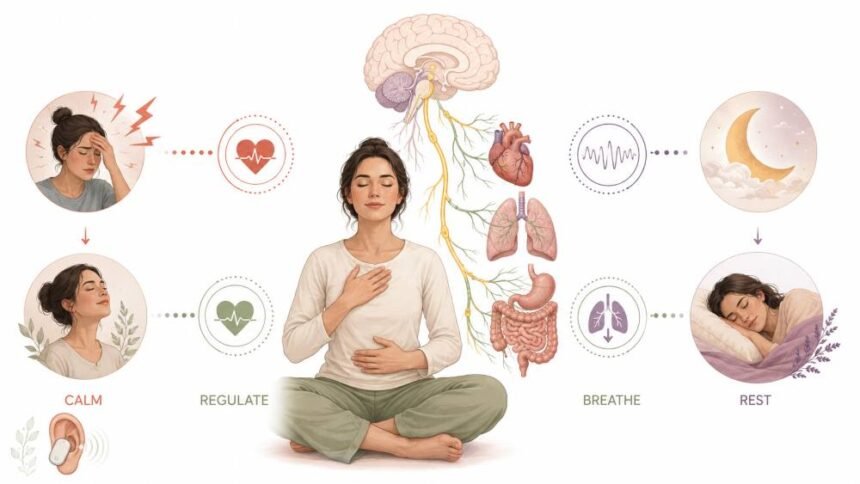
Anxiety and broken sleep tend to get treated as two separate problems. Often they are two faces of the same one: a nervous system stuck in a high-gear stress state that cannot easily settle back down. The vagus nerve is the body’s main pathway for making that shift, which is why it has become such a popular target for people trying to calm their minds and sleep better.
It helps to be clear-eyed from the start. The underlying biology is real and genuinely interesting. The tools range from free breathing techniques to electrical devices you wear at home. And the clinical evidence, while promising, is still early in a lot of areas. Vagus nerve therapy refers to any method, from paced breathing to gentle electrical stimulation, that aims to activate this nerve and nudge the nervous system out of stress mode and toward recovery. Here is what it actually does, what the research supports, and where the honest limits are.
What The Vagus Nerve Actually Does
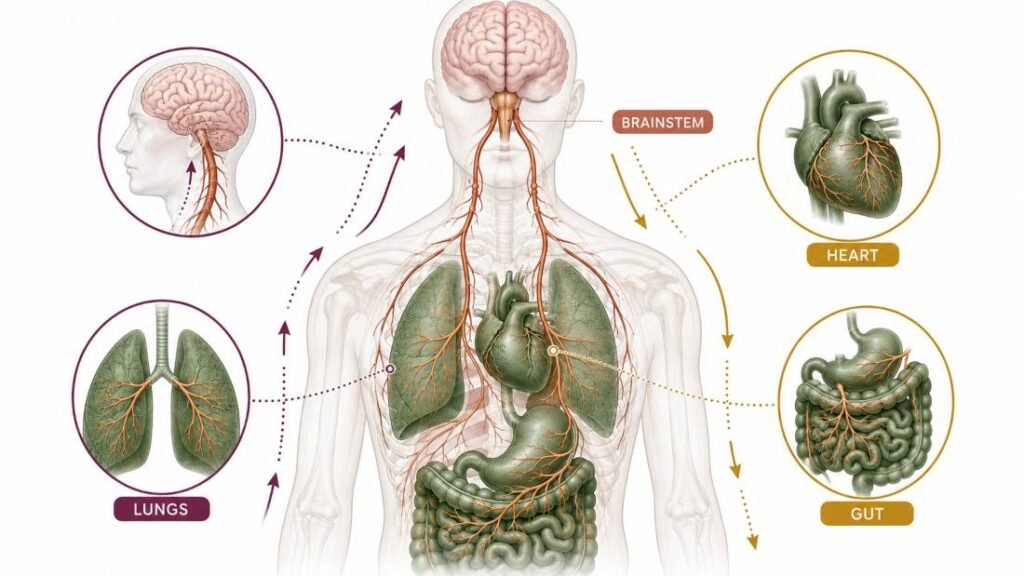
The vagus nerve is the tenth cranial nerve, running from the brainstem down through the neck and chest into the gut. It is the main highway of the parasympathetic nervous system, the rest-and-recover side of your autonomic wiring.
One detail reshapes how you think about it. Roughly 80% of vagus nerve fibers are afferent, meaning they carry signals toward the brain rather than away from it. The nerve is not simply issuing calm-down orders to your organs. It is feeding the brain a steady report on the body’s internal state, including heart rate, gut activity, and inflammatory signals, and the brain tunes its emotional and behavioral responses to match. This constant body-to-brain traffic runs through a brainstem hub called the nucleus tractus solitarius, which relays the information onward to regions involved in mood and stress. Change the incoming signal, and the brain can read a calmer state and respond accordingly. That loop is why a single nerve can touch heart rate, digestion, inflammation, and emotional recovery all at once.
Vagal Tone And Why It Matters For Stress
Vagal tone is the baseline activity level of the vagus nerve, essentially how quickly the parasympathetic brake engages when a stressor hits. The usual way to estimate it is heart rate variability, the small beat-to-beat differences in your heart rhythm. Higher variability generally reflects a flexible, adaptable nervous system. Lower variability tends to reflect one that stays in low-level arousal even when nothing is wrong.
This shows up in how people read the world. Neuroscience research has found that people with lower heart rate variability are more likely to interpret ambiguous situations as threatening. In comparison, those with higher variability read the same cues more neutrally. It is worth holding that finding loosely, since it comes from correlational work and heart rate variability is shaped by sleep, fitness, age, and much else. Still, it points to something intuitive: when your nervous system is calmer at baseline, the world tends to feel less threatening before you have consciously thought about it.
How Vagus Nerve Stimulation May Support Emotional Regulation
The proposed mechanism is specific rather than vague relaxation. Stimulation is thought to reach the nucleus tractus solitarius first, which then signals the amygdala, hypothalamus, insula, and prefrontal cortex, the structures behind threat detection, emotional memory, and self-control. In effect, stimulation may insert a competing signal into that chain, one suggesting the emergency has passed even while the stressor is still present.
There is early human evidence behind this idea. Clinical research involving PTSD patients tested transcutaneous cervical stimulation, applied through a handheld device at the neck, against a sham device in a double-blind trial. Active stimulation blunted the body’s sympathetic response to acute stress more than sham did, lowering heart rate and easing vascular constriction during stressful recall. That is a real, measurable shift rather than a placebo effect. The caveats matter, though. The trial was small, with 25 patients, and it measured short-term autonomic signals during brief stimulation sessions rather than changes in PTSD symptoms or how stressed people actually felt. The authors were careful to say the results should not be read as proof of reduced perceived stress. So it is an encouraging signal about physiology, not evidence that the device treats the condition.
How It May Help With Sleep
Falling asleep is not a switch. The body has to hand over from sympathetic activation to parasympathetic dominance, and for people with low vagal tone that handover is sluggish. Heart rate stays up, breathing stays shallow, and the nervous system keeps treating bedtime as another window for threat monitoring. Tiredness piles up while actual rest does not arrive.
This is the transition that stimulation is meant to ease, by increasing parasympathetic output, slowing the heart, and opening the physiological window the brain needs for deep sleep. The brainstem structures usually named here are the locus coeruleus and the raphe nucleus, which help govern sleep-stage transitions and the neurotransmitters that make deep sleep possible. Vagal pathways feed into these serotonin and noradrenaline systems, which is part of why researchers think stimulation could influence both mood and sleep. Treat that as a working mechanism rather than a settled fact.
The most direct clinical test so far is worth walking through carefully. A randomized controlled trial from JAMA Network Open enrolled 72 adults with chronic insomnia and compared active auricular stimulation, applied at the ear, against a sham version, twice daily over eight weeks. The active group improved more than the sham group on the Pittsburgh Sleep Quality Index, by about 4.2 points, comfortably above the 2.5-point threshold the researchers had set for a clinically meaningful change, and the gains were largely maintained at the 20-week follow-up. Anxiety and fatigue scores improved alongside sleep. Encouraging, but not the final word: it was a single-center trial, relatively small, and it departed from its registered plan by dropping a pre-registered brain-imaging component, which prompted some reviewers to question it. One good trial points a direction. It does not close the case.
Tools, From Free To Device
Vagus nerve therapy is not one thing, and the options differ a lot in cost, evidence, and effort. It is reasonable to start with the cheapest, best-supported approaches before buying hardware.
| Approach | Mainly Aimed At | What You Need |
|---|---|---|
| Slow diaphragmatic breathing | General vagal tone and calming | Nothing |
| Humming, chanting, or extended exhales | Laryngeal vagal activation | Nothing |
| Auricular stimulation (taVNS) | Sleep quality and relaxation | Ear-clip or headphone device |
| Cervical stimulation (tcVNS) | Stress and mood | Handheld neck device |
Start with breath, because it is free and the evidence is decent. Breathing slowly, at roughly six breaths a minute, reliably raises heart rate variability and shifts autonomic balance toward the parasympathetic side. A systematic review of slow-breathing research links these techniques to greater heart rate variability along with reduced anxiety and lower ratings of anger and confusion. Humming and long, slow exhales work along similar lines and cost nothing to try.
Devices are the next step up. At-home vagus nerve therapy devices deliver low-current electrical pulses through the ear or the neck, and some newer ones build the stimulators into headphones so a session slots into a relaxation routine. Two things are important to understand before you buy. First, these consumer devices are sold as general wellness products. The FDA does not clear them to diagnose or treat anxiety, insomnia, or any medical condition. The one non-invasive vagus nerve device with FDA clearance, gammaCore, is cleared specifically for migraine and cluster headache, not for stress or sleep. Second, while the broader field of non-invasive stimulation is advancing quickly, independent evidence for any single consumer device is still thin, and some of the studies you will see cited are small and run by the manufacturers themselves. None of that makes the devices useless. It means treating them as an experiment worth trying, not a proven cure.
What The Evidence Does And Doesn’t Show
It helps to separate what is solid from what is hopeful. Non-invasive stimulation does reliably produce short-term shifts toward parasympathetic activity in controlled settings, and there are promising early trials in insomnia, anxiety, depression, and stress reactivity. That is genuinely encouraging.
The limits are just as real. A systematic review of transcutaneous stimulation for trauma and stress-related conditions concluded that the parasympathetic effects appear short-lasting and that the impact of repeated use on long-term function is still unknown. A separate critical review of the field has flagged real challenges in turning these effects into reliable clinical treatments. Most trials are small, short, and varied in how they stimulate, which makes firm conclusions hard. The fair summary is that vagus nerve therapy is a reasonable thing to try, especially the low-risk versions. Still, it is not a proven standalone treatment and not a replacement for evidence-based care.
Safety And When To See A Professional
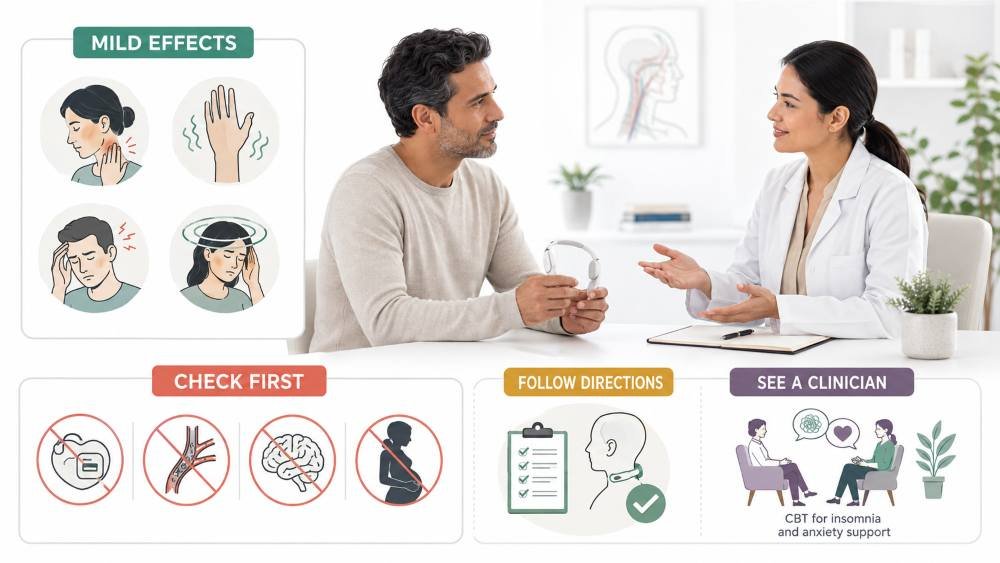
For non-invasive transcutaneous methods, the safety record in published research is reassuring. A systematic review of taVNS safety found that side effects are generally mild and temporary, most commonly minor skin irritation, tingling at the contact site, or occasional headache or dizziness.
Some people should check with a doctor before using any electrical stimulation device: anyone with a cardiac pacemaker or other implanted electronic device, carotid artery disease, an active neurological condition, or who is pregnant. When in doubt, ask first.
It is also worth being honest with yourself about what you are dealing with. Persistent anxiety and chronic insomnia are common and treatable, and they deserve more than a gadget. Cognitive behavioral therapy for insomnia is the first-line treatment for ongoing sleep problems, and effective, well-studied options exist for anxiety too. Breathing practices and stimulation devices can sit alongside that kind of care as supports. Still, if your sleep or your anxiety is meaningfully affecting daily life, the most useful step is talking to a qualified clinician who can look at the whole picture.
Frequently Asked Questions
| Question | Answer |
|---|---|
| Does Vagus Nerve Therapy Actually Work For Anxiety? | Early research suggests vagus nerve stimulation may support relaxation and reduce anxiety symptoms, but evidence is still limited. It is better described as promising rather than proven, and consumer devices are not generally cleared specifically to treat anxiety. |
| How Long Before I Notice Anything? | Breathing techniques may affect how you feel within a single session. Studies of stimulation devices have generally used daily or twice-daily sessions over several weeks, so consistency is more important than one-time use. |
| Is It Safe To Use A Vagus Nerve Device At Home? | Non-invasive devices appear generally well tolerated when used as directed, with mostly mild, temporary side effects. People with implanted devices, carotid artery disease, neurological conditions, or pregnancy should consult a healthcare professional first. |
| Can Breathing Exercises Do The Same Thing As A Device? | They are not identical, but slow breathing is an accessible, low-cost approach that can support relaxation and heart-rate variability. Some people may benefit from breathing exercises without needing a device. |
| What Is The Difference Between taVNS And tcVNS? | taVNS stimulates areas around the outer ear associated with the auricular branch of the vagus nerve, while tcVNS targets the cervical region of the neck. Both are non-invasive approaches but are studied for somewhat different applications. |
A Note On Medical Guidance
This article is for general education and is not medical advice. Vagus nerve stimulation devices sold for wellness are not a substitute for professional care, and they are not cleared to treat anxiety, insomnia, or any medical condition. If you have persistent anxiety or ongoing sleep problems, or any underlying health condition, speak with a qualified healthcare professional before starting a new device or stopping any existing treatment.
References
- Transcutaneous auricular vagus nerve stimulation for chronic insomnia disorder: a randomized clinical trial. JAMA Network Open, 2024.
- Transcutaneous cervical vagal nerve stimulation reduces sympathetic responses to stress in posttraumatic stress disorder: a double-blind, randomized, sham-controlled trial—Neurobiology of Stress, 2020.
- How breath-control can change your life: a systematic review on psycho-physiological correlates of slow breathing. Frontiers in Human Neuroscience, 2018.
- Transcutaneous vagal nerve stimulation for the treatment of trauma- and stressor-related disorders: systematic review of randomized controlled studies. BJPsych Open, 2025.
- Safety of transcutaneous auricular vagus nerve stimulation (taVNS): a systematic review and meta-analysis. Scientific Reports, 2022.
- Critical review of transcutaneous vagus nerve stimulation: challenges for translation to clinical practice—Frontiers in Neuroscience, 2020.