
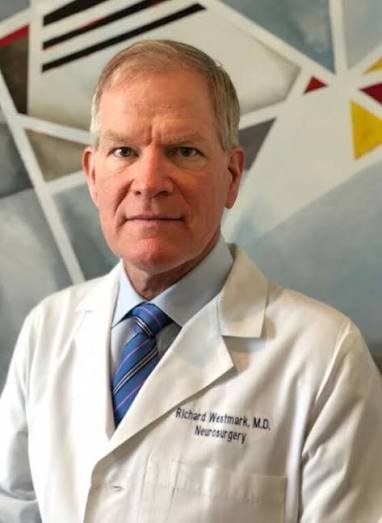
Dr. Richard M. Westmark, MD Neurosurgeon and Spine Surgery Care
Dr. Richard Meredith Westmark, MD, FAANS, is a board-certified neurosurgeon with a professional focus on neurosurgical spine care. Current HCA Houston Healthcare information identifies his specialty as Neurological Surgery, while Doximity lists his practice area more specifically as Neurosurgical Spine Surgery. His training includes neurosurgery residency at Massachusetts General Hospital and advanced spine fellowship training at Barrow Neurological Institute.
His clinical background is particularly relevant for patients referred because of persistent neck or back pain, spinal nerve compression, degenerative spine disease, spinal stenosis, herniated discs, or another structural problem that may require a neurosurgical opinion. Current provider data also associates his practice with spinal fusion, decompression, and other cervical and lumbar spine procedures, although the exact procedure appropriate for an individual patient depends on examination findings, imaging, previous treatment, and neurological function.
A neurosurgical consultation does not automatically mean surgery will be recommended. The American Association of Neurological Surgeons notes that many common causes of low back pain are initially managed with nonsurgical treatment, while surgery becomes more relevant when symptoms persist, significant nerve compression is present, or neurological function is threatened.
Patients researching similar concerns can also read the Doctiplus guide to degenerative disc disease and back pain and the discussion of when to review surgery options with a spine doctor.
About Dr. Richard M. Westmark
Dr. Westmark’s full professional name is Richard Meredith Westmark, MD. His National Provider Identifier is 1063450948, and current CMS Open Payments information classifies him in Neurological Surgery. HCA Houston Healthcare likewise identifies Neurological Surgery as his specialty.
Doximity identifies his subspecialty practice area as Neurosurgical Spine Surgery and lists him as a Fellow of the American Association of Neurological Surgeons. Its certification information shows board certification through the American Board of Neurological Surgery.
His professional history is especially centered on spine surgery. After completing neurosurgical training at Massachusetts General Hospital, he pursued dedicated neurosurgical spine fellowship training at Barrow Neurological Institute. Massachusetts General Hospital’s own neurosurgery alumni directory also identifies Dr. Westmark as an alumnus practicing with Houston Spine & Neurosurgery Center.
Medical Education and Neurosurgical Training
Dr. Westmark graduated from the University of Florida College of Medicine in 1988. He then completed a neurological surgery internship at the University of Michigan from 1988 through 1989.
His neurosurgery residency followed at Massachusetts General Hospital, where Doximity lists training from 1989 through 1993. He then completed advanced fellowship training in Neurosurgical Spine Surgery at Barrow Neurological Institute at St. Joseph’s Hospital and Medical Center in 1994.
| Training Area | Institution | Details |
|---|---|---|
| Medical education | University of Florida College of Medicine | MD, 1988 |
| Internship | University of Michigan | Neurological Surgery, 1988–1989 |
| Residency | Massachusetts General Hospital | Neurological Surgery, 1989–1993 |
| Fellowship | Barrow Neurological Institute | Neurosurgical Spine Surgery, 1994 |
| Board certification | American Board of Neurological Surgery | Neurological Surgery |
| Professional designation | American Association of Neurological Surgeons | Fellow, FAANS |
Massachusetts General Hospital continues to list Dr. Westmark in its neurosurgery residency alumni history, while Barrow’s academic archive includes him as an author on research involving cervical spinal fusion.
Board Certification and FAANS Credential
Doximity’s current ABMS-sourced certification section lists Dr. Westmark as certified in Neurological Surgery by the American Board of Neurological Surgery. His profile also identifies him as a Fellow of the American Association of Neurological Surgeons, reflected by the FAANS designation.
Board certification helps establish that a physician has completed specialty training and certification requirements, but it does not determine whether surgery is the correct treatment for an individual patient.
For spine problems, the important question is whether symptoms, neurological findings, and imaging all point toward a structural condition that surgery can reasonably address.
Neurosurgical Spine Care
Dr. Westmark’s professional profile specifically identifies Neurosurgical Spine Surgery as his practice area, making spinal disorders a central part of his clinical background.
Neurosurgical spine care includes evaluation of the spinal cord, nerve roots, discs, vertebrae, and other structures affecting the nervous system. The same MRI finding can have very different significance in two patients, which is why imaging should be interpreted alongside symptoms and a neurological examination.
A scan may show age-related changes without causing meaningful symptoms. Conversely, a smaller abnormality in a critical location may produce substantial nerve irritation or spinal cord compression.
A surgical decision should therefore be based on the complete clinical picture rather than the MRI report alone.
Herniated Disc and Nerve Compression
Herniated discs are among the common structural problems evaluated by spine specialists. The AANS explains that a herniated disc may cause little or no discomfort when it does not compress a nerve, but nerve compression can produce pain, numbness, or weakness along the pathway supplied by that nerve.
Dr. Westmark’s current secondary procedure profile includes herniated disc surgery, laminectomy, laminotomy, and foraminotomy among procedures associated with his practice. These directory-listed procedures provide evidence of spine surgical activity but should not be interpreted as meaning every patient with a herniated disc needs an operation.
Many herniated discs improve without surgery. A neurosurgical opinion becomes more useful when symptoms continue despite appropriate conservative treatment, weakness or other neurological changes develop, or imaging shows compression that corresponds closely with the patient’s symptoms.
Lumbar Spinal Stenosis
Lumbar spinal stenosis occurs when the spinal canal becomes narrowed enough to affect nerves traveling through the lower back. Patients may experience leg discomfort, numbness, weakness, or symptoms that become more noticeable with prolonged standing or walking.
Age-related changes involving discs, joints, bone, and ligaments can all contribute to narrowing. Importantly, stenosis on an MRI does not automatically establish the need for surgery.
A neurosurgeon may compare the imaging with walking tolerance, strength, sensation, reflexes, previous treatment, and how much the symptoms interfere with daily activity.
When symptoms remain manageable and neurological function is stable, nonsurgical treatment may continue. Surgery becomes more relevant when significant nerve compression produces persistent symptoms that have not responded adequately to other approaches.
Cervical Spine and Neck Problems
The cervical spine contains the vertebrae and nerves of the neck. Degenerative changes, disc herniation, and spinal stenosis can sometimes compress nerve roots or the spinal cord.
When a cervical nerve root becomes compressed or irritated, symptoms may extend beyond the neck into an arm or hand. AAOS notes that cervical radiculopathy commonly causes pain, numbness, tingling, or weakness and often improves with conservative treatment without requiring surgery.
Surgery becomes a different discussion when there is persistent nerve compression or spinal cord involvement.
Current procedure information associated with Dr. Westmark includes cervical laminectomy and cervical spinal fusion, reflecting the cervical spine component of his neurosurgical practice.
Cervical Myelopathy and Spinal Cord Compression
Spinal cord compression in the neck can be more significant than ordinary neck pain because it may affect neurological function below the level of compression.
AAOS notes that cervical spinal cord compression can occur when degenerative changes or herniated discs reduce space around the cord. Progressive weakness, changes in walking, numbness, or loss of coordination can make surgical assessment more relevant.
The purpose of surgery in selected cases is not simply to make an abnormal MRI look better. It is generally to relieve harmful compression and protect or improve neurological function when the expected benefits justify the operation.
Patients should ask whether their symptoms suggest nerve-root compression, spinal-cord compression, or another cause because those situations can lead to different treatment decisions.
Spinal Fusion
Current procedure listings associated with Dr. Westmark include cervical spinal fusion as well as anterior and lateral lumbar spinal fusion procedures.
Fusion surgery joins selected vertebrae to create greater stability across a spinal segment.
It may be discussed when instability, deformity, disc degeneration, nerve compression, or another structural condition requires both decompression and stabilization. However, fusion is not necessary for every painful or degenerative spine problem.
A patient considering fusion should understand exactly what level of the spine is involved, why stabilization is necessary, what alternatives exist, and whether the goal is mainly nerve decompression, mechanical stability, alignment, or a combination of these.
The Doctiplus article on reviewing spine surgery options with a doctor provides additional context on how symptoms, imaging, and previous treatment influence this discussion.
Decompression Procedures
Decompression surgery is intended to create more room for a nerve or the spinal cord when bone, disc material, ligaments, or another structure is producing clinically important compression.
Dr. Westmark’s current secondary procedure profile includes laminectomy, laminotomy, and foraminotomy, all of which are procedures used in selected decompression situations.
AANS explains that minimally invasive decompression techniques may sometimes be used for spinal stenosis, including procedures such as laminectomy and foraminotomy. Whether a minimally invasive or traditional approach is more appropriate depends on the location and complexity of the problem.
The label “minimally invasive” should not be treated as proof that an operation is automatically better or easier. The more useful question is which approach allows adequate treatment of the specific structural problem while limiting unnecessary disruption.
Degenerative Disc Disease
Degenerative disc changes become increasingly common with age and may occur even in people without significant pain.
AANS and AAOS both describe age-related disc degeneration as a common contributor to spinal stenosis, disc collapse, and nerve compression, but symptoms and imaging findings do not always match perfectly.
This is why a neurosurgical evaluation should focus on whether a particular level seen on imaging actually explains the patient’s pain, weakness, numbness, or functional limitation.
Readers can review Doctiplus’s detailed explanation of degenerative disc disease, causes, and treatment choices for more background.
Sciatica and Lumbar Nerve Symptoms
Sciatica describes symptoms traveling along a lumbar nerve pathway, commonly from the lower back or buttock into the leg.
AANS notes that lumbar disc herniation is a common cause and that nerve compression can lead to radiating pain, tingling, numbness, or weakness.
A patient experiencing leg symptoms therefore may need more than an assessment of how much the lower back itself hurts.
The physician may compare where the symptoms travel with muscle strength, reflexes, sensation, and MRI findings to determine which nerve root may be involved.
If these pieces do not line up, an abnormal scan may not explain the complaint as clearly as it first appears.
When Surgery Is Not the First Step
One of the most important facts about spine surgery is that many people referred to a spine specialist do not immediately need an operation.
AANS lists physical therapy, exercise, medication, rehabilitation, activity modification, and selected injections among nonsurgical approaches commonly considered for lower back pain. It notes that conservative therapy is generally attempted before surgery when urgent neurological problems are not present.
AAOS similarly notes that most cases of cervical radiculopathy respond to conservative treatment and do not require surgery.
The purpose of seeing a neurosurgeon can therefore be to answer a narrower and more useful question: is there a surgically correctable problem that explains the symptoms?
If the answer is no, continued nonsurgical treatment may be the more appropriate recommendation.
When a Neurosurgical Opinion Becomes More Important
A spine consultation becomes particularly useful when symptoms continue despite reasonable nonsurgical treatment, neurological deficits appear, imaging shows significant nerve or spinal cord compression, or another physician believes structural instability may require surgery.
Certain neurological changes may require faster assessment. AANS advises prompt medical evaluation when back problems are accompanied by neurological symptoms such as weakness or changes involving bladder or bowel function.
These symptoms should not be used by patients to diagnose themselves. Their importance is that they can change how quickly professional medical evaluation is needed.
Spine Navigation and Surgical Technology
Dr. Westmark has also been involved with newer spine-navigation technology.
In November 2025, Becker’s Spine Review reported that he performed the first outpatient spine procedure at an ambulatory surgery center using the PathKeeper optical navigation system. The system is designed to provide real-time 3D guidance during spinal procedures.
This provides current evidence that Dr. Westmark remains professionally involved in spine surgery and surgical-navigation technology.
Technology itself, however, should not determine whether a patient undergoes surgery. Navigation is a tool used during selected procedures. The underlying diagnosis and need for the operation remain the more important questions.
Research and Professional Contributions
Dr. Westmark’s professional history includes published neurosurgical research.
Barrow Neurological Institute’s scholarly archive lists him as a co-author of research involving cervical fusion and recombinant human bone morphogenetic protein. PubMed also lists him as a co-author of a published case involving an intracranial angioleiomyoma.
Doximity additionally lists publications involving neurosurgeon-hospital relationships and radiological case literature.
These publications provide background on his participation in professional and academic work but should not be interpreted as proof that every technique discussed in older research remains part of his present clinical practice.
Patient Education and Back Pain Writing
Dr. Westmark has also written for patients about spine problems.
His 2021 book, My Back Hurts: A Guide to Understanding What’s Wrong and Choosing the Best Treatment, was written as a patient-oriented explanation of back pain, warning symptoms, diagnostic questions, and treatment choices. The book’s professional biography describes his Massachusetts General Hospital neurosurgical training and subsequent advanced spine training at Barrow Neurological Institute.
This patient-education work provides another indication that spinal disorders have remained a substantial part of his professional focus.
What a Neurosurgical Spine Consultation May Involve
A spine consultation usually begins with the patient’s symptoms rather than the scan.
The physician may want to understand when the problem began, whether pain remains in the back or neck or travels into an arm or leg, whether numbness or weakness is present, how walking or balance has changed, and what treatments have already been attempted.
Imaging may then be reviewed in relation to those symptoms.
MRI is particularly useful for examining discs, nerves, the spinal cord, and other soft tissues, while X-rays or CT may provide additional information about bone, alignment, or structural stability depending on the clinical question.
The key is correlation. A radiological abnormality is most useful when its location and severity make sense in relation to the neurological symptoms and examination.
Preparing for an Appointment With Dr. Westmark
Patients can make a spine consultation more productive by bringing the information that shows how the problem developed.
Useful records may include recent MRI or CT reports, access to the actual imaging studies, previous X-rays, reports from physical therapy or pain management, records of earlier spine surgery, current medications, medication allergies, and a short history of treatments that have already been attempted.
Someone who has previously undergone spine surgery should bring the operative report when available because the exact procedure and spinal levels treated can affect future planning.
It can also help to describe functional changes rather than only giving a pain score. A patient might explain that walking tolerance has become shorter, one hand has become less coordinated, or leg symptoms appear after standing for a particular amount of time.
These details can help the surgeon connect symptoms with neurological function.
Questions Worth Asking Before Spine Surgery
Patients considering an operation should understand what specific problem surgery is intended to correct.
Useful questions include whether the imaging finding clearly explains the symptoms, whether further nonsurgical treatment remains reasonable, whether decompression alone is enough, whether fusion is necessary, and what could happen if surgery is postponed.
Patients can also ask which spinal levels would be treated, what the surgeon expects surgery to improve, which symptoms may remain, what recovery will involve, and whether another surgical approach could accomplish the same goal.
A useful surgical discussion should address alternatives as well as the proposed procedure.
Second Opinions for Spine Surgery
A second opinion can be reasonable before major elective spine surgery, particularly when fusion is proposed, more than one spinal level is involved, previous surgery has already been performed, or different specialists have suggested different approaches.
Patients can also compare Dr. Westmark’s background with another neurosurgeon profile on Doctiplus to understand how neurosurgical training and areas of practice can differ.
A second opinion does not necessarily mean the first surgeon’s recommendation is questionable. Two specialists reaching the same conclusion independently can help clarify that the structural problem and proposed treatment are reasonably matched.
Current Practice and Appointment Information
Current HCA Houston Healthcare information lists Dr. Westmark in Neurological Surgery and provides 281-333-1300 as his professional contact number.
Current Doximity and Providence provider information place his office at 18333 Egret Bay Boulevard, Suite 200, with the same 281-333-1300 telephone number. Providence’s current provider directory identifies him in Neurological Surgery and lists him as accepting new patients at that location.
WebMD currently identifies the location as Houston Spine and Neurosurgery Center and lists Dr. Richard Meredith Westmark among its neurological surgeons.
Current Healthgrades information also associates him with HCA Houston Healthcare Clear Lake and lists him as accepting new patients. Because hospital privileges, insurance participation, telehealth availability, and scheduling arrangements can change, patients should confirm these details directly with the office before arranging care.
Understanding Dr. Westmark’s Clinical Profile
The clearest verified professional picture of Dr. Richard Meredith Westmark is that of a board-certified neurosurgeon with dedicated advanced training in spine surgery. He graduated from the University of Florida College of Medicine in 1988, completed neurological surgery training through the University of Michigan and Massachusetts General Hospital, and then completed a Neurosurgical Spine Surgery fellowship at Barrow Neurological Institute.
His current professional profile continues to identify neurosurgical spine surgery as a principal practice area. Secondary current procedure data associates his work with cervical and lumbar decompression, herniated disc surgery, and spinal fusion, while his 2025 professional activity demonstrates ongoing involvement with modern spine-navigation technology.
For patients, the most important part of this background is not simply access to spine surgery. Good neurosurgical decision-making requires deciding whether an abnormality seen on imaging actually explains the symptoms, whether nonsurgical treatment remains reasonable, and whether an operation offers a meaningful neurological or functional benefit.
That distinction is particularly important because common spinal conditions such as disc degeneration, herniated discs, and stenosis can range from incidental imaging findings to significant nerve or spinal cord compression. The role of a spine neurosurgeon is to determine where an individual patient falls within that range before an operation is considered.



Reviews
There are no reviews yet.