

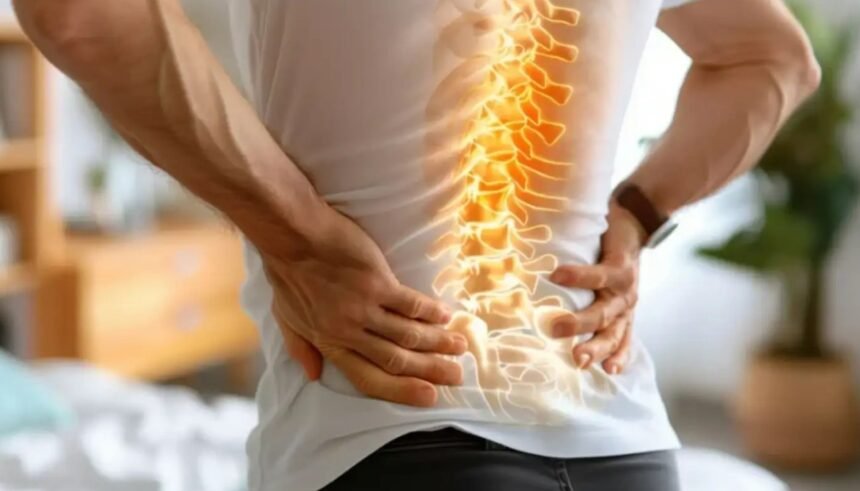
Back pain has a way of creeping into every part of your life. It changes how you sit, sleep, work, and even how you plan your day. For a lot of people, that pain traces back to a condition called degenerative disc disease – and the frustrating part is that most don’t even know they have it until it becomes hard to ignore.
If you’ve been dealing with persistent discomfort and haven’t found real answers yet, this guide breaks down what degenerative disc disease actually is, what causes it, and most importantly, what treatment for back pain NJ looks like when it’s done right.
What Is Degenerative Disc Disease?

Degenerative disc disease refers to the gradual wear and tear on spinal discs over a long period of time. The spinal discs lie between each vertebra and help absorb pressure while keeping the spine flexible and supported.
As one grows older, spinal discs can start to dry out and lose elasticity. This leads to disc thinning, tears, or migration out of place, which decreases a person’s capacity for pressure absorption and nerve irritation. It commonly relates to back pain, a stiff back, and decreased movement, and pain may be referred into the legs or arms depending on the spine segment involved.
Common Causes of Degenerative Disc Disease
Disc degeneration is very rarely caused by just one thing. It’s normally due to a mixture of the following factors:
- Age and “wear and tear”: in the vast majority of cases, the patient will be over 40 and a scan of their discs will reveal some degree of degeneration, even if they aren’t complaining of pain.
- Repeated stress: jobs that involve repeated lifting, sitting for a long period, or years of poor posture can contribute.
- Injury or trauma: an accident on the road, the floor, or during sports can rapidly cause severe damage to the disc.
- Existing spinal problems: disc herniation, arthritis, scoliosis, spinal stenosis, and spondylolisthesis, to mention a few, of these will damage or contribute to DDD.
- Inherited Predisposition: In some cases, people are just predisposed to wear and tear, however well they look after their backs.
Symptoms Worth Paying Attention To
People with disc disease do not all have the same experience with degenerative disc disease. Some people with disc disease have a dull ache in their back that will not go away. Other people with disc disease have really bad pain that comes on suddenly, and they cannot move for days because of degenerative disc disease. You should watch out for these things with disc disease:
- Pain in your lower back or neck that does not go away even when you rest, because of degenerative disc disease
- You feel stiff in the morning and cannot move around very well because of degenerative disc disease.
- Pain that goes down your legs. This is often a sign that a nerve is being squeezed, and it is called sciatica with disc disease.
- Your muscles spasm or feel weak in your stomach or legs with degenerative disc disease
- You feel numb or tingly, and it goes into your arms or feet because of disc disease.
A lot of people with degenerative disc disease say that their pain from degenerative disc disease is worse when they sit for a long time then it feels a little better when they get up and move around with their degenerative disc disease. But then the pain from degenerative disc disease comes back when they stop moving with their degenerative disc disease.
Why Early Diagnosis Matters
Many people ignore early signs of back pain, hoping it will resolve on its own. However, identifying the root cause early is essential for effective back pain treatment.
At specialized clinics, diagnosis typically involves:
- Physical examination
- Imaging tests such as X-rays and CT scans
- Evaluation of nerve function and mobility
These steps help pinpoint the exact cause of discomfort and guide a personalized treatment plan.
Treatment for Back Pain NJ Caused by Degenerative Disc Disease at MVM Health
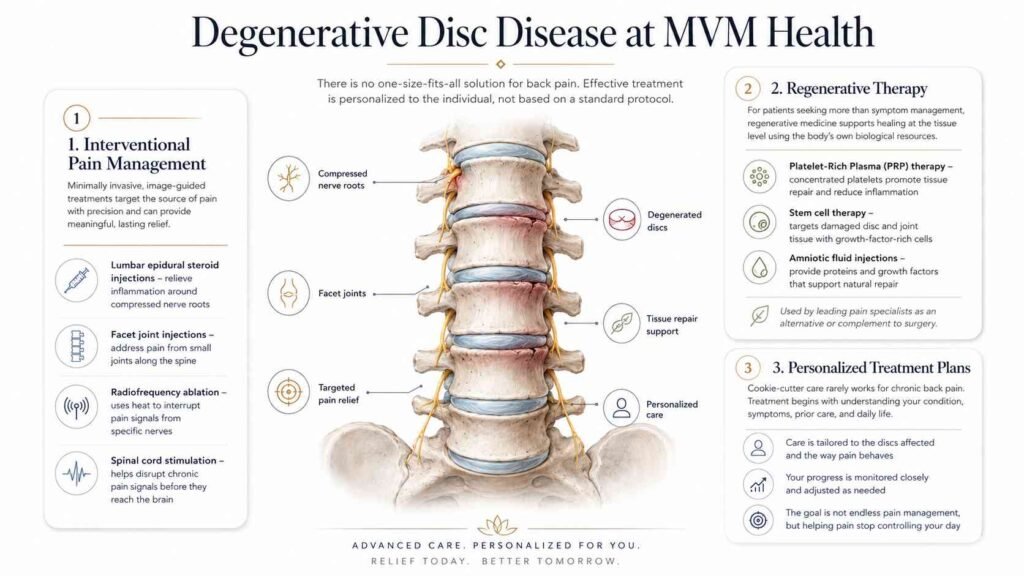
There is no “one size fits all” solution for the treatment of back pain. An effective course of treatment is formulated around you as an individual, not around a standard protocol applied to everyone who walks through the door.
1. Interventional pain management
We’ve come a long way in pain management since simple anti-inflammatories were prescribed. Interventional pain management delivers minimally invasive treatments targeting the source of your pain with pinpoint precision, techniques involving precisely administered, image-guided treatments without surgery that yield tangible and enduring pain relief.
MVM Health offers the following:
- Lumbar Epidural steroid injections: relieve inflammation around compressed nerve roots
- Facet Joint injections: address pain originating in small joints along the spine
- Radiofrequency ablation: uses heat to interrupt pain signals transmitted from particular nerves
- Spinal cord stimulation: a long-term approach that disrupts chronic pain signals before they reach the brain.
2. Regenerative Therapy
For patients who want treatment that goes beyond symptom management, regenerative medicine offers something different: the chance to actually support healing at the tissue level.
These therapies use your body’s own biological material to repair damaged structures:
- Platelet-Rich Plasma (PRP) therapy: concentrated platelets from your own blood, injected to promote tissue repair and reduce inflammation
- Stem cell therapy: targets damaged disc and joint tissue with growth-factor-rich cells
- Amniotic fluid injections: contain proteins and growth factors that support the body’s natural repair process.
These aren’t experimental fringe treatments. Leading pain specialists increasingly use them as a meaningful alternative or complement to surgical intervention.
3. Personalized Treatment Plans
Cookie-cutter care rarely works for chronic back pain. What helps one patient may do nothing for another, because no two spines or two lives are the same.
At MVM Health, the process starts with understanding your specific condition: which discs are affected, how the pain behaves, what you’ve already tried, and what your daily life actually looks like. From there, your care team combines the most appropriate treatments and monitors your progress closely, adjusting as needed.
The goal isn’t to manage your pain indefinitely. It’s to get you to a place where your pain no longer runs your day.
Living With Chronic Back Pain – Practical Steps That Help
Treatment does the heavy lifting, but what you do in between appointments matters too. A few habits that genuinely make a difference:
- Watch your posture, especially at a desk. A small adjustment to your screen height or chair can take real pressure off your lumbar spine over time.
- Don’t stay still for too long, but don’t overdo it either. Short, regular movement breaks beat both prolonged sitting and sudden heavy exertion.
- Stay consistent with your care plan: missing sessions or stopping treatment early when pain temporarily eases is one of the most common reasons people plateau.
- Communicate changes to your specialist: if something’s worse, or better, your team needs to know so they can adjust your plan accordingly.
When to See Back Pain Specialists NJ
If your pain persists for weeks or affects your daily routine, it’s important to consult back pain specialists in NJ.
You should seek professional help if:
- Pain becomes chronic or worsens over time.
- Mobility is limited
- Pain radiates to other parts of the body.
- Previous treatments have not worked.
Early treatment can help prevent complications and support better long-term results.
Conclusion
Degenerative disc disease is one of the most common reasons people end up in chronic pain – but it’s also one of the most treatable, especially when addressed properly. The key is moving past temporary fixes and finding care that actually targets what’s happening in your spine.
From precision interventional procedures to cutting-edge regenerative therapies, MVM Health’s approach to treatment for back pain in NJ is built around one goal: getting you back to living fully, with less pain and more confidence in your body.
Don’t let back pain call the shots. Schedule your consultation today with MVM Health and take the first step toward real, lasting relief.
Frequently Asked Questions
Q: What’s the best treatment for back pain from DDD?
- A: Honestly, it depends on how far things have progressed and what your daily life looks like. For most people, targeted procedures like nerve blocks, epidural injections, or radiofrequency ablation make a significant difference without any surgery. PRP therapy is also showing strong results for the right patients. There’s rarely one answer – a proper evaluation tells you what actually makes sense for your spine.
Q: Do I actually need surgery, or can this be managed another way?
- A: Most people with DDD never end up in an operating room – and that’s not just reassuring talk. Interventional procedures and regenerative treatments have genuinely replaced surgery as the preferred path for a large number of patients. The key is getting a proper assessment first, so you’re not guessing.
Q: How do specialists figure out what’s going on?
- A: It goes beyond just pressing on your back and asking where it hurts. You’ll typically get imaging – X-rays, MRI, or a CT scan – so the specialist can actually see which discs are affected and how. They’ll also test your nerve function and reflexes, because sometimes what shows up on a scan doesn’t tell the whole story on its own.
Q: Is this just something I have to learn to live with?
- A: That’s probably the most common thing new patients say when they walk in, and it’s almost never true. Chronic back pain feels permanent because it’s been there so long, not because it actually is. Most patients see real improvement with the right treatment plan. “Learning to live with it” shouldn’t be the answer you settle for.