

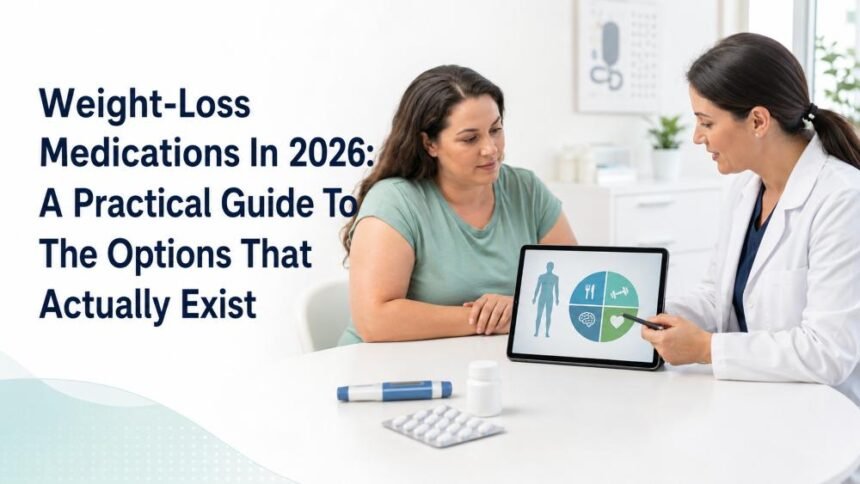
Not long ago, the difficult part of a weight-loss consultation was explaining what a GLP-1 even was. That conversation is mostly finished. The harder question now is which one because, for the first time, someone walking into an obesity clinic is choosing among several approved medications rather than hoping to qualify for the only game in town. It is a better problem to have. It is also a genuinely confusing one, and most people arrive unprepared for it.
The field is moving fast enough that a guide written a year ago is already describing a smaller menu than the one on the table today. So here is where things actually stand, what is coming, and how to think about the choice without getting swept up in whatever headline landed this week.
What Is Approved And Available Right Now

Before anything else, a point that trips up half the people reading about this: the four FDA-approved weight-loss brands run on only three underlying drugs. Two of them are the same molecule in different packaging. Keep that in mind, and the landscape gets a lot less bewildering.
- Tirzepatide, sold as Zepbound, is still the most powerful approved option, delivering roughly 22.5% average weight loss at its top dose in trial data. It works on two hormone pathways at once, and that dual mechanism is a big part of why it outperforms the single-pathway drugs.
- Semaglutide, sold as Wegovy, comes in two forms now. The original weekly injection produces closer to 15%. The pill version approved in late December 2025 is the more interesting development, because oral GLP-1s have historically been the weak cousins of the injectables. This one is not: the OASIS 4 trial behind its approval showed 16.6% average weight loss among patients who stayed on treatment, essentially matching the shot despite being a once-daily tablet. (Worth clearing up here: Ozempic and Mounjaro, the brands people mention constantly, are these same two molecules, semaglutide and tirzepatide, just labeled for type 2 diabetes rather than weight management.)
- Orforglipron, sold as Foundayo, is the newest arrival. It represents a real category shift rather than just another entry. The FDA cleared it on April 1, 2026, as the first small-molecule, non-peptide oral GLP-1, meaning, unlike the Wegovy pill, it does not depend on finicky absorption chemistry. It can be swallowed any time of day with food, coffee, or other medications. Its efficacy is lower: the ATTAIN-1 trial put the top dose in the neighborhood of 12%. But because it is a simple small molecule rather than a peptide, it may eventually be far cheaper and easier to mass-produce than any injectable, a fact that matters more than its efficacy number suggests, for reasons we will get to.
Pipeline Behind Them Is Genuinely Crowded
The current menu is not the finished menu, and understanding what is coming helps explain why waiting is such a tempting trap.
- CagriSema pairs semaglutide with an amylin analogue, a second satiety hormone, in one weekly injection. Novo Nordisk filed its application in December 2025, with a regulatory decision expected in the closing stretch of 2026, and its placebo-controlled data landed above 22%. The complication: a head-to-head trial against tirzepatide early this year failed to prove the combination was even non-inferior to Zepbound, roughly 20% versus 24% under the stricter analysis. Strong drug, but the early hype that it would dethrone tirzepatide has cooled.
- Retatrutide is the one researchers keep talking about, because it hits three receptors instead of one or two, and the numbers are unlike anything approved. Its pivotal obesity trial landed around 28% average weight loss at 80 weeks, with a two-year extension pushing past 30% territory that starts to approach bariatric surgery. It is also nowhere near your pharmacy. Because retatrutide is a biologic, Eli Lilly does not plan to file until early 2027, which realistically means approval no sooner than late 2027 and actual availability sliding into 2028. Impressive data on a distant horizon is still a distant horizon.
How To Choose Among What You Can Actually Get
Strip out everything that is not yet available, and the real decision is among Zepbound, Wegovy in either format, and Foundayo. Nothing further down the pipeline is a practical near-term choice, however good the trial slides look.
For many clinicians, tirzepatide’s higher efficacy makes Zepbound the default when a patient’s insurance allows it. Semaglutide, especially the new pill, tends to appeal to people who want the simplest possible routine, or who have tangled with tirzepatide’s side effects specifically and want to try a different molecule. Foundayo sits in an odd but useful middle: less weight loss than the others, but as a small molecule it may prove easier to manufacture at scale, which could translate into steadier supply and, eventually, lower prices. That last part is still speculative, but it is exactly why some doctors are already reaching for it in patients who do not need maximum firepower and would rather have something dependable and affordable.
In other words, “most effective” and “best for this person” are not the same question, and the second one is the one that actually matters at the appointment.
Why Speed Is The Wrong Thing To Optimize For
Rapid weight loss is what most people are really chasing when they start one of these drugs, and with numbers like retatrutide’s floating around, it is easy to treat the whole thing as a race toward the fastest possible result. That framing quietly undermines the outcome you are actually after.
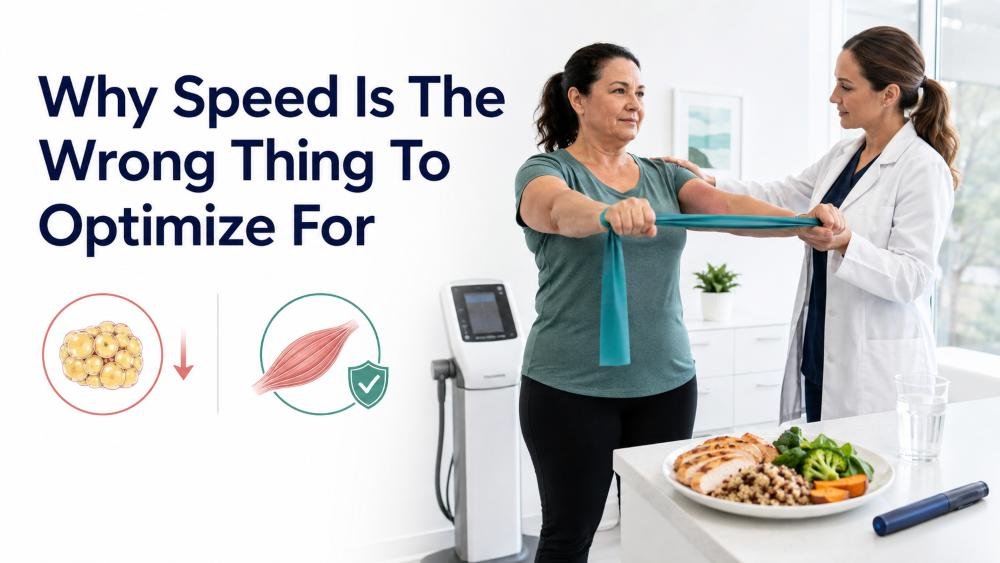
Here is the uncomfortable part the scale does not show you. When weight comes off quickly without enough protein and some resistance work, a disproportionate share of it comes from muscle rather than fat; the STEP and SURMOUNT trials both suggested something like 30 to 40% of total weight lost was lean mass. Lose muscle, and you erode your resting metabolism and long-term metabolic health even as the number on the scale looks triumphant. This is why the clinicians managing these drugs increasingly emphasize that the medication is the easy half. Adequate protein, generally above 1.2 grams per kilogram of body weight, paired with structured resistance training, is what determines how much of your loss is fat you wanted gone versus muscle you needed to keep.
The tolerability trade-off of the strongest drugs points the same direction. Retatrutide’s trial data carried meaningfully higher rates of gastrointestinal side effects than tirzepatide, a reminder that the biggest efficacy number is not automatically the right fit, and that what you do alongside the drug matters more than how fast it works.
Insurance Has Not Caught Up To The Science
Every drug named here, approved or pending, runs into the same wall: coverage. A medication existing on the market and a patient actually getting it paid for remain two very different things, and that gap is not closing at the pace the pipeline is expanding.
The specifics as of 2026 are sobering. On the Medicaid side, only 13 states covered GLP-1s for obesity as of January 2026, and even then usually behind prior-authorization hurdles. Medicare is statutorily barred from covering drugs used purely for weight loss. However, a temporary pilot called the Medicare GLP-1 Bridge now offers eligible Part D enrollees Wegovy, Zepbound, and Foundayo for a $50 monthly copay a workaround, not a permanent fix, and one with real gaps around low-income beneficiaries. Cost bites even for the insured: roughly half of GLP-1 users report the drugs are hard to afford. And newer, premium-priced entrants like CagriSema are expected to launch expensive, which could throttle real-world access no matter how the trials read.
Where This Actually Leaves You
The number of approved options has ballooned in a remarkably short window, and that abundance breeds a specific kind of paralysis: the sense that something better is always a year or two out, so why not wait. The honest answer is that the drugs sitting on the shelf right now are already producing results that would have looked like science fiction five years ago. For most people, starting with what is approved, accessible, and covered beats waiting on a pipeline that keeps extending its own timeline every time fresh data rolls in.
The medication is a tool, not the whole plan. Pick the one you can actually get and stay on, build the protein and strength work around it, and let the pipeline arrive whenever it arrives.
A Closing Note
If you take one thing from all of this, let it be that the choice is no longer about finding a drug; it is about matching the right drug to your body, your routine, your side-effect tolerance, and your coverage, and then doing the unglamorous work that protects your muscle while you lose fat. That is a conversation to have with a clinician who knows your history, not a decision to make from a comparison chart or a headline. The best medication is the one you can afford, tolerate, and stick with, and the habits you keep around it will shape the outcome more than the brand name ever will.
Disclaimer
This article is for general educational and informational purposes only and does not constitute medical advice, diagnosis, or treatment. It is not a substitute for the guidance of a qualified healthcare professional. Weight-loss medications carry risks, contraindications, and side effects, and are not appropriate for everyone; approval status, labeling, pricing, and insurance coverage change frequently and may have shifted since publication. Do not start, stop, or change any medication based on this content. Always consult your physician or another licensed healthcare provider about your individual circumstances before making decisions about obesity treatment.
References
- U.S. Food and Drug Administration. “FDA Approves First New Molecular Entity Under National Priority Voucher Program.” FDA Press Announcements, April 1, 2026. https://www.fda.gov/news-events/press-announcements/fda-approves-first-new-molecular-entity-under-national-priority-voucher-program
- American College of Cardiology. “ATTAIN-1: Oral Orforglipron Significantly Reduces Weight, Cardiometabolic Risk.” ACC.org — Latest in Cardiology (Journal Scan), September 24, 2025. Summarizing Wharton S et al., published in The New England Journal of Medicine, September 16, 2025. https://www.acc.org/Latest-in-Cardiology/Journal-Scans/2025/09/24/16/48/ATTAIN-1
- Applied Clinical Trials. “FDA Approves Oral Wegovy Following Positive Phase III OASIS 4 Trial Results.” Applied Clinical Trials Online, 2026. https://www.appliedclinicaltrialsonline.com/view/fda-approves-oral-wegovy-positive-oasis-trial-results
- The American Journal of Managed Care. Retatrutide Achieves Up to 30.3% Average Weight Loss in Phase 3 TRIUMPH-1 Trial.” AJMC.com, May 2026. https://www.ajmc.com/view/retatrutide-achieves-up-to-30-3-average-weight-loss-in-phase-3-triumph-1-trial
- HCPLive. “CagriSema Demonstrates Weight Loss, Fails to Achieve Primary Endpoint Compared to Tirzepatide.” HCPLive.com, February 2026. https://www.hcplive.com/view/cagrisema-demonstrates-weight-loss-fails-to-achieve-primary-endpoint-compared-to-tirzepatide
- “Optimizing GLP-1 Therapies for Obesity and Diabetes Management.” Peer-reviewed review hosted on the National Institutes of Health / National Library of Medicine PubMed Central (PMC12661421).