

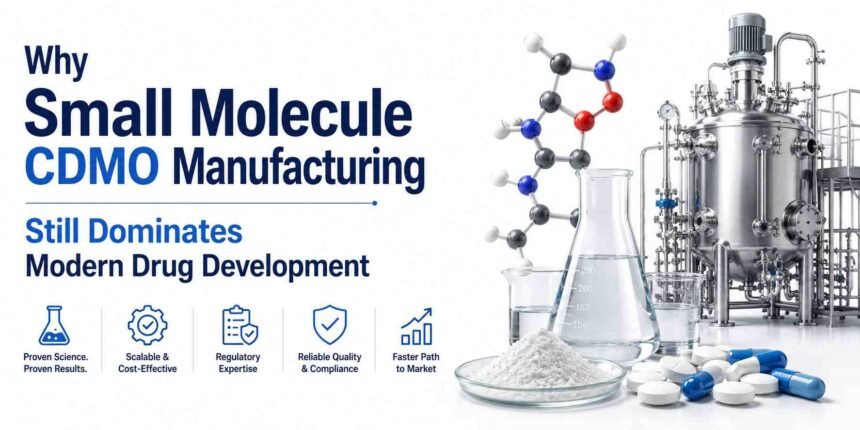
Biologics get the headlines. Peptides are surging. Gene therapies promise to rewrite medicine. But when it comes to actual drug approvals and patient prescriptions, small molecules still lead.
That might surprise some observers. The reality is that small molecule CDMO partnerships power the majority of new drug programs reaching patients today. And that trend isn’t slowing down.
Small Molecules Still Make Up Most Approved Drugs
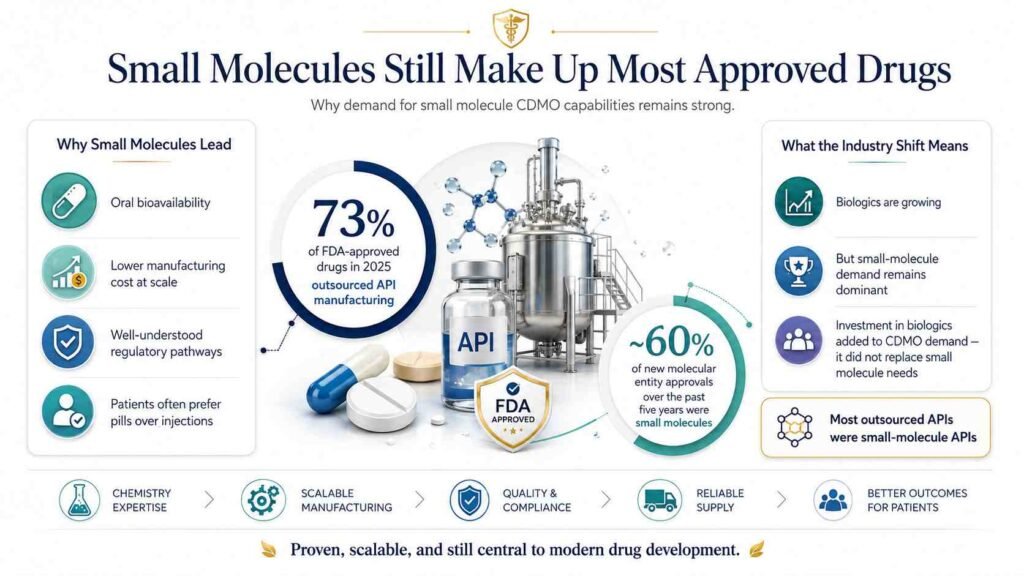
The numbers tell a clear story. In 2025, 73% of FDA-approved drugs outsourced their API manufacturing. The majority of those were small-molecule APIs. Despite the growth of biologics, small molecules accounted for roughly 60% of all new molecular entity approvals over the past five years.
Why? Because small molecules work. They offer oral bioavailability. They’re cheaper to manufacture at scale. They have well-understood regulatory pathways. And patients prefer taking a pill over an injection.
The pharmaceutical industry invested heavily in biologics over the past decade. But that investment hasn’t replaced the demand for small molecule CDMO capabilities. It has added to it.
Why Small Molecule Manufacturing Has Gotten Harder
The molecules being approved today are not the same as those from 20 years ago. Modern small molecules are more complex. They have multiple chiral centers, require hazardous chemistry steps, and demand tighter impurity control.
Consider what many of these programs involve:
- Cryogenic reactions at temperatures below -40 degrees Celsius
- High-pressure hydrogenation requires a specialized reactor design
- Fluorination chemistry using highly toxic reagents
- Multi-step synthesis with 10 to 20 reaction stages and compounding yield loss
This complexity is exactly why the small molecule CDMO model has grown. Most pharma and biotech companies can’t maintain the equipment, expertise, and regulatory infrastructure needed for these chemistries in-house.
Economics Driving Outsourcing
Building a GMP manufacturing facility costs $200 million or more. Maintaining specialized reactor systems, containment infrastructure, and qualified analytical labs adds ongoing expense. For a company with two or three pipeline molecules, that capital is better spent on clinical trials.
The global API CDMO market reached $107 billion in 2024. Small molecule APIs account for the largest share. This reflects a structural shift. Companies are choosing small molecule CDMO partners not to cut corners, but to access capabilities they can’t build fast enough on their own.
Emerging biotech firms feel this most acutely. They have no manufacturing infrastructure at all. Their entire path to approval runs through a contract partner. But even large pharma companies are outsourcing more complex chemistry programs to CDMOs with deeper technical specialization.
What a Strong Small Molecule CDMO Brings to the Table
The value of a small molecule CDMO goes well beyond reactor time. The strongest partners offer services across the full development lifecycle.
For companies evaluating this model, understanding the scope of small molecule CDMO services helps clarify what a modern contract partner delivers. Here’s what the best programs include:
- Route scouting and process optimization to find the most scalable synthetic pathway
- Analytical method development covering impurity profiling, stability, and release testing
- GMP manufacturing from clinical to commercial scale
- Regulatory CMC support, including DMF preparation and filing documentation
- Scale-up management with validated technology transfer protocols
A small molecule CDMO that covers all of these reduces the number of vendors a company needs to manage. It also cuts the risk of process changes between development phases.
Why the Trend Will Continue
Several forces ensure that small molecule CDMO demand will keep growing.
First, generics and biosimilar competition are pushing branded companies toward more complex molecules. These require specialized manufacturing that favors outsourcing.
Second, regulatory expectations continue to rise. FDA CDER warning letters jumped 50% in FY2025, and pre-approval inspections are more rigorous than ever. CDMOs with clean inspection records directly lower the filing risk for their clients.
Third, the BIOSECURE Act, signed in December 2025, is reshaping supply chains. Companies that relied on Chinese manufacturing partners are now diversifying toward CDMOs in India, Europe, and the United States. That shift is creating new demand across every modality, but especially for small molecule production.
The bottom line: biologics haven’t replaced small molecules. They’ve raised the bar for what small molecule manufacturing requires. And that higher bar favors specialized small molecule CDMO partners.
Where Neuland Laboratories Fits in This Picture
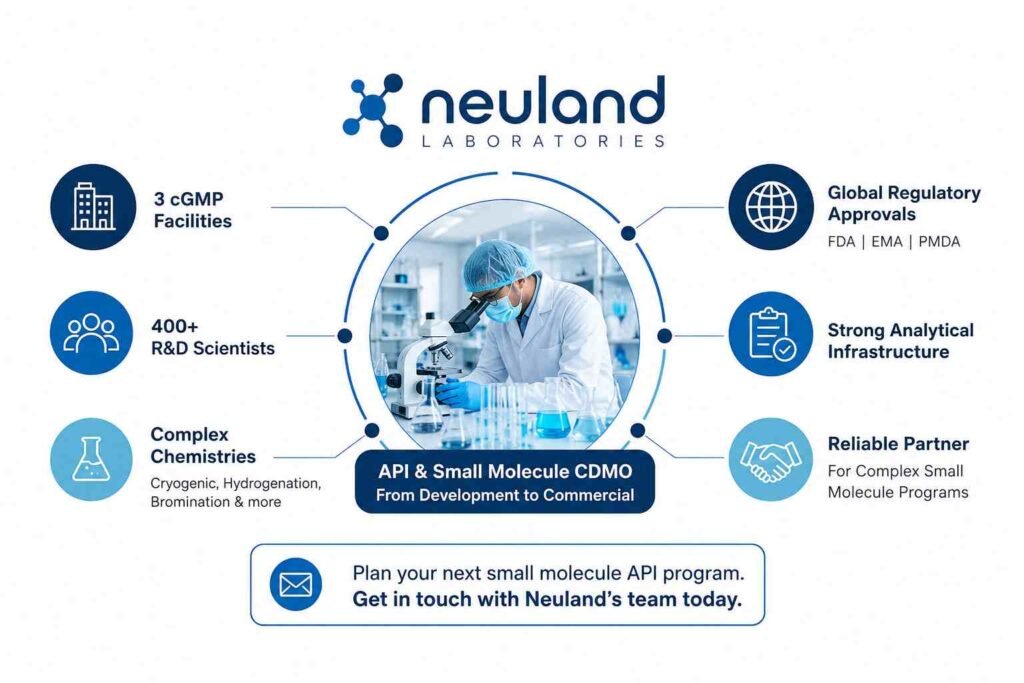
Neuland Laboratories is well-positioned in this space. As a focused API and small molecule CDMO with three cGMP-certified facilities, over 400 R&D scientists, and capabilities spanning complex chemistries including cryogenic reactions, hydrogenation, and bromination, Neuland supports pharma and biotech clients from early process development through commercial production. Their regulatory approvals from the FDA, EMA, and PMDA, combined with a strong analytical infrastructure, make them a reliable partner for companies working on complex small molecule programs.
For teams planning their next small molecule API program, the right manufacturing partner shapes both the timeline and the outcome. Get in touch with Neuland’s team today.
FAQs
1. What types of small molecule programs benefit most from CDMO outsourcing?
Programs involving any of the following tend to benefit most:
- Molecules requiring hazardous chemistry, like fluorination or high-pressure hydrogenation
- Multi-step syntheses with 10 or more reaction stages
- Compounds with multiple chiral centers need strict stereochemical control
- Early-stage biotechs with no internal manufacturing infrastructure
The common thread is technical complexity that exceeds what most companies can handle in-house.
2. How does regulatory scrutiny affect the choice of a small molecule manufacturing partner?
- It affects the choice significantly. FDA inspection intensity has increased year over year, and warning letters now frequently cite data integrity and process validation failures. A CDMO with a clean inspection record across FDA, EMA, and PMDA reduces the compliance risk that companies would otherwise carry into their own filings.
3. Can a company switch from in-house small molecule manufacturing to a CDMO mid-program?
- Yes, but the transition adds time and cost. Process transfers require engineering batches, method revalidation, and updated regulatory documentation. Most programs need 12 to 18 months to complete a full transfer. Starting with a CDMO from early development avoids this disruption entirely and keeps the regulatory data package consistent from first batch to filing.
Final Conclusion
Small molecule drug development remains a central part of modern pharmaceutical innovation, even as biologics, peptides, and advanced therapies continue to grow. Their proven effectiveness, oral delivery advantages, scalable manufacturing potential, and established regulatory pathways keep small molecules highly relevant for both emerging biotech companies and large pharmaceutical organizations.
However, today’s small molecule programs are becoming more technically demanding. Complex chemistry, tighter impurity controls, specialized equipment, and rising regulatory expectations make experienced CDMO partnerships more important than ever. A reliable small molecule CDMO can help reduce development risk, improve manufacturing efficiency, and support a smoother path from early-stage development to commercial production.
For companies working on complex API programs, choosing the right manufacturing partner is not just a cost decision. It can directly affect timelines, compliance readiness, product quality, and long-term success. This is why specialized CDMO partners continue to play a major role in the future of small molecule drug development.
Disclaimer
This article is for general informational and educational purposes only. It should not be considered medical, regulatory, financial, or professional business advice. Drug development, API manufacturing, regulatory filings, and CDMO partnerships involve complex technical and compliance requirements that may vary by product, region, and organization.
Companies should consult qualified regulatory, scientific, legal, and manufacturing experts before making decisions related to pharmaceutical development, outsourcing, GMP production, or commercial supply planning. Any references to market trends, regulatory expectations, or company capabilities are provided for informational context and should be independently verified before use in business or investment decisions.