


Most families arrive at this decision sideways. There is a discharge planner with a folder, or a doctor who pauses a beat too long before answering a question, and a word that used to belong to other people suddenly belongs to you.
Four things separate a hospice that genuinely helps from one that enrols a patient: how reliably it controls pain and other symptoms, how much it actually does for the relatives doing the day-to-day caregiving, whether it can deliver care in the place your person wants to be, and how straight it talks when the news is bad. There is no best hospice in the abstract. There is only the one that fits this patient, this household, and this level of medical need, right now. Insurance rules, staffing depth, home versus facility, and the sheer exhaustion of the moment all shape the choice, so the sections below take them one at a time.
What Hospice Care Actually Means
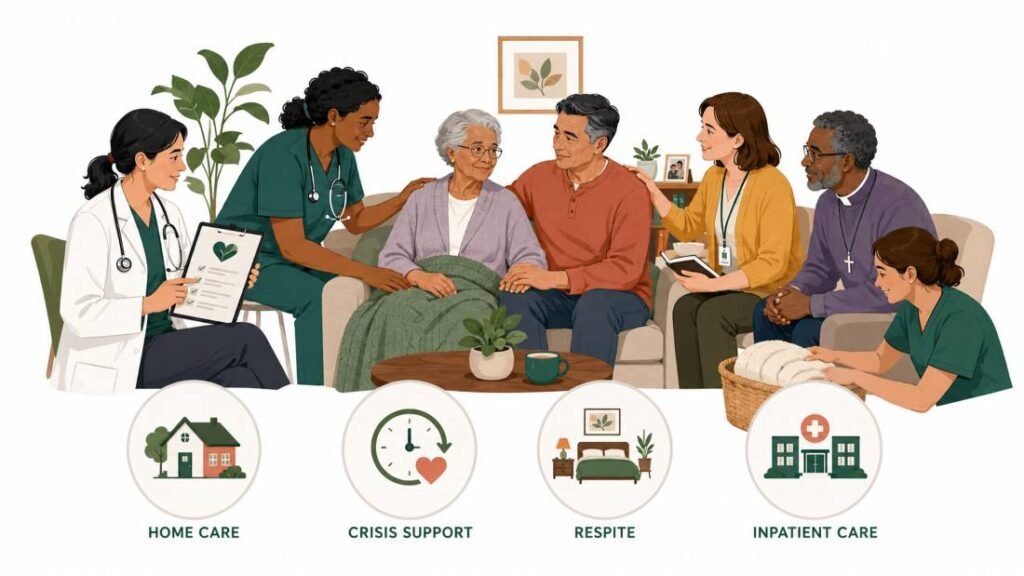
Hospice is a benefit and a way of working, not a building. It becomes available when a physician certifies that an illness is expected to end a person’s life within about six months if it runs its usual course, and when the patient decides to stop treatments aimed at cure and accept care aimed at comfort instead. A hospice doctor and the patient’s own doctor both sign off on that prognosis.
People often use “hospice” and “end-of-life care” as if they were the same thing. Hospice is one specific delivery model with its own eligibility rules, funding, and team structure. At the same time, palliative care is the broader discipline it grew out of and can start at diagnosis alongside chemotherapy or dialysis. The National Institute on Aging sets out how the two differ in plain language, which is worth reading before any meeting with a provider.
Two practical points get lost in most explanations. First, the six-month figure is a prognosis, not a countdown clock. Under Medicare, coverage runs in two 90-day benefit periods followed by an unlimited number of 60-day periods, each renewed if the patient still qualifies. People who live longer than expected are not thrown off the benefit. Second, hospice is not a one-way door. A patient can revoke the benefit at any time, go back to curative treatment, and re-enrol later if circumstances change.
Care also comes in four levels, and knowing the names of them makes conversations with providers far more productive: routine home care (the everyday visits), continuous home care (extended nursing hours during a crisis at home), inpatient respite care (a short facility stay so the family can rest), and general inpatient care (a facility stay when symptoms cannot be controlled at home). A provider that never mentions the upper three levels is worth questioning.
Why So Many Families Wait Too Long
Almost nobody researches this in calm weather. The conversation usually starts after a doctor says treatment is no longer likely to help, which means the decision gets made by people who are already frightened and running on four hours of sleep.
Awareness is part of the problem. A 2025 report on hospice awareness pointed to a University of Michigan National Poll on Healthy Aging finding that roughly a third of adults aged 50 and over said they knew very little or nothing about hospice, though around 85% said they would want it if they were dying once someone explained what it involved. The gap is information, not willingness.
The cost of that gap shows up in the data. In MedPAC’s analysis of Medicare hospice claims, the median length of stay has sat at 17 or 18 days for years, and a quarter of patients receive five days or fewer. Symptom control is not instant work. Getting pain medication titrated correctly, teaching a spouse to use it safely, arranging a hospital bed and an oxygen concentrator, and building enough trust that someone will actually pick up the phone at 3 am all take longer than five days. Families who start early are usually the ones who later say the death was peaceful.
Signs It Might Be Time To Consider Hospice
There is rarely a single dramatic moment. It is normally a pattern of small changes that only looks obvious in hindsight.
Common Triggers Families Notice
- Repeat hospital admissions or emergency visits over a few months, especially for the same underlying problem
- Weight loss, weakness, or a shrinking appetite that continues despite treatment
- A clinician saying, in whatever words they choose, that further treatment is unlikely to change the outcome
- More time asleep than awake, or a clear step down in what the person can do for themselves compared with six months ago
- Wounds that stop healing, or infections that keep returning
- The patient saying, directly or in a roundabout way, that they are tired of hospitals
Clinicians sometimes use a shortcut called the surprise question: would you be surprised if this person died within the next year? If the honest answer is no, a hospice conversation is reasonable now. It costs nothing to ask a provider for an informational visit, and doing so commits you to nothing. Meanwhile, the NIA’s guidance on providing care and comfort at the end of life is a useful reference for the weeks before any decision is made.
Comparing Providers: Where To Start
Hospices vary enormously, including between two agencies serving the same postcode. Hospital staff can make a referral quickly, but the family chooses the provider, and that choice is worth twenty minutes of scrutiny.
- After-hours reality. Every hospice advertises 24/7 availability. Ask what that means operationally: who answers at 2 am, is it a nurse or an answering service, how often do after-hours calls result in someone actually coming to the house, and how long does that take at night. Ask how many patients each nurse carries.
- Range of services. The core team is a nurse, a physician, a social worker, a chaplain, and a home health aide. Some agencies add music therapy, massage, dietary counselling, or veteran-specific programmes. Ask which are staffed year-round and which are aspirational.
- Aide hours in writing. This is where expectations break most often. Hospice does not provide round-the-clock caregiving. Aide visits are typically measured in hours per week, not hours per day. Get the number before you enrol, and plan the rest of the coverage around it.
- Bereavement support. Medicare requires hospices to offer bereavement services to the family for up to a year after the death. Ask what that actually looks like: scheduled calls, groups, individual counselling, or a mailing list.
- Setting flexibility. Confirm whether the agency can follow the patient into a nursing home or assisted living, and whether it owns an inpatient unit or contracts beds elsewhere. Ask what happens if symptoms become uncontrollable at 4 am on a Sunday.
- Track record. Look the agency up on Medicare’s Care Compare tool, which publishes quality measures and a Family Caregiver Survey Rating drawn from the CAHPS Hospice Survey of bereaved families. Star ratings only appear for agencies with at least 75 completed surveys, so a missing rating means low volume rather than poor care. State survey agency inspection reports fill in the rest.
Questions To Ask During A Tour Or Consultation
- How quickly can you admit, including on a weekend?
- If symptoms escalate suddenly, what happens in the first hour?
- How many aide hours per week will we actually receive?
- How are medications delivered and refilled, and do you leave a comfort kit in the home?
- What training do volunteers get before they visit?
- Who do we call instead of 911, and what should we do if we panic and call anyway?
These questions are better predictors than brochures. A 2024 systematic review in the Journal of Hospice & Palliative Nursing pooled 38 studies of hospice satisfaction and found that what families rated most highly clustered around communication, comfort, and emotional support rather than any particular service or setting. Providers who answer clearly before enrolment tend to be the ones who communicate well afterwards.
Common Misconceptions About Hospice Care
| Myth | Reality |
|---|---|
| Choosing hospice means giving up | The goal shifts from curing the disease to controlling symptoms. Patients may still see clinicians regularly and receive active care focused on comfort. |
| It is only for the last few days | Hospice benefits can build over weeks. Starting earlier may give patients and families more time to use available support and services. |
| It is too expensive | Medicare’s hospice benefit generally covers care, equipment, and medications related to the terminal illness without a deductible. Medicaid and private insurance may also provide hospice coverage, though details vary. Room and board is a common gap. |
| Once you sign, you are locked in | Patients can revoke hospice at any time and return to curative treatment. They may also be able to re-enrol later if they meet eligibility requirements. |
| Hospice provides full-time caregiving | Hospice provides visits, equipment, medications, training, and phone support, but it does not usually provide continuous hands-on caregiving. Families or hired caregivers often handle day-to-day care between visits. |
How Primrose Hospice Approaches Care
The starting point at Primrose Hospice is a conversation rather than a form. Nurses, aides, chaplains, and social workers coordinate as one team, which in practice means a family should not have to repeat the same medical history to four different people in a week. An end-of-life care hospice plan built this way records what the patient values: how much sedation they will accept in exchange for pain relief, who they want in the room, whether they want to stay home at all costs or would rather move to an inpatient bed if breathing becomes difficult.
That plan is meant to be revisited. Preferences written in month one often look different in month three, and a good team asks again rather than assuming.
Volunteers And Ongoing Support
Volunteers do quiet work that rarely appears in a brochure: sitting with a patient so a spouse can go to the pharmacy, or simply providing company on an afternoon when the house is too silent. Ask any provider how volunteers are screened, trained, and matched, because it says a lot about how the organisation thinks about the family as well as the patient. Trust is usually built or lost in that first intake conversation, and honest answers there tend to predict honest answers later.
Taking The Next Step With Confidence

No family gets every part of this right, and there is no perfect moment to begin. Three things help more than anything else: start the conversation before a crisis forces it, ask each provider the awkward operational questions rather than the polite ones, and write down what the patient wants while they can still tell you. CaringInfo publishes free, state-specific advance directive forms that make those wishes enforceable.
One last thing worth saying plainly. Caring for someone at the end of their life is physically and emotionally punishing, and exhaustion is not a character flaw. Respite care exists precisely because the system expects families to reach their limit. Ask for it early, and ask again when you need it.
Disclaimer
This article is for general information and does not constitute medical, legal, or financial advice. Eligibility rules, coverage, and available services vary by insurer, state, and provider. Decisions about hospice or any other treatment should be made with the patient’s physician and, where relevant, a licensed benefits adviser. If you are supporting someone with a serious illness and feel you are struggling to cope, speak to your own doctor or the hospice’s social worker.
References
- Hoff, T., Trovato, K., & Kitsakos, A. (2024). Hospice satisfaction among patients, family, and caregivers: A systematic review of the literature. American Journal of Hospice and Palliative Medicine, 41(6), 691 to 705. https://doi.org/10.1177/10499091231190778
- University of Michigan Institute for Healthcare Policy & Innovation. (2025). National Poll on Healthy Aging: awareness of and interest in palliative care and hospice among adults age 50 and over. Survey conducted by NORC at the University of Chicago, February 2025.
- Medicare Payment Advisory Commission. (2025). Report to the Congress: Medicare payment policy, Chapter 9, Hospice services. Washington, DC: MedPAC.
- Centers for Medicare & Medicaid Services. Hospice care coverage. Medicare.gov.
- Centers for Medicare & Medicaid Services. CAHPS Hospice Survey. CMS.gov.
- Centers for Medicare & Medicaid Services. Hospice benefits. Medicaid.gov.
- National Institute on Aging. (2025). What are palliative care and hospice care? National Institutes of Health.
- National Institute on Aging. (2025). Providing care and comfort at the end of life. National Institutes of Health.
- National Alliance for Care at Home. (2025). Facts and figures: 2025 edition, executive summary. Alexandria, VA.